

I don’t know about you, but I use WhatsApp without even realizing it. I wake up and I open WhatsApp, I check my messages during the day, and I send voice recordings when I am too lazy to write.
Table of Contents
But really, when you see the numbers that WhatsApp moves, it is quite shocking.
Billions of users, countries that live off WhatsApp, and companies that have already adopted WhatsApp as an official channel of communication. This article is about me analyzing these numbers and what it means.
Global WhatsApp User Statistics (2026): How Many People Use WhatsApp Today?
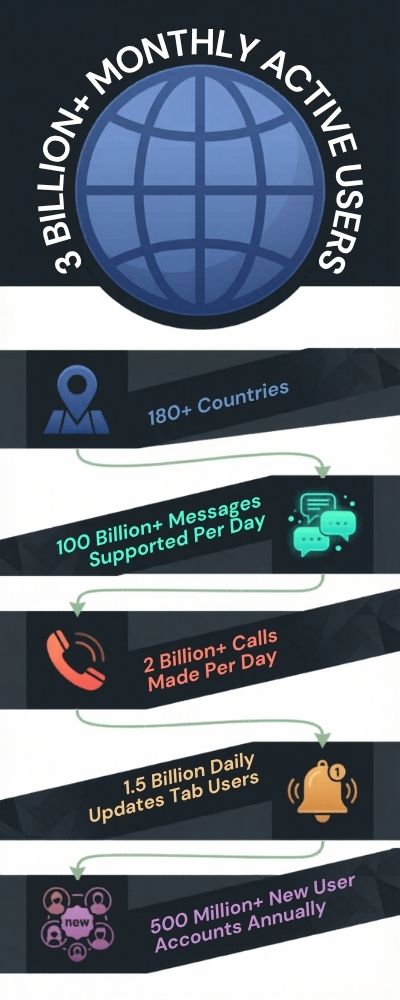
WhatsApp is big. Like, seriously big. As of the last public figures, going into 2026, WhatsApp has more than 3 billion monthly users, in 180+ countries. That makes it one of the few things in life that you really can’t avoid, alongside Wi-Fi, coffee, and that family group chat you say you’ll respond to soon.
How many people use WhatsApp in 2026, then?
The closest thing we have to an official number is “more than 3 billion monthly active users.” That’s what Meta executives told investors on their Q1 2025 earnings call and that’s what WhatsApp itself claims on its “About” page. That’s worth pointing out because lots of news stories still say “2 billion users” which is clearly not true.
To translate: when someone asks you how many people use WhatsApp in 2026, you can tell them that the answer is 3 billion or more, according to the most recent data Meta has released.
Global WhatsApp stats
| Metric | Latest public figure |
|---|---|
| Monthly active users | 3 billion+ |
| Countries where it’s used | 180+ |
| Messages supported per day | 100 billion+ |
| Calls made per day | 2 billion+ |
| Daily users of the Updates tab | 1.5 billion |
And the kicker is that WhatsApp is not just “on lots of phones.” People are actually using the hell out of it. WhatsApp claims that it handles over 100 billion messages daily, and in the second half of 2024, the company said users were making over 2 billion calls a day.
Not to mention that even its Updates tab alone now has 1.5 billion users daily, a sign that the app is becoming something more than just a messaging app.
Which countries use WhatsApp the most?
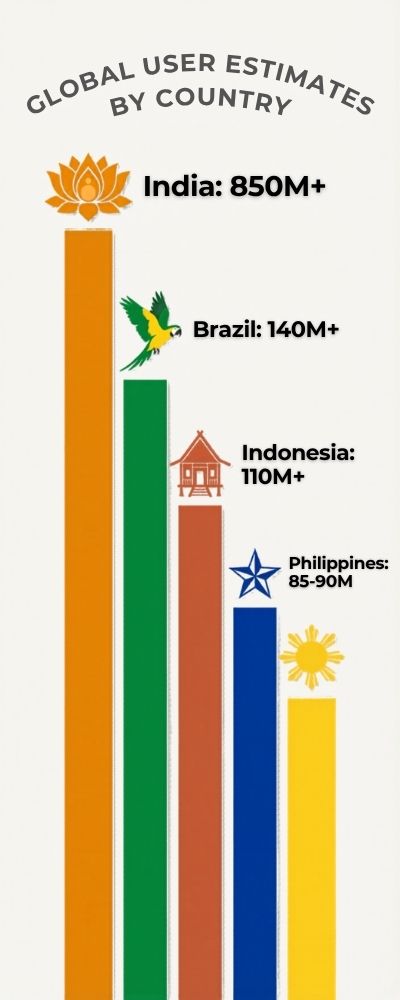
At a country level, the biggest market is India, by a landslide. Data compiled by third parties in 2026 showed India had around 853.8 million users, followed by Brazil (148 million), Indonesia (112 million), the U.S. (around 98 to 100 million) and the Philippines (88 million). I wouldn’t take country-by-country numbers too literally, but I think the order is fairly accurate: WhatsApp is most popular in bigger mobile-first nations.
| Country | Estimated users |
|---|---|
| India | 853.8 million |
| Brazil | 148 million |
| Indonesia | 112 million |
| United States | 98–100 million |
| Philippines | 88 million |
The US figure is particularly noteworthy. For a long time, WhatsApp has felt like an app that Americans only downloaded to text their cousin in another country or to endure a group vacation.
But in 2024, Meta said WhatsApp had reached 100 million monthly users in the US, a sign that the app is making some real headway even in an iMessage-dominated market. That’s not a small step; that’s the sort of step that makes competitors stand up a little straighter. [Sources: ]
Why the growth still matters in 2026
What’s driving WhatsApp is pretty straightforward: it’s fast, cheap, familiar, and tied to a person’s phone number. Businesses are flooding in, too. Meta has continued to roll out new WhatsApp business tools, ads in the Updates ecosystem, and commerce features, and regulators in Europe have recently taken notice of its size after WhatsApp reported 46.8 million average monthly users in the EU over a six-month period ending in December 2024. A sign that WhatsApp isn’t just huge in terms of chat, it’s huge in terms of infrastructure.
Final Takeaway
So how many people are on WhatsApp now? Over 3 billion, and the figure is stubbornly refusing to stand still. WhatsApp’s global penetration, its daily message volume, the increasing use of calls, and even its increasingly important business component, all point to it being more than just an “app”, but one of the default ways that humans communicate in the digital age. Not bad for something we often check in a bleary-eyed haze even before we’ve had a glass of water.
Countries With The Most WhatsApp Users: Which Country Uses WhatsApp The Most?
Obviously, WhatsApp usage isn’t uniform all over the globe. It’s more popular in some areas than others. You might have noticed this while visiting another country, or if you tried sending a message to a friend who is based in another country. While one friend tells you, “Text me.” another says “WhatsApp me.”
Countries That Use WhatsApp The Most
Here are some of the countries that use WhatsApp the most.
| Country | Estimated Users |
|---|---|
| India | 850M+ |
| Brazil | 140M+ |
| Indonesia | 110M+ |
| United States | ~100M |
| Philippines | ~85–90M |
India, and it’s not even close. Over 850 million users. In India, WhatsApp isn’t an app, it’s a public utility. Then Brazil and Indonesia. WhatsApp is how you message, do business, and even how you deal with customer service in these places. The USA has a large number of users too, but its still contending with iMessage.
Why these countries?
Alright, so this part gets a little more human. In a lot of these countries, back in the day, SMSes were very expensive. WhatsApp came along and offered messaging, voice notes, groups etc for free. Once people switched, they never went back.
Phone number based messaging also made things easier. No need for usernames. Your aunt, your boss, your delivery boy. Everyone is on WhatsApp. That kind of ubiquity is hard to let go of. Plus, once your entire family is on WhatsApp, you’re not really going anywhere.
Countries where it is most used
Latin America
In Brazil, Mexico, Argentina and others, WhatsApp is omnipresent. Not only individuals but businesses, educational institutions, and even government services, use it. For many, it is part of their routine.
South & Southeast Asia
India, Indonesia and the Philippines are other countries where this platform is very widespread, due to the mobile-first approach. Most of the population of these countries jumped directly from having no internet to having it only on their mobiles. In this context, the app was in the right place at the right time.
Europe
In Western Europe, particularly in Spain, Italy and Germany, it is the leading messaging application among all age groups (something quite rare in the digital world).
Countries where it is not so widespread
United States, Canada and some East Asian countries (Japan and South Korea) are not so into WhatsApp. Before it arrived, other applications such as iMessage, Line or KakaoTalk were already consolidated in the market.
Of course, this does not mean that it is not present in these markets. In some cases, it is used more for international communication than for daily use.
The conclusion (and a little bit of truth)
If you have asked yourself in which countries does WhatsApp have the most penetration, the answer is not only in those with the largest populations. The answer is in the countries that needed to communicate in the cheapest, fastest and easiest way. And where, in addition, it was adopted en masse.
And here is the key. It is not about the functionalities, nor the brand, nor anything like that. It is about the timing, the accessibility and the network effect. Once all your friends are already there, there is no turning back. Like it or not.
The History of WhatsApp: From Zero to 2 Billion Users
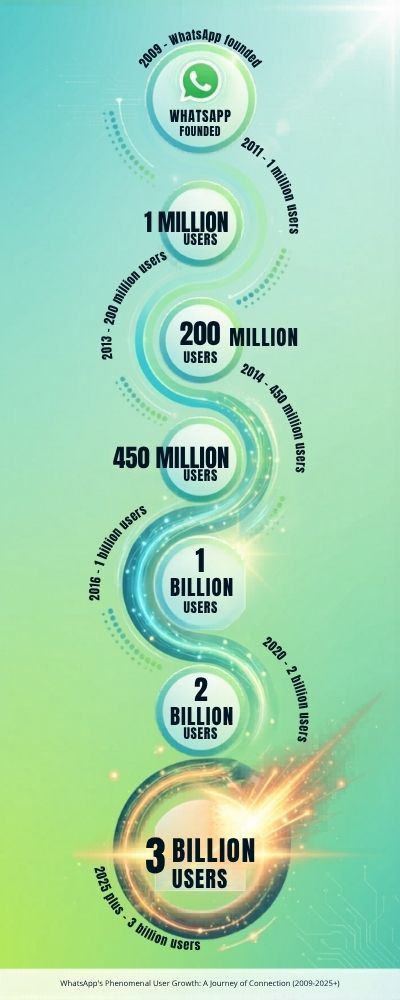
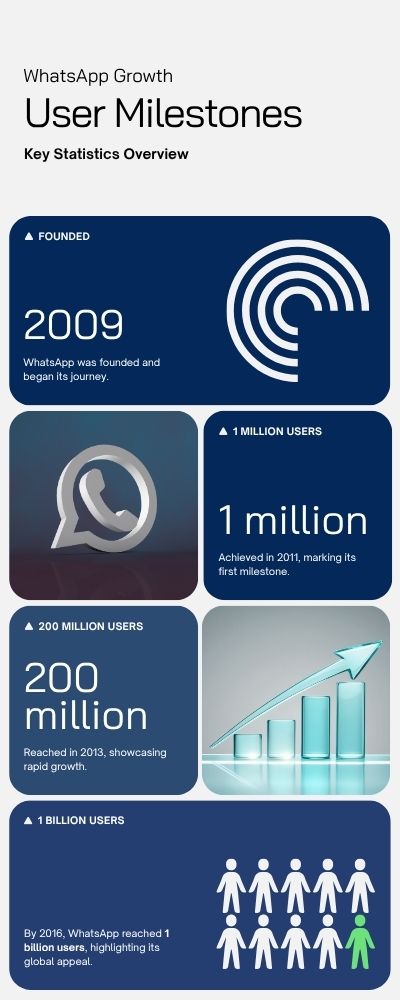
WhatsApp wasn’t always a messaging phenomenon. When Jan Koum and Brian Acton founded WhatsApp back in 2009, it wasn’t even a messaging app; it was a status-sharing app. The app crashed frequently and the founders struggled to find users, with Koum even contemplating throwing in the towel.
However, when Apple released its push notifications feature, WhatsApp morphed into a messaging app almost by accident. It’s amazing how many success stories in the tech industry start with “we didn’t plan on that…”
The first few users: From “who’s on this?” to “everyone’s on this”
Fast forward to 2011, WhatsApp had about 1 million users. This was a respectable number for a fledgling startup, but it was only the tip of the iceberg. By 2013, the number of monthly active users had ballooned to 200 million. During this period, WhatsApp had no official advertising and relied heavily on word-of-mouth to acquire new users.
All it took was someone recommending the app to a friend or family member (“Get this, it’s free!”), and the next thing you know, everyone and their grandma was on WhatsApp. I kind of miss the days when user acquisition was that simple…
The $19 billion deal that raised a few eyebrows
In 2014, Meta Platforms bought WhatsApp for $19 billion. Yes, you read that right: $19 billion! A lot of people thought that was a crazy valuation at the time (I’m guilty as charged), but the truth is WhatsApp was already boasting 450 million monthly users and was still growing at an alarming rate.
In retrospect, Mark Zuckerberg didn’t overpay for WhatsApp; he simply made an intelligent investment on one of the world’s most popular communication channels.
1 billion: Not just big, but necessary
By 2016, WhatsApp has over 1 billion monthly active users. This is one of those numbers where an app goes from being a nice-to-have to a must-have.
It’s a utility. People use it to communicate with their families, businesses use it to respond to their customers, and communities are organized around group chats. It’s not just that the app is growing; it’s that the app is becoming central to people’s lives. Once that happens, it’s really hard to displace.
2 billion and beyond
By 2020, WhatsApp hits 2 billion users. That means it’s doubled in size in just four years. That’s nuts when you consider how hard it is to grow at scale. Then, without too much fanfare, it crosses 3 billion users by 2025, according to Meta’s filings. At this point, we’re mostly just talking about penetration. You’re everywhere.
Growth in bullet points
| Year | Milestone |
|---|---|
| 2009 | WhatsApp founded |
| 2011 | 1 million users |
| 2013 | 200 million users |
| 2014 | 450 million users |
| 2016 | 1 billion users |
| 2020 | 2 billion users |
| 2025+ | 3 billion users |
Why it grew so fast (and why people stayed)
This is my interpretation, feel free to disagree. I think WhatsApp succeeded because it was simple, affordable and came at the right time. SMS text messages were expensive, particularly when you had to send messages between different countries, and WhatsApp offered them for free. This was the hook that reeled people in.
However, the nail in the coffin was network effect. Once your family group chat is there, once your work chat is there and once all your friends are there, you’re not going to leave, no matter how pretty another app is. You know how hard it is to get people to leave a group chat and start a new one. That’s basically what switching messaging apps is.
Final thought
I don’t find WhatsApp’s overnight success story very glamorous. I don’t find it very exciting. I actually find it quite… obvious.
But I do find it more relatable than most overnight success stories.
WhatsApp Growth Over Time: From Startup to 2+ Billion Users
There’s no real “schedule” to using WhatsApp, is there? You check it, respond to something, send something else, and before you know it, you’ve sent 10 messages. There are over 100 billion messages sent on WhatsApp every single day, across the entire world. I mean, that’s insane. That’s not “usage”, that’s “conversation”. I got this stat from the official WhatsApp blog, so it should be accurate.
How much time do people spend on WhatsApp every day? I just said that people don’t really spend all that much time on WhatsApp in a single session, but that they open the app many times per day.
That’s according to a report by DataReportal, which also named “messaging apps” (of which WhatsApp is one) as some of the most frequently opened types of apps in the world.
| Metric | Estimate |
|---|---|
| Messages sent daily | 100 billion+ |
| Voice/video calls daily | 2 billion+ |
| Status views daily | 500 million+ users |
| Updates tab users | 1.5 billion daily |
In addition, WhatsApp revealed that more than 2 billion voice and video calls are made on the platform every day. That in itself is a testament to the growth of the platform. It’s not just messaging anymore; it’s effectively serving as a replacement for phone calls for a large part of the world.
Not to forget their stories feature (Status) that boasts more than 500 million daily users that contributes to the passive consumption.
Messages: short, fast, constant
To be fair, not all the messages on WhatsApp are lengthy novels. They’re short, abrupt, sometimes half-typed messages. “On my way,” “Did you eat?”, “Call me.” You get the idea.
And this is precisely one of the reasons behind high engagement. The effort to send a message is almost nil. Zero cost, zero waiting time, zero effort. As per Statista, messaging apps are the most preferred mode of communication globally, majorly due to their simplicity and ease of use.
You know this one if you opened the app to look at something and ended up responding to five different conversations. It isn’t a content-based app; it’s people-driven. There are real conversations to catch up with and real expectations to be met.
There’s a mild social obligation to it as well. You have seen the message. You have seen the double ticks. You feel compelled to respond. That little push to your psyche keeps the engagement going without the need for fancy features. I must say, both impressive and a little tiring at the same time.
In conclusion
WhatsApp’s daily usage isn’t about long sessions, it’s about constant presence. The app runs in the background of our lives, managing conversations that never really seem to end.
Perhaps, that’s the best part. It doesn’t really ask for attention. It just remains useful. Somehow, that’s enough.
Demographics of WhatsApp Users: Age, Gender, and Behavior Trends
Who uses WhatsApp? A closer look at the age, sex, and usage patterns of the most popular messaging app in the world. WhatsApp is truly an app that everyone uses.
No matter if you are a teenager, a parent, or even a grandparent who types messages with just one finger, you have WhatsApp. And it’s not surprising, given that the messaging app counts more than 3 billion users worldwide.
However, if you dig deeper, you can see certain trends in terms of age and usage.
Age of WhatsApp users
It’s not an app for Gen Z WhatsApp is certainly not an exclusive app for younger generations. According to data from Statista, the majority of WhatsApp users are between 18 and 44 years old.
| Age Group | Share of Users (Approx.) |
|---|---|
| 18–24 | ~20–25% |
| 25–34 | ~25–30% |
| 35–44 | ~20–25% |
| 45+ | Growing steadily |
The interesting part: older demographics are growing, too. In many parts of the world, especially Europe and Asia, those 45 years and older are on WhatsApp, and it’s not that they’ve become hip, it’s just that it makes sense. I’m going to go out on a limb and say that at least half of their WhatsApp usage are family chats.
Gender breakdown: balanced, with nuances
It’s not like some social media platforms where there’s a heavy gender bias: on WhatsApp, it’s roughly half and half, give or take, depending on the country.
In some countries, particularly in Asia and Africa, there are more men than women using WhatsApp, but that’s largely due to digital adoption patterns.
In other parts of the world, like Europe or Latin America, it’s more balanced or even skewed slightly towards women. There isn’t a massive disparity either way, and that’s significant. It means that WhatsApp doesn’t really feel geared towards one gender over the other. It’s just…WhatsApp.
Usage patterns: how people use WhatsApp
Now this is where we get to the juicy part. People don’t use WhatsApp in the same way across demographics.
- Younger demographics (18-34): messages, memes, voice notes, group chats
- Middle aged demographics (35-54): family planning, work-related chat, group chats
- Older demographics (55+): catching up with family, photos, forwarded messages
Yes, the culture of forwarded messages is a thing. If you’ve ever gotten a long, somewhat suspect message from an aunt or uncle, you know what I mean.
WhatsApp also shared that 100 billion messages were sent and 2 billion voice and video calls were made every day on the platform, which gives you an idea of just how ingrained WhatsApp is in people’s daily lives.
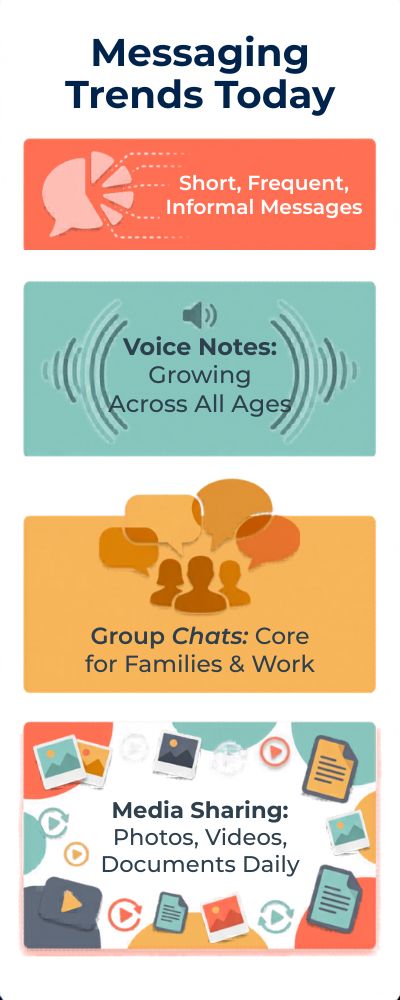
A behavioral snapshot
| Behavior | Trend |
|---|---|
| Messaging | Short, frequent, informal |
| Voice notes | Increasing across all ages |
| Group chats | Core feature for families & work |
| Media sharing | Photos, videos, documents daily |
Why it all makes sense
These numbers aren’t surprising. WhatsApp’s greatest feature is that it doesn’t have one; no usernames, no multiple-step signups, just your phone number and a contact list. Simplicity transcends age and sex.
WhatsApp’s use-cases are also inherently familial. It’s the app for keeping in touch with family, for checking in on a daily basis or asking if someone has arrived home safely. It’s the app of relationships. That’s why it’s spread between age groups.
Closing thoughts
What makes WhatsApp demographically strong is its fluidity. The service doesn’t skew towards any age or sex; it shifts. Maybe that’s why the service is still growing. Not because it’s the coolest new thing, but because it simply has a way of sitting in the background and working for everyone.
Key WhatsApp messaging statistics for 2026

What types of messages are being sent? You would expect that with this many messages, they’re all long and composed. No. Most messages are short, hasty, and to the point. Like: “Where are you?”, “Have you eaten yet?”, or just a 👍.
Statista research on global messaging trends indicates that messaging apps are used for the majority of communication because they are fast and informal. No need to be perfect. And that’s their appeal. Nobody is spell-checking a WhatsApp message, unless something has gone horribly wrong.
| Type of Interaction | Daily Volume |
|---|---|
| Messages sent | 100 billion+ |
| Voice & video calls | 2 billion+ |
| Photos shared | Billions daily |
| Voice notes | Rapidly increasing |
A special note here for voice notes. You either love them or… not so much. But the use of voice notes is increasing because they’re more intimate. You can gauge the tone, the hesitation, the emotion. They’re closer to talking than text.
One-on-one vs group chats
Here’s a question: do you use WhatsApp for private conversations or group chats? Most of us do both, but group chats are where things get crazy, in a good way. Family groups, work groups, friend groups, they make up a huge portion of engagement.
DataReportal says that messaging apps are central to community interactions, not just personal communication. Which is why a single message often turns into 10 different responses, and why your phone refuses to shut up.
Communication styles are changing
We’re not just typing on WhatsApp anymore. Communication here is layered:
- Text for straight-forward communication
- Voice notes for nuance
- Images to add context
- Calls when things get too complicated
We’ve basically reconstructed offline communication within the app. And maybe that’s the intent. WhatsApp revealed that they were clocking over 2 billion calls a day, proof that even voice isn’t going away, it’s just moving to a different medium.
hy do people like using WhatsApp?
The one-line answer? Simplicity. No usernames, no complexity, no charge per message. You can open the app and start typing. That’s it.
Another reason is expectations. If someone sends you a message on WhatsApp, you’re expected to respond. The double tick, read receipts, all these features contribute to this expectation. It’s not hard, but it’s enough.
The bottom line
In 2026, using WhatsApp isn’t a feature, it’s a habit. Billions of little things, all day, every day.
Maybe that’s why it works. It’s not trying to be a big deal. It just quietly gets on with letting people stay in touch. Which, when you think about it, is quite a big deal.
WhatsApp vs Other Messaging Apps: Market Share and Competitive Insights
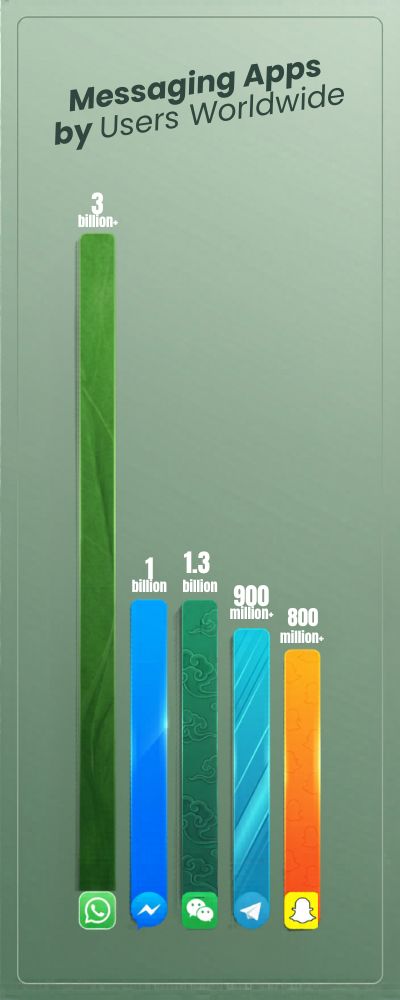
WhatsApp is an interesting case, as it is, at the same time, a leader and under attack. With 3 billion+ users worldwide, it has a significant lead over the majority of other messaging apps.
However, this doesn’t necessarily mean it leads everywhere. Different countries and regions, different habits, different usage patterns, and, let’s be honest, different choices of your friends.
| App | Estimated Users |
|---|---|
| 3 billion+ | |
| Facebook Messenger | ~1 billion |
| ~1.3 billion | |
| Telegram | 900 million+ |
| Snapchat | 800 million+ |
According to Statista and company reports, WhatsApp is the undisputed global champion. The thing is, though, the number of users doesn’t always tell the full story. There are apps that hold sway over their markets to such an extent that WhatsApp isn’t even a thing.
There are markets where WhatsApp has a solid foothold. India, Brazil, Europe, and most of Africa for instance. In those places, it’s the go-to messaging app.
In China, WeChat dominates. Actually, WeChat isn’t just the go-to messaging app in China. It does everything. In Japan and Thailand, LINE is very popular. In South Korea, it’s all about KakaoTalk.
Then there’s the United States, where although WhatsApp is popular, it has to contend with iMessage, which is widely adopted due to the popularity of Apple devices. It’s as if each market decided which service they like a long time ago, and just went with it.
Market share isn’t just about users
This is something that goes unnoticed, as engagement is as relevant as user base. 100 billion messages per day is an insane number of usage.
Other platforms, like Snapchat, focus more on sharing content rather than messaging, and Telegram has an amazing user growth but different use-cases (channels, communities etc.) So, even if an application has hundreds of millions of users, the chances that they are not as frequently used are high.
Why people use one or the other
Let’s face it, nobody “chooses” a messaging app. They go wherever their friends are.
- WhatsApp: simple, global, phone-number based
- Telegram: privacy, big groups, channels
- WeChat: all-in-one app
- iMessage: Apple integration
It’s not a matter of which app is better, but a matter of which app your group chat is on. Try moving 10 friends to another platform, and you will understand what I mean.
Competitive advantage: what makes WhatsApp win?
Now, this is a tricky question, but I think that what makes WhatsApp competitive is its simplicity. No usernames, no nothing. It just works. And it works on (almost) any phone, and in (almost) any country.
And while everyone is innovating, adding features and functionalities, WhatsApp is working on making sure that their service is as solid as a rock. Not that sexy, but it works.
Last but not least
WhatsApp is the leading global messaging application, but this is not a one size fits all kind of market. It’s more of a map, where each geography has its own champion.
That being said, stepping back and looking at the bigger picture, it’s tough to deny the presence of WhatsApp. They are not only playing the game, they are defining the norm of how billions of people communicate on a daily basis.
WhatsApp Business Statistics: How Companies Use WhatsApp to Grow

Are you curious about WhatsApp business statistics? We will dive into the ways businesses are leveraging WhatsApp to grow. In the past, WhatsApp was primarily used to chat with friends and family, and occasionally participate in a group chat.
Today, businesses are taking advantage of the app as well, and for good reason. With over 3 billion users worldwide, it’s clear that if you want to attract customers, you should be on the platform.
Number of businesses on WhatsApp
According to Meta, there are more than 200 million businesses that leverage WhatsApp Business tools to communicate with customers. These range from small neighborhood stores to large global brands. But how active are these businesses on WhatsApp?
Millions of these businesses use the platform daily to communicate with customers about support requests, order inquiries, sales, and more. It’s essentially like turning a messaging channel into a store, minus the “can I help you?” awkwardness.
What businesses actually do on WhatsApp
| Use Case | Example |
|---|---|
| Customer support | Answering questions in real time |
| Sales conversations | Recommending products directly |
| Order updates | Shipping & delivery notifications |
| Marketing | Sending offers & promotions |
In addition to those, messaging apps are also increasingly used for direct brand interaction, especially in mobile-first markets.
Engagement rates are… surprisingly high
Now, this is when it gets a bit crazy. WhatsApp messages have open rates of 90 to 98%, while emails often have a hard time even reaching 20 to 30%. Of course, that also means that people notice messages more, which can be a double-edged sword.
If you send something irrelevant, you will come across as intrusive. But if you send something useful? That is where WhatsApp truly excels.
Why customers actually respond
In fact, if you think about it as a human being, an email from a business is something that you can easily brush off. But a WhatsApp message from a business? That’s a bit more direct, almost personal. Which is also the biggest challenge for a business. They have to provide value without being intrusive.
People don’t want to turn their messaging app into a billboard. But if you get it just right, it works like a charm. The customer receives instant support, the business sells more in less time, and the entire experience feels more fluid.
WhatsApp Business growth
| Metric | Estimate |
|---|---|
| Businesses using WhatsApp | 200 million+ |
| Daily business interactions | Millions |
| Message open rate | 90–98% |
| Global users reachable | 3 billion+ |
Why businesses continue to invest in it
Convenience. WhatsApp eliminates the friction. No sign-ins, no loading times, no cluttered screens. One text, and a response.
In a culture of instant gratification, that’s worth a pretty penny.
Takeaways
WhatsApp is no longer a messaging platform. It’s a business tool, a support channel, and in some instances, a sales funnel.
Like it or not, the distinction between “messaging your mate” and “messaging a brand” is blurring. The hurdle now? Keeping it personal.
WhatsApp Revenue and Monetization: How Meta Makes Money from WhatsApp
But… does WhatsApp even make money? For the longest time, it felt like that friend who never wants anything in return. No ads, no monthly subscriptions, no paid features, no money whatsoever for messaging. So people understandably began to ask: how does it actually make money?
The answer is that while it didn’t for a long time, it does now. At least, kind of. In a series of baby steps that started a few years ago, Meta has been gradually shifting WhatsApp from a non-revenue-generating product into a bonafide moneymaker. In the process, it’s also managed to not completely kill the WhatsApp experience.
The old days: almost no revenue
To be clear, WhatsApp technically did make some money in its early days. It charged a nominal annual subscription fee of about $1 per year. That fee was eliminated entirely in 2016. But outside of that fee, WhatsApp didn’t make much money at all.
When Meta acquired the company for $19 billion in 2014, it wasn’t focused on revenue. Instead, it was focused on growth. And it largely succeeded. WhatsApp grew to billions of users before Meta started to meaningfully prioritize revenue.
Frankly, it’s pretty rare for tech companies to not shove ads down users’ throats within the first year or two of operation.
The primary revenue source: WhatsApp Business API
Fast-forward to today, and the single biggest source of revenue for WhatsApp is the WhatsApp Business API. The API allows businesses to communicate with their customers directly via the messaging app — whether that’s sending notifications, confirmations, customer support responses, etc.
Meta charges those businesses a fee per conversation — that is, per interaction with customers — rather than per message. Between the sheer volume of businesses that use WhatsApp (more than 200 million) and the volume of messages each business sends, that all adds up to a lot.
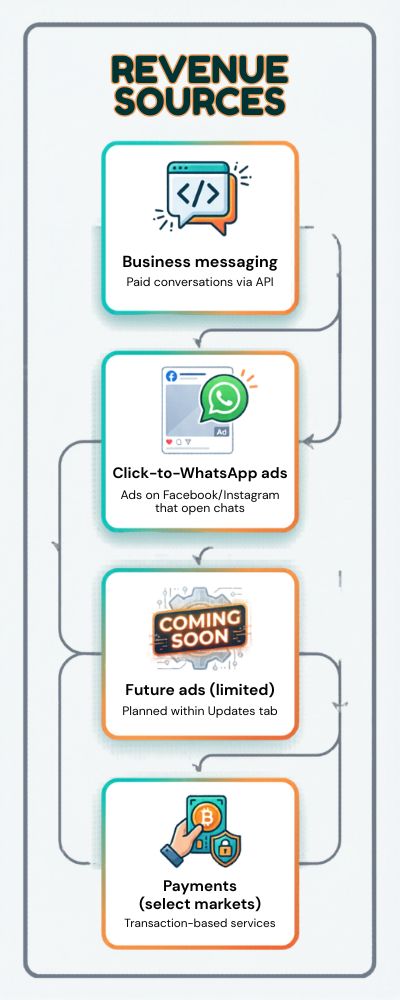
Revenue streams
| Revenue Source | How it works |
|---|---|
| Business messaging | Paid conversations via API |
| Click-to-WhatsApp ads | Ads on Facebook/Instagram that open chats |
| Future ads (limited) | Planned within Updates tab |
| Payments (select markets) | Transaction-based services |
You know what’s cool? Click-to-WhatsApp ads. It’s when businesses advertise on Facebook or Instagram, and then you click and it opens up a WhatsApp chat. Meta makes money from the ads even if WhatsApp remains largely ad-free. Neat, huh?
What about WhatsApp revenue?
While Meta doesn’t disclose much about WhatsApp revenue, analysts think it makes a few billion dollars a year, largely from business messaging and ads on messaging.
Fun fact: WhatsApp is still largely “under-monetized” for how big it is. With 3B users, even small revenue per user can add up to a lot. This is why Meta invests so much in it.
What about ads in WhatsApp?
This is the part that gets a little… dicey. Users like WhatsApp because it’s simple and private. Nobody wants banner ads interrupting their chat.
Meta seems to understand that. Rather than filling the chat with ads, they’re trying to monetize in other, less obtrusive places, like the Updates tab (Status & Channels).
But to answer your question, “Will we see more ads on WhatsApp eventually?” Yeah, probably. Hopefully not terrible ads, though.
Why it works
After all, Meta isn’t charging users; it’s charging businesses to connect with users. That’s a much better proposition. Users keep using WhatsApp for free. Businesses pay for access. Meta collects a toll. It’s a platform business model, dressed up as a messaging product.
Final thoughts
The WhatsApp business model is a slow burn. Strategic. A little bit cunning. It waited for scale. It’s now turning scale into revenue. And, so far, it’s not messing up the product.
Privacy, Security and Encryption: What do users really think about WhatsApp?
The promise: “Your messages are private”
WhatsApp rides on one of the largest concepts possible, privacy. The service has been using end-to-end encryption as a default feature since 2016. This means that the messages you send can only be read by you and the intended recipient. Even Meta Platforms, WhatsApp’s parent company, can’t read them.
Technically, this should be enough. But if you are wondering why there are still trust issues despite the encryption, you are not alone. Because there’s more to privacy than just the messages. There’s also the metadata.
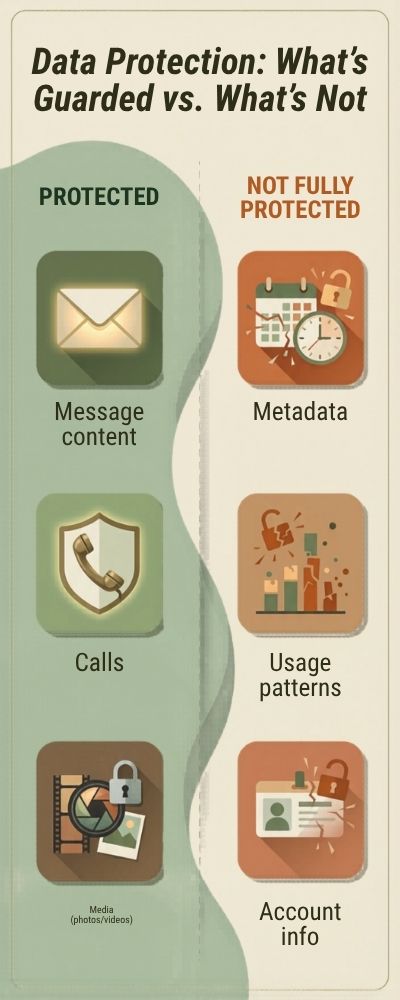
What does encryption protect and what it doesn’t? To simplify this,
| Protected | Not fully protected |
|---|---|
| Message content | Metadata (who you contact, when) |
| Calls | Usage patterns |
| Media (photos/videos) | Account info |
end-to-end encryption means your messages remain private, but metadata (i.e., who you chat with and when) can still be accessed. Which is a fine line that makes a bigger difference than you think; it’s like sealing your mail, but leaving the address visible.
User opinions on WhatsApp privacy
On the trust level, it’s… not great. Based on surveys cited by Statista, sizable percentages of users were uneasy about Meta data-sharing, particularly after 2021 policy changes.
Some left, some downloaded Telegram or Signal. And yet, most users ultimately did not leave WhatsApp, you know how people are more comfortable than they’d like to admit.
| User sentiment | Trend |
|---|---|
| Trust in encryption | Generally high |
| Concern about data sharing | Moderate to high |
| Switching to alternatives | Temporary spikes |
| Long-term retention | Very strong |
This is somewhat contradictory. There are privacy concerns, yet users continue to use the application. And truthfully, I understand why. Leaving WhatsApp often means leaving your entire social circle behind.
Security tools that are being underutilized
WhatsApp has introduced several additional tools along the way:
- Two-step verification
- Encrypted backups (User Opt-in)
- Disappearing messages
- Chat Locks
These tools are useful, however most WhatsApp users fail to take full advantage of them. It’s similar to purchasing a strong door lock, and never engaging it.
Why the gap in trust still exists
Part of it comes down to perception. WhatsApp is owned by Meta, and Meta has had a questionable past regarding data privacy. Regardless of whether WhatsApp may be secure, the relationship with Meta causes users to question trust. Once someone’s trust has been compromised, the gap in trust will linger.
A dose of reality
Come on, let’s get real for a moment. Humans don’t read privacy policies. They don’t configure options. They don’t understand (or care) about encryption…until it fails.
They just want the app to work, and their conversations to be sorta private. Not totally private. Just “private enough.”
Conclusion
So, WhatsApp is in a sort of limbo. Secure in theory. Probably trustworthy when it comes to encryption. Still questionable because of its parent company and data management.
Perhaps that’s the actual moral of the story. Privacy is not (only) a technological issue, but a matter of trust. And once the trust is broken, it takes forever to heal.
Top Emerging Trends: AI, Payments, and Beyond
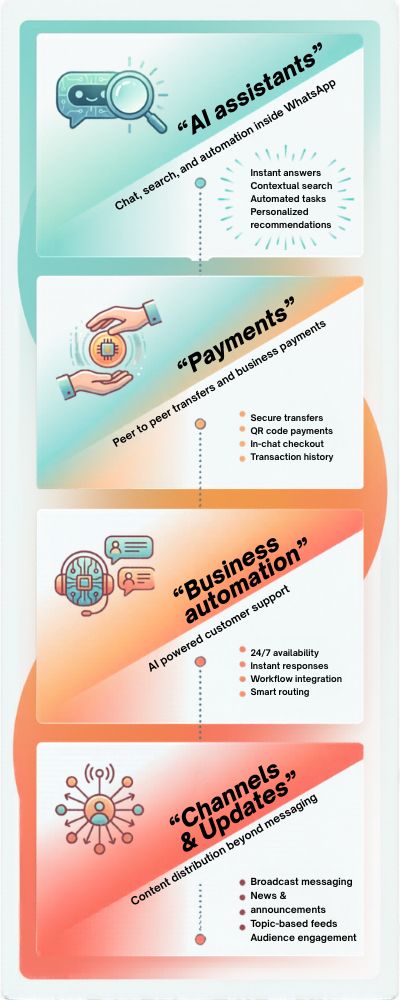
As mentioned above, there are so many recent updates to WhatsApp
It’s not just chat, call and then forget about it as it used to be. With 3+ Billion users worldwide, Meta Platforms is no longer seeing WhatsApp as a “Chatting App.” It’s increasingly becoming a platform. Slowly, but surely.
AI inside WhatsApp: useful or unnecessary?
Meta has already started adding AI-related features to the WhatsApp platform. They include chatbots built on their AI model. These chatbots help users with tasks like searching the internet, drafting messages, etc.
Are they useful? Yes. Are they necessary? Not always. But Meta is heavily investing in AI capabilities for all its applications. WhatsApp is no exception.
Payments: the road to chat-commerce
WhatsApp has already rolled out WhatsApp Pay in countries like India and Brazil. With this feature, users can make or receive payments directly through the chat. WhatsApp has more than 500 million users in India.
The adoption of WhatsApp pay in India is increasing albeit slowly. The Indian market is dominated by other strong UPI-based payment apps. But it is sure catching up. With this, the possibilities are endless. Chat + Payment = Super App.
Other emerging trends in WhatsApp
| Trend | What it means |
|---|---|
| AI assistants | Chat, search, and automation inside WhatsApp |
| Payments | Peer-to-peer transfers and business payments |
| Business automation | AI-powered customer support |
| Channels & Updates | Content distribution beyond messaging |
These things demonstrate WhatsApp getting outside of messaging and into services. Not just talk, but act, within the app.
Business + AI = a potent mix
Businesses are already using WhatsApp in big ways: 200M+ businesses. Add AI to that (autoresponders, suggested responses, etc) and this ramps up rapidly.
For the user this could be positive… or somewhat negative if done too aggressively. No one likes having to wrestle with a chatbot that doesn’t have any nuance. But when it works, it’s a timesaver for all.
The grand plan? Everything app?
If this all feels a bit familiar, it’s because WeChat is a thing, and does all of this. Messaging, payments, services, all in one. WhatsApp isn’t all the way there, but it’s definitely inching in this direction. Slowly, quietly, perhaps hoping not to spook users.
A dose of reality
Now, my take on this. Some of this is actually pretty cool. Payments in chat? Cool. Improved business messaging? Cool.
But you do have the danger of over-engineering a product that’s popular because it’s dead simple. “It just works” is WhatsApp’s super power. If that ever goes away, it’s trouble.
Wrapping up
That’s the future of WhatsApp: Bigger. Smarter. More connected. AI. Payments. Business tools.
And there’s no doubt that these features are coming. But what’s not so certain, is whether or not WhatsApp can do this without breaking the simplicity that made it so successful in the first place.
Which, frankly, is a big ask.
2030 Extrapolation: What will WhatsApp be by 2030?
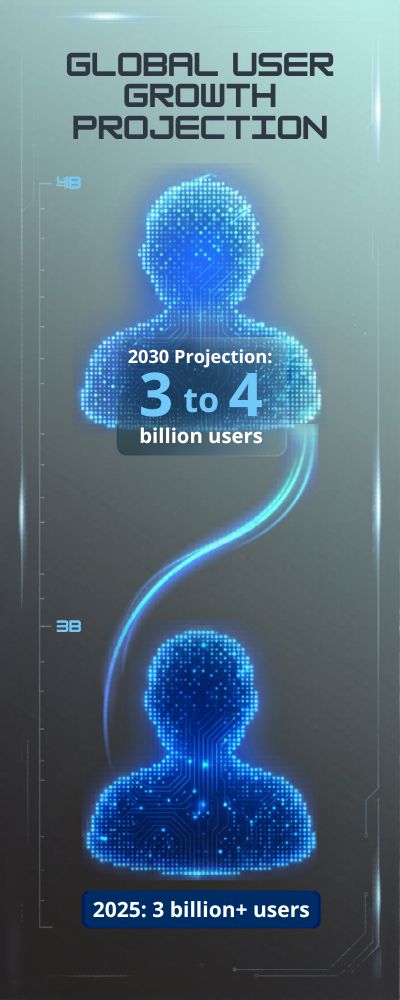
Still “just a messaging app”… or something bigger? Interestingly, despite it being just a messaging app, it’s already reached the scale where one can talk about it becoming “just a messaging app”.
(If you remember, that is how Mark Zuckerberg described WhatsApp when he acquired it) with > 3 billion users today, it’s edging towards becoming infrastructure, like email or even phone networks used to be. So what will happen by 2030? More of the same… but not really.
User growth: how big can it get?
The most obvious question to ask would be, will WhatsApp continue to grow? Will it still be growing in 2030? Yes, but the rate of growth will be less and less over time.
Statista and international telecom union estimates that by 2030, the number of internet users will cross 6 billion. Assuming WhatsApp’s share of the internet users remains the same, it can aim to reach somewhere between 3.5 to 4 billion users.
| Year | Estimated Users |
|---|---|
| 2025 | 3 billion+ |
| 2030 (projection) | 3.5–4 billion |
At that scale, growth isn’t about new markets; it’s about deeper usage. More features, more services, more reasons to stay.
Given that nearly three-quarters of the global population will have internet access, what does the future of WhatsApp look like? The company will need to find other ways to expand its user base.
Growth at this point won’t come from new users; it will come from more features and more services. But, here are some of the changes we can expect to see:
- Improved messaging
- Enhanced AI
- E-commerce
Improved messaging
People will still be messaging each other, though. That’s not going to go away. However, the way we communicate is changing. We’re using more voice notes, video and real-time communications.
Currently, WhatsApp supports 100 billion messages a day and two billion calls a day. These stats suggest communication is becoming more complex, not less. By 2030, texting might seem a little dated. WhatsApp Blog: Helping Billions Ring in the New Year on WhatsApp
Enhanced AI
This is the change we can’t ignore. Meta Platforms is investing big in AI, and WhatsApp is one of the primary platforms for that technology. By 2030, AI will be able to:
- Draft responses
- Translate messages instantly
- Answer customer support queries
- Offer personal assistant services within conversations
Will people like it? Some of them will. Others will hate it. It’s one of those changes that seems like a good idea until it isn’t. Meta AI News: Introducing Meta AI
E-commerce
In India and Brazil, WhatsApp Pay is already operational. It’s pretty clear where this is going. Chats will become transactions. By 2030, you’ll be able to:
- Pay bills through chats
- Buy products directly from businesses
- Send cash as easily as you send a message
Other apps, like WeChat, are already doing this. WhatsApp isn’t pioneering the technology, it is just playing catch up on a global scale. Reuters WhatsApp Pay coverage: WhatsApp Pay India
Growth What might change (and what won’t)
| Feature | Likely in 2030 |
|---|---|
| Messaging | Still core |
| AI tools | Deeply integrated |
| Payments | Widely adopted |
| Ads | More visible (carefully placed) |
| Privacy features | Strong but debated |
My no bullshit answer: WhatsApp will grow in features. But it can never stop feeling simple. The day it doesn’t feel simple, we will know.
Simple
A slightly uncomfortable truth. There is a trade off. More features means more data, more revenue, more complexity. Users want privacy, simplicity, no ads. Companies want growth, revenue, engagement. Somewhere in the middle, WhatsApp will find a middle ground. But it won’t be easy.
Final thoughts
By 2030, WhatsApp will probably look pretty much the same, but will have more features than you would think. You will still be able to send a message. But on top of some AI, payments and services stack.
The question isn’t what features will it have. The question is, can it grow without feeling like anything other than “just send a message” And to be honest, that’s the bit I’d pay attention to.
Daily WhatsApp message volume
WhatsApp processes more than 100 billion messages a day. That’s text, voice notes, images, and videos sent through both consumer and business conversations. That’s more than any other communication channel in the world and speaks to the ubiquity of the platform, especially in regions where people no longer use SMS.
Average time spent on WhatsApp
The average time spent per day on WhatsApp is between 30-40 minutes. However, this varies by country and demographic. For example, users in India and Brazil tend to be more active due to their heavy reliance on messaging both personally and professionally. That coupled with the need to check the app throughout the day for real-time conversations is a big reason for its user retention.
WhatsApp voice messages vs text
WhatsApp has seen billions of voice messages sent every day on the platform. This is largely due to the ease and expressiveness of voice notes. Many consumers prefer to use voice notes for longer messages or in situations when it’s not convenient to type. This behavior skews toward younger demographics as well as in multilingual countries. It’s a strong indicator of the rising trend toward asynchronous, audio-first communication.
Group chats and communities
WhatsApp groups have a maximum capacity of 1,024 members, while larger groups can be formed through the use of Communities. WhatsApp has become an essential platform for messaging for groups of people, including schools, workplaces, and local communities. These platforms are an integral part of why WhatsApp became more than a simple chat app: it’s a tool for coordination and collaboration. It also plays a big role in user retention since many people can’t imagine their lives without shared group chats.
WhatsApp status usage
WhatsApp Status has more than 500 million daily active users. The feature lets users share photos, videos, and text updates that disappear after 24 hours. The popularity of Status is reminiscent of the growth of Stories across other platforms like Instagram and Snapchat. Status is particularly popular in emerging countries, where it is not only used for personal sharing but also for business. It’s another sign that WhatsApp is more than just a messaging app.
WhatsApp call usage
WhatsApp supports billions of voice and video calls daily. This has significantly impacted consumer behavior when it comes to traditional phone calls and telecom providers. Being able to make free calls over the internet is especially useful in countries where international calling rates are high. WhatsApp’s calls are also end-to-end encrypted, which appeals to those who prioritize private conversations.
Multi-device usage
Users can now use WhatsApp on up to four devices simultaneously without their phone even being connected to the internet. Since the rollout of multi-device support, the platform has seen more activity on desktop, tablets, and web. This has enhanced the experience for users both personally and professionally. For example, many businesses manage customer conversations on the desktop version of the app. It’s yet another sign that WhatsApp is morphing into a cross-platform experience.
Conclusion
But it’s funny… after all of this, what I remembered most wasn’t how massive WhatsApp is, but how everyday it is. 3B monthly users and billions and billions of more daily messages. That’s not growing anymore, it’s just a utility now. It’s how people communicate, get work done, share life, and get into fights, get reacquainted, etc.
And the strange thing is… most of us don’t really think about it anymore. It’s just like texting used to be. If anything, what should probably sink in is less the sheer scale, and more how boring it is that it’s such a normal part of life at this point.


