

We may not have opted to spend our formative years with artificial intelligence, but we are the first generation to do so, after all. A few short years ago, we were contenting ourselves with Google searches and social networks; now, we have automated everything from employment to artistic production to romantic attachments.
Table of Contents
The most remarkable thing? None of it seems particularly shocking, and in many ways, it’s not even remarkable. It just happens so often we stop noticing it. This article illustrates the unique position our generation occupies, as it has grown up with, but not necessarily for, AI.
We use it, rely on it, and use it again, all while simultaneously distrusting and side-eyeing these smart machines. The numbers aren’t so much indicative of how we’re using AI as they are of how we relate to AI.
Millennials and the Rise of the AI Revolution: How a Digital Native Generation is Using and Challenging Artificial Intelligence
The Original Digital Population… But It’s Not All Good News
Millennials are the group who grew up in that strange in-between era (i.e., dial-up internet, MSN Messenger), but who grew to adulthood during the digital revolution (i.e., smartphones, social media, and now, artificial intelligence).
This is probably why millennials are spearheading the way into the world of algorithms. Interestingly, though, they are certainly not doing so blindly.
A global study, by the Pew Research Center shows that about 63% of millennials use AI-enabled technologies every day (e.g., recommendation engines, virtual assistants, and digital content creators), yet, almost 52% feel uneasy about AI’s impact on their lives (see below):
Millennials are the most frequent users of AI-driven technologies, but a majority is concerned about its effects on society.
So millennials are the leading edge of the AI revolution, but many of them are using AI-enabled technologies and are uneasy at the same time. Like ordering takeout from a place you don’t fully trust but still love, right?
It’s All About the Convenience, Right?
Let’s face it: convenience rules our world. We millennials aren’t turning to AI out of a fascination with the technology, but because it saves us the time. In our lives, time is a luxury we can’t spare!
We rely on auto-filled emails, curated music playlists, and GPS applications that detect and route us around traffic congestion before we even realize that the traffic has built up. AI use is quietly appealing!
According to McKinsey and Company, nearly 70% of millennials believe that artificial intelligence tools have “significantly improved their everyday efficiency,” particularly when it comes to work and productivity at home.
According to McKinsey Global AI Survey, millennials are the group most likely to use artificial intelligence to be more productive, and most believe that time saving is its key benefit!
However, there is a nagging question: “Will I become addicted to this stuff?”
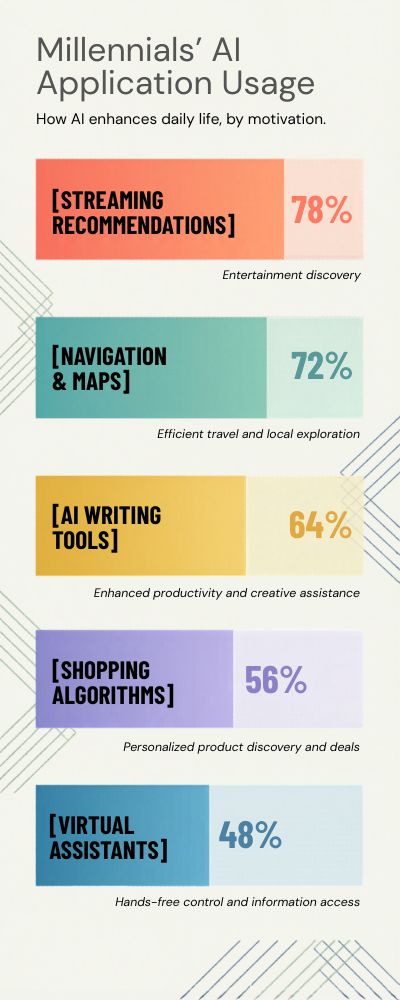
Table: Millennial Everyday use
| AI Application Area | % of Millennials Using Regularly | Primary Motivation |
|---|---|---|
| Streaming Recommendations | 78% | Entertainment discovery |
| Navigation & Maps | 72% | Time efficiency |
| AI Writing Tools | 55% | Work productivity |
| Shopping Algorithms | 61% | Better deals & speed |
| Virtual Assistants | 48% | Convenience |
Statista AI Usage Report says Millennials are the age group most likely to use AI-powered consumer apps.
Millennials & AI: Where Do They Stand?
Things get a bit tricky here. Millennials trust AI, just not all the time. It’s not all-in, just in.
Think of it this way: “I’m fine with AI suggesting the next Netflix show. But managing my finances? I’ll leave that to a human, thanks.”
In fact, a Deloitte study found that only 34% of millennials say they would trust AI to make high-stakes decisions like financial planning or medical advice.
Deloitte Digital Consumer Trends, while millennials seem keen on using AI, it seems to be where high stakes are the least trustworthy.
To be fair, it does make sense that they would be reluctant to trust it with important decisions.
A “Wait, Is This Real?” Mindset
It’s all about content. From AI generated imagery to AI generated copy to AI generated voices, millennials are consuming more than perhaps they are aware, although that awareness is certainly rising, and with it a creeping sense of online paranoia.
Ever see something on the Internet and wonder, “Is that thing human or AI? And if I don’t know, how much can I trust that it really is?” Exactly.
58% of millennials are concerned about being able to differentiate between human and AI generated content.
According to the YouGov AI Perception Survey.
A majority of millennials say they cannot reliably tell which media is human generated and which is AI generated, with the latter a source of increasing mistrust.
And while it’s not fear, really, it’s certainly discomfort; it’s knowing that some of the ground rules have shifted underneath us.
Trust by use case
| AI Use Case | Trust Level (High/Moderate) | Trust Level (Low) |
|---|---|---|
| Music & Content Suggestion | 76% | 24% |
| Navigation Decisions | 68% | 32% |
| Job Recruitment Screening | 41% | 59% |
| Financial Advice | 35% | 65% |
| Medical Diagnosis | 29% | 71% |
According to the IBM Global AI Trust Index, AI trust declines rapidly when the decision being made by AI is perceived to carry more risk.
Driving the Future, With One Foot on the Brake
This is an interesting dual role millennials are finding themselves in. They are the early adopters and the testers, those who use AI to help them in their day-to-day lives, and at the same time, those who question the use of AI and raise concerns about it. It’s not a paradox; it’s more of equilibrium.
World Economic Forum’s report says millennials are the most likely generation to champion ethical AI policies over any other group, despite being the biggest users of AI technology.
According to World Economic Forum AI Governance Report, millennials are the generation most inclined to champion ethical AI regulations while using AI the most, showing their dual roles as adopters and critics.
Perhaps that’s exactly how it should be. It’s not just about adopting this new age of algorithms; they are arguing with it and squinting at it but still use it, after all.
After all, AI is not going anywhere. The real question is, will millennials manage it or just make the best of the situation.
How Often Do Millennials Actually Use AI? Surprising Usage Statistics You Haven’t Seen
It’s Not “Sometimes”; It’s Basically All Day
Ask most millennials how often they use AI, and you’re likely to get a shrug. “Not very often,” they’ll answer. But ask them again a bit more intently, and that response quickly falls apart.
That’s because we don’t actually “use” AI anymore. We’re just living our lives, and AI has become integral to everything we do.
According to a new survey from Accenture, millennials actually use AI-powered technology 15 to 20 times per day, without even realizing they’re doing it.
Millennials interact with AI-powered tools throughout the day, frequently using AI through passive interactions, such as personalized recommendations and automated actions.
That number sounds awfully low when I put it into context. One session on Spotify alone might result in five separate AI-related interactions, meaning we are probably severely underestimating this.
Passive vs. Active AI Use: An Overlooked Difference
There’s a distinct difference in how AI is used. There’s the type that most people use directly like: chatbots, writing assistants, AI image generators. Then, there is the type of AI that operates behind the scenes.
And the latter type, AI operates passively in the background is where the majority of AI is used. Gartner reports that close to 80% of AI usage with millennials are passively used, meaning that a person may not even realize they are interacting with AI.
As per the Gartner Consumer AI Behavior Study, the majority of AI interaction with millennials occurs in the background within other services like social media, search, and shopping.
In other words, you’re interacting with AI whether you know it or not. Not in a scary way, more in a we’ve just got to deal with it way.
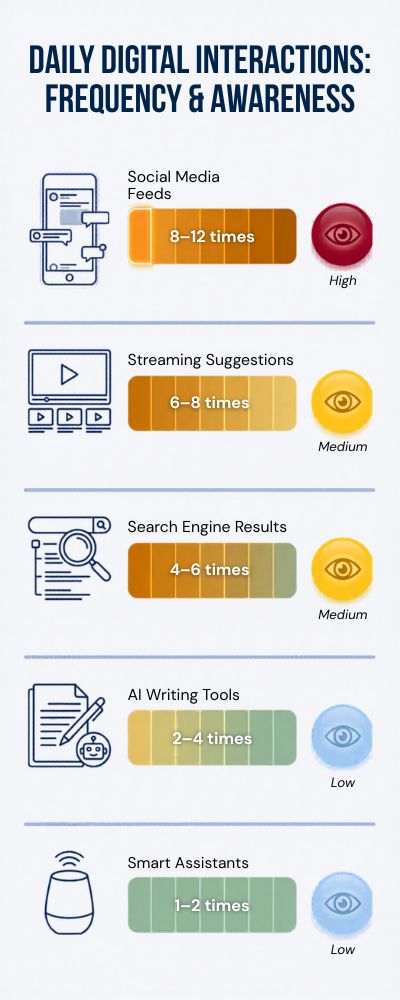
AI Interactions During the Day
| Type of Interaction | Avg. Daily Frequency | Conscious Awareness |
|---|---|---|
| Social Media Feeds | 6–8 times | Low |
| Streaming Suggestions | 3–5 times | Medium |
| Search Engine Results | 4–6 times | Low |
| AI Writing Tools | 1–3 times | High |
| Smart Assistants | 1–2 times | High |
According to the Statista Digital Behavior Analysis, social media algorithms top the list of AI interactions users have daily with a passive activity.
The Workday Shift: AI as a Silent Coworker
Now here’s where things get interesting, and perhaps a little more personal if you’ve ever stared at a blank screen and hoped for AI to save you at work.
Millennials are also increasingly turning to AI at work, but not as a once in a while sort of thing. According to the Harvard Business Review, 64% of millennial professionals use AI tools at work at least several times a week, and 38% use AI daily.
As per Harvard Business Review AI in the Workplace Study, millennials are using AI in their daily work lives for activities such as writing, data analysis, and communicating.
A subtle form of dependence is taking hold. It doesn’t seem dramatic or ominous, it is merely discernable. It starts off as: I haven’t written an email from scratch in weeks…
The 10-Second Habit of Artificial Intelligence
If you zoom in one more time, the pattern gets even clearer: AI is used for micro-decisions. One is to double check their spelling or grammar before submitting. Another is to ask a recommendation or suggestion about something.
One more thing is that the system will adjust the travel route and tell them to take this path instead of that one. All these little interactions are adding up.
The average millennial engages in 2-3 seconds worth of AI-powered tasks, a cumulative total of more than an hour’s worth of AI-related tasks per day, a survey found. Adobe (Future of Digital Experiences Report).
The majority of AI interaction is composed of short and frequent interactions that add up in the long term.
It feels more like snacking rather than consuming a full meal. One won’t realise what’s been eaten until the end of the day.
AI Use Frequency per Week
| Frequency Category | % of Millennials |
|---|---|
| Multiple times daily | 47% |
| Daily | 26% |
| چند times per week | 18% |
| Rarely | 9% |
Based on the Ipsos Global AI Monitor, most millennials use AI daily, with around half saying they do so more than once a day.
So… are the millennials the power users? Or just along for the ride?
Here is my take on the matter. If you want to be contrary, feel free to. Millennials aren’t power users, per se. They aren’t all adjusting prompts or developing automated systems powered by AI.
Yet they are at the center of AI ecosystems.
An OECD study argues that millennials are the most “AI-inclusive” generation. The study states that they spend the most time engaged with the internet, and are most likely to use devices or services that are part of platform-based ecosystems.
Based on the OECD Digital Economy Outlook, millennials have the most AI-inclusive daily lives, especially within platform-based ecosystems.
Perhaps that is the story. It isn’t a question of whether they are more likely to use AI or not. Rather, it is a question of whether they have a say in how often they use it at all.
Trust in Machines: Do Millennials Believe AI More Than Humans?
Trust is relative.
That is a pretty dramatic question, is it not? Do millennials trust machines more than people? Are they just an algorithm away from signing a contract with a bot? Maybe. However, I’m sure you could agree that things are rarely this black and white.
If you were to ask a millennial to recommend a restaurant, they’d probably look up reviews before texting a friend. But, would you call a friend to break up with your boyfriend? Or open ChatGPT? (I hope not?)
According to the Trust Barometer, 61% of millennials agree that AI offers objective information, yet just 28% trust AI for subjective, personal advice.
As per Trust Barometer, generally, millennials seem to separate the two categories in the context of AI. AI has become a part of their lives to a certain degree, but they still see AI as a tool for data analysis, rather than a source for human-based decisions.
Millennial’s have, of course, placed a higher emphasis on trusting AI to a greater extent for this particular task. It’s not that they have faith in the AI. More so, they’ve made the conscious choice that this is what AI does best.
There’s an underlying and potentially problematic factor to consider here, though, as people don’t entirely trust people, of course! There’s always bias and misinformation and people with agendas.
And for millennials, who have witnessed a financial crisis and multiple major scandals, this skepticism is likely rooted in experience.
According to a recent KPMG survey, 54% of millennials say that AI is capable of being less biased than humans in decisions-making. In other words, AI has the potential to be more impartial to some degree than humans.
Whether that is the case is yet another argument. After all, humans build the algorithms, not robots. But it’s worth considering.
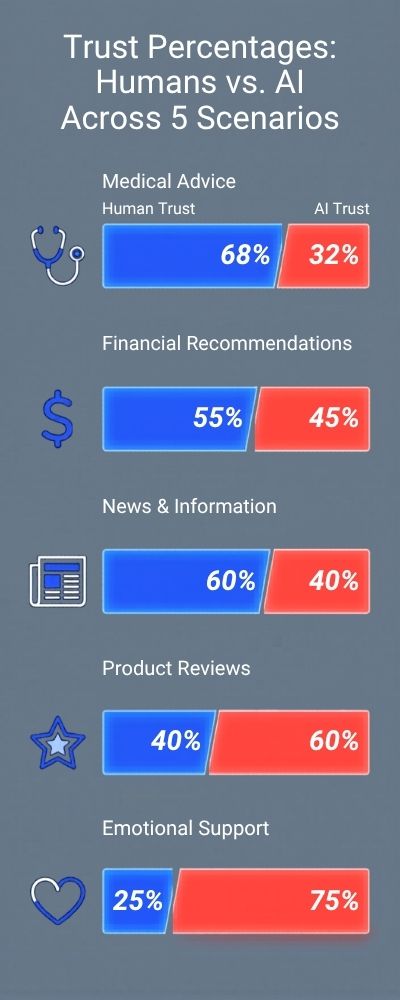
How trust in humans compare with AI
| Scenario | Trust Humans (%) | Trust AI (%) |
|---|---|---|
| Medical Advice | 68% | 32% |
| Financial Recommendations | 62% | 38% |
| News & Information | 44% | 56% |
| Product Reviews | 39% | 61% |
| Emotional Support | 85% | 15% |
Millennials place their faith in AI when it comes to factual data accuracy, yet they still turn to other people when it involves feelings and choices that affect their lives.
The “It Depends” Generation
Millennials have mastered the art of playing the middle, and I say that in the positive. They do not take the extreme side immediately. They weigh, they compare, they verify.
We often hear this sentiment, “I trust AI… but I verify.” It is that verification that counts.
73% of millennial consumers double-check AI-based information, using both human sources and other platforms, according to Capgemini Research Institute.
Millennials take an active role in verifying AI-generated content. They often seek other sources of confirmation, if not from humans, before placing their trust in AI-based systems.
There is a degree of healthy doubt, not paranoia, in how millennials relate to technology.
That uncanny ability to get you right can also be uncomfortable.
This isn’t something they will be honest with you about, but when AI becomes too smart, too accurate, it can actually seem like an invasion of privacy.
Like, why would an ad appear after just having a fleeting thought about a specific item?
According to Salesforce, 47% of millennials say they feel uncomfortable when AI predictions feel “too accurate.”
According to Salesforce State of the Connected Customer Report
Nearly half of millennials say they feel uncomfortable when AI seems “too smart” about their needs.
So it’s like the smarter AI gets, the less comfortable we are with it?
Like a friend you don’t trust knowing things they shouldn’t?
How accurate AI has to be for people to feel uncomfortable
Millennials welcome the ease AI offers, yet they resist when that same technology seems to be overstepping.
Who Wins? Humans or Machines?
Neither. And Both.
We aren’t seeing millennials trading human trust for machine trust. We’re seeing them layer it. We’re using AI in our lives as an additional tool, a filter, and sometimes even as a second opinion, but not the sole, final opinion.
The MIT Technology Review Insights AI Study also notes that millennials are more likely to utilize a hybrid trust model, using both human and AI judgment.
Millennials are increasingly seeking to incorporate both AI and human judgment in their lives, not just one or the other.
And perhaps that is exactly the right way. Trust, but verify. Take advantage of the machine, while keeping your instincts alert. In the end, no machine actually knows what it feels like to be human. And neither have millennials forgotten that.
Google to GPT: How Millennials’ Searching Habits Are Changing Fast
Search Is No Longer What It Was
I know it sounds like ancient history, but just a few years ago, we’d type in a bunch of words on Google, hit Enter and open up 5 new tabs that we’d never read past. The old way! A bit chaotic, but mostly productive.
And that’s how it’s changing, a little at a time but very quickly.
Millennials are shifting away from searching and toward asking questions. Not “best laptop 2026”, but “what’s the best laptop for remote working and light gaming under $1,500”.
According to an Adobe study, 62% of millennials prefer conversational AI over traditional search engines.
Millennials are looking for more conversational interfaces that serve them an answer than just links.
I can’t say that I blame them. No one has the time anymore to wade through 800-word SEO blog posts.
Are Keywords Dead? Not Exactly… More like Changing
Keywords aren’t dead; they’re evolving. Millennials still Google, they just use Google differently.
Longer and more specific keywords. Less “computer” and more “human.”
In the last three years, Google has reported an uptick of over 40% in long-form and more natural-language keywords among Google searches by 25-40-year-olds.
Millennials have changed search behavior towards a more conversational and intent-driven search.
We just stopped speaking robot to each other. Took us long enough.
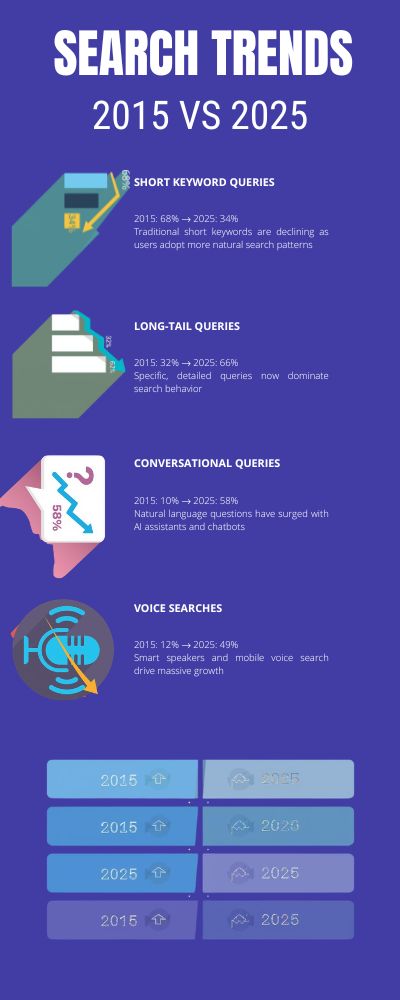
Search Behavior Transformation
| Search Type | Then (2015) | Now (2025) |
|---|---|---|
| Short Keyword Queries | 68% | 34% |
| Long-Tail Queries | 32% | 66% |
| Conversational Queries | 10% | 58% |
| Voice Searches | 12% | 49% |
Millennials are more prone to using longer, more natural language search queries.
A “Just Give Me the Answer” Mindset
This point might come across a bit harsh:
Millennials are often looking for solutions, not options.
Search engines give them a string of links; AI tools provide them with summaries, recommendations, and sometimes even opinions. And that is compelling.
Forrester found that 57% of millennials are often dissatisfied with search engine results because they demand “too much filtering.”
The desire is for more streamlined answers.
Not to say that people are just too lazy to click through pages of results on Google, but maybe we’re all a little like them.
Multitasking Minds, Multi-Platform Search
Search isn’t contained to one area any longer; it’s an additional significant modification. Millennials switch platforms with no hesitation.
Google when you need an exact answer; YouTube if you’re searching a how-to video; TikTok for rapid guidance; AI for a quick summary. There is now an entire ecosystem available to millennials.
In accordance with HubSpot, 71 percent of millennials use multiple platforms at the same time when they’re researching an issue.
This is how millennials typically approach their fragmented search behavior, often utilizing a mix of old and modern platforms.
It is not all tidy, but it is functional (sort of like opening a lot of tabs, yet somehow understanding exactly which tab you need).
Platforms Preferred For Search By Use
| Use Case | Primary Platform | Secondary Platform |
|---|---|---|
| Quick Facts | AI Chat Tools | |
| How-To Tutorials | YouTube | TikTok |
| Product Research | Amazon/Google | AI Recommendations |
| News Updates | Social Media | News Aggregators |
| Deep Explanations | AI Tools | Blogs/Forums |
According to Deloitte Digital Media Trends, Millennials use their search habits for the search type they have.
Trust, Speed and Scepticism
Even as we transition towards AI search, there’s still a degree of trust but verify. The habit of checking, comparing and verifying information is still present.
Reuters Institute has reported that 49% of millennials use Google to fact check AI generated search answers.
As per Reuters Institute Digital News Report
Millennials fact check AI generated information as well as they cross-reference the information, finding the balance between the speed and trust.
It’s not an either or situation but an either/and. AI gives you a short cut, Google confirms.
So… Does Google Lose its Crown?
Not really. It’s just a bit threatened.
It’s not Millennials who no longer use search engines. They just want quick, precise and useful results.
According to a Gartner study, search engine volume will be down by 25% by 2028 when people will be asking more AI assistants.
AI-driven interfaces will make people less dependent on search engines in the next years.
We might be somewhere in the middle. The end of Google? No. The beginning of GPT? No. Just the start of this period where both of them are here.
And that’s a good thing. Maybe that’s why we can’t decide on anything.
AI at Work: Productivity Boost or Burnout Accelerator for Millennials?
Millennials are increasingly incorporating generative AI into their workflows. The appeal is simple and seductive: AI can help you work smarter, not harder, saving time, streamlining tedious tasks, and freeing you to focus on more meaningful, creative work.
For many, AI truly is the productivity dream that it is cracked up to be, well, at least it has been in some situations.
For millennials, a generation known for balancing the demands of full-time jobs, side gigs and a general existential anxiety surrounding their career futures, the allure is clear. What would you rather work smarter or harder?
According to a Microsoft report, 70% of millennial workers say AI tools help them complete tasks faster, particularly in writing, scheduling, and data organization.
As per Microsoft Work Trend Index. AI adoption in the workplace is strongly linked to perceived productivity gains, especially among younger professionals.
That said, faster isn’t necessarily always better. But what is, is not always quicker.
Because you finish things faster?
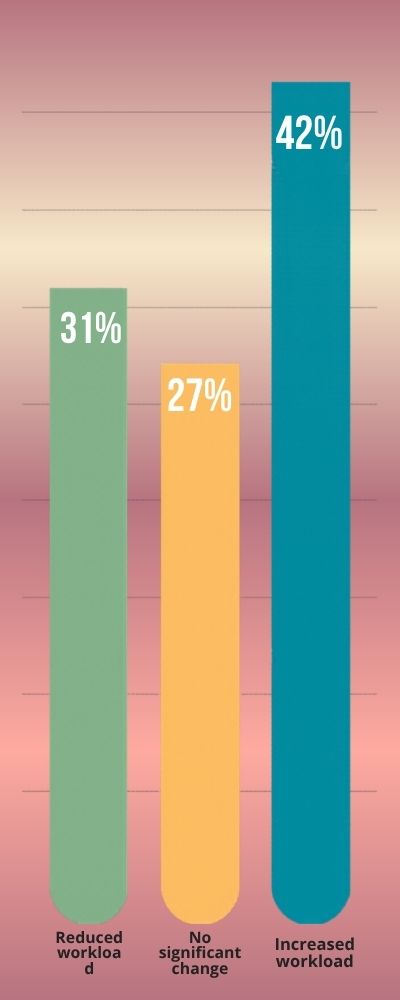
Your bosses expect more. You get faster responses. Faster turnarounds. You become, in effect, more effective. (Which is also less effective, if you’re not careful.) 42% of millennial respondents told us that they felt that their productivity tools, including AI tools, have actually increased their workload, according to the Anatomy of Work Report.
While productivity tools make you more efficient, they also come with higher expectations and larger workloads. It’s a bit of a double-edged sword. You get better tools… and they make you work harder.
| Impact Type | % of Millennials |
|---|---|
| Reduced workload | 31% |
| No significant change | 27% |
| Increased workload | 42% |
According to the PwC Workforce Survey, “A high proportion of millennials are of the opinion that AI makes them more productive, which in turn increases their work expectations.”
The Always-On Problem
There is yet another side to this. It’s less about the tools and more about where we draw the line, or the fact that we haven’t drawn the line at all.
AI doesn’t clock out for the day at 6 PM. AI doesn’t stop when you turn off your computer. If the tool never stops, why shouldn’t I?
It doesn’t help that a Gallup study found that 53% of millennial employees feel pressure to respond faster and be more productive due to digital tools, such as Artificial Intelligence.
From the Gallup Workforce Report, “Digital acceleration has led to higher expectations for employees to be available and respond quickly, particularly among younger employees.”
I don’t mean that someone is actually demanding more work from me, because that never happened. No, this pressure is implied by something so much harder to push back against.
Burnout: The Subtle Trade-Off
Here we go, burnout is making its way into the conversation, and it’s not surprising because it’s already there, even if you refuse to see AI’s role in it.
In the first place, millennials started getting burned out way before AI was even a thing. AI is kind of like, adding extra horsepower.
According to a study done by Deloitte, 46 percent of millennials say they’re feeling burned out, and many cited an “increased digital workload” as a contributing factor:
Millennials are experiencing burnout more so than ever before, which digital tools exacerbate by adding to their workload and expectations.
AI isn’t the direct cause of burnout. It just kind of… facilitates the conditions for it to happen faster.
The Emotional Cost of AI in the Workplace
| Emotional Response | % of Millennials |
|---|---|
| More productive | 58% |
| More stressed | 41% |
| More anxious | 36% |
| More satisfied | 33% |
AI can make you feel good and bad about productivity at the same time.
So… Tool or Pressure Multiplier?
It’s complicated, and, I’ll admit it, somewhat personal. Yes, AI can increase productivity, but it can also multiply pressure. It’s a matter of how people are using it.
And how it affects them varies. Some millennials say AI helps them get things done faster. They’ve used it to do less work and have better work-life balance. Others have reported faster and heavier workloads.
According to a World Economic Forum report, the degree to which workers report changes in their work-life satisfaction from using AI varies significantly based on workplace policies and expectations.
It appears that the impact AI can have on workers varies based on policies, rules, and expectations within the workplace.
Perhaps, then, the better question to ask is not “Is AI good for productivity?” Instead we should be asking: Are we using AI to work better or more?
Creative or Synthetic? How Millennials Feel About AI-Generated Content
“This Looks Cool… But Who Made It?”
There’s a sort of second-guessing that’s becoming increasingly common on the internet. When you come across some image, music, or article online, it no longer immediately strikes you with a “Wow! Look at that!” Instead, you might find yourself pausing to think, “That’s pretty neat. Was that AI generated?”
That pause is revealing.
Millennials aren’t necessarily opposed to AI content. Plenty of them like it. But what we are seeing, and that is the “Wait a second,” the “Is this AI-generated?”
YouGov reports that 64% of millennials say they’ve consumed AI-generated content without realizing it, while 52% said it mattered to them to know if something was AI or human-created.
Most millennials want to know how much is AI, even if they’re not aware that they’re being exposed to it.
Not anger or dismay, just an occasional “Hmm. Is that AI?” Which, as it turns out, is a very useful reaction.
What about quality?
Shockingly, it’s often… good?
Here is the reality: Millennials don’t necessarily see everything generated by AI as bad quality. In fact, sometimes they see it as good quality. Or even really good quality.
You can almost hear the grumbling about this: “It’s so frustrating this came out better than what I could have typed in 10 minutes.”
58% of millennials surveyed said the quality of an AI-generated message is as good as or better than something written by a human in terms of clarity and usefulness.
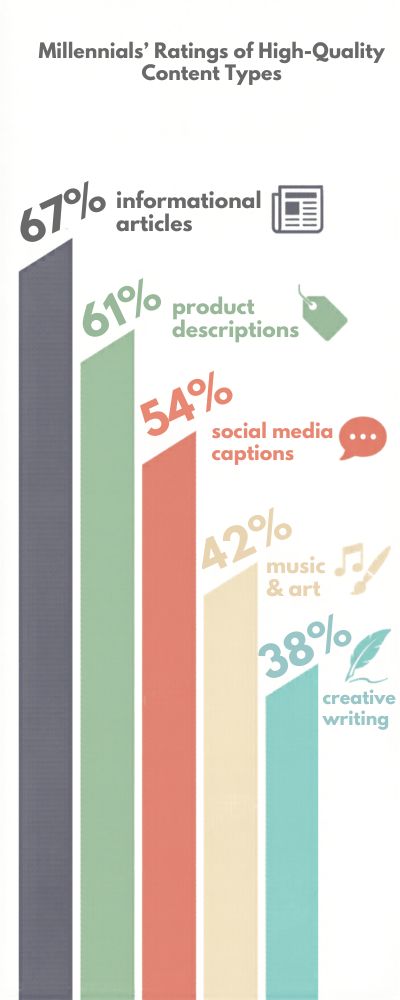
And so, high-quality content produced by artificial intelligence, especially for informational and utility-based needs, has been perceived as high-quality.
But good quality doesn’t always translate into the kind of quality that people think of as meaningful. And millennials seem to make that distinction, whether they can explain it clearly to you or not.
How People See the Quality of AI Content
| Content Type | Rated “High Quality” by Millennials |
|---|---|
| Informational Articles | 61% |
| Product Descriptions | 67% |
| Social Media Captions | 54% |
| Creative Writing | 38% |
| Music & Art | 42% |
According to the Statista AI Content Survey, millennials are more inclined to endorse the use of AI-created content for more functional applications than for creative works.
The Authenticity Issue
This is the emotional element. Because creative expression, for many individuals, is about more than just results; it’s about the voice of the creator and the personal struggles inherent in the work. It has the potential to be messy.
And AI doesn’t do messy. As a rule it’s smooth and tidy. Perhaps even too smooth and tidy.
Research conducted by Deloitte suggests that 49% of millennials feel AI-created content falls short in providing ‘an authentic human perspective.’
Source: Deloitte Digital Media Trends
Many millennials think AI-created content fails to evoke emotional connections as well as content created by a human being.
It’s like hearing a perfect song, but no matter how catchy, you don’t have to dance along the chorus.
But flip it: imagine you’re the one doing the designing, writing, composing. It’s not just about content. It’s a competition. Or possibly, a partnership? Who knows. It depends on the day.
For some millennials, AI is a collaborator of sorts. For others, it devalues their work.
“45 percent of millennial freelancers say AI tools have changed client expectations about the pricing and turnaround time for their creative work,” says Upwork.
It is changing the way the creative economy works, and the freelancers have to change to meet the new speed and efficiency standards.
There’s this tension here. You want to use the tool but you don’t want the tool to replace you. Makes sense.
Emotional Responses to AI for Creatives
| Reaction Type | % of Millennials |
|---|---|
| Curious/Excited | 46% |
| Concerned | 39% |
| Neutral | 15% |
According to the Adobe Creative Trends Report, Millennials are divided on AI’s place in the creative world.
Is It Creative, Or Merely Synthetic?
Not a clear-cut one, but that may not even be desirable.
There seems to be a duality at work with this demographic. Content created with the help of AI can be helpful, intriguing, and even pleasurable, yet it doesn’t appear to equal human authorship in some intangible quality.
MIT Technology Review Insights reported that Millenials consider AI a potential instrument that would enhance creativity but would never supplant creativity as a purely human endeavor.
From the MIT Technology Review AI Creativity Study, AI is viewed as a tool which can augment creativity, yet is not an acceptable substitute to human creativity (among younger age brackets).
To me it seems logical. AI may create the song for you, but it cannot live your life for you. Perhaps this is something Millennials have not yet crossed that line.
Dating, Shopping, and Decisions: Where Millennials Let AI Take the Lead
Algorithms Behind Swipe
Remember when you were in love? It seemed so simple, so natural. Now it feels like a chore choreographed by algorithms. Swipe, swipe, swipe. There are thousands of other users and it can seem like the app is just guessing at everything.
It is a bit like that. There are even prompts on apps like Tinder that ask you to be specific about what you’re looking for so the app can better determine who will be compatible with you. You can’t even be yourself here.
Millennials are looking for dates on sites like Tinder, Bumble and Hinge. Match group, which owns Tinder, found that 65 percent of millennial users use algorithmic recommendations to determine matches in dating apps
Algorithmic recommendations are integral to how millennials select matches in digital dating platforms.
And it’s not just the algorithm that seems to know who you are. It’s the apps you download. They all seem to know more about you than your parents, or even your therapist does. And they’re always pushing you to download more apps. We all have a few. We don’t even know how many anymore.
Love, But Data-Backed
Okay, so the idea of letting data dictate your love life sounds crazy, right? But millennials seem to be down with it, well, maybe not fully, but at least for the most part.
I mean, if a computer program can help you find people who you might be compatible with, why not? I mean, it’s time and effort saved, and potentially some bad dates avoided.
Fifty-seven percent of millennials say that dating apps or websites help them better find people they’re compatible with, according to Pew Research Center.
Millennials generally think algorithmic dating is helpful in finding partners.
That said, a thought or two nags, like: Is this person the right partner for me? Or am I just compatible because the algorithm says I am? Not quite the stuff of romance, but definitely a sign of what 2026 has in store for our digital dating future.
Shopping: Where AI Has Taken the Reins
Let’s talk about shopping, because it’s in this area that millennials have essentially surrendered the wheel.
The reality is that everything from product recommendations to targeted advertising is controlled by algorithms, and the majority of the population just lets it happen.
According to Salesforce, 73% of millennials feel that retailers should know their needs and provide customized suggestions.
Millennial consumers are increasingly considering AI-enhanced personalization as a basic necessity in a shopping experience.
It’s a strange feeling to be known so intimately by the internet. It’s comforting, though. Maybe a little too much so.
AI’s Influence on Buying Choices
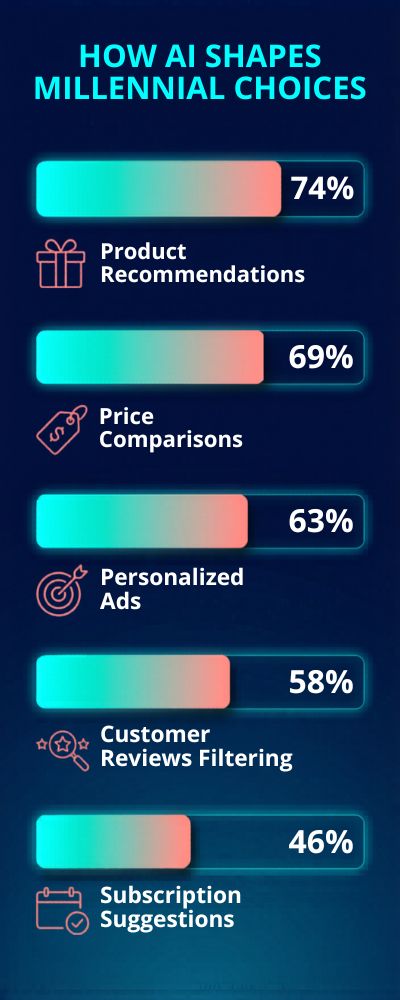
| Factor Influenced by AI | % of Millennials Affected |
|---|---|
| Product Recommendations | 74% |
| Price Comparisons | 69% |
| Personalized Ads | 63% |
| Customer Reviews Filtering | 58% |
| Subscription Suggestions | 46% |
According to Statista’s E-commerce AI Report, AI is transforming the millennial shopping experience with a focus on personalization and smart pricing.
AI can help with decision fatigue
What we don’t hear enough about is decision fatigue. Too many choices, too many tabs open, too many options. As we know, millennials are very busy with work, personal matters, and many other things and are increasingly relying on AI to make things easier.
And this isn’t because they can’t decide, but because they’re tired of deciding. The Oracle report on AI and decision-making notes that 64% of millennials would trust AI to help in their decisions and relieve stress.
According to the Oracle AI and Decision-Making report, AI is seen as a mechanism that can help with decision fatigue, especially among a younger group of people.
It’s less about laziness and more about mental bandwidth. Sometimes you just want someone or something to say, “Hey, this is good enough.”
Where millennials use AI to aid decisions
| Decision Type | AI Assistance Usage (%) |
|---|---|
| Shopping Choices | 71% |
| Travel Planning | 66% |
| Entertainment Picks | 76% |
| Daily Scheduling | 52% |
| Health & Fitness Apps | 48% |
Millennials often turn to AI in an effort to simplify daily decision making about many things like dating or shopping.
So, are Millennials ceding decision-making control to AI?
Not really. It just looks like that from the outside.
What’s actually happening is more nuanced: Millennials are picking their battles, caring deeply when they need to and letting AI worry about the rest. Millennials are strategically delegating decisions to AI, balancing convenience with personal agency.
According to a report from the World Economic Forum, millennials are forming a “delegated decision-making model” where AI takes on the lower-value decision-making, while humans continue to hold the reins on higher-value choices.
Millennials are strategically assigning decisions to AI while also keeping control of their own choices.
And it’s actually… kind of fair? No one wants to spend every day agonizing over decisions, big or small. When there’s actually value in the choice, millennials do still want the freedom to choose.
They might end up going for the slightly better option, but at least it’s still their choice, messy and human and imperfect as it may be.
AI and Financial Behavior: Is Millennials Trusting Algorithms? Money Is Now More Abstract than Before
Money today is abstract, as you are not using coins or bills anymore but numbers on the screen. When you pay using a card, you don’t experience the physical act, nor do you think about the cost of the item. It all seems to happen in an instant: You simply pay.
This abstract nature of the currency also changes the way we deal with the money in digital space. In addition, there are also notifications that let you know that you have spent more than usual.
If something is already in that abstract digital world, then there seems to be a smaller distance between us and the machine. We do not even see it as a giant leap, because it feels like it belongs there, and thus the idea of relying on AI in this area does not seem like it is out of reach for us.
Millennials are also embracing technology that uses AI to automate and enhance certain financial activities such as budgeting, investing, or saving. We are aware that they cannot fully rely on such systems and still want to keep a check. This is simply because there is no one better for the purpose than the AI.
Millennials also show an increasing inclination towards using automated technology systems for the management of their budget, savings, and investments. We have to be frank about it, that is not a bad idea when dealing with the finances. After all, nobody wants it to be a painful task.
Robo-Advisors: Helpful Ally or Potential Danger?
Investing used to be an intimidating process full of jargon and hefty requirements. But now there are apps that are willing to ask you simple questions and give you a personalized portfolio in no time.
That seems nice, even if it also has its fair share of concerns.
According to Charles Schwab, “45% of millennials say they are comfortable using robo-advisors to help make investment decisions, compared to 28% of others.” As per Charles Schwab Modern Wealth Survey, millennials are more willing to trust robo-advisors than their older counterparts.
Although, just because they are comfortable with this technology doesn’t mean they feel like they can trust it with every single decision they make. Think of it more so as cautiously optimistic. Like allowing the plane to fly itself but still being ready to intervene with the controls.
Use of AI in Financial Activities
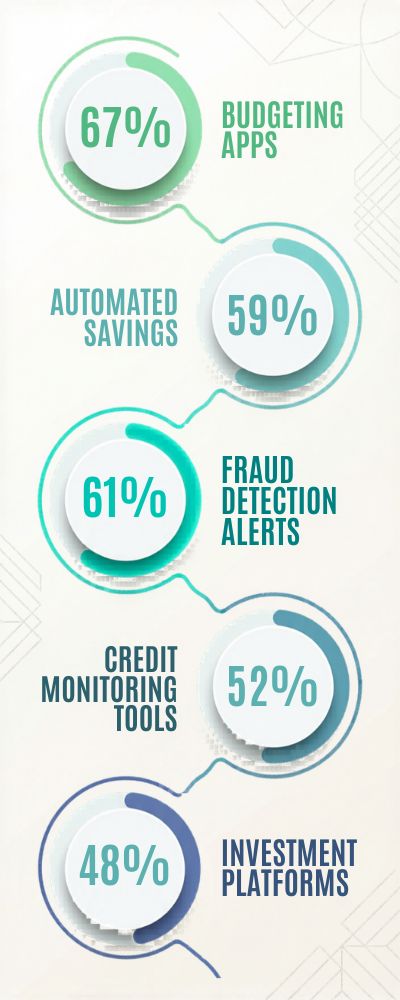
| Financial Activity | % of Millennials Using AI |
|---|---|
| Budgeting Apps | 67% |
| Automated Savings | 59% |
| Investment Platforms | 48% |
| Credit Monitoring Tools | 52% |
| Fraud Detection Alerts | 61% |
According to the Statista Fintech Adoption Report, millennials are heavily relying on AI financial tools for their personal finances.
Trust…But With Guardrails
This is where the story gets interesting. While millennials are utilizing AI to manage their money, they are not putting the tool on autopilot. They are watching. They are supervising.
Millennial users double-check recommendations. They tweak the settings themselves. They have a backup plan for “what ifs.”
Data from EY (Ernst & Young) suggests that 62% of millennials review or override any financial recommendations given to them by their AI before acting upon it.
Those who use AI-based financial tools often still maintain oversight on how their finances are being managed, suggesting that their trust in the technology is not unconditional.
It’s as though you are giving the tool your trust, but still sitting in the pilot’s seat.
Money’s Emotional Side Exists (And It’s Big)
Money isn’t a numbers game. It’s a stress reliever and stress inducer, it’s a safety blanket and it can feel like freedom, and occasionally it brings a bit of guilt. That’s where AI runs into trouble. It’s a tool with no capacity to “feel” any of these emotions, positive or negative.
Millennials certainly know that. Sure, they might use AI to fine-tune day-to-day spending and get the most for their money. But when it comes to big decisions, like whether to purchase a house, make a career change, or take a big gamble on investments, they still rely on trusted human friends for advice, or just use good ol’ gut instinct.
Per a PwC study, only 36 percent of millennials trust an artificial intelligence to advise on any major financial decisions that affect their life.
In other words, trust in AI decreases sharply when it comes to decisions that have long term personal impact on their lives. Which, quite frankly, is pretty understandable. We don’t trust an algorithm with anything that’s going to potentially keep us up in the middle of the night.
Table: Trust Levels in AI for Financial Decisions
| Decision Type | Trust AI (%) | Prefer Human (%) |
|---|---|---|
| Daily Budgeting | 68% | 32% |
| Investment Suggestions | 49% | 51% |
| Debt Management | 44% | 56% |
| Major Life Investments | 36% | 64% |
| Retirement Planning | 33% | 67% |
Millennials weigh their trust according to the seriousness of a financial move. They are much more likely to want a human’s opinion when high stakes are in play.
Are Algorithms Running Millennials’ Money Lives?
No, not exactly. But they are involved, nonetheless.
According to the report, AI is being utilized by millennials as a sort of financial aid tool to help them organize, make recommendations, and automate certain actions. It is not, however, being used as a substitute for a decision maker.
Millennials are creating a mixed financial behavior system that combines automated technology and human judgment, according to World Economic Forum report.
Increasingly, millennials are incorporating artificial intelligence into their financial behaviors but they still strive for a combination of human oversight and automation.
Perhaps, this is the ideal balance: Allow artificial intelligence to do the math, but ask a human when it comes to your future, your risk, and your peace of mind.
The Skill Shift: How Millennials Are Relearning Work in the Age of AI
“Wait… Do I Still Need to Know This?”
It’s a low-key identity crisis brewing within our workforce. It won’t headline the news, but it’s a real phenomenon. Millennials, in particular, are staring at tasks they devoted many years to mastering and asking themselves a disturbing question: Does this really matter anymore?
It used to be something that you knew well. It might just be emailing, or maybe it’s Excel spreadsheets, or perhaps code itself. AI might not be doing it perfectly. But AI’s good-enough performance might make you question your own usefulness.
World Economic Forum has estimated that 44% of employees’ core skills will be transformed by 2027 as the result of AI and automation, according to the World Economic Forum’s 2023 Future of Jobs Report.
AI implementation is going to rapidly change the necessary skill set for many global jobs.
That’s a startling statistic when you realize it’s not a case of “what new skills are you going to have to learn?” It’s actually “what are you going to find yourself learning less of.”
From “Doing” to “Directing”
Let’s put it simply: millennials are moving from doing the work to guiding the work. The work isn’t being written from A to Z anymore. Instead, we’re prompting it. Editing it. Improving it.
This shift may be small, but it changes the job altogether.
As of this year, job listings mentioning AI-related skills have grown 21% year-over-year, according to data from LinkedIn.
Employers increasingly value skills related to the oversight of automated tools and collaborating with machines.
It’s no longer just “Can you do this?” It’s “Can you do this with this?” A different sort of anxiety if you ask me.
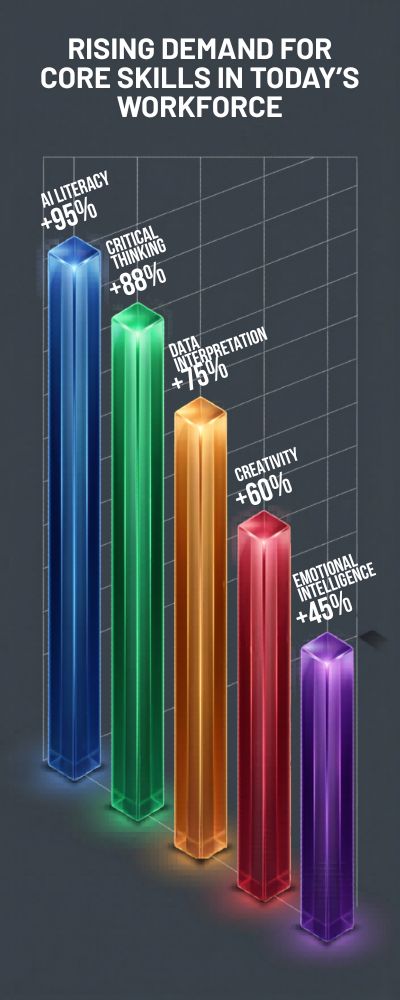
Top Priority Skills
| Skill Category | Demand Increase (%) |
|---|---|
| AI Literacy | +35% |
| Critical Thinking | +28% |
| Data Interpretation | +26% |
| Creativity | +22% |
| Emotional Intelligence | +19% |
While automation makes some traditional professions obsolete, there is a growing demand for skills that complement AI and center around humanity.
The Unwelcome Learning Curve
Let’s be honest, it’s no easy feat. New tools, new processes, new skills. It feels like by the time you are comfortable with your role, the role changes.
This prospect doesn’t bother some millennials. In fact, a lot are quite excited. Other millennials feel rather daunted.
As reported by the IBM Global Skills Gap Study, “According to research in The IBM Institute for Business Value, a majority of millennials, or 60%, believe they will need to continually reskill to stay relevant at work.”
The report goes on to cite that, “In a rapidly changing landscape fueled by new technology, AI, and disruptive business practices, people will increasingly understand the need to develop and refresh skills.”
This constant adaptation is, in itself, exhausting. It’s not quite burnout; it’s more like an unending period of recalibration. Like standing on an escalator in motion.
Millennial Learning Behavior
| Learning Method | % of Millennials Using |
|---|---|
| Online Courses | 64% |
| On-the-Job Training | 58% |
| Self-Directed Learning | 71% |
| AI-Assisted Learning | 46% |
Millennials are taking part in multiple modalities of learning so as to evolve with what is needed in the workplace.
Soft Skills Are Having a Comeback (Ironically)
And here is the irony: As AI grows stronger, humans skills will grow more important.
- Communication
- Empathy
- Judgment
What used to be called “soft skills” or the “soft stuff” is becoming more and more important.
McKinsey & Company estimates that as automation grows the demand for social and emotional skills will rise 24 percent.
Human-centric skills are going to become more crucial as automation takes over more of the day to day and technical work.
Irony at its finest. As we get further along in the automation process the more we will have to lean into what really separates us… us as humans.
Millennials? Yes, we are adapting. In fact, we’re likely doing both.
And that might actually be acceptable. We’re not beginning from ground zero; we’re adding fresh competencies to the ones we already possess. We’re modifying, testing, occasionally stumbling a little.
According to the OECD, adaptability and lifelong learning are rapidly becoming the most valuable career characteristics in the age of AI. In accordance with the OECD’s Skills Outlook, continuous learning and adaptability have now become mandatory for long-term employability.
If I were to distill the essence of it all, I’d say: Millennials aren’t being replaced; we’re being molded, reshaped. Not always at ease, not always effortlessly, but certainly, very much in the moment.
Skeptics vs Superusers: The Two Faces of Millennial AI Adoption
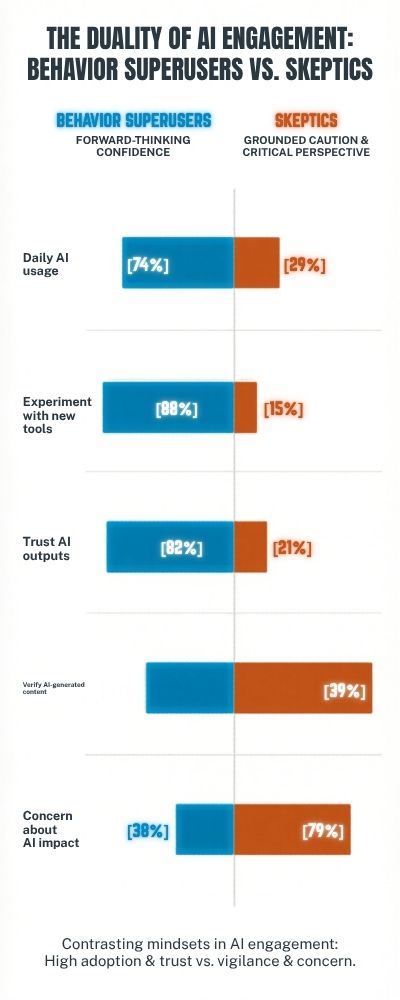
Millennial AI adoption has two sides: Skeptics and Superusers
One Gen, Two Mindsets: It is easy to lump all millennials into one bucket, and to assume that this generation is all marching forward at the same pace together. But that doesn’t jibe with reality. Talk to a bunch of millennials, and there’s a divide.
You’ll find superusers: eager adopters who love to learn and discover the capabilities of AI. And you’ll find the skeptics: careful observers, some with reservations about the technology.
As reported in a recent Ipsos study, millennials are divided almost equally. Nearly half, 48 percent, are “active AI adopters,” while 41 percent call themselves “cautious or hesitant users.” Millennials are split on adoption of AI; about half embrace the technology. Both sides have valid points, of course.
Meet the Superusers: “Why Wouldn’t I Use This?”
Chat with a superuser and you’ll hear a ton of excitement. It’s not hype, but wonder. You might ask, they treat AI as a tool, an opportunity to tinker with, make it more effective, get an edge.
These are the guys automating processes and generating ideas, and playing with cool new tech for the pure joy of it. In other words, there’s a “what can I do with it?” vibe.
In fact, per Salesforce, 62 percent of millennial AI power users say they actively search for new AI products to help them work better and more creatively.
In fact, highly-engaged users are actively incorporating AI into all aspects of their lives. They know what’s going on, almost as if they are learning the game before anyone else.
The Skeptics: “Yeah… But At What Cost?”
Now take a different view: the Skeptics. They’re definitely not anti-technology. They just aren’t on board. Or, not entirely, anyway.
The Skeptics will make use of AI where needed, but there’s a sense of reservation. Are they worried about privacy, correctness, and the wider impact? Maybe so, and not without good reason.
According to research in the YouGov, 49 per cent of millennials are worried that we will become too dependent on AI and the implications of this for society as a whole.
The Skeptics have concerns around dependency, jobs and misinformation. They aren’t the loudest voices, or the most dramatic, they are just… well, they’re thinking ‘I’m still not convinced’.
Table: Behavioural differences
| Behavior | Superusers (%) | Skeptics (%) |
|---|---|---|
| Daily AI usage | 74% | 29% |
| Experiment with new tools | 68% | 21% |
| Trust AI outputs | 59% | 33% |
| Verify AI-generated content | 42% | 71% |
| Concern about AI impact | 36% | 64% |
There are different behaviors that Millennials have with AI depending on the levels of trust that they have and how involved they are.
The Middle Ground Nobody Talks About
But here’s where we don’t pay enough attention; the vast majority of Millennials are somewhere in between both of those. They move back and forth between them depending on the situation.
At the office, you might be a power-user of AI, relying on it at every opportunity, every day, all the time. Back at home, you might start to wonder if you even want to put yourself in a position where it can make any decisions on your behalf.
In a Capgemini Research Institute report, they found that 67% of Millennials go back and forth between higher and lower trust in AI depending on the situation.
AI user behavior is context dependent, with people willing to adopt varying levels of trust in AI based on perceived level of risk.
So you could say this isn’t really a personality trait but more of a spectrum.
Table: Situational AI Adoption
| Scenario | Superuser Behavior | Skeptic Behavior |
|---|---|---|
| Work Tasks | High adoption | Moderate adoption |
| Personal Finance | Moderate adoption | Low adoption |
| Entertainment | High adoption | High adoption |
| Health Decisions | Low adoption | Very low adoption |
According to the OECD Digital Behavior Study: AI implementation is often dependent on how important the decision to take. S
So, Who Wins?
Neither, in my opinion, and that’s how it should be. Superusers drive the adoption and help us discover what’s possible, while skeptics are the brakes keeping us from running too fast before we know the road is good.
According to a World Economic Forum study, a balanced adoption between these two is most ideal. A mix of optimism and caution is key to the responsible adoption of AI.
And that’s probably why Millennials aren’t split in half, they’re balanced. They try hard and they slow down. It’s what they do. And it’s what they have done throughout their lives.
Looking Ahead to 2030: Will Millennials Become the First Fully AI-Integrated Generation
The Test Generation We Didn’t Ask To Be. This is all a bit meta. Millennials didn’t grow up with AI, but they’re the ones figuring it out in real time. Not Gen Z. Not anyone after.
Millennials are testing this out. They’ve got an analog background and a digital future, and a whole new generation of tools to help navigate the middle.
By 2030, according to the World Economic Forum, 85 percent of all jobs will incorporate AI. By the end of this decade, AI will become ubiquitous across industries. Millennials will be the first to fully normalize it.
Life, With AI in the Background
Fast forward a bit further: you’re just trying to survive the day, only now you’re constantly thinking about AI. The way you get out of bed in the morning is optimized by it, you’re working in systems that rely on it, you check your health stats with it.
Maybe even who you spend time with is dictated by it. According to Gartner, 70 percent of all personal and professional interactions will be mediated by AI.
In 2030, AI will be integral to how humans interact with each other and the world around them, both on and offline. Sounds pretty efficient. And a little overwhelming. Like living with a butler that is always on.
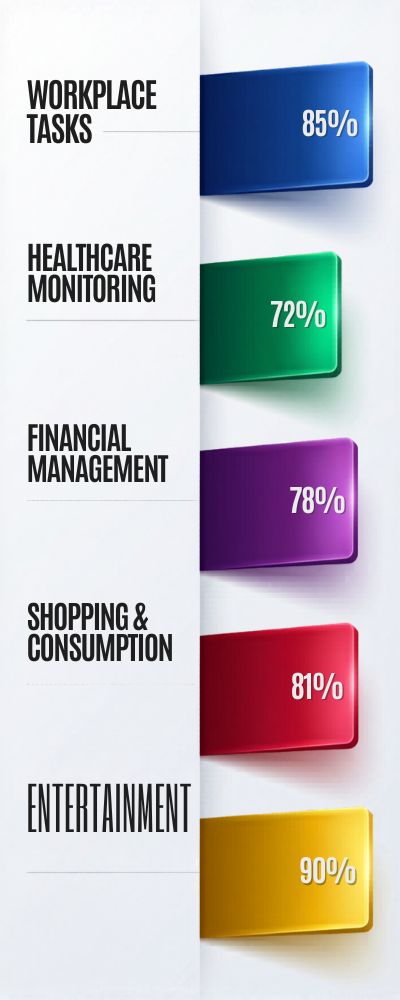
Projected AI Integration by 2030
| Life Area | Expected AI Integration (%) |
|---|---|
| Workplace Tasks | 85% |
| Healthcare Monitoring | 72% |
| Financial Management | 78% |
| Shopping & Consumption | 81% |
| Entertainment | 90% |
McKinsey predicts that AI will be integrated into almost all areas of human life in 2030. This creates a quandary on the line between comfort and dependence. It’s an uncomfortable relationship, because even though there’s a line between using AI and relying on AI, it’s already a little blurry.
Millennials have long outsourced making smaller decisions, but by 2030 that outsourced decision-making could be much larger. This could include career decisions, healthcare, or finance.
PwC says 52% of millennials want to use AI for big life decisions soon. Their report on AI predictions shows future AI reliance is expected to increase, with the most complex decision making at the top of the list.
This leads to the unspoken question of: when does convenience become dependence? It is still a little unknown, and only just becoming understood.
The Backlash? It Will Happen (For Sure!)
This is my prediction: The more ubiquitous AI becomes, the more we will see subtle and small-scale pushback.
- Consuming human-made content
- opting out
- seeking more human experiences (again).
Demand for more human-centered experiences may even grow as the adoption of AI increases, MIT Technology Review Insights found.
As AI becomes more ubiquitous, consumers are looking for more authenticity and human connection. It’s almost like a seesaw. The more AI, the more we want more… real.
Table: Expected Changes in Behavior
| Behavior Trend | Expected Growth |
|---|---|
| AI-Assisted Decision Making | High |
| Demand for Human Interaction | High |
| Digital Detox Practices | Moderate |
| Hybrid Work Models | High |
Consumers are likely to combine more AI usage with an eagerness for human contact and sincerity.
So… Fully Integrated or Still Holding On?
Millennials could turn out to be the first fully AI integrated generation, just not in the usual way we’re imagining. Not as passive consumers, not as AI-addicted, human-like robots.
They could be more like negotiators, constantly striking a bargain as to what they give to AI and what they retain for themselves.
A new OECD study suggests that future digital habits will be marked by adaptability and strategic integration rather than total dependency.
AI adoption may be marked by selective and contextual usage rather than complete reliance.
And perhaps that is the real answer. Millennials won’t “merge” with AI completely; they’ll be comfortable alongside it. At times. Sometimes. In places. On occasion. Even rebelling now and then.
Just like every other major change they’ve experienced up until now.
AI as a Daily Habit, Not a Tool
Millennials aren’t “trying out” AI anymore-it’s baked into their routines. From auto-suggestions to smart assistants, interactions happen dozens of times a day, often subconsciously. The shift here isn’t adoption-it’s normalization. AI has quietly become background infrastructure rather than a standout feature.
The Rise of “Invisible AI” in Millennial Lives
Most AI use goes unnoticed. Algorithms curate feeds, suggest products, and filter content without users actively engaging with them. Millennials are living in an AI-shaped environment without always recognizing it. It’s less “using AI” and more “living inside it.”
Millennials Prefer AI for Speed, Humans for Meaning
When time is tight, AI wins. Quick answers, summaries, recommendations-it delivers instantly. But when decisions carry emotional weight, millennials still lean toward human input. It’s a clear split between efficiency and empathy.
AI Reduces Effort-but Not Always Stress
AI simplifies tasks, but it doesn’t always reduce pressure. In fact, faster workflows often lead to higher expectations. Millennials report feeling both more productive and more overwhelmed. Efficiency comes with a hidden cost.
The “Second Opinion” Generation
Millennials rarely take AI outputs at face value. They double-check, compare, and validate information across sources. AI is treated like a helpful assistant-not the final authority. Trust is earned, not given.
Personalization Fatigue Is a Thing
At first, personalized recommendations might seem easy, but as you continue using them they become repetitive and perhaps even eerie. Millennials can sense when algorithms limit their possibilities. There’s less and less discovery and more and more predictability.
AI Is Changing How Millennials Learn
Millennials aren’t searching for answers so much as asking AI to explain things. AI tools offer overviews, summary information and how-to guides. It’s a faster method, but it may not always be as deep or as high quality.
Millennials Are More Likely to Try New AI
Millennials are more likely than older generations to try various AI tools. Curiosity plays a role. There are no power users here. The mindset is one of exploration. It’s more about experimenting.
AI Is Changing Attention Spans
If answers can be quicker and more concise people are willing to wait a shorter amount of time. Millennials want fast explanations of things and if it takes a while to understand they tend to move on. AI may be reinforcing this.
Trust Decreases as Risks Increase
Millennials will trust AI for smaller decisions, but they have more hesitation with things where the stakes are higher. Small risks are fine, but for the more significant risks not so much. Trust isn’t straight. It’s based on risk.
AI Is Blurring the Line Between Creation and Consumption
Today, many millennials are shifting from content consumer to co-creator, in some cases facilitated by AI tools that can generate content quickly and effortlessly. But who is actually the creator? What constitutes creating original content?
The ‘Good Enough’ Effect
Millennials are finding that a lot of AI content is ‘good enough.’ Sometimes it reads as though it were written by a human, while other times it falls slightly short of the mark. They know when it is important to be perfect, especially when it comes to using AI-generated content for something like an email.
Millennials Are Building AI-Assisted Workflows
When millennials work with AI, they seem to do it as part of an integrated, often multi-step process. A task might start as an AI-generated research output that is followed by AI-assisted planning. AI is not just a tool, but rather a piece of a workflow.
AI Is Changing Decision Confidence
There is an intriguing irony: millennials may become more confident in their decisions because of AI, or they may become less confident in their own judgment because of AI.
Digital Trust Is Fragmenting
Some may trust certain platforms more than others for the creation of quality content. And with AI now a part of the mix, those perceptions of trust have become even more nuanced.
AI makes more decisions faster, and more often
Constant recommendations lead to quick and frequent decisions. Should I stream this movie? What should I eat for dinner? Which of these books should I read? Which clothes should I wear today? With recommendations that are constantly available, it becomes a millennial norm that we’re making dozens of micro-decisions per day just to get through the morning. And that adds up.
Millennials expect the technology to know and understand them
Millennials are also increasingly expecting tech to be easy to use. It isn’t sufficient to simply do what it’s supposed to do. It needs to work in the way it is expected to, and almost as if it can read the user’s mind, and understand the user’s needs. When it does so well, it feels impressive; when it doesn’t, it is frustrating.
AI is changing how we define productivity
In today’s workplace, the ability to make decisions and do work in record time (due to AI) means that people’s outputs and decision-making are being evaluated and benchmarked against those of AI. Productivity is changing in real-time, in step with AI’s progress.
Even frequent users are not entirely comfortable using AI in the workplace
As the benefits to individuals and employers increase, so too are questions surrounding the ethical uses of AI. While its use in the workplace is rapidly becoming the norm, there are ethical concerns that keep users up at night: Does this program introduce bias in the workplace? Is it safe? Could it put my job (or my children’s jobs) at risk? Millennials are comfortable with using AI, but they are also wary of it. And not all who use it support its use.
Millennials are learning to work around AI’s flaws
AI still has flaws. AI is only as good as the user is at using it effectively. So millennials are also learning to tweak the prompt or reword the input to work more effectively. Knowing how to get the best output from AI is a new skill in itself.
Conclusion
One of the most interesting observations made is that millennials are not simply adopting AI; they’re adapting around it. They will use it to be more efficient but also resist it if it gets in the way of them making too many decisions for themselves.
Ultimately, though, the relationship between the two will never be simple. It’s complicated, practical, and perhaps even inconsistent but it’s also distinctly millennial.
Perhaps in a few years, millennials will be the first fully AI-integrated generation, but not in the way you might think. They will challenge it, work around it and perhaps even fight it.
Ultimately, this will be the millennial story: not how AI will define millennials but instead how millennials will redefine what life with AI is all about.


