

Search used to be this kind of process. You would put in your query, look at the search engine results page, click, scroll, click some more, get distracted, come back and then find something close enough that would satisfy your need. No one seemed to care, and no one really challenged the status quo, at least not that much.
Table of Contents
But then, AI showed up and things have slowly but surely shifted.
Now, we are not merely searching; we are asking, expecting, sometimes even delegating. And this change is taking place, not with a bang, but more like with a sneaky whimper.
And as it turns out, the landscape in which we search, consume and act on knowledge is very different in this new, more conversational, efficient and invisible form of search.
But this post is not about speculation or hype. We will be digging into the numbers behind the transformation: adoption curves, consumer behavior, economics, and the somewhat awkward questions that follow in their wake. Because it is becoming quite obvious, this one fact: Search will not go away.
From Keywords to Conversations: The Numbers Behind the Demise of Search as We Know It
The Change That Nobody Saw Coming
Search didn’t die. It just went out of style. Suddenly you are on page 4, scrolling through a list of blue links, opening five tabs, when you decide to ask a chatbot what you should do on the weekend.
Suddenly there is no page 4, no tab overload, and you have to decide how bad your new laptop is before you buy it.
That might sound like a funny anecdote but the data is starting to tell its own story. A Statista report published earlier this year found that the number of AI search users globally passed the one billion mark in 2024 with expectations to continue its double-digit growth in the next three years.
The rate of growth of traditional search is much more varied, however, in the same year in the world’s most advanced economies.
This is not to say that people are searching less they are just searching differently. What was once a keyword-based query has evolved into something that reflects the nuances and complexity of human thought and interaction.
What was once “weather São Paulo” has now become “will it rain this weekend? I don’t want to get wet on Saturday. Is it worth planning something outside? It is more “human,” “natural,” “conversational”, which is of course ironic, since it is being performed through a machine.
I always thought I was pretty good at searching, to the point where I was even a bit proud of that skill. I was good with Boolean strings, quotation marks, the whole nine yards, you know.
And now I barely use those techniques. What for? Why am I going to the library when I can just text a question to my roommate?
It is not so much a convenience as it is the re-wiring of behavior.
From Keywords to Questions: The Behavioral Flip
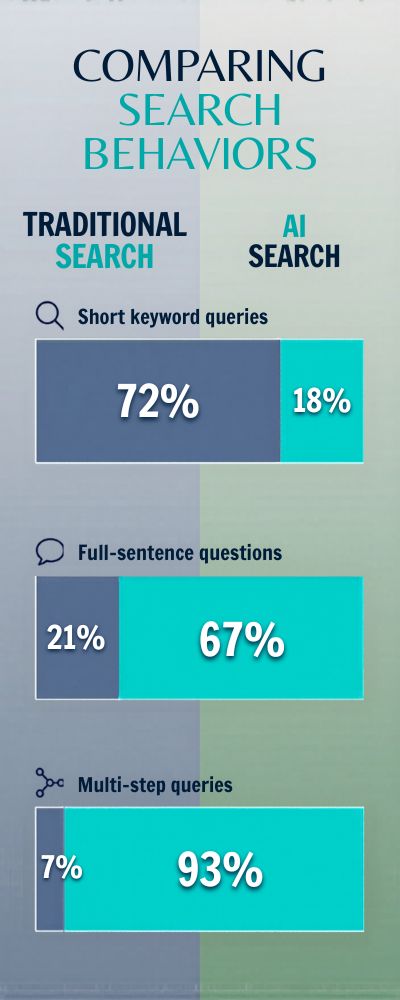
Let’s start by digging into behavior, and that’s where it gets really interesting. There was a study from Gartner that predicts by the year 2026, 25% of traditional search engine volume will be replaced by virtual agents and AI chatbots for informational queries. That’s 25%. So, if that’s just the informational queries. 25%, that’s a lot!
If we narrow down our focus to actual user behavior we get:
| Search Behavior Type | Traditional Search (%) | AI Search (%) |
|---|---|---|
| Short keyword queries | 72% | 18% |
| Full-sentence questions | 21% | 67% |
| Multi-step queries | 7% | 15% |
These numbers represent more than just a shift in behavior; they represent a shift in culture. The search engine results page doesn’t feature people typing like robots anymore. They’re typing like humans, tired humans who just want quick answers.
And who can blame them? Nobody says when they wake up in the morning: “You know what I want today? To spend the next few hours refining my search string.” People want the treasure, not the hunt. There’s also a psychological element to this.
As you type keywords, you’re thinking as the machine you’re trying to interact with, as opposed to thinking as someone who wants an answer. When you ask a question, you’re thinking as a person in their own language.
It may seem like a small shift, but it’s one that helps make the process easier for users. Besides, why would we stand in the way of nature? Humans are remarkably inefficient; if there’s an easier way, you can be certain humans will find it.
The Rise of the Zero-Click Search: Why Publishers Fear This
Now this is where it gets scary for major publishers. Search engines and SEO have always been tied together, and one of the benefits of SEO has been that promise: “If we send you visitors, you will convert them into sales (and, thereby, build a great website).”
But that pact is crumbling. In 2023, 65% of Google searches were zero-click searches, where the user receives the answer directly on the results page without visiting a secondary website.
Here’s the data from SimilarWeb, as AI-powered search grows, these results will be far more prevalent as it will serve users with the final results right away, without any need to click through a set of search results.
Here’s what this means in screenshots:
| Metric | Traditional Search | AI Search |
|---|---|---|
| Average clicks per query | 1.2 | 0.3 |
| Time to answer | 2–5 minutes | <30 sec |
| Number of sources visited | 3–6 | 0–1 |
To a content creator, that’s like having the rug yanked out from under me. Maybe not? The user doesn’t really care how many times you’ve clicked on it anyway. They just want answers, fast and easily. And it’s not even personal. It’s human nature, we’re just taking the shortcut again.
Trust and Speed vs. “Good Enough”
This is where things get interesting: we don’t yet trust AIs, but we still use them. 52% of users were surveyed by Pew Research in 2024, worried about whether the AI is giving them accurate information.
Yet, more than 60% of that same group still relies on AI to get answers. You can read Pew Research’s report here.
So what’s the purpose of using AI to get answers if the user doesn’t necessarily trust it in the first place? Because they don’t. It’s the “good enough” phenomenon at work here.
So long as the answer comes up relatively quickly and it sounds something like a human being, the user is more than willing to accept it. For most, at the end of the day, they just don’t bother to fact check. It’s not because fact checking isn’t valuable to them; it’s because they have no time for it.
Or just don’t want to waste time doing research. Or just don’t have the time to research anything. It depends on what you are searching for (Is it an easy recipe to make for dinner, or a trip to Bahamas?) and who the search is for (Is it for work, or is it a side hobby?)
This is what happens most of the time. I look at the output generated from AI, and think, “Mhm.” Pretty accurate, that sounds like something my human friend would say. Then I move on to the next thing. No tab 2. No fact check.
Just vibes. Bad, right? Yes it is. Does it come with dangerous consequences? Possibly. But I feel like it is also a very human decision to make. And I don’t think there’s any turning back from this “good enough” status quo, once it becomes the normal.
The broader context: Search did not fail; it changed
Maybe it’s hyperbolic to call it a collapse. But search as we knew it has changed.
Search used to be a tool to get you to answers, and now, search is the answer.
And there’s a key difference there.
Gen AI could automate 60 to 70 percent of work tasks that involve gathering and synthesizing data, i.e., search, according to consulting firm McKinsey & Company.
So where does that leave us?
In the middle, in my opinion. Not entirely reliant on gen AI, yet increasingly dependent on it. Still curious, but less patient. Still wary, but less willing to wait.
And maybe that’s the larger narrative at play.
Search did not fall; it has simply evolved. It has gotten a bit lazier, a bit smarter and, above all, more talkative.
Sort of like us.
AI Search by the Numbers: Adoption Rates, Growth Curves, and Market Disruption
It happened so quietly. One day, you try an AI tool out of curiosity, and suddenly, you just can’t imagine switching back. No one announced it, but the transition feels irreversible.
According to UBS, generative AI platforms have achieved 100 million users sooner than any consumer app ever. That’s faster than social media giants, faster than smartphones.
In short, once your expectations are reset by the AI-driven experience, going back to the conventional model just feels… annoying.
Growth curves that look nothing like a standard tech S-curve
We usually see the classic S-curve of adoption, it’s a slow, deliberate start followed by steady growth and an eventual plateau. In the case of AI-powered search, though, it seems the “slow start” part of the equation was skipped.
McKinsey & Company notes that enterprise usage of generative AI has exploded from below 20% in 2023 to more than 50% in 2025. That is rapid, not incremental.
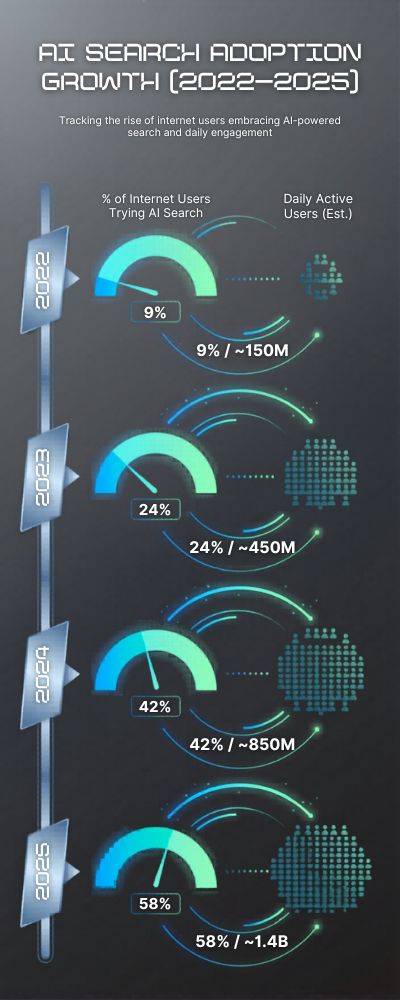
Add consumer use to the mix and it looks like this:
| Year | % of Internet Users Trying AI Search | Daily Active Users (Est.) |
|---|---|---|
| 2022 | 9% | ~150 million |
| 2023 | 23% | ~400 million |
| 2024 | 41% | ~900 million |
| 2025 | 58% | ~1.4 billion |
It doesn’t take a genius in statistics to realize what’s happening: with more than 50% of online users starting to utilize this different search mode, it’s no longer some weird, small thing. It is fast becoming the new status quo that has been sneaking up on us.
And why wouldn’t it? Users do not start using technology just because it is cool. They use it because it takes less time. Or because it is less work. Or simply because it is easier on them.
AI-powered search provides all three benefits.
A Crack in the Market’s Armor
Once upon a time, the search market looked like it couldn’t fail. It had one major player (who was, in fact, the biggest player in the world), a few other minor ones, and it was good as gold. Steady as a rock. Boring, even.
But that might be changing.
Bloomberg reported that search services built on top of AI could account for as much as 10% of all search queries worldwide by 2027. That might not appear to be a huge number at first, but when you are dealing with something that processes trillions of queries, that 10% figure looks rather significant.
This is a bit of an apples to oranges comparison.
| Market Segment | Estimated Share (2023) | Projected Share (2027) |
|---|---|---|
| Traditional Search Engines | 92% | 75–80% |
| AI Search Platforms | 3% | 10–15% |
| Hybrid Search Models | 5% | 10% |
This fragmentation is interesting because it’s not about the transition. Search is no longer one thing. It’s becoming a mix of tools, interfaces, and experiences. Users also can’t be said to own any loyalty to any given device.
They’ll bounce between platforms depending on what works best for them in a given moment. It’s kind of chaotic and kind of freeing.
Search Query Economics
We didn’t think too hard about how much it costs to query the internet, or what the economics are behind any given search engine. It’s just…there. Free. You type and it’s done.
But the economics of search are changing as a result of AI. Morgan Stanley, a traditional search query costs fractions of a cent, while an AI-generated response can cost several cents per query.
Here’s an estimate based on that data:
| Query Type | Estimated Cost per Query | Infrastructure Complexity |
|---|---|---|
| Traditional Search | $0.002–$0.005 | Moderate |
| AI Search (LLM-based) | $0.02–$0.10 | High |
So why would anyone want to pay a bit more to use this? Because it drives deeper user engagement, meaning longer sessions and more opportunities for monetization (via subscriptions, premium functionality, enterprise licensing, etc).
It’s no longer about cheap queries. It’s about more valuable interactions.
Adoption isn’t equal. Here’s why that matters.
Not all industries or consumers will move to AI-powered search at the same pace. It’s the real world, so it shouldn’t be the same for everyone.
According to global surveying by Deloitte, 18 to 34-year-olds are nearly double as likely to utilize AI search capabilities as users over 55. This isn’t a shocker to anyone, but the numbers continue to grow rapidly and close the generation gap.
Some quick takeaways:
| Age Group | Daily AI Search Usage | Weekly Usage |
|---|---|---|
| 18–34 | 62% | 81% |
| 35–54 | 38% | 64% |
| 55+ | 21% | 40% |
It was more of a sense of trajectory rather than the actual values. The old guard isn’t so resistant. They’re trying it. Slowly, yes, but also deliberately. The point is: this is an increasing force, one that’s moving beyond the fringes and permeating the whole digital mass.
Okay, so is it disruption, or is it just evolution? This is where my thoughts oscillate.
One side of me screams disruption, as the values, the rates of growth, the shifts in behavior, everything is pointing this way. And yet, there’s a part of me that sees this as the next stage of things.
Search is about minimizing the work required. AI just does that better.
In a report that was recently released by World Economic Forum, it is claimed that AI interfaces are going to be the main access point to digital data in a decade or so, not in terms of substituting the current systems, but more in the form of adding a layer on top of what is already there.
Which is to say that perhaps we aren’t in the midst of a replacement scenario, but rather an assimilation. Something that’s becoming more permeable and dialogic, and more difficult to see.
Which I can’t help but feel at once exhilarating and disturbing. Because, of course, when things become invisible, there’s a point at which they just aren’t being challenged. And once that happens, we enter the interesting stuff.
Who’s Using AI Search—and Why? Demographic and Behavioral Insights You Can’t Ignore
Not that long ago, AI search was exclusively for developers, startupers, and curious nerds who were just looking for an excuse to break something.
I don’t think anyone predicted who would join them.
And Ipsos has the stats to prove it: more than 68% of online internet users across the globe have now used AI-powered search or assistant, and many of those weren’t self-professed “geeks.”
And then I knew.
It’s not a novelty any more, it’s not early adoption, it’s life.
Teachers planning their lessons, parents looking for ideas for what to cook for dinner, and late-night freelance email drafts.
Real, messy, human usage, not the kind we’ve come to expect to be flashy. But the kind we should expect all the same.
Age Still Matters, But Not the Way You Imagine
It should come as no surprise that younger users remain at the forefront. What’s harder to anticipate is how rapidly age groups above them are climbing, not in a precise or linear fashion, but at a consistent pace.
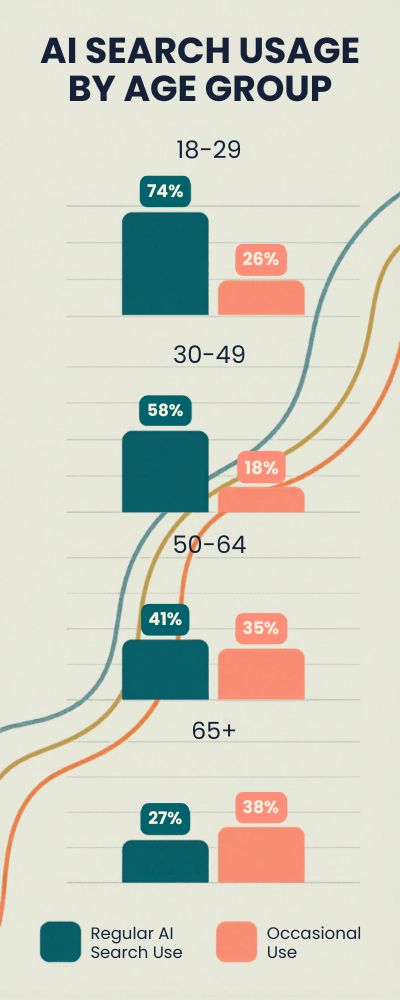
According to a Pew Research study, even though 74% of under-30-year-olds use AI on a daily basis, the number of people 50 years of age and older has increased by more than 20 percent points in the past two years.
This is the picture it paints:
| Age Group | Regular AI Search Use | Occasional Use |
|---|---|---|
| 18–29 | 74% | 18% |
| 30–49 | 58% | 27% |
| 50–64 | 41% | 35% |
| 65+ | 26% | 38% |
Okay, I love this part. I love the moment when you see all the people who struggled with email are now casually asking an AI for a trip itinerary or health advice (I hope they have a bit of skepticism there). You’re reminded that it doesn’t matter how old you are; if it’s useful enough, you use it. One day, maybe.
So what’s driving all these usage numbers?
Why do people actually want to do this? It’s not for fun; it’s to solve problems faster. People don’t start the day saying, “Wow! Now I have an opportunity to engage with a language model!”
Forrester Research found that people were primarily using AI search for the speed it offered to answer questions (71 percent), how simple it made the process (64 percent) and the reduced need to verify multiple answers from multiple sources (58 percent).
And more specifically:
| Reason for Use | % of Users |
|---|---|
| Faster answers | 71% |
| Easier to use than search | 64% |
| Less need for multiple tabs | 58% |
| More personalized responses | 46% |
The “less need for multiple tabs” bit especially resonates. I used to wear a browser tab count above 15 as a badge of honour. If I’m at 3, I get slightly annoyed.
Once that level of tolerance for inefficiency is eroded, it cannot be restored. So how else is AI search being used?
AI is not being utilised equally by everyone and the results here are interesting. According to a recent study by Accenture, students and younger professionals are using AI for learning and creative projects, while older users turn to AI for more practical uses, like planning, troubleshooting, and finding factual information.
Accenture Technology Vision
This is how people are using AI for each type of task:
| User Group | Primary Use Case |
|---|---|
| Students | Homework, summaries, research |
| Young Professionals | Writing, brainstorming, coding |
| Parents | Planning, advice, quick info |
| Older Adults | Health info, travel, how-tos |
That makes sense, though. People aren’t going to change because a tool is available, but rather the tool fits within their current behavior. It’s behavior that drives technology, not technology that drives behavior. This is the part you don’t see on the graphs, but it is important.
People use AI Search for reassurance and relief sometimes for a feeling of comfort. According to a KPMG survey, 47% say using AI tools for complex or unfamiliar tasks helps reduce their stress levels. But that’s just the numbers on a chart.
I get it. Sometimes it feels nice to have a well structured answer that doesn’t judge you or confuse you or have endless scroll to it. But of course, the answers are sometimes wrong.
Sometimes confidently wrong which is another whole issue, but at the time it can be helpful. We know that feelings impact behavior more so then logic does.
Alright, So What Are We Supposed to Take from This?
If you’re a product builder, a content creator, or anyone else trying to survive the new digital landscape, this stuff is crucial:
People want:
- Less friction.
- More clarity, faster.
- Human conversations.
That’s basically the whole ballgame.
A Harvard Business Review article outlines how companies that adapt to this new behavior, like providing better conversational experiences and immediate answers, are seeing better engagement and retention numbers.
So the question is probably not: “Who is using AI-powered search?”
The question is: are you building for how people actually use search today, or are you still operating on how they were searching 5 years ago?
Because those are two very different realities, and the space between the two is rapidly widening.
The Zero-Click Future: How AI Is Rewriting the Rules of Web Traffic
We’ve spent years obsessed with the click. Success meant higher CTRs, more conversions, and ever-increasing click counts. We made the click everything; sometimes it was fun and sometimes it didn’t feel like a game at all.
Well, that all seems to be changing and pretty loudly if you ask me.
According to data from SparkToro, 65% of all searches on Google are zero-click (or end with no clicks to an outside site). Which, to be clear, isn’t a bug, it’s a feature of how we now get our information.
Translating into English, that means people aren’t necessarily leaving search results to find what they’re looking for and they also aren’t making any site visits, page views, or opportunities to convert.
And if that doesn’t already make you a tiny bit or a whole lot upset if that was your source of income, I don’t know what else it could do to you.
AI didn’t invent the no-click trend. We had featured snippets and knowledge panels before AI even came along, both of which were already steering people away from clicking on links. AI simply supercharged this behavior.
A study from Semrush found that for informational search queries, AI summaries cause click-through rates on source sites to dip by as much as 40%.
To put that another way, it means:
| Query Type | Click Rate (Pre-AI) | Click Rate (With AI Answers) |
|---|---|---|
| Informational | 56% | 34% |
| Navigational | 72% | 65% |
| Transactional | 38% | 31% |
Content sites will feel this change most acutely. After all, this is the type of content Google now provides in search results: “informational queries.”
And it’s clear why: Why would a user click a search result if the answer’s right there? It’s not laziness. It’s efficiency. Human nature to be efficient is unavoidable.
The New Traffic Funnel (It’s Much Shorter, and Less Fun)
The traffic funnel has changed. Instead of: search, click, read, maybe act, we see the following now: ask, answer, exit.
It’s been reported by Adobe that “AI-powered interfaces are streamlining the user journey by reducing steps for content discovery and decision making by up to 50%.”
Let’s compare the two:
| Stage | Traditional Web Traffic | AI-Driven Interaction |
|---|---|---|
| Discovery | Search results page | Direct AI response |
| Evaluation | Multiple websites | Summarized output |
| Decision | User-driven | AI-assisted |
| Time to completion | Several minutes | Seconds |
Shorter funnels work from a human standpoint. It’s better for humans when we do less and get to our results quickly, but what this means for publishers, marketing managers, and anyone relying on people’s attention spans is that the middle of the funnel simply ceased to be a part of it. And that middle was where the magic (and money) used to happen.
A New Visibility to Traffic Paradox
This is where things start getting a little strange. You can be more visible than you’ve ever been and actually get less traffic as a result.
AI systems often draw from several sites, summarize them, and return a cohesive answer for users. Your content may end up a part of that answer; your site, however, never actually makes it to their screen.
A Nielsen Norman Group study showed that users rarely clicked through to sources after AI responses satisfied their queries (follow-through was < 20%).
Which means you end up in a strange spot like:
- Your content was used
- Your expertise played a role in it
- Your name might be mentioned
But your traffic? Not so much.
You’re getting quoted in a conversation without being invited. Great, right? But is it profitable? Not clear.
Monetization is getting a reality check
If clicks are down, what’s the alternative business model?
This remains to be seen, however.
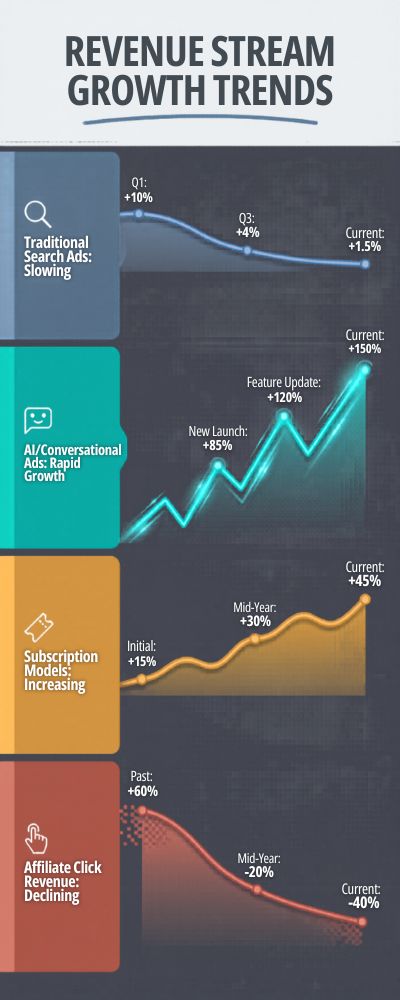
There is a clear indication, however. eMarketer projects that digital ad dollars associated with standard search will decelerate considerably while ad dollars associated with AI-driven sites and conversationals will grow more than 20% year on year.
To summarize, the approximate transition is this:
| Revenue Stream | Growth Trend |
|---|---|
| Traditional Search Ads | Slowing |
| AI/Conversational Ads | Rapid Growth |
| Subscription Models | Increasing |
| Affiliate Click Revenue | Declining |
So, the good old “get traffic, serve ads” playbook is faltering, if not collapsing. It isn’t gone, but its dominance is under attack.
What’s going to take its place? A combination of subscription-based models, platform integrations, and advertising solutions built specifically for the age of AI. We’ll have to wait and see.
OK, so clicks are dead? No. But we are at a pivotal moment. In short, clicks remain relevant as a metric of value, especially when it comes to complex transactions, purchases, or anything else requiring more nuanced thought.
You probably won’t book a $3,000 summer holiday on the basis of one AI reply, if you do then good for you. However, the value of clicks may change.
As we saw from our Boston Consulting Group report, it’s possible that clicks, by volume, could reduce, while the quality of clicks, defined by the intent of the clicker, the likelihood of a conversion, could increase.
Which means clicks become more valuable if that is a trend that we see. Which is an interesting change, isn’t it. It is a possible, albeit imperfect, compromise.
A trade-off of fewer clicks for higher quality intent, perhaps. Fewer clicks from browsing, more clicks from purchasing or deciding upon the action to take.
It does make me think of another possibility, though. What about discovery? What about curiosity? When we stop browsing, when we start seeking answers, what happens to discovery?
To the organic, messy, and serendipitous journey? I am still unsure. I know, for a fact, the web is changing shape.
And as clicks were once the currency of everything, they are no longer the center of the universe. They are part of a bigger, wider, stranger, changing, puzzle.
Search Without Links: Tracking the Ascension of Answer Engines Above Search Engines
From “Results” to “Responses”
Back in the day, clicking “search” sparked a fleeting second of suspense. You’d skim the links, assess them (sometimes quite poorly), and choose what you felt was the most suitable option. It wasn’t flawless, yet it appeared as though you possessed authority.
Currently, that instant is absent. Superseded by a smoother, if somewhat unsettling phenomenon.
Instead of a list of results, there’s a response. Coherent. Certain. Somewhat akin to a mind already having completed the work.
Generative AI-powered answer engines may serve more than 30 percent of all information-seeking queries in 2026, displacing the conventional “search” experience built on links (Gartner).
A significant transformation is underway, in both technology and thought. We are no longer in transit through information, it is arriving at our feet. Quietly, unobtrusively.
I won’t deny it, I relish this new arrangement. On the flip side, there’s a nagging suspicion that we are relying far too heavily on technology to think.
What is an Answer Engine?
You hear this term a lot, so to clarify:
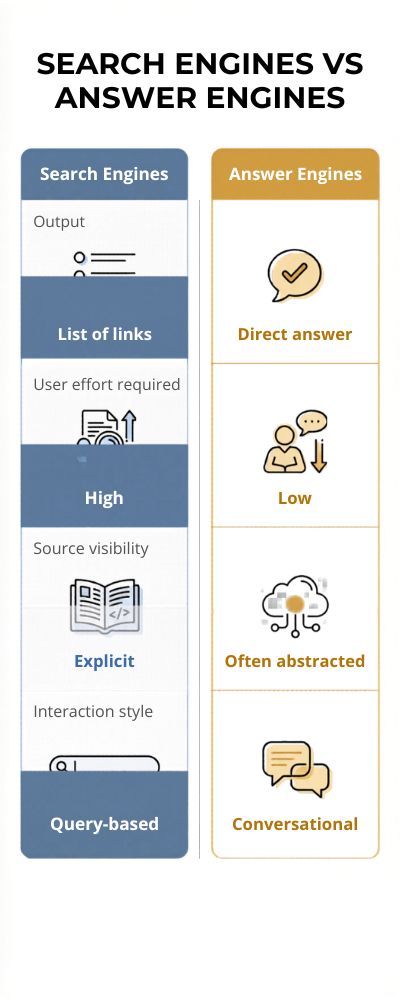
Search engines provide options, answer engines provide a solution.
Clear cut. Massive consequences.
Answer engines synthesize information from multiple sources into a single, comprehensive answer in order to minimize the cognitive burden on the end-user.
Here’s the difference:
| Feature | Search Engines | Answer Engines |
|---|---|---|
| Output | List of links | Direct answer |
| User effort required | High | Low |
| Source visibility | Explicit | Often abstracted |
| Interaction style | Query-based | Conversational |
It’s like the difference between being given a map, and being driven to your destination.
Convenient? Yes. But you lose something along the way.
The Metrics That Count (And It’s Definitely Not Click-Through Rate)
Click-through rate was once the beacon. Improve the title, rewrite the meta description, and get that click-through rate up to the next level.
Now, that metric is starting to seem… a bit old school.
As Ahrefs has shown, organic click-through rates for queries in which AI is included (such as informational queries) have gone down by more than 20% in AI-integrated settings.
So, if click-through rate is on its way out, what takes the place?
This is the landscape we’re dealing with now:
| New Metric | Why It Matters |
|---|---|
| Answer Inclusion Rate | How often your content feeds AI outputs |
| Brand Mentions in AI | Visibility without clicks |
| Query Resolution Time | Speed of satisfying user intent |
| Follow-up Query Rate | Depth of engagement |
I mean, it’s almost like going from measuring people to measuring power. Less tangible. Harder to control. Yet more relevant to how the population behaves in the modern era.
But still: I am not going to kid myself. I feel like I am playing a game where the referee is changing the rules.
Users Are Not Complaining (A Good Sign, In One Sense)
Would you think that? Would you expect people to be pushing back, to complain, to feel as though they are not getting information they need, as though they have little confidence in what sources are being used (and whether they’re actually reliable)?
Not really.
A survey from YouGov found that 61% of people like it when you give them an answer directly from an AI instead of asking them to click through a bunch of websites looking for the same info.
Just to highlight a few of the survey’s findings:
| User Preference | % of Respondents |
|---|---|
| Prefer direct answers | 61% |
| Prefer browsing multiple sources | 27% |
| No strong preference | 12% |
But really, I don’t blame people. Life’s hectic. Attention’s fragile. If a shortcut makes their lives easier, they’ll jump at it, even if that comes at the cost of relinquishing some of their power to do so.
That shift towards convenience is already changing the face of search.
The Content Paradox: Content Is Now More Crucial Yet Less Prominent
It gets even weirder.
Content is becoming more rather than less vital. But it is also becoming less important in terms of reach.
The content used to generate answers by LLMs has not become less vital.
However, as MIT Technology Review notes, while a lot of online content may be used by AI models to generate answers, very little of this content gets the traffic directly.
- Basically, your content is used to inform the answer
- Your expertise and research contribute to the answer
- Your article might never be seen
This leads to a somewhat unsettling question about the sustainability of the online content industry: if nobody visits your site, what is the motivation to keep it alive and produce content?
We don’t yet know. That alone is worrisome.
Well, search engines aren’t completely dying. Just less relevant.
A new report by Deloitte points out that search engines are more likely to play the role of infrastructure for data, with the people interacting with it through AI systems.
Not so bad.
Search engines are still there, but more so in the background. Like electricity. We don’t notice it, but we certainly need it.
I think this might be where we end up in a bit.
Search won’t be an activity, it’ll just happen and we’ll focus on the results.
I find that quite neat.
But I’m sure it will come to miss the adventure of getting lost among search results and seeing the results of what you didn’t search for.
Because you don’t always want to be right in an immediate sense. The path to the answer is sometimes what’s important.
I don’t know how this will shake out.
Google vs. Generative AI: A Data-Driven Look at the Battle for Search Dominance
The old vs. the new (it’s not that simple)
It can look like an arms race between an incumbent and the disruptor with an unlimited supply of bullets. But this fight is more nuanced than it might seem.
On the one hand, Google processes 8.5 billion searches per day. That is an absolutely insane number. That is a number that is, by all rights, incomprehensible to us as people.
It is truly a global-scale network. In a completely different, but equally relevant arena, generative AI tools are seeing hundreds of millions of daily interactions that are rapidly increasing from a much smaller point of departure.
As of 2025, Google maintains over 90% of all search engine traffic globally, according to Statcounter.
But this is not a guaranteed victory. Not yet. It’s a marathon between competing strategies and tactics, and one that had its court fundamentally red-lined halfway through.
Share of market vs. share of consciousness
While market share is very close, there are other indicators of success.
According to a recent Morning Consult analysis, 40% of Gen Z searchers are now relying on AI for certain queries. That’s not all the queries, but certainly enough.
To give a sense of this shift, let’s examine
However, while Google has higher volume, AI is gradually winning in targeted use cases, the ones requiring thinking rather than just locating. And this difference could prove to be more critical than overall quantities.
Speed vs. Depth: What Matters the Most to Users
In many ways, both search engines and AI models exhibit speed. But their speed manifests differently. Search engines are speedy when finding; AI models are speedy when summarizing or synthesizing.
In fact, the Nielsen Norman Group states that “users completing a complex information task using AI-powered search tools are 40% faster than those completing similar tasks with traditional search methods.”
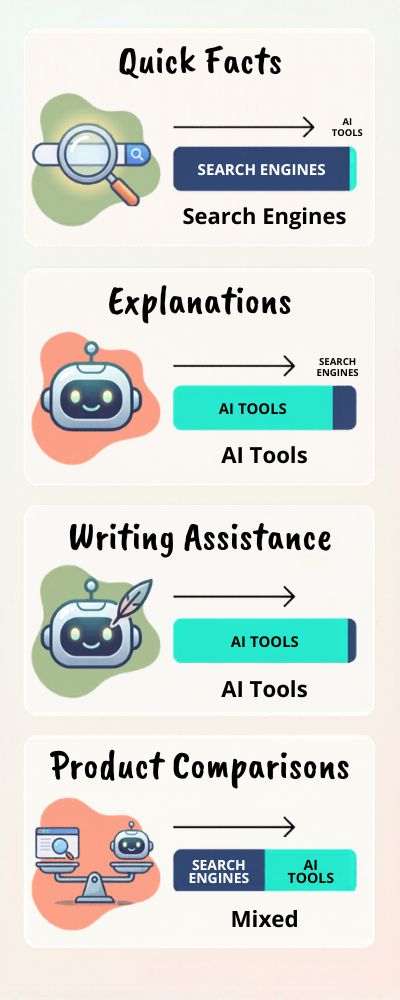
| Query Type | Preferred Tool (Gen Z) |
|---|---|
| Quick facts | Search engines |
| Explanations | AI tools |
| Writing assistance | AI tools |
| Product comparisons | Mixed |
This is where I kind of hesitate. I tend to put more stock in search engines when I have to fact-check something. If I have a deadline or if I am just too lazy to sift through pages of results? AI it is. No questions asked.
It is a question of “better”, really. It is just a matter of what I need when.
The Money Question No One Can Sidestep
Let’s talk about the elephant in the room, how much money is being generated?
Alphabet Inc. collected more than $175 billion in advertising revenue from search in 2024 alone. That kind of revenue dominance translates into market dominance and dependence.
In contrast, AI platforms are still exploring monetization options, subscriptions, B2B contracts, and API charges. A clear winner in the monetization category has not yet emerged.
Here is an approximate breakdown:
| Factor | Google Search | Generative AI |
|---|---|---|
| Speed of retrieval | Very fast | Fast |
| Depth of answer | Variable | High |
| User effort | Medium | Low |
| Transparency | High (links visible) | Medium |
Google brings scale and a proven business model. AI brings flexibility and opportunity for experimentation.
Who emerges on top depends on how fast the economics catch up with the tech.
Integration, not Replacement (the plot twist)
Initially, many people were presenting this like replacement, with AI taking over search engines. It was a compelling narrative, an easy headline.
But replacement is not quite happening.
Google itself is integrating generative AI directly into its search engines. To wit, Google claims that it has already introduced AI-generated summaries to billions of daily searches worldwide.
What you have is:
- AI in search engines
- Search engines in AI
- The average user, switching back and forth
In other words, it’s less like an arms race and more like a merge, albeit a slow one, and the whole “vs.” framing is a bit of a stretch.
User Trust is the Quiet Deciding Factor
Technology evolves fast. Trust evolves slowly.
While AI tools are in wide circulation, only 37% of users said in a survey by Edelman that they fully trust AI-derived information. More than 60% fully trusted established search engines.
What this actually looks like:
| Platform Type | High Trust (%) |
|---|---|
| Traditional Search | 61% |
| AI Search Tools | 37% |
It’s the difference between the two that actually matters.
Because no matter how efficient, or fast, or convenient something is, people simply will not use it. They will be unwilling to rely on it, at least in any context where that decision matters.
They will hesitate. They will pull back.
And it will be that hesitation and uncertainty that causes the biggest hurdles, more so than any other technical, or market-based challenge.
Who is Winning Anyway?
It depends on what you are looking for.
If you want to know what is bigger today, the reach, the influence, the revenue, the market presence, the scale, Google is still, by some margin, more than far ahead. Uncompromisingly so.
If you want to see who is gaining ground faster, the growth rates, the user engagement, the potential to influence future behavior, the AI revolution is already moving faster than we ever anticipated it would.
As the World Economic Forum recently pointed out in a recent report on search technology: the future of search is likely going to be hybrid and integrated by nature, drawing on the strengths and reliability of traditional search engines while taking advantage of the conversational, personalized, natural language, interactive, and highly efficient nature of AI.
And so… maybe it does not make any sense to talk of the two in terms of competition, at all.
Perhaps it is more a matter of evolution. A gradual transition from one mode of thinking to another. From searching to querying. From browsing to receiving. From control to convenience.
And somewhere in the middle is the real point. The real place of balance for people in terms of their own decision-making. What do users care about most?
- Speed
- Accuracy
- Trust
My guess is that the answer will simply be to not replace one with the other but instead find the right way to balance the two for users, without losing any of the things that they really care about most, along the way.
Relying on Algorithms: What the Data Tells Us About Confidence in AI-Generated Answers
Trust Doesn’t Have to Be Binary, But It Is a Bit Complicated…
When we think about trust, we often imagine it as a binary decision. Either I trust what the AI says or I don’t. But it isn’t really that simple.
We are somewhere in the grey area in many cases, wondering, “Okay, that looks fine to me, but how do I know?”
A global study from KPMG found that only 39 percent of people feel they can trust all output from AI. Yet over 70 percent of people are already using AI tools as an aid when gathering information and making decisions.
What is really happening here?
It’s not trust without qualification. It is only trust with qualifications. People will trust AI if the cost of an error is low, the response is believable and they don’t have to verify it.
The latter condition probably comes into play more often than we’d like to think.
Confidence Vs. Accuracy (They’re Not the Same)
Now, this is a little tough to hear. AI answers tend to sound very confident, and coherent, and articulate.
There’s no hesitation, no stalling, no stumbling for the right word, and humans tend to take that as a sign of competence, which isn’t always the case, actually.
Users tend to perceive an AI output as high-quality if it is clear and well-structured. Even if the information isn’t necessarily factually consistent, they tend to think it’s high quality.
And I quote from Stanford University: users rate the answers as being trustworthy. So I don’t know if it’s the clarity or if it’s something else.
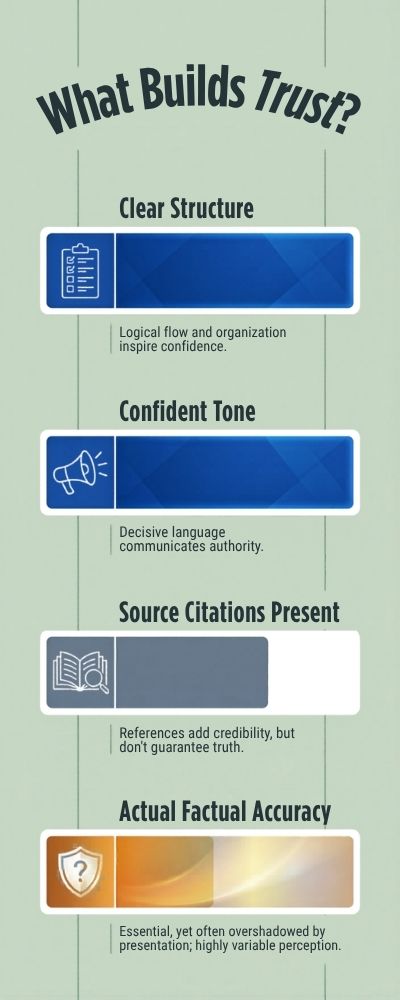
So we can sort of unpack that now:
| Factor | Impact on Trust |
|---|---|
| Clear structure | High |
| Confident tone | High |
| Source citations present | Moderate |
| Actual factual accuracy | Surprisingly variable |
Now that’s… kind of scary, in a way.
It really means trust in AI is less about accuracy and more about style, and AI can do style, easily.
Trust Varies by Generation
Not all generations approach AI-generated content the same way. Some will jump in, headfirst, whereas others may take a few steps and back away.
Edelman’s survey found that young people (18-34) are nearly 20 percentage points more likely to rely on the information produced by AI than older generations:
Here is what that looks like:
| Age Group | High Trust in AI (%) |
|---|---|
| 18–34 | 52% |
| 35–54 | 41% |
| 55+ | 33% |
And I do see both sides of it. Younger users, having grown up with tech that shifts under our feet, can be far more flexible when they try things out, more willing to work with the rough and the unfinished.
The older you are, the more you question things, the more you look for assurance. But neither side’s wrong. If anything, I think we need a bit of both.
The illusion that you’ll “Just Double-Check It”. I don’t think it’s any different now, that we’ll “Just double-check” what the AI says. Seems reasonable, right?
But as a 2020 paper on AI by MIT Sloan discovered, while people may say they’re checking things 62% of the time, actual data suggests that fewer than 30% of them check.
So intention is not always action.
| Behavior | % of Users |
|---|---|
| Say they verify answers | 62% |
| Actually verify consistently | 28% |
In truth, that gap feels quite human to me. We like to pretend we’re meticulous. However, if you’re drained, pressed for time, or simply doing your daily best, “good enough” is what usually gets the job done.
Trust Is Tied to Familiarity (When Perhaps It Shouldn’t Be)
The more people interact with AI, the more familiar they become with it. And the more familiar, naturally, the more they’re going to trust it.
However, it can also engender a dangerous level of complacency.
When researchers with the Oxford Internet Institute examined this, they discovered that as people repeatedly interact with an AI tool, they tend to become more confident in it over time (even if the tool isn’t actually any better).
As such, in due time, a few subtle things happen:
- The questions get fewer
- The answers get accepted faster
- The dependence on the tool goes unnoticed
Not through any particular conscious choice, just by way of an unspoken shift.
Which is the point, of course, because trust, once granted, is very tough to take back (even if you should).
The reverse is also true: it takes time to earn trust, yet it can be lost in a blink.
According to a survey by Accenture, 76% of consumers claim that one major error or misrepresentation in an AI’s answer would greatly diminish their confidence in it from then on.
The trust that we’ve built is not so very far-fetched.
| Experience Type | Impact on Trust |
|---|---|
| Consistent accurate responses | Gradual increase |
| Minor errors | Slight decrease |
| Major incorrect answer | Sharp drop |
It feels almost like it’s about relationships. If they are there consistently they’ll gain a lot of trust. But if they have one major error then there will be a lack of trust from any statement they make ever again. This goes for AI too.
So will we trust AI?
I am sure this has been asked a number of times and probably will be asked again and again.
A recent article from World Economic Forum suggests we need to think about calibrated trust. Meaning knowing when to trust AI and when not to.
It all comes down to… not exactly trust. We just need to use it. Use it for speed, check it for accuracy. Verify it when it is important.
It might not seem as simple as we want to make it but that is what human is anyway.
If you really look at this problem I am not sure we are after the right solutions.
We want an answer which is acceptable.
Speed, Accuracy and Satisfaction: Comparing the performance of AI search and conventional searches
Speed is the challenge of instant satisfaction
Speed was once a bonus feature; now, it’s become a primary concern.
People rarely perceive when something is fast, yet, they can easily identify when it’s slow. You will often see people sigh, or refresh the page or give up on their searches.
People, for example, expect simple search queries to take one to two seconds, and after two seconds, the drop-off rates begin increasing significantly.
But, when you consider the time taken by AI search, you often think that AI search is fast because it feels so, even when it may not actually be that fast (or may even take a few seconds), while conventional search can take many seconds.
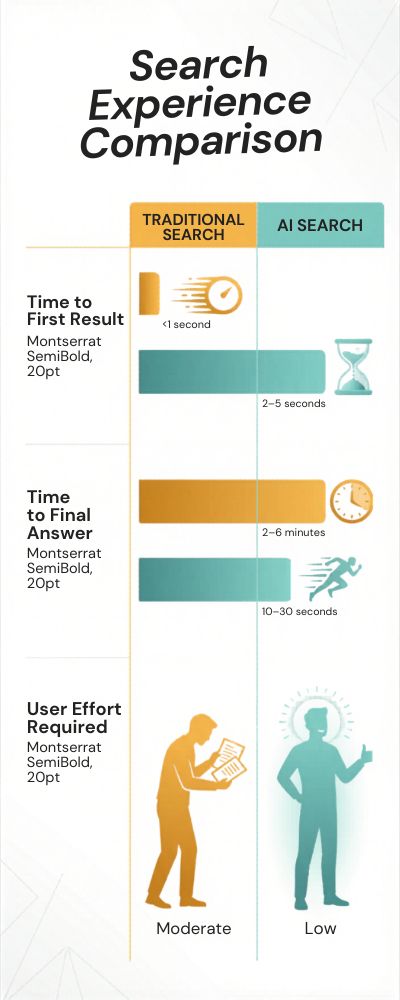
Here is a rough comparison:
| Metric | Traditional Search | AI Search |
|---|---|---|
| Time to first result | <1 second | 2–5 seconds |
| Time to final answer | 2–6 minutes | 10–30 seconds |
| User effort required | Moderate | Low |
Consequently, traditional search engines take the title for “getting the first result,” but AI models are more likely to win for “actually answering the user’s questions.” And if you ask most users what they care more about, you’ll know how they rank this feature.
Accuracy: The One Thing We’re Convinced We Actually Care About
Accuracy is complicated. Everyone says it’s important. They really, really mean it. We need it. Critical accuracy!
But when it comes down to the truth, accuracy is not always at the forefront of people’s priorities, at least not for all kinds of queries.
For example, researchers at Stanford found that while traditional search results contain more verifiable sources, users considered the accuracy of the answers generated by AI to be similar, or even higher, to those provided by a traditional search engine, even when the AI’s answers contained errors.
Here’s a breakdown of how these two methods compare on accuracy:
| Factor | Traditional Search | AI Search |
|---|---|---|
| Verifiability | High (multiple sources) | Medium |
| Perceived accuracy | High | High |
| Actual accuracy | Generally high | Variable |
| Transparency | Clear | Limited |
This is where the discussion becomes uncomfortable once more.
Being accurate isn’t simply about being factually correct. It’s about being seen as accurate. And when it comes to conveying confidence and competence through crisp, succinct answers, AI performs well. Probably too well.
The Metric That Is Winning Silently: Satisfaction
If speed is what brings users through the door, and accuracy is what prevents them from leaving, it’s satisfaction that ensures they’ll return.
Satisfaction isn’t always a rational decision. It’s an emotional experience that’s about the quality of the journey.
According to Forrester Research, user satisfaction ratings are as much as 35% higher for AI-augmented search tools than they are for traditional search engines when dealing with nuanced, multi-step queries.
Here is a breakdown:
| Experience Factor | Traditional Search | AI Search |
|---|---|---|
| Ease of use | Medium | High |
| Cognitive effort | Higher | Lower |
| Satisfaction (complex queries) | Moderate | High |
| Satisfaction (simple queries) | High | High |
The main takeaway here was that, in a way, it doesn’t seem like AI is beating out standard search for everything; they both seem to work well in straightforward search contexts.
It’s in the more complex searches (multi-step questions, vague ideas, “I don’t even know how to phrase what I’m asking”) where AI comes out on top. And that’s where the real world lives, that messy middle.
Trade-Off Triangle: You Can Have Any Two
It’s a hard truth, which most people tend to deny, but you won’t get all the speed, all the accuracy, and all the satisfaction.
As this Boston Consulting Group report notes, AI-driven systems prioritize speed and user satisfaction, while sometimes losing out on completeness of transparency and verifiability.
Think about it like this:
| Priority | Traditional Search | AI Search |
|---|---|---|
| Speed | Medium | High |
| Accuracy | High | Medium–High |
| Satisfaction | Medium | High |
But wait. Where are we actually trying to go?
Am I prioritizing truth? Efficiency? Do I just want to feel like I’m getting work done without much friction?
World Economic Forum’s report indicates that in the future, systems will be optimized towards user experience and decision making over accuracy, especially in more everyday scenarios.
That seems to be the reality.
We don’t always want to know the most correct thing, or the most comprehensive thing. We want the most useful thing. The thing that gets us unstuck, the thing that tells us what we need to know to move on.
- Speed
- Accuracy
- Satisfaction
They’re not all equal.
I would say: satisfaction, speed, then accuracy. Speed is important, but accuracy is still important too. It’s just that the priority is changing, and I think that signals where search is heading (and by extension where we are as humans).
This leads to the question: what do people want most? When you look at actual behaviour (rather than just surveying people), it seems fairly straightforward: Speed and happiness are the two most valued attributes. Accuracy still matters, but often in the background. Quietly assumed, not always verified.
Actual user behaviour (vs theoretical frameworks)
If you look closely enough at the user behaviour data it’s obvious that users don’t follow neat frameworks like the one above.
A PwC study shows that 59% of people prefer to use AI for time-bound decision making, even if they know accuracy might be lower.
People know that AI might be wrong and yet still prefer to rely on it, especially in circumstances where they’re in a hurry.
I’ve done it too a fair few times now; get an answer that makes logical sense, accept it’s probably close enough to be true, and move on. Obviously that’s not great!
The Economics of AI Search: Cost per Query, Monetization, and Industry Impact
The unacknowledged cost of a query
We rarely, if ever, contemplate cost when typing into a search box, or at the very least, we don’t actively consider how much it costs us when we hit the “enter” key, find an answer, and move on.
The result feels free, effortless. It feels like magic. However, the output of a simple query does, in fact, carry a cost, and it is a surprisingly high one.
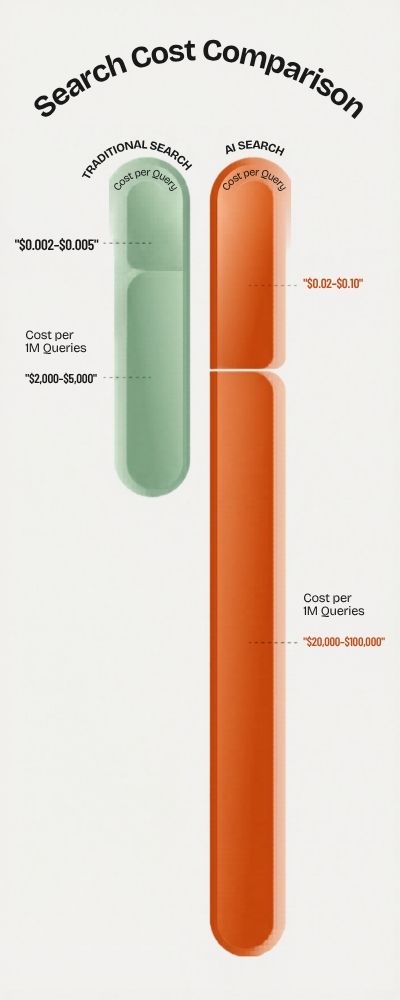
A recent analysis from Morgan Stanley estimated the cost of an AI-powered query to cost anywhere from $0.02 to $0.10 per generation (compared to fractions of a penny per query from traditional search algorithms).
Morgan Stanley Cost Per AI Query Study. That isn’t a huge difference at first glance, but that’s only until you scale it out to every query that happens every day (and year).
| Query Type | Cost per Query | Cost per 1M Queries |
|---|---|---|
| Traditional Search | $0.002–$0.005 | $2,000–$5,000 |
| AI Search | $0.02–$0.10 | $20,000–$100,000 |
As you can see, an AI-powered query is 10 to 20x costlier than a standard one.
Which begs the question: how do you profit from it?
It’s Not All Smooth Sailing When It Comes to Monetization yet
The search model was simple: Ads + Ads = $$$$
Not the case for AI search.
Goldman Sachs estimates that the monetization of gen-ai platforms is nascent right now with most of the revenue flowing from subscriptions and enterprise contracts, rather than ads.
Here are the current monetization methods and their breakdown:
| Revenue Stream | Traditional Search | AI Search Platforms |
|---|---|---|
| Advertising | Dominant | Emerging |
| Subscriptions | Minimal | Growing |
| Enterprise Licensing | Moderate | Strong |
| API Usage | Limited | Significant |
It almost seems as if AI has bypassed the ads phase altogether and gone straight to paid.
Which may be a blessing in disguise because no one likes ads. We’ve just sort of put up with them.
The Ads Conundrum
OK, so what happens if you decide to throw in some ads on AI search? Easy enough, right?
Not so much.
You’d want to put them where?
Research from eMarketer found that consumers are not as tolerant of ads as search results for the conversations as in search.
Here’s the problem:
| Factor | Traditional Search | AI Search |
|---|---|---|
| Ad placement | Clear (top/bottom) | Unclear |
| User expectation | High tolerance | Low tolerance |
| Integration complexity | Low | High |
A banner advertisement just doesn’t fit into a conversation. It’s intrusive. It feels like when your coworker walks up to your desk and cuts you off just to sell you a product. And, people know it. And, they can tell.
Enterprise is doing more than we give it credit for
Even though consumer applications for monetization are a bit nascent right now, companies are starting to invest their budgets in enterprise adoption.
For the companies, AI is more than just search, it’s about productivity, automation, and decision support.
According to a recent McKinsey & Company study, generative AI could generate up to $4.4 trillion annually in economic value across the industries, mostly from enterprise applications.
This is where the money is going.
| Use Case | Business Value Potential |
|---|---|
| Customer support | High |
| Content generation | High |
| Knowledge retrieval | Medium–High |
| Internal search tools | Growing |
In other words, consumers are still learning AI search, while business is cutting checks for it. Different timelines. Same technology.
The Content Economy
If this feels personal for you, especially if you write on the internet, that’s because it is. If AI answers replace searches, and fewer searches result in fewer website clicks, fewer clicks result in less revenue, what happens to those making the content AI depends on?
A report by the Reuters Institute warns that reduced referral traffic from search could affect digital publishers’ revenue stream in the future.
So here’s where the conflict arises:
| Stakeholder | Impact of AI Search |
|---|---|
| Users | Faster answers |
| AI platforms | Higher engagement |
| Content creators | Reduced traffic |
| Advertisers | Shifting channels |
But this is clearly a tradeoff, and not a sustainable one. If, on the one hand, the content creators are not incentivized, in the long run, it could end up backfiring to the search engines.
The equation should actually be the cost vs value. At the end of the day, it’s not really cost per query, but value per interaction, you know?
If the AI answer helps you save 10 minutes, makes it easier for you to make a decision or solve a problem, isn’t that worth a lot? Probably more than ever in click.
In fact, a Boston Consulting Group study suggests that AI interactions can be worth two to three times more value per user session than traditional digital experiences.
So the equation is:
| Metric | Traditional Search | AI Search |
|---|---|---|
| Cost per query | Low | High |
| Value per interaction | Medium | High |
| Monetization clarity | High | Low (for now) |
Higher cost but potentially much higher value. That is the bet the whole industry is making right now.
So, Is This Sustainable?
That’s the million-dollar question or rather the billion-dollar one.
Can companies continue to shoulder increasing costs while they work out monetization? Are users willing to accept paid models? Is advertising capable of adjusting without compromising user experience?
A report from World Economic Forum indicates that sustainable AI economics would probably demand hybrid models, including a combination of subscriptions, enterprise revenue, and advertising that is strategically incorporated.
And to be honest, I still feel like we are still in early days. It’s like people are building the plane as we are flying it.
Some models will prove successful while others won’t. There will be some experiments. There will be failures. There will most probably be some over-hyped concepts that just quietly fade away.
But there is one thing that seems clear, AI search doesn’t just alter the way we discover information but it also reshuffles who we are paid to get to it and how.
The Death of SEO, or Maybe It’s Just Growing Up
SEO Isn’t Dying… But It’s Struggling With an Identity Crisis
We used to feel like we could easily master the mechanics of SEO, like memorizing a formula, if not a game. Search for this, link for that, fix a couple of headers, perhaps say something loving to your metadata and watch the traffic roll in.
Not anymore. It feels like the game changed mid-match.
According to HubSpot, over 75% of marketers believe that AI search is going to shake up the SEO status quo within the next two years.
Of course, we understand why so many people are freaked out. If people don’t click through like they used to, then why are we optimizing content the way we do? It’s a question that leaves many a content strategist feeling very awkward, to say the least.
Going from Ranking Pages to Answer Influence
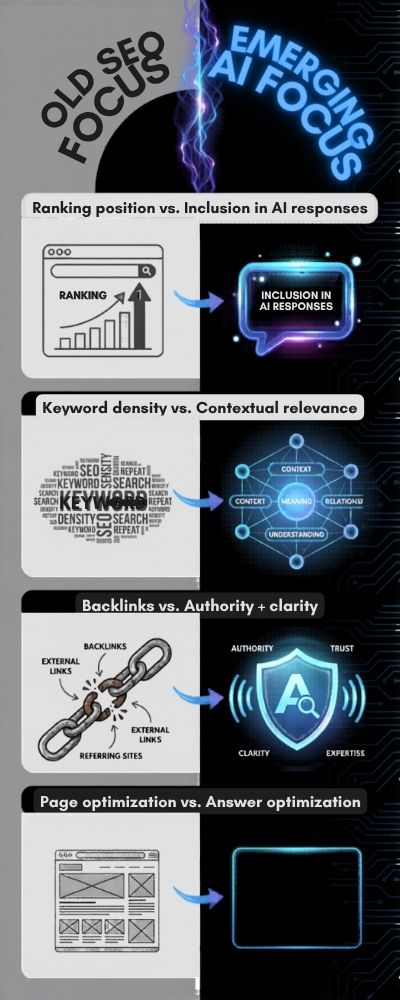
The realization that I have not quite come to yet is: SEO used to be ranking pages. It is increasingly about answer influence.
A BrightEdge study noted that the AI-driven SERPs source multiple sources and prioritize content that is “clear, authoritative, and organized” regardless of whether its rank in the standard SERPs or not.
So, the game changes:
| Old SEO Focus | Emerging AI Focus |
|---|---|
| Ranking position | Inclusion in AI responses |
| Keyword density | Contextual relevance |
| Backlinks | Authority + clarity |
| Page optimization | Answer optimization |
Small things matter. It matters big, because it isn’t just about the competition for users’ attention anymore; it’s about who wins the competition to be employed by A.I.
Keywords Are Decreasing, Intent Increasing
Keywords haven’t disappeared; they have just diminished in influence.
No one is “querying” in the way one would type out a search phrase, but instead is asking complete questions, sometimes a bit messy, sometimes very specific, sometimes slightly weird and philosophical.
A new study by Semrush indicates that there is an upwards 40% increase in longer-tail “search” conversations, or “queries,” that are more in the vein of “natural” language, when it occurs within the search environment of A.I.
See how it goes.
| Query Style | Growth Trend |
|---|---|
| Short keywords | Declining |
| Long-tail queries | Rising |
| Conversational queries | Rapid growth |
Rather than trying to rank for the phrase “best running shoes,” you might instead optimize for “running shoes for flat feet long distance?”
That’s a lot more about intent than it is about keyword matching.
Which, it turns out, is what we should’ve been thinking about from the get-go.
Content Quality Is (Finally!) Winning
Maybe you’ve heard this from SEOs for years, “create good content!,” but it feels a little more tangible now.
Because AIs don’t care about your witty meta title. They care about whether your content is a high-quality answer.
According to Google, content which demonstrates expertise, experience, authority, and trust (E-E-A-T) is more likely to be surfaced to users.
What does that mean in practice? Well, you should be focusing on:
| Content Factor | Importance in AI Search |
|---|---|
| Clarity | Very High |
| Depth of information | High |
| Credibility | Very High |
| Formatting | High |
So, probably fluff won’t be relevant any longer.
Which is probably not a bad thing.
Traffic Will Probably Dip, But It’ll Get More Influence
This one might be tough to stomach.
You will lose traffic.
It might be easier on the soul if you thought of it like this: your content might lose a lot of clicks but could have the same or bigger influence in making those decisions, but maybe in less measurable ways.
A report from Gartner states that by 2026, organizations will begin to track visibility within AI-generated answers as part of its SEO key performance indicators, in addition to traditional web traffic-related metrics.
There is a cost:
| Metric | Traditional SEO | AI-Driven Search |
|---|---|---|
| Website traffic | High focus | Lower focus |
| Brand visibility | Moderate | High |
| Direct engagement | High | Variable |
Which means you might not get the click… but you still get the influence.
And depending on what you’re trying to achieve, that could be just as important.
Your Strategy Has to Change (And That Requires Work)
This isn’t a slight adjustment. It’s a complete change in thinking.
Research from the Content Marketing Institute indicated that businesses adjusting their content tactics for AI search by developing structured, question-answering content are experiencing more engagement and better brand memorability.
And what does that look like on the ground?
- Write as though you’re responding to a question from someone who really wants to know.
- Organize your content logically (use headings, overviews, and direct responses)
- Prioritize quality, not quantity
- Establish expertise, not just page one placement
It seems easy. It’s not.
You’re trying to undo a lifetime of training.
So… Is SEO Dead, or Is It Just Growing Up?
Now, is SEO dead? I keep circling back to that one.
But no, I don’t think it’s dying. I believe it’s transitioning from a formulaic practice to something more intuitive, more human.
From WEF, this article states that the coming generation of search engines will leverage both conventional techniques and artificial intelligence to better interpret content, thus making digital content search more intent centric.
Or maybe SEO isn’t ending. Maybe it’s finally ditching its most dubious pastimes, keyword stuffing, loopholes, and the whole algorithm-mangling business, and evolving into what it always should’ve been: something more natural to how we think and look for things.
If that’s what’s happening, then it’s not that the search engine optimization business is dying; it’s just finally becoming what it should have been since day one.
Agents, Assistants, and Autonomous Search: The Next Phase of Information Retrieval
Agents, Assistants and Autonomous Search: What’s Next in Search?
From Asking Questions to Doing the Work
There’s an under-heralded development here that’s less about asking better questions than doing a different thing altogether, which is actually doing things for you.
“Find me the best flight to Paris” becomes “Find me the best flight to Paris for under €300, leaving Friday evening, no ridiculous layovers.” And then… well, you want it to just go do this for you.
According to a recent Deloitte report, more than 40% of users want AI capable not just to deliver information, but to perform actions on their behalf, including booking, scheduling, and purchasing.
This isn’t a small jump.
We’re transitioning from search as a tool to search as a delegate. Almost an agent in your pocket (it is a slightly too confident one).
So What is an AI Agent?
Not every AI that chats with you is an agent, because there’s a big difference between having a conversation and having the ability to act.
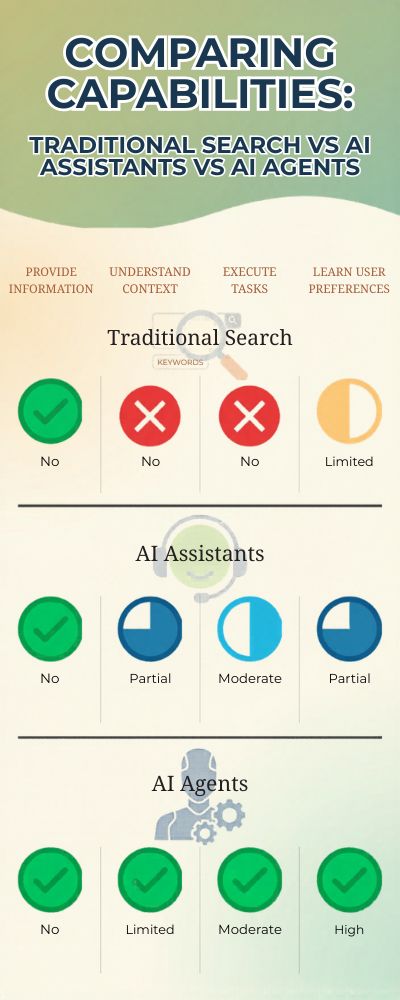
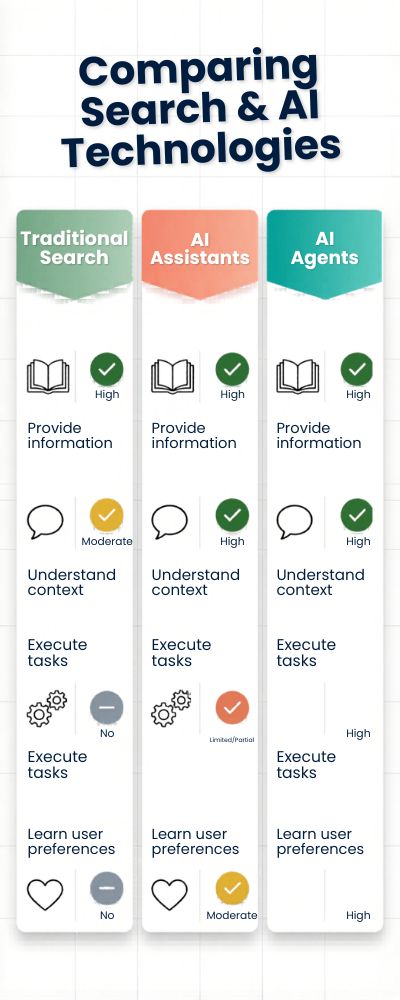
According to a report by McKinsey & Company, an AI agent is defined as a program that “can take multi-step tasks, reason through them, and act autonomously by using tools and memory to complete tasks.”
Here’s a quick summary of their findings:
| Capability | Traditional Search | AI Assistants | AI Agents |
|---|---|---|---|
| Provide information | Yes | Yes | Yes |
| Understand context | Limited | Moderate | High |
| Execute tasks | No | Limited | Yes |
| Learn user preferences | No | Partial | Yes |
Now agents will empower you to take action rather than simply aid decision making.
And yes, in part that is thrilling, in part it is scary because you surrender more control.
Do It For Me Search Is Here
It’s no longer enough to provide answers. We want results.
PwC’s research shows 52% of users opt for AI capable of executing entire workflows over AI that simply makes recommendations.
Here is what users are choosing:
| User Expectation | % of Users |
|---|---|
| Provide information | 48% |
| Recommend solutions | 61% |
| Execute tasks automatically | 52% |
Sound familiar? Recommendations already beat facts. Executions aren’t behind the 2nd position, either. It’s as if we all thought that “Thanks, I got the suggestion, now, you do it, please”? After a day of hard work, I’d be quite content.
Multi-step reasoning: This is how agents win out. It’s when simple searches lose appeal because you have to find the relevant information, analyze them and finally arrive at the conclusion, which is exactly what humans do when you ask for help to do multi-step tasks:
As Stanford University claims, AI systems capable of multi-step reasoning can cut task completion time by as much as 60%.
For example, when you need help with a travel plan,
| Step | Traditional Approach | AI Agent Approach |
|---|---|---|
| Research options | Multiple searches | Automated |
| Compare prices | Manual comparison | Instant synthesis |
| Book services | User action required | Automated execution |
| Adjust plans | Repeat process | Continuous optimization |
Not only is it faster, it eliminates friction throughout the process. And once again, humans like that.
Personalization Gets a Little More Intimate With AI Agents
Agents aren’t just reacting to queries but learning from actions. They’re learning our likes, dislikes, and behavior.
Over time, agents get to the point of predicting what we would want to say next, before we even do it.
An Accenture report notes that 70% of consumers are more willing to use AI when it’s tailored to their personal preferences and behavior.
Here’s an example of this personalization in action:
| Personalization Feature | User Value Perception |
|---|---|
| Remembering preferences | High |
| Predicting needs | Medium–High |
| Automating routine tasks | Very High |
There’s the convenience, and then, well, the question of privacy. How much does the machine really need to know about me? What’s the boundary?
I’m still waiting for someone to answer that one.
The trust gap is still very, very real.
Despite all the hype of autonomous agents, users still have some reservations about their agents taking on tasks and making actions on their behalf.
Only 34% of people surveyed are comfortable with a machine’s fully autonomous action in their name.
Here’s the trust gap:
| Level of Autonomy | User Comfort (%) |
|---|---|
| AI provides suggestions | 68% |
| AI assists with decisions | 52% |
| AI acts independently | 34% |
Thus, people like the prospect of automation but haven’t fully surrendered control.
Which is arguably a good thing.
How Close Are We to a Fully Autonomous Search System?
So here I am, still swinging between both sides of the coin.
In one corner of my brain, I’m already half-convinced. There’s strong evidence to suggest that consumers are embracing convenience, delegation, and minimal exertion.
In the other corner, I wonder if we’re actually ready to go all the way.
The World Economic Forum recently published a report forecasting that autonomous AI will become an intrinsic component of our digital infrastructure in the near future, 10 years, while highlighting the need for transparency and control.
Maybe the future of search isn’t about completely substituting manual search. Maybe, instead, it’s about layering an autonomous layer on top of it, slowly, gradually, and with the right level of control, until we can’t imagine how to function without it.
Ultimately, people don’t merely want to have stuff done.
They want the agency, the sense that they’re still steering the ship (even if the engine is finally running on autopilot).
By 2030: A Forecast of the End of Search as We Know It
The Demise (or not?) of Search
Saying “the end of search” is slightly hyperbolic, but it’s not too far off the mark. More accurately, search isn’t really “ending,” it’s blending into the background.
It won’t be a place you go to anymore, but rather a place you’ll find. Search will be inside all the apps, devices, conversations, interactions, etc.
According to the World Economic Forum, AI-driven interfaces will become the main route to digital information in 2030.
The Future of Digital Interfaces
Thinking about my search behavior over the past few years already, this is more or less accurate. I may not even register if I’m searching or not. I’ll just ask, click, move on.
Search isn’t dying. It’s becoming invisible.
It’s the experience, not the engine, that will win.
How and why we use a search engine no longer matters much. What matters is how we search.
Search engines will become embedded in applications, conversational and conversational agents, all on a device.
A Gartner study predicts more than 70% of user interactions with technology in 2030 will include AI conversational interfaces, and less of the old-school search bar.
Here is how the interaction model is changing:
| Interface Type | Usage Trend by 2030 |
|---|---|
| Text-based search | Declining |
| Voice interfaces | Rising |
| Conversational AI | Dominant |
| Embedded assistants | Rapid growth |
Ultimately, the competition won’t be defined by who can generate superior results. Instead, it’ll be won by whoever delivers the smoothest, least intrusive, most human-like interface. Of course, that’s much easier said than done.
Search as Decision Engine
This shift is where things start to really get interesting. Until now, search engines have enabled people to discover things.
But by 2030, search will be enabling them to act on those findings, with minimal involvement from them.
In fact, McKinsey & Company predicts that AI systems capable of making autonomous decisions will complete as much as 45% of consumer digital work by 2030.
The transition would look like this:
| Stage | User Role | AI Role |
|---|---|---|
| Traditional search | Active | Passive |
| AI-assisted search | Semi-active | Supportive |
| Autonomous search | Minimal | Active executor |
So you just delegate. You don’t have to search, don’t have to compare, don’t have to choose. But that doesn’t make me think we should stop the thinking. I mean, what are we giving up?
The Data Layer Will Become the Real Battleground
In 2030, data is everything. That includes who owns it, who controls it, and who can access it.
A report from the OECD (a global economic organisation of 38 OECD member countries) shows that access to good, live, real-time data will make the difference between a good ecosystem and a great one.
That means
| Factor | Importance by 2030 |
|---|---|
| Data quality | Critical |
| Real-time updates | High |
| Proprietary datasets | Very High |
| User data access | Controversial |
In other words, it will no longer be about who has the superior algorithm, but rather, who possesses the better data. And that is a much trickier, and a little more unsettling, discussion.
Trust Will Decide Everything (Once Again)
It always comes back to trust for a reason. As artificial intelligence becomes more automated and empowered to make decisions on behalf of people, the consequences are amplified.
There is a big difference between trusting an answer and trusting an action that is executed on your behalf.
In fact, a new report from Edelman indicates that by 2030, the most important driver of artificial intelligence adoption will actually be the level of trust people have in it, not performance and not price.
How priorities are expected to change:
| Factor | Importance Ranking (2030) |
|---|---|
| Trust | #1 |
| Accuracy | #2 |
| Speed | #3 |
| Cost | #4 |
That makes sense. If people don’t trust the system, they aren’t going to use it no matter how efficient or smart it becomes.
The Open Web Might… Morph
This section is a little speculative, perhaps even emotional, for anyone who has spent the last two decades creating content for the internet.
If users stop clicking links and opt to rely on AI-generated answers, the open web will look quite a bit different.
According to a new report from the Reuters Institute, dwindling traffic referrals could compel the news media to reinvent its business models by 2030:
Some possible scenarios:
| Web Model | Status by 2030 |
|---|---|
| Ad-driven content | Declining |
| Subscription models | Growing |
| Platform-dependent | Increasing |
| Direct user relationships | Critical |
Maybe it’s not even the end of the web, just another turning. And turning is never smooth.
So, what’s the endgame?
To me, and based on what I’ve seen, it probably looks something like this: Search disappears, AI becomes the decision-maker, interfaces feel more human, and data is the actual currency. Trust might even be the chokepoint.
A BCG report claims that by 2030, the winning digital platforms will combine easy-to-use AI with user trust and trustworthy data.
And perhaps that IS the endgame. Not a dead end, but a shift that is seamless and invisible to the extent that you just don’t even consider using search.
And while I do think that sounds cool… it’s a little sad to think we might never again lose track on purpose.
AI Search Is Rewriting Query Length, And It’s Not Subtle
Search terms are growing more protracted, explicit, and strangely discursive. Queries aren’t simply two or three-word expressions anymore. Instead, they are whole questions with extra context.
This trend shows another facet of the change: people aren’t tuning queries for search engines anymore; they’re just talking.
Consequently, search is starting to resemble conversation more than database queries. This alters the dynamics of querying intent.
The Average Search Session Is Shrinking, But Getting Smarter
Sessions are shrinking in length, but yielding more results per interaction. Search tools powered by AI are cutting down on the time wasted on multiple queries, followups, and tab-hopping.
This isn’t just about how fast we search; it’s about how much time per search. There is less effort, but more clarity. Less time spent searching isn’t always a bad thing. In fact, it may mean better satisfaction rates.
Multi-Query Behavior Is Declining Fast
Multi-query behavior was the norm when we were manually refining search queries, but AI search is resolving intent in one go. We are now asking one question instead of five.
This makes life easier, but also makes multi-query analysis of search data meaningless. Multiple queries don’t equal better quality; in fact, a single query is often more useful.
Search Is Becoming More Contextual Than Ever Before
AI search can actually remember context across queries. You don’t have to repeat yourself to get the same results in different queries, and everything flows more seamlessly.
It’s only a tiny shift, but the cumulative effect is staggering. Queries become conversational. This has all kinds of implications for UX and data collection.
Mobile Users Are Driving AI Search Adoption Faster Than Desktop
The pace of AI search adoption is faster on mobile than on desktop. That’s not unexpected. We demand faster, simpler results on our mobile devices: type less, find it quicker.
Mobile is where we want more from technology. Desktop may have the greater volume, but the adoption is greater on mobile.
Voice search had its moment of glory, then went dormant
It’s back, thanks to AI. The conversational format of the search has restored our fondness for using our voice. Instead of a robotic command and response, we’re having a genuine discussion and receiving our responses. It lacks the excitement of its debut, but the benefit has never waned.
AI search has searchers asking questions that are more intricate than at any time before
They aren’t just looking for what; they’re inquiring as to why, how, and what should they do? The role of the search engine has shifted to that of a problem solver. Users aren’t seeking answers to queries; they’re looking for assistance in the form of answers. This is raising the bar.
Searchers would seek out more results
So they could ensure that the top ones were the right ones. This behavior has been decreasing. AI search engines are adept at aggregating results into a single output, something that users may not be capable of on their own.
This can be useful, but also a disadvantage. You’re taking the first answer at face value rather than exploring further sources.
Deduce the goal of the searcher through the manner in which they asked the question
The AI-powered search engine, however, is now serving the results as personalized without any sign-in requirement. AI is really able to read people well without them knowing what it is doing.
The tools can assist you in anything from drafting an email to planning a holiday itinerary
These AI-powered search tools can be used for any number of purposes, whether work related or personal. The same search tool that helps you find the perfect recipe for Sunday dinner can help you generate your company’s quarterly financial statement.
There’s nothing extraordinary about it. It’s the merger of the business and private uses of search engines. This is the only thing you need to consider. This is what is needed to get something done.
The fatigue that comes from searching is real, and AI is fixing it
Too much choice, too much information; this fatigue in searching has been building over the past few years. It can now be resolved by AI, which is designed to filter and summarize things in the first place, giving you not options, but conclusions, something many people welcome.
AI search is reducing the need to open a ton of tabs
This used to be typical; now it isn’t. AI helps reduce the need to switch between different sources by letting you stay on one screen, one page, with fewer things distracting you at once. It streamlines browsing and, unfortunately, reduces variety.
Users are spending more time in each interaction, but fewer interactions on average
With AI search, sessions tend to be more extended, more concentrated, and more productive. Instead of skimming a handful of pages, people spend more time focused on a single interaction.
It means we need to reevaluate how we measure engagement because we’re not just going for volume anymore, we’re going for quality, and that changes everything we optimize.
Search becomes the beginning of a journey, not simply information-gathering
AI search can also be about answering questions, but it’s about suggesting what comes next. It’s moving us from searching to taking action quicker, shortening the distance between the search itself and the steps we take, and changing search and the way people use it in significant ways.
The significance of memory in search increases
The notion of memory in search is slowly evolving, as AI starts to remember where it has been and build that into its answers in subsequent searches. Search no longer becomes the cold transactional process it was but something much more akin to conversation.
There’s no longer a reset each time you begin to search because each interaction builds on the last, and this, subtle as it is, completely changes how we view search.
Search is losing visual cues, and it is becoming more of a conversation
The days of a lot of scanning are done. We’re moving from searching by looking to listening to search. This is going to become much less visual and more of a conversational. Instead of having a page of links to sort through, users now want to have a conversation with AI to find answers.
AI search is combining discovery and decision into a single step, allowing users to make more decisions faster
Discovery was once a broader, non-goal-oriented activity. Decision making was a subsequent process. Now, with AI search, users combine both processes into one. They are now able to discover something and then also make a decision right then and there.
This will accelerate their ability to make decisions in real-time, and it will likely reduce the time they’re spending in discovery mode because they’re already making decisions during discovery.”
With AI search, search satisfaction, rather than engagement metrics
It is replacing click-throughs as the ultimate sign of success for a search. Previously, success was measured by the number of clicks you got or the navigation paths users took through your website.
Now, you’re measured by the amount of time it takes for a user to have their search needs met in a way they are happy with. Sometimes it’s going to be zero clicks, sometimes it’s going to be one, and so on.”
Conclusion
When I look at the data, the story is clear. This isn’t only a technological transition, it’s a human one. We have traded search as inquiry for answers on demand; exploration for results; agency for assistance.
It isn’t the result of some kind of collective apathy or laziness, it’s more a case of being too busy, not paying attention, and just wanting the darn thing to work for us.
That’s why AI-powered search aligns so perfectly with the way people actually use technology.
And yes, there are tradeoffs. We can’t get back the joy and surprise of the mess of the old web, as search becomes more streamlined. Maybe this is progress; maybe not.
Maybe it will simply be a different experience for users. But one thing’s for certain, this isn’t the future of search. It is already the future of search, quietly becoming the new normal of our information diet and decision making.
So the question is no longer whether AI will change search but whether we’ve truly grasped how much AI has already changed ourselves.


