

Spotify didn’t just revolutionize the way we consume music; it also subtly transformed the way we consume audio, period. Take a moment to reflect on when the last time you bought an MP3. See what I mean?
Table of Contents
What began as a music streaming service is now a complex global ecosystem of audio, driven by data, algorithms, and, well, our addictive listening habits.
With hundreds of millions of monthly active users, billions of dollars in revenue, and tens of millions of tracks, albums, podcasts, and audiobooks, Spotify has become the epicenter of the digital audio universe.
In this article, we’ll explore the key statistics of the service’s success, from user base to revenue to listening habits, royalties, and more. But we’ll also discuss what these statistics mean for listeners, artists, and the streaming industry as a whole.
Because while the stats are undoubtedly fascinating, the real story is the context behind them.
Key statistics for Spotify: Number of users, revenue, market share, and more in 2026
The service that crept up and became “part of life”. There’s not much these days that we can do without “Spotify”. We open it when we’re having our morning coffee, on the daily commute, or during those “regular” workouts we’re going to have “from now on”.
At some point, it stopped being a “service” and became a “lifestyle”. I know, I know, I sound like a soap commercial, but just take a look at those numbers and you will see what I mean.
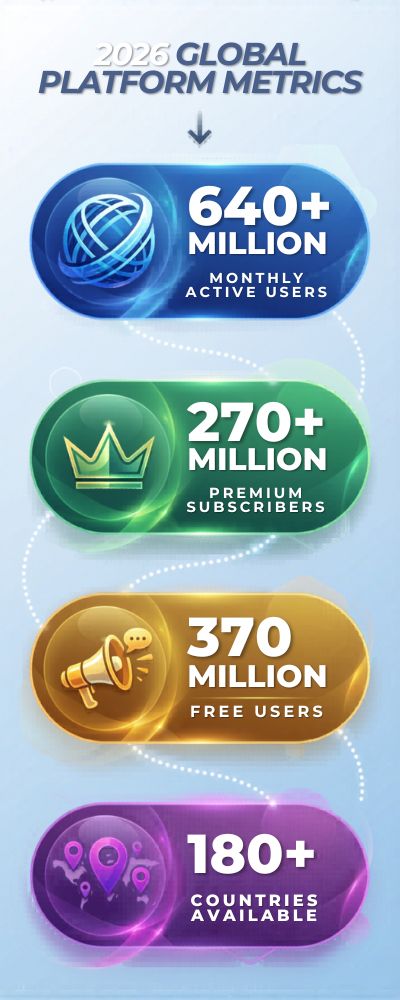
As of 2026, Spotify has 640M monthly active users (MAUs) around the world, 270M of which are premium users. I don’t even need to tell you what that means.
What is more fascinating is the user engagement. People don’t just open and close the app, they actually use it. According to Statista. The average amount of time a user spends on Spotify per day is well over 2h. 2 hours! That is more than the time we dedicate to cooking, reading or even talking to our neighbors.
Monthly active users (MAU) are still on the rise. Yes, you read that right. Despite the market maturing in the US and Europe, the application is still finding its way in markets like India, Brazil, and African countries.
| Metric (2026) | Value |
|---|---|
| Monthly Active Users (MAUs) | 640+ million |
| Premium Subscribers | 270+ million |
| Free (Ad-Supported) Users | ~370 million |
| Countries Available | 180+ |
The free tier is massive in this regard. It’s the best Trojan horse Spotify has. You start with the free plan, you listen to the ads for a while, and then you just subscribe when you can’t take listening to the same ad before a track anymore.
Business of Apps claims that this strategy has been one of the biggest growth drivers for Spotify. And yeah, it works because it’s low pressure. You don’t want to be forced into a subscription, but just give people enough of a pain point and they’ll do it themselves. It’s clever, a little bit dirty, but clever.
Revenue: Big Numbers, Complicated Reality
Spotify’s annual revenue in 2026 is somewhere between €16 and €18 billion. Sounds good right? Wrong.
| Revenue Stream | Share of Total Revenue |
|---|---|
| Premium Subscriptions | ~86% |
| Advertising | ~14% |
The majority of which is generated through subscriptions, as can be seen in Spotify’s financial reports.
However, here’s the… awkward part. Revenue aside, profits have been rather slim. Why? Royalties. Spotify must pay a large percentage of its revenue to rights holders, labels, publishers, and artists. It’s the nature of the beast, but it keeps the margins around 25-30%.
It’s at this point that people divide. Some claim Spotify doesn’t pay artists enough, while some claim it’s simply the streaming model that is the problem. In my opinion? It’s possible for both to be right. It works, but it’s just not entirely fair in a neat sort of way.
Market Share: Dominant but not Invincible
Spotify still leads the world in music streaming, with around 30-32% market share. Respectable, yes, but not invincible.
| Platform | Estimated Market Share (2026) |
|---|---|
| Spotify | 30–32% |
| Apple Music | 15–18% |
| Amazon Music | 13–15% |
| YouTube Music | 10–12% |
| Others | Remaining share |
Now, it’s true that, as of the writing of this piece, at least, Spotify is still leading the pack in streaming, at least according to the data from MIDiA Research. Apple is coming at it with an ecosystem-driven strategy; Amazon is bundling in Music with a Prime membership; and YouTube… well, YouTube is just winning at everything, so there’s that.
But Spotify? Spotify has one thing going for it that keeps it at the top: personalization. I mean, this thing is good. A little too good. I mean, I play one song, and Spotify can sort of… make a whole “mood” out of it. Sometimes, it’s perfect. Sometimes, it’s hilariously off.
The Bigger Picture: More Than Just Music
These days, however, Spotify is less about music and more about… well, I’m not sure how to describe it yet. The platform is pushing podcasts, and audiobooks, and experimental audio formats. Podcast listenership, in particular, has surged over the past few years.
According to Statista, Spotify has grown to become one of the largest platforms for podcasts, and is now challenging Apple in the space.
Now, here’s my hypothesis. I think that this push isn’t just about expanding a user base. I think it’s about necessity. Music alone is a tough business.
And by pushing into spoken word audio, whether that’s podcasts or audiobooks or whatever else, the company is able to exert more control over the supply chain, have higher profit margins, and ultimately tighten its grip on users’ attention.
Still, there’s just something… human about the platform. It’s not perfect. Sometimes it gets it right; sometimes it gets it wrong. Sometimes it’ll recommend a playlist about sadness when you’re having the best day ever.
But I think that’s why we keep coming back. It’s not perfect… and in a weird way, that makes it feel kind of perfect.
How Big Is Spotify? A Deep Dive into Global Streaming Dominance
How big is Spotify? Let’s put it this way, it’s a lot bigger than you think. You know, one of those things that are easy to overlook until you step back and really consider it.
You go like “Ok, it’s really big” and then you see that it’s available in over 180 countries and that it has hundreds of millions of daily users and you’re like “Wait a minute, big isn’t even the word.”
Spotify is a global audio distributor, it has over 640 million users worldwide according to their investor website Spotify Investors and that’s nearly the population of an entire continent that’s using the platform, that’s crazy.
And the interesting thing about it is that Spotify isn’t available in every country equally but it’s available in almost every country which is an interesting distinction to make. It’s a global company that speaks enough of each country’s language to get by, but not enough to be fluent.
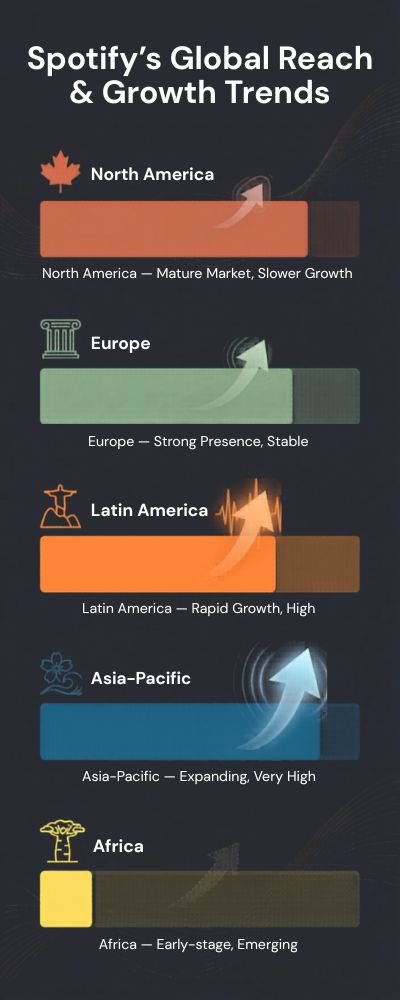
Spotify global is a footprint that continues to grow They’ve been pretty aggressive about entering new markets over the past few years, especially in places where the concept of streaming is still very much in its infancy, that’s where most of the growth will come from.
| Platform | Global Market Share |
|---|---|
| Spotify | ~30–32% |
| Apple Music | ~15–18% |
| Amazon Music | ~13–15% |
| YouTube Music | ~10–12% |
As pointed out by the global music report from the IFPI, Latin America and Asia Pacific now are two of the fastest growing regions in music, and it’s thanks to streaming. Spotify is at the center of that story.
You have to think of it like throwing as many seeds as you can and hope some will grow into a forest. Some will grow faster than others, but you want to be everywhere.
Streaming Dominance: The Leader (For Now)
Spotify’s dominance isn’t just about the amount of users, it’s also about positioning. It is still the leader in market share of the global streaming market (30%+).
| Content Type | Volume (2026) |
|---|---|
| Songs | 100+ million |
| Podcasts | 6+ million |
| Audiobooks | Rapidly growing |
And, let’s be real, nobody’s actually going to listen to 1% of that. But, you know, that’s sort of the idea. Spotify is a labyrinth. You enter in search of one track and emerge two hours later, having wondered whether you actually like any of your favourite music.
Sometimes it feels too much. Too many choices. Too many playlists. But isn’t that what life is like these days? Spotify is merely holding up a mirror.
Data, Personalization, Habit
The one advantage that is the core of Spotify’s success isn’t even a function of size. The big advantage of Spotify over the rest is its data. The algorithm is one of the best recommendation algorithms in the world.
Research by McKinsey has shown that the personalization of the type employed by Spotify can lead to more than a 30% increase in the level of engagement. This is massive. This is the difference between an app that people use and one that people can’t seem to do without.
But it gets personal. Spotify doesn’t just know what you like. It knows when you like it. It knows when you are in the mood for that morning playlist. It knows when you are in the mood for that late-night listening. It knows when you are in the mood for the gym playlist.
Do you ever get the feeling that it knows your mood better than you do? Yeah, me too. Maybe that’s why it is so big. It isn’t just an app. It is a habit. And habits are very difficult to shake off.
Spotify vs Competitors: Market Share Comparison with Apple Music, YouTube and Amazon Music
The Streaming War isn’t Loud… But it’s Intense… You might think that’s a super dominant position for Spotify and you would be right. But the truth is that it’s not as if the other services are really that far behind. It’s not a winner takes all market.
It’s just a game of inches where everyone plays for ecosystem, price and, let’s be honest, for how long can they keep you captive without you even realizing it. A
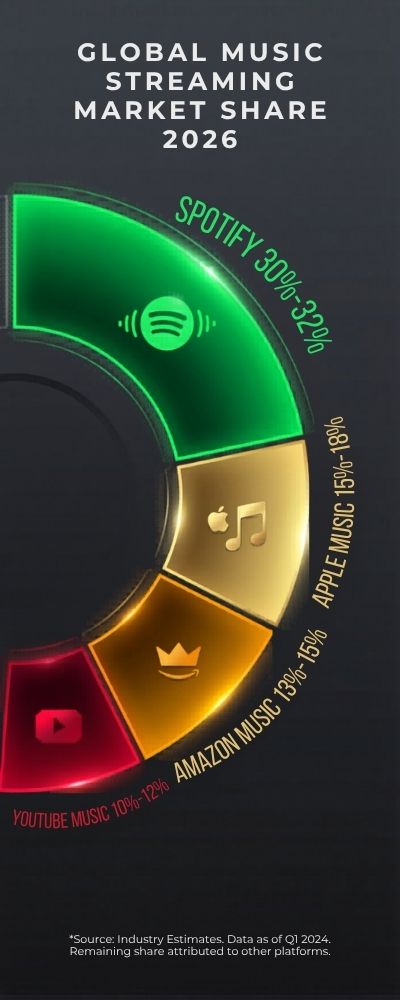
s it stands, Spotify still has the largest market share of around 30 to 32% globally but it isn’t miles ahead of the pack. Apple, Amazon and YouTube all have competitive offerings and market share to match.
According to data from MIDiA Research, the market share of the major streaming services has become increasingly competitive over the last few years as streaming has emerged to become the default mode of music consumption.
Also, let’s be clear here and say something that a lot of people don’t want to hear. Most consumers don’t care about “market share”. They care about convenience. That’s where the battle is being fought.
Market Share Breakdown: Who’s Winning (and Where)
Okay, let’s take a look at all of these numbers side by side because this is where it gets really interesting.
| Platform | Global Market Share (2026) |
|---|---|
| Spotify | ~30–32% |
| Apple Music | ~15–18% |
| Amazon Music | ~13–15% |
| YouTube Music | ~10–12% |
According to the most recent global music report from the IFPI: Streaming now represents the majority of the music industry’s revenue and between the four major streaming services listed above they make up a large majority of that revenue share.
The catch here though is that these figures do not represent the whole picture. While Spotify may be the largest streaming service globally, it’s not necessarily the largest in every market.
Apple is very strong in the US, YouTube in territories where streaming is more video-centric, and Amazon through bundling etc. So who is actually winning? Well it depends where you are in the world.
Apple Music: Ecosystem is key
It doesn’t feel like Apple Music is actively trying to keep up with the Joneses in terms of features. It doesn’t need to be, as it’s the sole music streaming service within the Apple ecosystem that spans hundreds of millions of closed users who never leave.
According to recent reports from the official Apple newsroom, Apple Music currently has over 100m subscribers. That’s still less than Spotify but is a mightily impressive figure nonetheless.
The advantage of Apple Music is that if you have an iPhone, Airpods, Mac etc then it’s the obvious choice for you. There’s no fuss and no need to use any other service. In my opinion I think that Apple are playing the long game when it comes to their service.
They’re not trying to compete with Spotify like-for-like and are instead focusing on the user experience. For many users that will be more than enough. For many users ‘it’s good enough and convenient to use’ will always trump ‘it’s technically the best option’.
YouTube Music: The underdog that shouldn’t be underestimated
YouTube Music is a strange beast. Nobody really talks about it as much as they should.
YouTube Music and Premium have over 100 million paid subscribers, according to Google themselves. This doesn’t count the billions of users who listen to music on regular YouTube.
Be honest, how many times have you looked up a song on YouTube instead of firing up Spotify? .
YouTube’s secret sauce is that it’s already a daily habit for most people. Music is just something you do there. It’s less “listening to a music app” and more just a thing people do.
Amazon Music: The bundling strategy that actually works
Amazon Music is like that kid in class who keeps their head down and somehow manages to do really well.
Amazon Music has over 80 million subscribers, according to Amazon themselves.
That’s nothing to sneeze at. What’s their secret?
Bundling. Prime users get music as a value-add to something else. You don’t choose Amazon Music. It’s just part of everything else.
Frankly, it’s brilliant. Users don’t feel like they’re paying for music. It’s just something that comes with everything else. And that makes a big difference psychologically than people give credit for.
So… Why Is Spotify Still Ahead?
This is where the subjectivity comes in. Spotify isn’t winning because of price or bundling or hardware lock-in. It’s winning because it feels personalized. Its algorithms are still the best. A study done by McKinsey showed that good personalization can increase engagement by more than 30%, and Spotify’s goes all in on that.
You open the app and it “gets you”. Well, it tries to, at least. Sometimes it fails, but when it succeeds, it REALLY succeeds. And maybe that’s the difference.
Apple gives you shine. Amazon gives you price. YouTube gives you nostalgia. Spotify? It gives you discovery. And for a lot of people, that’s enough to keep them.
Spotify User Demographics: Age, Gender, and Geographic Breakdown
In addition to Spotify’s overall global user base, we can look at the age, gender, and geographical distribution of Spotify users. I think it’s fair to say that many people assume that the majority of Spotify users are Gen Z.
While it’s true that the majority of Spotify users are under the age of 35, there is a rising trend of users over the age of 35 that are also using the platform.
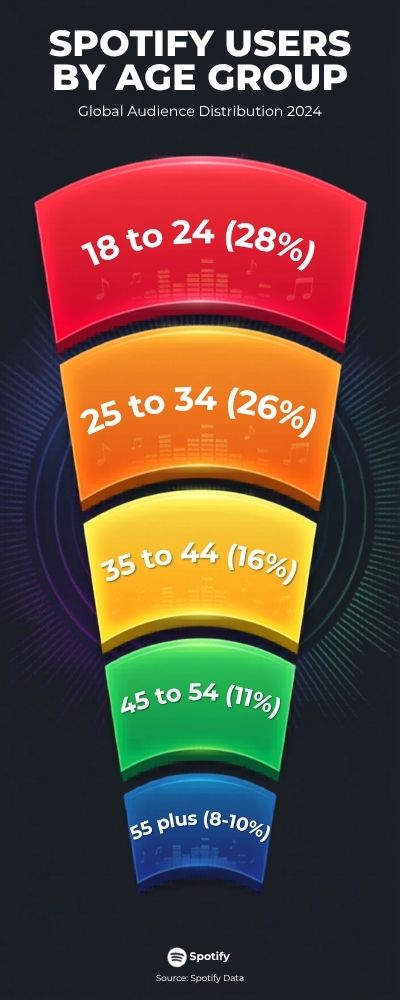
According to Statista, the majority of Spotify users are between the ages of 18 and 34, with this age group accounting for over 50% of Spotify’s user base. While this age demographic is still the most popular for Spotify users, the number of users between the ages of 35-54 is also on the rise.
| Age Group | Share of Spotify Users |
|---|---|
| 18–24 | ~28% |
| 25–34 | ~26% |
| 35–44 | ~16% |
| 45–54 | ~11% |
| 55+ | ~8–10% |
As reported by Business of Apps, the platform is slowly shifting in age.
And you know what? I think that’s a good thing. There’s something endearing about a platform where a 22 year old and a 52 year old can have a really fulfilling experience, even if they’re listening to hyperpop and 80’s rock respectively, or true crime podcasts.
It also explains why Spotify has pivoted into podcasts and audiobooks. Different age, different habits. That’s it.
Gender Distribution: Mostly Even, Mild Skew
Spotify’s distribution of genders is mostly even, with a slight skew depending on market and category.
| Gender | Estimated Share |
|---|---|
| Male | ~55% |
| Female | ~45% |
Sure, let’s look at the gender split. Well, according to Statista, male accounts still account for a bit more than females worldwide, but only just.
More importantly, I think, is how we use Spotify. There’s research to suggest that women use the playlists and Discover Weekly features more than men, and men listen to more albums and use the discovery features more than women. Not exclusively, of course, but in general.
So the algorithm doesn’t care that you’re a man or a woman, it cares about what you do, and that’s very human of it. Let’s move on.
Location: Spotted all over the world
The distribution of Spotify users across the globe isn’t equal. Europe and North America account for large numbers, but the majority of growth now comes from other countries.
| Region | Share of Users | Growth Trend |
|---|---|---|
| Europe | ~30% | Stable |
| North America | ~25% | Mature |
| Latin America | ~20% | Fast-growing |
| Asia-Pacific | ~20% | Very fast-growing |
| Africa & Middle East | ~5% | Emerging |
In fact, the fastest growth in streaming is coming from regions such as Latin America and Asia-Pacific, areas where Spotify is doubling down on investment.
You notice this in the content too. More regional playlists, more local artists breaking out globally. No longer is it Western music that rules the world, and this is overdue.
What These Demographics Actually Tell Us
Stats are one thing, but they aren’t everything. What I see in these demographics is a reflection of the real world. It’s complicated, messy, and doesn’t always make sense.
You have teens exploring their identities through music, adults seeking out podcasts to navigate the world around them, and boomers revisiting the music of their youth. This isn’t just about the data, it’s about behavior, emotions, and habits.
Perhaps this is where Spotify’s secret to success lies. It’s not trying to jam everyone into the same mould. It’s fluid. It moves. Sometimes it misfires, sure, but it’s constantly trying to learn.
Ultimately, these demographics say one thing: Spotify isn’t for one specific demographic anymore. It’s for anyone who hits the play button and expects it to feel just right.
The Most Popular Spotify Genres, Artists and Viral Songs in 2026
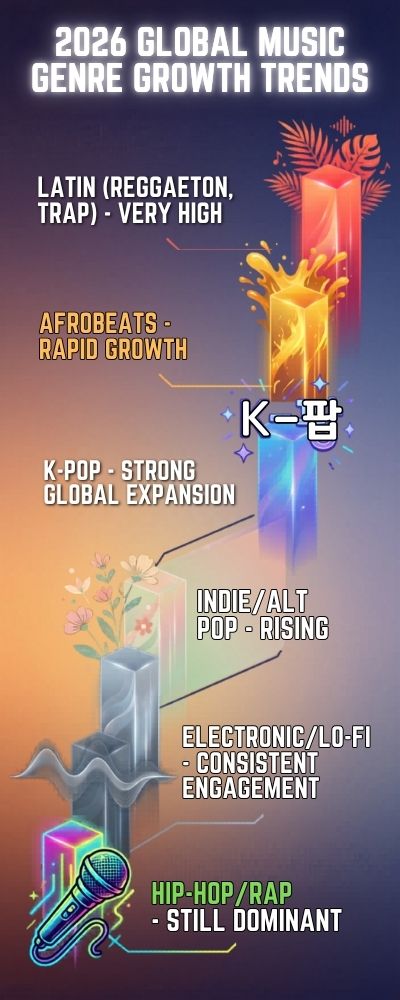
How Music is becoming… kinda sorta more Global? You’ve probably noticed this if you’ve opened the Spotify app recently… your playlists feel kinda less Americanized… you hear a pop song from the US followed by a Latin trap track and then an Afrobeats track inserts itself like it is the coolest dude in town.
That’s not an accident. Music is becoming more globalized. According to Spotify’s annual report (link) and the global music industry report from IFPI (link, non-English language music is increasingly popular and accounts for a rising proportion of global listening, with Latin, K-Pop and Afrobeats experiencing double-digit year-on-year growth.
I kinda like it though, people are not restricted to a particular genre of music, language is no longer a barrier if you like the beat.
The Most Popular Genres and Music Trends
What use to be a box is now a circle that keeps shifting. Music genres are becoming more and more hybrid. Genres are no longer what they used to be, they are shifting to a fusion of sounds. Here are some of the popular music genres and trends that are expected to dominate in 2026.
| Genre / Style | Growth Trend (2026) |
|---|---|
| Latin (Reggaeton, Trap) | Very high |
| Afrobeats | Rapid growth |
| K-pop | Strong global expansion |
| Hip-Hop / Rap | Still dominant |
| Indie / Alt Pop | Rising |
| Electronic / Lo-fi | Consistent engagement |
Spotify Wrapped and platform stats aside, Latin music is at over 200% growth in global streaming over the past few years, which is kinda nuts. What’s even cooler is the fusion. Afrobeats fused with pop, reggaeton mixed with electronica, etc. And it all kinda works? It’s messy, in a good way. A playlist that shouldn’t make sense but does.
Artists Leading the Charge
Names make trends, so let’s talk names.
| Artist Category | Examples (2026 Trends) |
|---|---|
| Global Pop Icons | Taylor Swift, Bad Bunny |
| Latin Superstars | Bad Bunny, Karol G |
| Afrobeats Leaders | Burna Boy, Rema |
| K-pop Acts | BTS, BLACKPINK |
| Viral Indie Artists | Emerging TikTok-driven names |
You can look at the global Top 100 on Spotify Charts, and see Bad Bunny and other Latin American artists garner more streams than English speaking artists.
You see that fame is no longer what it was 20 years ago, it’s no longer about being played on the radio or selling albums, it’s about getting one moment to go viral and then being pushed all over TikTok and… that’s it. It’s crazy, exciting, but it’s a bit mad.
And you can’t help but think… how many of these people will be around in 5 years? No idea.
Viral Hits: The Internet Is the New Hitmaker
The way hits are being created is completely different. It’s not about labels pushing a song and then it going viral, but about algorithms and social media doing their magic.
As reported by Billboard and Spotify, many of the top streamed tracks have now started going viral on TikTok before becoming massive hits on Spotify.
| Viral Factor | Impact on Streams |
|---|---|
| TikTok Trends | Massive spike |
| Playlist Placement | Sustained growth |
| Algorithm Boost | Long-term discovery |
| User Shares | Organic spread |
You know this feeling. You catch a 15 second snippet of a song somewhere, it runs on repeat in your head, and the next minute you’re streaming the full song on repeat. It’s kinda sad how much we can be relied upon to do this. But also interesting.
Mood Based Listening: The Under-Appreciated Trend
The thing that I don’t think gets enough credit is how we decide what music to listen to now. It’s less about genre, more about mood.
According to Spotify’s own data, playlists like “Chill Hits”, “Sad Songs” and “Workout Mix” are consistently the most popular.
Ok, this makes sense. We don’t wake up and think “today I want to listen to indie rock”. We think “I need something to get me through today”.
This change, from genre to mood, is nuanced but important. It affects the way music is created, marketed and listened to.
What’s Actually Causing These Trends?
Zooming out a bit further, it’s technology, culture and human psychology all playing a part. The algorithms facilitate discovery, the social media accelerates it, and us? We just follow the dopamine.
It’s all a bit untidy. Trends pop up out of nowhere, blaze hot and bright, and sometimes sputter out again just as quickly. But perhaps that’s just what’s happening. Music has always been associated with moments, feelings, phases of life.
Spotify is just mirroring that madness in real time.
So to summarise. Listening in 2026 is less predictable, more global, and a bit more personal. And you know what. I wouldn’t change a thing.
Spotify Revenue Statistics: A Closer Look at Their Ad and Premium Revenue Model
Monetizing Music: Easier Said Than Done
Spotify generates billions of euros in revenue. That is the easy part. However, when looking at the different revenue streams and how they interplay, things can get as complicated as a circus performance, impressive but messy and prone to errors.
As of 2026, the platform’s yearly revenue is between €16 billion and €18 billion. That is a staggering number, but revenue alone doesn’t paint the whole picture, for that, you also need to look at how the revenue is distributed, which is just as important.
And in case you were curious, yes, the majority of it comes from subscriptions. Obviously.
Premium Subscriptions: The Breadwinner
Spotify Premium subscriptions constitute the lion’s share of the platform’s revenue. Were it not for the premium subscriptions, the platform wouldn’t have made it as far as it has.
| Revenue Source | Share of Total Revenue |
|---|---|
| Premium Subscriptions | ~85–87% |
| Advertising | ~13–15% |
According to Spotify’s financial reports, subscription-based revenue accounts for the largest share of total revenue.
Why? Easy answer. Recurring payments. People pay Spotify monthly. Spotify receives predictable revenue. It’s stable, scalable, and let’s be honest, pretty damn addictive as a business model.
Yet, what’s the underlying reason why people pay? It’s not about removing ads. It’s about control. You gain unlimited skips, offline listening, improved audio quality, etc. After you get a taste of that, it’s hard to go back to the free version. And here’s the key idea behind subscription revenue.
Advertising Revenue: Smaller, but Still a Piece of the Pie
The free version of Spotify doesn’t exist simply to push users into subscribing. It’s actually a business model in and of itself.
Spotify makes billions of dollars on advertising, albeit it a smaller piece of the pie than their premium offerings. In 2026, the company is expected to bring in 2-3 billion euros in ad-supported revenue, according to Statista.
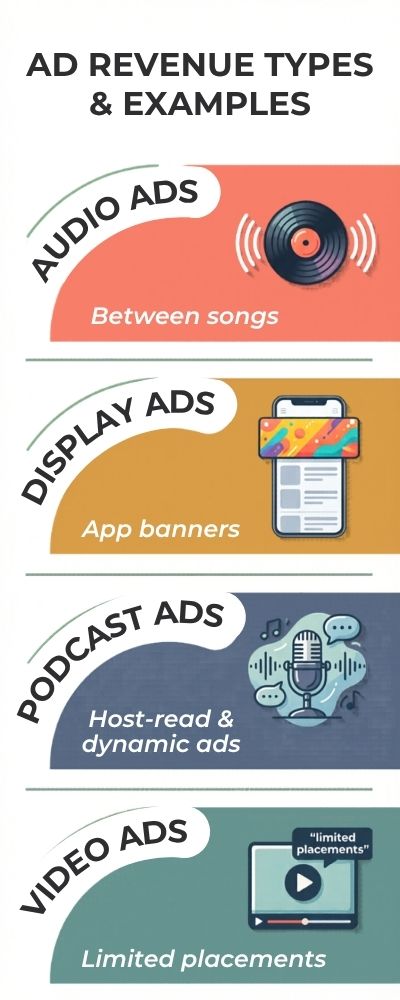
| Ad Revenue Type | Examples |
|---|---|
| Audio Ads | Between songs |
| Display Ads | App banners |
| Podcast Ads | Host-read & dynamic ads |
| Video Ads | Limited placements |
Now, to the juicy part. Podcast advertising is skyrocketing. It’s REALLY skyrocketing. Businesses like it because it’s more humanizing, more of a suggestion than an advertisement.
I’m sure you’ve come across ads that seem like the host is just talking about a product. It sometimes works. It sometimes fails miserably. Regardless, it’s working well enough to keep growing.
The Hidden Cost: Why Profit Isn’t Guaranteed
This is what people fail to understand, as Spotify doesn’t actually get to pocket most of its revenue. A lot of it ends up leaving the building.
Per industry analysis by Business of Apps, Spotify pays rights holders, including labels, publishers, and artists, between 65 to 70% of revenue.
| Cost Category | Estimated Share |
|---|---|
| Royalties & Licensing | ~65–70% |
| Operations | ~20–25% |
| Marketing & Other | Remaining |
That doesn’t leave a lot of room. Spotify’s gross margin is usually around 25–30%, which is pretty good, but not really “tech giant” territory.
This is the part where it starts to get a little messy, depending on which side of the table you sit on. Artists feel like they’re not getting enough. Spotify says the model is maxed out already. Everyone’s kinda right. It’s not really going away.
New revenue streams
For a little while now, Spotify has been looking for new revenue streams. Honestly, it kinda has to. Music is too high-risk a business to be all-in.
Podcasts are a big one. As reported by Spotify Newsroom, they’ve been pouring some serious money into podcasts, which makes a lot of sense. That’s an ecosystem where they can actually control both the supply (content) and demand (revenue) sides.
Audiobooks are another one. Still small, but getting there.
| New Revenue Stream | Status (2026) |
|---|---|
| Podcasts | Rapidly expanding |
| Audiobooks | Emerging |
| Creator Tools | Growing ecosystem |
And my hypothesis? They aren’t actually innovating here. They have to. Margins in music suck. Margins in podcasts and audiobooks are amazing. So they pivot. Ugly or not.
Is Spotify Actually a Profitable Business?
Well, that is the question isn’t it? They make a ton of money. But profitable? Not so much. Sometimes they do. Sometimes they don’t. You can find their quarterly reports here. They are still figuring out the balance between growth and expenses which is difficult.
And in my opinion, Spotify is still figuring it out. They are enormous. They are extremely influential. They are embedded in the fabric of life. But they are financially unstable. But the model works well enough to keep growing.
Subscribers keep coming. Advertisers keep coming. And the engine rolls on. It ain’t pretty. It’s probably sustainable. It isn’t great.
Spotify Podcast Statistics: Growth, Audience Behavior, and Monetization Trends
From “Side Feature” to Serious Business
Spotify wasn’t always synonymous with podcasts. A few years back, it was a bit of a novelty. You’d try it out, and move on.
Clearly that’s no longer the case.
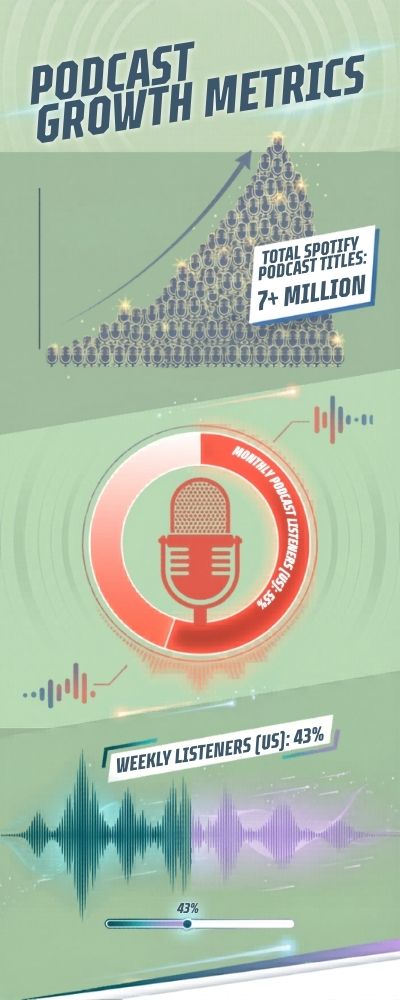
Today there are over 7 million podcast titles on the platform (which is actually pretty daunting when you think about it). According to Spotify’s own newsroom, “podcasting is no longer a niche category, but a core part of our offering.”
This is no accident. The company has invested hundreds of millions of dollars into acquiring podcast networks, signing exclusive deals with top creators, and developing new technology for publishers.
While not every investment has panned out, overall the strategy has paid dividends. Podcasts are now a fundamental aspect of the platform.
Growth: Not Exploding Anymore, But Still Expanding
The podcast market used to grow like crazy. Everyone was jumping in. Now it’s a bit more… stable. Still growing, just slower.
Worldwide, more people are listening to more podcasts. In the United States alone, 55% of people aged 12 and over have listened to at least one podcast in the last month, according to Edison Research. That’s over 160M people. It’s not a fad. It’s not a trend. It’s just the way things are.
| Podcast Growth Metric | Latest Data |
|---|---|
| Total Spotify podcast titles | 7+ million |
| Monthly podcast listeners (US) | 55% of population |
| Weekly listeners (US) | ~43% |
Even if that growth tapered a bit, the denominator is so massive now that any growth means another few million people. Creators salivate at that sort of scale.
Audience behavior: listening is only half the story
This is where it gets fun, if a bit tricky. People no longer only listen to podcasts, they watch them, clip them, share them. According to Edison’s Infinite Dial, 57% of podcast consumers have listened to and watched podcasts. Think about that for a second.
Podcasting is no longer just audio. Spotify has doubled down on video podcasts, and, frankly, it makes sense. Sometimes you want background noise. Sometimes you want faces, reactions, visuals. It’s like radio and TV, but, now it’s the same content doing both jobs.
How people discover podcasts (spoiler: not just Spotify)
Discovery is messy. There’s no clean funnel anymore.
| Discovery Channel | Impact Level |
|---|---|
| Social Media (TikTok, IG) | Very high |
| YouTube | High |
| Spotify Recommendations | High |
| Word of Mouth | Still strong |
Younger audiences, in particular, depend on social media platforms for discovering new podcasts as per Edison Research.
This changes everything. Spotify no longer owns discovery. A 30-second clip on TikTok will beat any algorithm. You’ve been there. You see a 30-second clip, and you HAVE to listen to the full episode. It’s emotional, illogical, and totally human.
Monetization: Now a Reality
We’ve talked about the promise of podcast monetization for years. It’s here. Spotify has been ramping up efforts around ads, subscriptions, and payouts to creators. The company paid out over $100M to podcast creators in a single quarter in 2025.
| Monetization Method | Description |
|---|---|
| Podcast Ads | Host-read & dynamic ads |
| Subscriptions | Premium content access |
| Video Monetization | Engagement-based payouts |
| Sponsorship Deals | Brand partnerships |
Now, my theory is not a perfect one. Monetization is spotty. Some people make a ton of money, many make almost nothing. That’s just the reality of most creative platforms, no?
Advertising: The Unsung Hero
You know those ads you hear on podcasts? They’re actually kinda… good. Not loud. Not obnoxious. Just… conversational. The IAB estimates that podcast ad revenue in the U.S. will hit $2.5 billion by 2026, and continues to rise while most other ad mediums are stagnant.
But what about the listeners themselves? Apparently, they don’t mind ads either. 88% of weekly podcast listeners believe that podcast ads are a fair trade-off for listening to their podcasts for free, according to Edison Research. That’s a massive number.
I can’t imagine getting that response on YouTube. I think the intimacy of the format makes people more trusting of ads, when a podcaster recommends something to you, it doesn’t feel like an advertisement, it feels like advice.
So… Where Is This All Going?
Podcasting isn’t slowing down; it’s just maturing. Different thing entirely.
Spotify is clearly thinking that the future of podcasts will be hybrid (audio + video), global, and more monetized. If their gamble will pay out in the long-term, well… That’s still to be seen.
But one thing does seem to be certain, podcasts aren’t niche anymore. They’re a part of the way people think, learn, relax, and sometimes just zone out.
And Spotify? They’re not just providing that experience. They’re defining it, one press of the play button at a time.
How Long Do People Spend on Spotify Per Day? A Look at Daily Engagement
Spotify is a Use, Not a Check
Spotify is an app that you don’t so much “check” as you do simply use. I know that sounds a bit melodramatic, but hear me out. How many times do you find yourself opening up Spotify out of habit?
Whether you’re getting ready in the morning, driving to work, at the gym, or simply scrolling through at 2 am, the app is something that you simply… use.
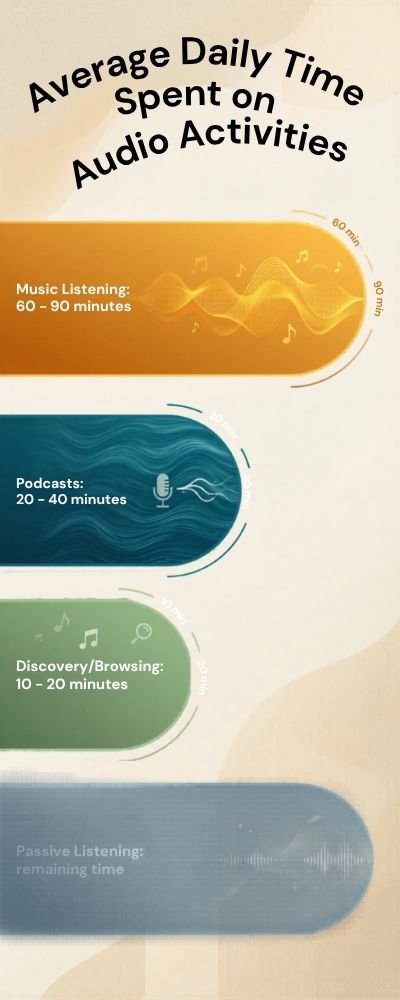
According to Statista and other reports, the average amount of time a user spends daily on the app is anywhere from 1.5-2.5 hours depending on the country and age of the users. That’s a significant amount of time.
But the crazy thing is, most users wouldn’t even realize that they’ve been using the app for that long. It’s one of those things that you simply have on in the background while you do other things. But how are users actually spending all of that time in the app?
| Activity Type | Average Daily Time |
|---|---|
| Music Listening | 60–90 minutes |
| Podcasts | 20–40 minutes |
| Discovery / Browsing | 10–20 minutes |
| Passive Listening | Remaining time |
How people use Spotify, according to Business of Apps: Music accounts for the majority of time spent on Spotify, but podcasts are growing: This shouldn’t surprise you. Music is the default, whereas podcasts feel more… purposeful. Like you’re trying to learn something. (Or appear like you are, at least.)
Engagement: Why People Stay So Long
What we’re really asking is: why do people spend so long on Spotify? The answer to this one is pretty simple. For one, Spotify knows a thing or two about personalization. In fact, McKinsey found that personalization can improve engagement by more than 30%.
Spotify takes full advantage of this: When you finish a song, there’s always another one ready that… just makes sense. Zero effort involved: But it is sort of addictive. Not in a bad way. More in the “I’ll just listen to one more song” type of addiction that suddenly takes an hour.
Device Usage: When and Where People Listen
Finally, we come to how people use Spotify in terms of their devices of choice: Where people use Spotify is pretty split, which is also one of its biggest advantages. You can take it anywhere.
| Device Type | Usage Context |
|---|---|
| Smartphones | Commutes, daily routines |
| Desktop | Work, study sessions |
| Smart Speakers | Home, background listening |
| Wearables | Fitness, outdoor activity |
Let’s take a quick look at how most people consume Spotify. According to Statista, the majority of users are on mobile, which intuitively feels correct. People want to use the service anywhere, not just at home.
That’s the key. Spotify isn’t fighting for attention (the way that Netflix and YouTube are), it’s fighting for ubiquity.
Rush Hour: When Are People Listening?
Spotify activity follows patterns, even if users aren’t aware of it.
| Time of Day | Listening Behavior |
|---|---|
| Morning | News, podcasts, upbeat music |
| Midday | Background music, focus playlists |
| Evening | Relaxation, discovery |
| Late Night | Chill, emotional playlists |
According to an analysis of Spotify data they posted on their own website, users listen the most during their daily commute and after dinner. Which makes sense. Y
ou listen in the morning to wake up, during the day to concentrate, and at night to relax. It’s like your own personal soundtrack. As if you have a friend who changes their behavior based on your time of day.
Free vs. Premium: Which Listens More?
But not all users are created equal.
| User Type | Average Engagement Level |
|---|---|
| Free Users | Moderate (ad interruptions) |
| Premium Users | Higher (no friction) |
Following the report, it’s no surprise that premium users spend longer listening as there is less disruption to the service. Fair play. There’s nothing more annoying than having your flow disrupted.
No ads and listening is more fluid. It’s like the difference between driving with traffic lights and the open road.
The Broader Context: Spotify as a Companion
It stands to reason that if we take a broader view of Spotify’s market, they’re not just competing for your time, but for your moments. All of them. Whether you’re trying to concentrate, procrastinate, feel joy or misery, Spotify is probably there.
This must be one of the reasons that engagement remains so high. There is no other service that doesn’t require your undivided attention yet still manages to penetrate your daily routine. Perhaps this is the magic. They don’t insist on owning your whole day, just a bit of it. And they hang around.
Spotify Payout Statistics: How Much Artists Really Earn per Stream
How much does Spotify pay per stream? That seems like an easy enough question, right? Nope! Not even remotely. There are various numbers floating around, but the most commonly cited figures, as outlined by Business of Apps and Duetti, are between $0.003 and $0.005 per stream. Yeah, that’s pennies on the dollar. I already hear you, “That’s it?” Kind of… but not really. I’ll explain.
So, yes, that’s the magic number. But, it’s not as simple as putting money in the vending machine and getting your candy. It’s a pro-rata system. I know, it sounds like a made-up term, but stick with me.
A pro-rata system is a system where you pool all the revenue, then split it according to the total streams and market share. More on that later. So, how much does Spotify pay per stream? Well, now you know!
Who gets the money?
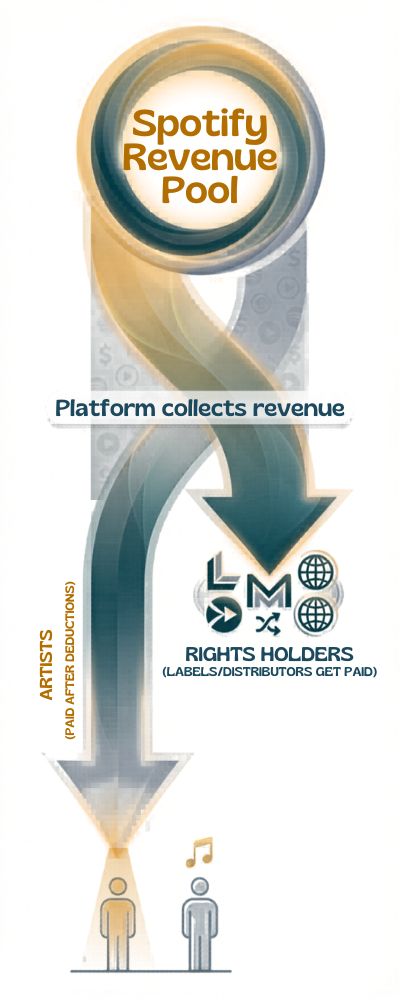
Okay, so here’s the part where people get a little queasy. The answer is, well… not the artists. At least, not directly.
| Revenue Flow Step | Who Gets Paid First |
|---|---|
| Spotify Revenue Pool | Platform collects revenue |
| Rights Holders | Labels / distributors |
| Artists | Paid after deductions |
As you can see from Spotify’s own transparency reports, they pay out around 70% of the money they make to rights holders. This doesn’t necessarily always reach artists. Labels, distributors, and other contracts reduce the amounts artists receive.
That’s why people claim “Spotify pays artists badly”. It’s not untrue, but also not the whole truth. It’s a complex system and fairly convoluted, if we’re being honest.
Realistic Examples of What Artists Actually Earn
Now let’s add some figures to the examples above, because obviously, the per stream figure means very little without them.
| Streams | Estimated Earnings (USD) |
|---|---|
| 1,000 streams | $3 – $5 |
| 10,000 streams | $30 – $50 |
| 100,000 streams | $300 – $500 |
| 1 million streams | $3,000 – $5,000 |
According to a report from Duetti, having a million streams doesn’t necessarily mean you’re making a life-altering income, especially if you’re having to share profits with other producers or a record label.
That’s the thing that people are most surprised about: a million streams is a big number. It feels like a big number. But financially it doesn’t always amount to much.
Independent vs Signed Artists: A Big Difference
Not everyone makes money the same way.
| Artist Type | Earnings Share |
|---|---|
| Independent | Higher (after distributor fees) |
| Signed (Label) | Lower (after label cuts) |
The Payout Model
DIY artists can retain more of their streaming income, particularly if they distribute through DistroKid or TuneCore. However, DIY artists are responsible for their own promotion and marketing, as there is no support net.
Artists who are signed to a label may not retain as much income per stream, but they receive a boost from the label. More reach, more exposure… but also more people who take a piece of the pie. It is a trade-off, and there is no right answer.
Why the Payout Model functions in this way: Spotify does not pay artists for individual streams. Instead, it distributes revenue from total streams across the platform as well as revenue from premium subscriptions, according to the company’s own explainer on how the business operates.
This means that streams of your song compete with streams of other songs. If a few artists are getting most of the plays, then those artists receive a large portion of the money in the pot.
The model is not particularly equitable. And, yes, this can be maddening, particularly for independent artists who are looking for a breakout.
But from the perspective of Spotify, it follows the pattern of listenership. If music is popular, it gets more streams, and therefore more money. Makes sense, right? Well, it is simple in theory but complicated in practice.
The Great Debate: Fair or Not Fair?
Ok, now things get… subjective.
Some folks feel that the model does not fairly compensate artists. Others feel that it has given them opportunities that did not previously exist (e.g. global distribution, access to distribution channels, not having to press a bunch of physical copies).
Me? I feel like there is truth on both sides.
Streaming has made music more widely available than ever before, but it has made it more difficult to monetize your art unless you achieve some level of scale. In essence, it is like being handed a giant megaphone and having to shout alongside a million other folks who also have giant megaphones.
So… Do Artists Get Paid?
Well, yes and no. Most artists do not make all of their money from streaming. Instead, they diversify their income streams:
| Revenue Source | Importance Level |
|---|---|
| Streaming | Moderate |
| Live Performances | High |
| Merchandising | High |
| Sponsorships | Growing |
As the artist income streams graphic from the International Federation of the Phonographic Industry shows, having multiple income streams is crucial for artists today.
Streaming is part of the story, not the full story.
Perhaps that’s the lesson here. Spotify is not a revenue spigot. It’s a discovery mechanism. A marketing vehicle. A method of distribution.
Revenues arrive at the end of the chain, if all other elements align.
The Most Streamed Spotify Songs and Artists Ever (2026 Update)
What Does “Most Streamed” Even Mean Anymore? Back in the day, it meant topping the radio and selling a lot of CDs. Today, it’s all about the billions. Yes, billions. It’s almost hard to believe.
The most streamed songs on Spotify have already passed the 4 billion stream mark. I mean… that’s wild. This information is based on Spotify Charts and the music analytics platform ChartMasters. The numbers are subject to change over time.
I also find this interesting: A song no longer peaks and declines. Instead, it might come back in a year. Or 2. Or 5. Or 10. You’ll see many old songs resurfacing in a year as a result of a challenge, a trend or a meme going viral.
The Top 10 Most Streamed Spotify Songs Ever (2026 Update)
Alright, let’s start with the most popular songs on Spotify of all time!
| Rank | Song | Artist | Streams (Approx.) |
|---|---|---|---|
| 1 | Blinding Lights | The Weeknd | 4B+ |
| 2 | Shape of You | Ed Sheeran | 3.8B+ |
| 3 | Someone You Loved | Lewis Capaldi | 3.5B+ |
| 4 | Sunflower | Post Malone & Swae Lee | 3.4B+ |
| 5 | As It Was | Harry Styles | 3.3B+ |
According to Spotify Charts, “Blinding Lights” by The Weeknd is currently the most-streamed song in the world.
I mean, fair enough. I hear it all the time. It’s catchy. Nostalgic. Easy to listen to on repeat. It’s the type of song that slips into your rotation uninvited.
Why These Songs Dominate (It’s Not Just Popularity)
You’d think it has everything to do with popularity, but that’s not the full story.
Typically, the songs that dominate streaming have:
- High replay value
- Huge factor: placement on playlists
- Appeal across generations
- Viral moments
According to IFPI, streaming success is more about algorithmic playlists and global reach than the success of initial release. Yeah. I can believe that. A song can have a massive debut, but if it doesn’t sustain itself on playlists, it dies. The songs that remain are the ones that play in the background of people’s lives.
Most Streamed Artists of All Time
Now, let’s talk about the artists. Songs are great, but artists are the ones who build the empires.
| Rank | Artist | Total Streams (All-Time) |
|---|---|---|
| 1 | Drake | 80B+ |
| 2 | Bad Bunny | 75B+ |
| 3 | Taylor Swift | 70B+ |
| 4 | The Weeknd | 65B+ |
| 5 | Ed Sheeran | 60B+ |
As explained by ChartMasters, artists like Drake and Bad Bunny sit atop the mountain because of a combination of prolific output and global appeal.
This is also the reason Bad Bunny’s success is so important. He proves that global success is achievable, even if you don’t sing in English. This fact on its own speaks volumes about the future of streaming.
Monthly Listeners vs Total Streams: Not the Same Thing
This is where the confusion often sets in.
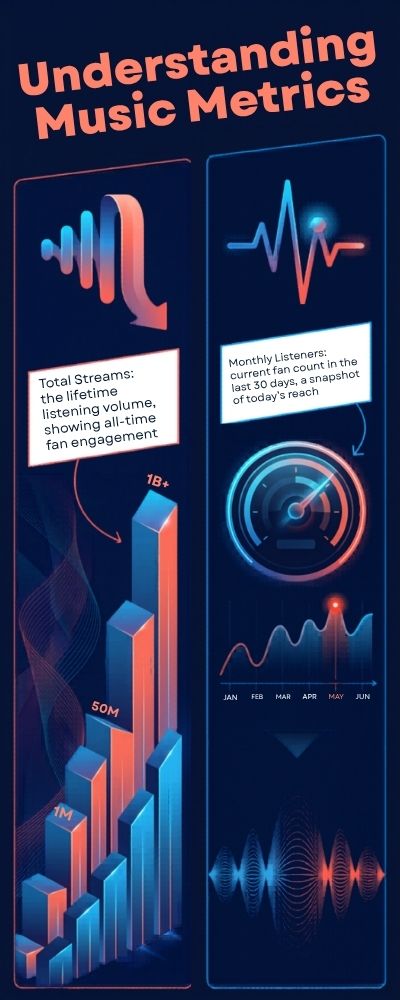
| Metric | What It Means |
|---|---|
| Total Streams | Lifetime listening volume |
| Monthly Listeners | Current popularity snapshot |
I’ve seen more people mention monthly listeners. The Weeknd and Taylor Swift regularly cross 100 million monthly listeners.
This number changes. It’s like a mood ring. It shows you what’s currently popular, but not necessarily what’s always popular.
Viral Popularity (TikTok Strikes Again)
I have to mention social media when I talk about streaming.
Music gains popularity in a different way. When a clip of a song goes viral, it can lead to that song getting billions of streams. Many of today’s hits became popular on TikTok first before becoming popular on Spotify.
Be honest with yourself. You’ve done the same thing. You hear a clip. The song gets stuck in your head. Then, you listen to the song nonstop.
We can’t deny it. Social media makes songs popular.
The Emotional Context Behind These Numbers
Alright, alright, numbers are great and all, but it still doesn’t answer the question, why do these songs keep getting replayed?
Well, the reality is that a lot of these songs are contextual. Breakups, road trips, random late nights when you feel like you need to throw something on that fit the mood.
Maybe that’s why the same songs keep resurfacing. They aren’t just “hits”. They’re emotional bookmarks.
So… Will These Records Ever Be Broken?
Eventually, yes. Streaming is still growing, and new artists are still coming up.
However, it’s tough. You need worldwide appeal, algorithmic support, viral buzz, and the tricky part is emotional attachment.
Repetitively.
And that’s the truth behind these numbers. It isn’t about just getting streamed. It’s about getting streamed repeatedly.
The Future of Spotify: AI Playlists, Personalization, and Algorithmic Discovery Trends
Spotify just gets you sometimes
Ever listened to a song on Spotify and then been blown away by how it can pick out the next 5 songs to play? It’s as if it knows you.
I know right? It’s a bit freaky. But this is just the Spotify algorithm becoming more and more refined. Spotify have been investing a lot into AI playlists. According to newsroom.spotify.com, it seems AI DJ and AI playlists are already making a big impact on users.
But are AI playlists a good thing or a bad thing?
I’d say a bit of both.
AI playlists. They’re no longer static playlists
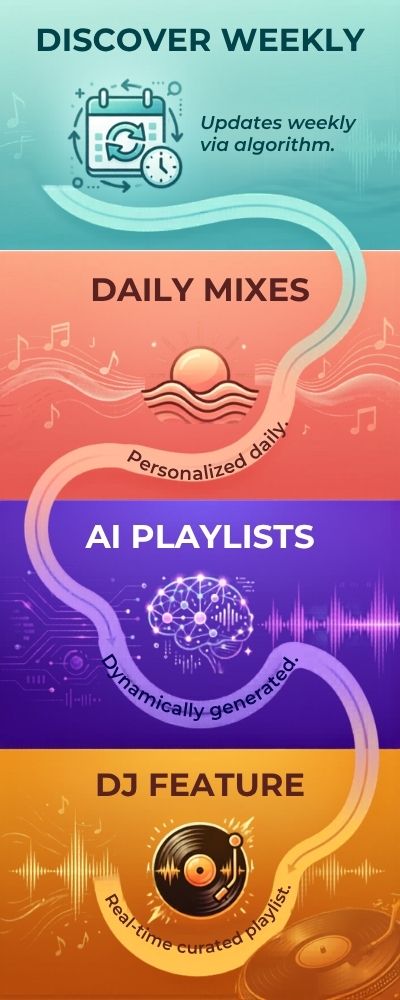
Remember when playlists were just playlists? You created them, you added to them and that was it. These days they’re a lot more dynamic.
| Playlist Type | Behavior |
|---|---|
| Discover Weekly | Updates weekly via algorithm |
| Daily Mixes | Personalized daily |
| AI Playlists | Dynamically generated |
| DJ Feature | Real-time curated playback |
Take Spotify’s AI DJ for instance. It’s not a playlist. It’s a DJ. It talks. It introduces tracks, it explains its selections, it learns from your listening habits.
According to Spotify, this feature “combines Spotify’s personalization technology with advanced generative AI technology to describe your music taste and offer suggestions in a uniquely personalized way, complete with music transitions between your tracks and voiced explanations for the music selected by the DJ.” It’s like having a friend who always has the aux cord and never fights with you about what to play.
Personalization: The Real Competitive Advantage
Listen, everyone’s got music these days. That’s not a differentiator anymore. What is different is personalization. According to McKinsey, “personalization can deliver 20 to 30 percent higher rates of customer engagement,” and Spotify has designed the entire platform with that in mind.
It’s not that you’re listening to music. It’s that you’re listening to your music. Admittedly, sometimes it’s wrong. You listen to one random throwback song and all of a sudden your Discover Weekly is stuck in 2007 for a week. But when it’s right? It’s really right.
Algorithmic Discovery: Finding Music You Didn’t Know You Needed
It used to take work to discover new music. You’d have to search for it. Browse for it. Ask your friends for suggestions. These days, it just…happens.
| Discovery Method | Role in 2026 |
|---|---|
| Algorithmic Playlists | Primary discovery tool |
| Social Media | Secondary driver |
| Editorial Playlists | Still relevant |
| User Search | Less dominant |
Data from IFPI shows that algorithms now influence the way most consumers find new music around the world. But this is the point where we enter slightly philosophical territory. Are we discovering music… or is it discovering us?
Because the algorithm doesn’t just react… it predicts. It guides. It influences our taste over time. That’s potent. It’s also a little unnerving when you think about it for too long.
The Data Behind the Curtain
Spotify crunches an awful lot of data, including what we listen to, what we skip, what we replay, what time of day we listen, what devices we use etc. It all goes into its recommendation engine.
| Data Signal | Impact on Recommendations |
|---|---|
| Skip Rate | Lowers song relevance |
| Replay Rate | Boosts ranking |
| Playlist Adds | Increases visibility |
| Listening Time | Shapes mood-based mixes |
As seen on Spotify’s engineering blog, these signals are used to tweak recommendations on the fly.
In addition, it’s not just what you like that matters. It’s how you act. Do you skip songs immediately? Do you repeat tracks constantly? That’s factored in.
In fact, the system probably picks up on more habits than you even know you have.
The Human Element vs the Algorithm
This is where things get tricky.
AI is definitely more efficient. It’s faster, more scalable, and more accurate. But does it replace human curation? Not fully.
Spotify’s editorial playlists still exist. Playlists that are actually curated by people still exist. As reported on their newsroom blog, editors still play a part even when algorithms are involved.
Frankly, I think that’s necessary. Without any curation, it all gets a bit… formulaic. Without any automation, it all gets a bit… arbitrary.
A combination of both is the best way to go.
So… What Does the Future Actually Look Like?
Fast-forward a bit, and it seems Spotify’s future hinges on three things:
| Trend | Direction |
|---|---|
| AI Personalization | Becoming more precise |
| Interactive Features | More real-time adaptation |
| Cross-Format Content | Music + podcasts + video |
As industry forecasts go, the global streaming market is expected to continue to see steady growth, with personalization being a major factor in retaining users.
Here’s my prediction: Spotify is no longer trying to just be a music app. They’re trying to be an experience that adapts to you at all times.
Sometimes that feels convenient. Sometimes it feels like you’re being researched.
But either way, it’s hard to ignore.
Because once you get used to something that “gets” you as well as this… anything else feels like a downgrade.
Will Spotify Reign Over Audio Forever? Music and Podcast Streaming Predictions For 2030
Dominance Is Not Destiny
Spotify is the industry leader at the moment. That much is clear. With over 600 million users worldwide and the lion’s share of the music streaming market, they must be doing something right. According to their investor reports, Spotify’s growth has been consistent from year to year.
So the question has to be asked, does their current success predict their future success?
Spoiler alert: not always. History is littered with tech companies that at one point were considered unstoppable. So yeah, Spotify is the market leader, but it’s definitely not set in stone.
The Audio Streaming Market Continues to Expand
But before we deep dive into Spotify, let’s take a look at the market as a whole. Audio streaming is growing.
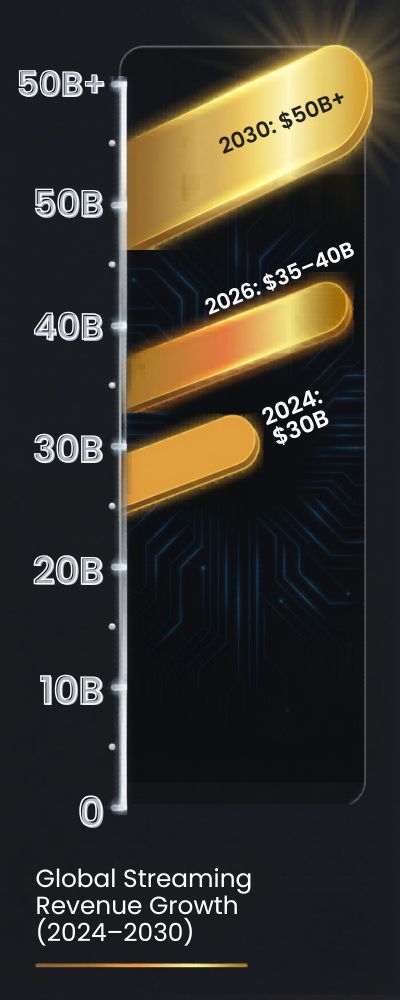
According to Statista, music streaming revenue is set to continue to climb until 2030. They predict the market will be driven by subscriptions and growth in developing countries.
| Year | Global Streaming Revenue (Est.) |
|---|---|
| 2024 | ~$30 billion |
| 2026 | ~$35–40 billion |
| 2030 | $50B+ |
But that’s a double-edged sword. There are more opportunities to be had when the industry is growing, but there’s also more competition. When the pie gets bigger, more people rush to the table. And they’re not particularly silent about it either.
The Competition Isn’t Standing Still
This is not news to Spotify. Apple, Amazon and YouTube are all ramping up their efforts, with each one having a slightly different strategy.
| Platform | Key Advantage |
|---|---|
| Apple Music | Ecosystem integration |
| YouTube Music | Video + massive user base |
| Amazon Music | Bundling with Prime |
| Spotify | Personalization & discovery |
Spotify may still dominate worldwide, but challengers are gaining ground in certain territories and contexts, as we explained in a report published last week for clients of MIDiA Research.
Spotify may win on personalisation, but Apple owns the hardware, YouTube owns the eyeballs, and Amazon owns…well, pretty much everything else. It’s not a fair fight. It’s a nuanced one.
Podcasts, Audiobooks and the Quest for “Audio Time”
Spotify is not just competing for music time. It is in the mix for all audio time. Podcasts and audiobooks are a big part of that quest. According to IFPI, audio consumption is diversifying rapidly, with spoken-word content growing alongside music streaming.
| Content Type | Growth Trend to 2030 |
|---|---|
| Music | Stable growth |
| Podcasts | Strong growth |
| Audiobooks | Emerging fast |
Frankly, that makes a ton of sense. Music has razor-thin margins. Podcasts and audiobooks are more lucrative. The thing is…Spotify still isn’t unique here either. There’s an 800-pound gorilla for audiobooks (Audible). YouTube still owns video podcasts. Apple still owns “podcasts.” So…yay, not easy.
AI and Personalization Will Rule the World
The one thing that may rule the world is Personalization. According to McKinsey, companies that excel at personalization can see 20 to 30% higher customer engagement and retention. This is one area where Spotify is #1…but holding onto that is the real trick.
Because AI is getting commoditized. Anything Spotify can do today, its competitors will be able to do tomorrow. And when “everyone” has “good enough” recommendations? Advantage lost. So now what?
Potential Landmines for Spotify
Let’s not assume that everything’s peachy. There are some potential landmines…
| Risk Factor | Potential Impact |
|---|---|
| Rising royalty costs | Lower profitability |
| Stronger competition | Market share pressure |
| Content fragmentation | User attention split |
| Platform fatigue | Slower engagement growth |
As Business of Apps points out, Spotify doesn’t have a ton of room to maneuver in the first place because of those licensing fees. And that’s not a great spot to be in when you’ve got a lot of competition. People can only afford so many subscription services. That’s just reality. Eventually something’s gotta give.
Will Spotify Still Be on Top in 2030?
Alright, this is where it gets a little subjective. I don’t think Spotify is going anywhere. Not even close. It’s way too integrated, way too popular, way too culturally ingrained. But will it still be the top dog? I dunno. That seems less likely.
Probably what happens is we just end up with an ecosystem where Spotify is one of the big players, but not THE big player. You know, like Netflix, Disney+, Amazon Prime, etc. And you know what? Maybe that wouldn’t be the worst thing in the world. A little competition never hurt anybody. It always keeps everybody on their toes.
The Human Side of It All
Because at the end of the day, we’re not really talking about market share or revenue. We’re talking about people listening to music. For millions of people around the world, Spotify is a daily part of life.
Sometimes it’s background noise, sometimes it’s emotional comfort, sometimes it’s a productivity aid, sometimes it’s an emotional escape. That’s hard to put into numbers, but it’s real. Can some other service come along and usurp that? Absolutely.
But I think it’ll be harder than people realize. Habits are hard to break, especially when they’re emotional. And I think that’s gonna be Spotify’s ace in the hole going into 2030. Not necessarily that it’s the biggest or has the best tech, but that for a whole lot of people, it’s already home.
How many songs are there on Spotify?
In total, there are over 100,000,000 songs on Spotify. That’s a whole lot of music. But what’s truly wild is how many new songs are added to Spotify every day. Thousands of new songs are uploaded every day, as more independent artists come online, and more music is produced globally. In other words, the competition for your attention is growing by the minute. All the more reason to use those discover weekly playlists!
How many streams does Spotify get per day?
Spotify sees billions of streams per day on their platform, across both music and podcasts. That’s a whole lot of eyeballs, and it’s one of the reasons why Spotify is a dominant platform in digital audio. It’s also an indication of how streaming has become the dominant form of music consumption. High traffic equals high ad revenue, and high royalties for artists.
But how many users actually pay for Spotify premium?
The freemium model is what made Spotify so successful in the first place. A huge portion of Spotify users remain on the free, ad-supported tier. However, the majority of Spotify’s revenue comes from premium users. As such, the divide between free and premium users is a delicate balance to strike. Their strategy to get users to upgrade to premium is always shifting.
What’s Spotify’s churn rate?
As with any subscription service, churn rate is a key metric when it comes to growth. While Spotify are able to retain a high percentage of their premium subscribers, many still do cancel their subscriptions due to price, or the presence of better alternatives. Spotify’s strategy to retain users is to personalise their playlists and offer exclusive content. The lower their churn rate, the better their revenue looks.
How do playlists affect artists?
Playlists are one of the most powerful tools on Spotify. A single editorial or algorithmic playlist can net you tens of thousands of streams. Many users don’t search for individual artists anymore, and instead play their favourite playlists. This is changing the way we discover new music.
Algorithms vs humans: who’s in control of your music?
Spotify’s approach is a balance between algorithmic playlists and human curation. While AI can personalize music at scale, human editors still play a huge role in surfacing up-and-coming artists.
What’s the average skip rate on Spotify?
The average skip rate on Spotify is a pretty key metric. Truth is, most users will skip a song after 30 seconds if it’s not grabbing their attention. High skip rates can affect how often you’re served to users through Spotify’s algorithm. This is why many artists are focusing on making their intros punchy.
How many times do users replay songs on Spotify?
If a song is really popular, it’s likely that users are replaying it multiple times. Replays are a key factor in chart success and in getting more algorithmic playlists. Songs which evoke emotion tend to have high replay value. This is why emotional songs often go viral.
How many users listen to Spotify offline?
Offline listening is one of the main benefits of premium subscriptions. Many users will download playlists onto their mobile devices for flights, commutes, or whenever they have low internet connectivity. This improves the user experience, and provides more value to paying users.
What devices do users access Spotify from?
The majority of Spotify usage is mobile, but more and more users are accessing the platform through smart TVs, speakers, and desktops. Smart speakers and connected devices are driving a resurgence in at-home listening. As such, it’s no surprise that Spotify are investing in a multi-device strategy to improve user access. This ecosystem strategy keeps users in the loop.
Smart Speaker Integration: Voice-Controlled Music Growth
There are a lot of smart speakers out there, most notably from Amazon and Google, and they can all play Spotify with voice commands. I imagine this is a popular feature, especially when you are at home. Overall, voice is where everything is going so this is no surprise.
Social Sharing Trends: How Users Share Music
Spotify users can share whatever they are listening to directly to any social media service. This has been aided by the direct integrations with Instagram and TikTok. Going viral here can really help streams for a song. Social is increasingly important.
Collaborative Playlists: Social Listening in Action
Users can create playlists that others can add to or modify. This is often done with groups of friends. It’s an interesting social feature that encourages more use of the service.
Music vs Podcast Listening Time: What Do Users Prefer?
Unsurprisingly, most listening is still to music, but podcasts are a close second. Many listeners split their time between the two. Podcasts tend to increase the amount of time spent listening and engaging with the service, so they are an important part of the offering.
Genre Diversity: How Global Music Tastes Are Changing
As Spotify has expanded around the world, more people have been exposed to more types of music. Music that is popular in different regions is being listened to in other places. This is partly driven by algorithms, but also social sharing. The world is flattening.
Independent Artists on Spotify: Growth and Market Share
Independent artists make up a growing share of Spotify’s catalog. Many top artists produce this way, and digital distribution makes it easier to get your music out there. This has leveled the playing field a bit in the industry.
Artist Discovery: How New Musicians Break Through
Obviously discovering new music is important to both artists and fans, and there are various ways this happens on the service. It’s a mix of playlists, going viral, algorithms, and social media. You still need to get lucky, but there are more opportunities now.
Audio Quality Preferences
Do Users Care About Sound Quality? For those that care, Spotify has a range of quality settings. Most people stick with whatever the default is, but some demand better. This is a key differentiator for some of the other services out there.
Regional Pricing Strategies
How Subscription Costs Vary Spotify charges different prices in different regions. This tends to be lower in developing markets. This strategy has worked to expand the service into new places. Pricing is an important lever.
Family and Student Plans
How Users Save on Subscriptions There are discounts for families and students. These make the premium service more accessible to more people. It’s a way of expanding the user base and keeping churn down.
Ad-Supported Listening
How Ads Impact User Experience On the ad-supported version of the service, you hear ads between songs or podcasts. This is how Spotify makes money off free users, but it can degrade the experience and encourage upgrades to paid. Finding the right balance is key.
Listening Trends During Major Events
Spikes in Streaming Music streaming can spike at big events such as concerts, awards, and anything that gets a song to go viral. This shows how music consumption is always changing. Cultural phenomena have a big influence here.
Conclusion
Taking all of these statistics into account, it is easy to come to one conclusion: Spotify is no longer just a platform, it is a routine, a lifestyle, a part of the way we function and operate.
All of these statistics scream one thing: volume and growth, but beneath all the noise, humans are utilizing audio in order to navigate through their days, emotions and experiences.
Is Spotify going to hold onto this leading position forever? The answer is probably not, trends fade, competitors become more aggressive, and technology improves. Will it disappear? It seems improbable, it is too integrated into our lives.
I believe that the future of Spotify, and streaming as a whole, is more about evolution rather than dominance. AI-personalized playlists, new content formats and the ever-shifting way we consume media, it is all still developing. Perhaps that is the story. It is not over yet. Far from it.


