

Except, almost without anyone noticing, they did. They went from being something that you, your computer-obsessed friend, or your really adventurous cousin listened to, to being played on the bus, in the kitchen, at the gym, and in those 3 a.m. moments when you just want to hear the sound of another human. And it isn’t just anecdotal. There are plenty of numbers to back it up.
Table of Contents
The thing is, the podcast industry isn’t just massive. It’s massive in increasingly intriguing ways. And by “intriguing ways,” I don’t necessarily mean linear, predictable ways, but more like the two steps forward, one step back variety as people’s habits change, platforms come and go, and the industry tests out ideas that work and don’t work.
Here are some of the interesting ways the industry is growing, in terms of audience, revenue, listening, and future plans. Because for every stat, there’s a behavior. And for every behavior, there’s a motivation.
Podcast Industry Report: How Big Will the Global Podcasting Market be in 2026?
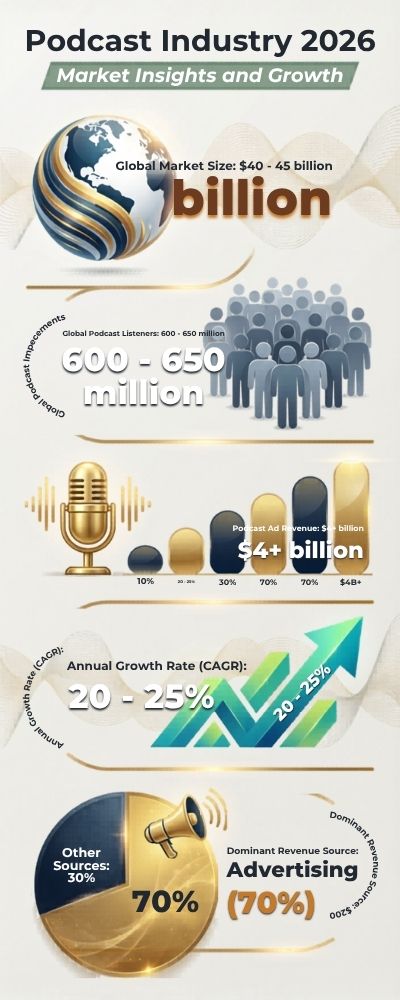
How big is the podcasting industry in 2026? A lot bigger than the casual listener while driving to work might think. The global podcasting market is expected to be around $40-$45 Billion (yes, that wide of a range is a sign that the industry is growing rapidly). For perspective, just 5-6 years ago, the industry was worth just over $10 Billion.
Today it is nearly half the size of the radio industry, and approaching the size of some streaming services. Not bad for an industry that began with folks recording into USB microphones in home offices.
I’d argue that the industry growth has felt somewhat inevitable. We are busier and more distracted than ever, yet simultaneously demanding more long-form content than ever before. Filling that void are podcasts. Essentially, you can listen to this and learn something while washing dishes. Boom.
Global Audience: How Many People Listen to Podcasts?
Audience size is where the money is. In 2026, there are expected to be more than 600 million podcast listeners globally. By the end of the year, we may eclipse 650 million listeners. That’s about 1 in every 13 people on Earth listening to a podcast of some kind. Not each day, mind you, but regularly.
Much of the recent growth in the industry has come from the United States, but the fastest growing markets for podcasting are Southeast Asia, Latin America, and Africa. These regions are mostly mobile-first, with more affordable cellular data plans and, yes, using YouTube as a gateway to listening to podcasts.
Revenue Streams: Where the Money Is Actually Coming From
Ok, now we’re getting interesting. It’s not all ads (although ads still account for ~70% of industry revenues). In fact, global podcast ad revenues are projected to top $4B by 2026, thanks to host-read ads and programmatic. (IAB)
However, subscriptions, premium content, and brand partnerships are picking up some steam. Spotify and Apple (and others) are pushing creators into mini Netflix-esque monetization models. Some are raking it in, others, less so. Still a bit of the wild west.
Market Growth: Still Accelerating or Starting to Plateau?
So the big question: are we getting close to maxing out? In short, no. The podcast market is still growing at a CAGR of ~20 to 25%. For an ostensibly “established” medium, that’s nuts.
However, growth is not uniform. Developed markets are flattening, while developing markets are just taking off. The market isn’t really “slowing down” so much as “shifting gears.”
Podcast Industry 2026 at a Glance
| Metric | Estimated Value (2026) |
|---|---|
| Global Market Size | $40–45 billion |
| Global Podcast Listeners | 600–650 million |
| Podcast Ad Revenue | $4+ billion |
| Annual Growth Rate (CAGR) | 20–25% |
| Dominant Revenue Source | Advertising (~70%) |
Yet, there’s something wonderfully human about podcasts in a hyper-digital age. It could be the voice, it could be the intimacy, or maybe we’re all just a little sick of screens. In any case, podcasting in 2026 is here to stay. It’s grown, it’s sprouted, it’s spread out, and it’s getting cozy. It’s not going anywhere, either.
Podcast Audience Growth Statistics: From Niche Hobby to Mainstream Media
Not so long ago, when you brought up the topic of podcasts in a conversation, you’d likely be met with a nonchalant smile and a sudden change of subject. Fast-forward to 2026, and it’s become quite unusual for someone not to have at least a favorite podcast.
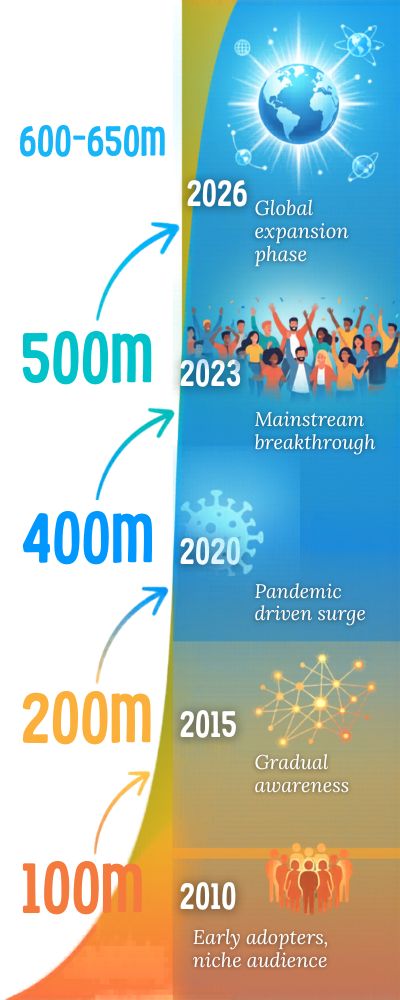
The growth has been astonishing. In 2010, there were less than 100 million global podcast listeners. As of today, that number has grown to over 600 million and is still rising.
In a survey by Edison Research, it was revealed that the number of people listening to podcasts has been increasing year-over-year. And the rate of adoption has been especially rapid since 2020, after the onset of the pandemic.
Interestingly, it all seemed so seamless. There wasn’t a particular announcement that “podcasts have gone mainstream.” It just kinda… happened. Much like how everyone decided to switch to oat milk overnight.
The Growth Curve: Slow Burn, Then Boom
The truth is, the podcast industry didn’t experience an overnight boom. Instead, it was a slow burn. There was a moderate increase in the number of users between 2015 and 2020. However, the real turning point came after 2020.
As of 2023, the number of global podcast listeners had already surpassed 500 million. And as of 2026, there are comfortably over 600 to 650 million users, according to Statista. This is one of the highest rates of adoption for a relatively new form of digital media.
However, with this level of growth usually comes consumer fatigue. Yet somehow, podcasts have managed to avoid the “ugh, another platform” mindset. Perhaps it’s because podcasts don’t require your undivided attention. You can continue with your day-to-day activities while listening to them. Perhaps that’s the beauty of it all.
Regional Adoption: Where the Industry’s Momentum Truly Lies
While you might assume the growth of the podcasting industry is a largely American phenomenon, that’s no longer the case.
The U.S. remains the most developed market, where more than 55% of the population has listened to at least one podcast, but the majority of growth is taking place in developing markets such as India, Brazil and Indonesia, where growth is being fueled by mobile-first users and declining data costs.
PwC predicts the Asia-Pacific region will be the fastest-growing market for podcasts through the late 2020s.
In a way, that shouldn’t come as a surprise. Podcasting tends to thrive in markets where commute times are longer and screen time is already saturated. Audio is just easier. It’s more convenient. It works.
Age: The Evolution of the Podcast Consumer
Contrary to the popular opinion that podcasting is still an activity dominated by younger demographics, growth among older listeners is rampant.
Gen Z and millennials still dominate, with around 65 to 70% of listeners falling between ages 18 to 44, but adoption among adults 45 and up has risen steadily over the last five years, according to Pew Research Center.
That’s comforting to see. It means the medium isn’t just one generation speaking into the void. It means there’s actually a conversation happening. Messy, but good.
| Year | Estimated Global Listeners | Key Insight |
|---|---|---|
| 2010 | ~100 million | Early adopters, niche audience |
| 2015 | ~200 million | Gradual awareness |
| 2020 | ~400 million | Pandemic-driven surge |
| 2023 | ~500 million | Mainstream breakthrough |
| 2026 | 600–650 million | Global expansion phase |
Why Podcasts Won (And Honestly, It Wasn’t Obvious)
Ten years ago if you had told me that podcasts would ultimately go head to head with video, I would have dismissed the thought entirely. Video was supreme, it was more engaging, more dynamic, more everything. But, while all of us were fixated on video, podcasts carved out their own home run.
They didn’t compete, they offered something else, intimacy. You don’t see a speaker giving a prepared presentation, you just hear a voice. Sometimes it’s a mess, sometimes it’s brilliant, sometimes it’s both.
And you come back for more. So yes, podcasting didn’t just get bigger, it changed. And somewhere along the way, it shifted from being fringe into mainstream.
How many podcast listeners are there in 2026? (Global)
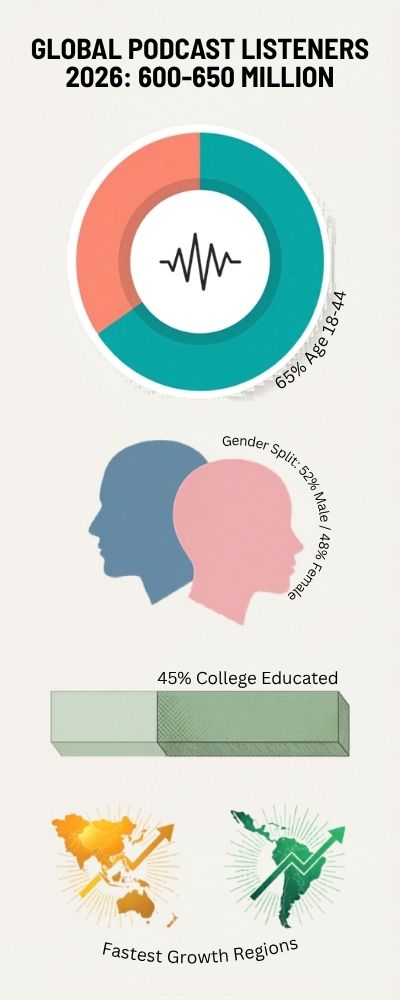
Let’s just rip the Band-Aid off. There are between 600 and 650 million podcast listeners in 2026. That’s the number you’re going to be quoting for the next 12 months. But how reliable is it? I mean, what does “listening” to a podcast even mean these days? 3 episodes a day?
A quick listen once a month and forgetting about it? Dunno. 600-650 million people are “listening to a podcast.” Alright. But what does that actually look like? How many podcast listeners are there?
The number has grown year by year, without ever declining. This is rare in the online space. Podcasting has long since crossed the “trend” line and is now just a regular part of life. Like drinking coffee. Or ignoring emails.
How old are podcast listeners? (Age)
You still believe that podcasting is a thing only for the young? Well, you’re kind of right. The average age of podcast listeners is still pretty young, but the gap is closing year on year.
But in the last 5 years alone, we’ve seen a huge surge in people over the age of 45 listening to podcasts. That’s huge. Creators are diversifying the space more and more.
It’s not just startup founders and internet personalities anymore. It’s teachers, parents, and even retired people. Reality is returning to the world of podcasting.
Gender Split: More Balanced Than You’d Think
One of the more unexpected aspects of the podcast audience is that it is actually fairly balanced in terms of gender. Yes, there are slightly more male than female listeners, but it is generally around 52% male and 48% female, depending on the country.
The divide has become more even in the last 10 years. And if you’ve looked at the top 100 podcasts in any genre recently, you’ll know that there really is something for everyone. Whether it’s true crime, wellness, finance, comedy or dating, it’s not a medium dominated entirely by one sex.
Income and Education: Who is Listening?
There is a slight skew towards higher income and education levels when it comes to podcast listeners, but it’s not as significant as you may think. 45% of monthly podcast listeners have a college degree and most of them are middle to upper class.
This is music to the ears of advertisers, as it represents disposable income. However, as smartphone ownership increases and data becomes more affordable, the wealth and education gap is beginning to close. No longer is it a ‘professional’ activity, but more of a mainstream pursuit. Which, let’s be honest, was inevitable.
Global Distribution: Where the Growth is Happening
In a global context, the growth in podcast listeners is not uniform. Whilst North America still accounts for the highest penetration, other markets are growing. India, Brazil and Indonesia are all seeing significant growth in podcast listeners.
The majority of growth will actually come from the Asia-Pacific region. This is not surprising. In many of these countries, commutes are longer and screen-time is more prevalent. Podcasts don’t require a video to buffer or a screen to be looked at. You just need to stick your headphones in and tune in.
At a Glance…
| Demographic Factor | Key Insight (2026) |
|---|---|
| Total Listeners | 600–650 million globally |
| Age Group (18–44) | ~65% of listeners |
| Gender Split | ~52% male / 48% female |
| College Educated | ~45% |
| Fastest Growth Regions | Asia-Pacific, Latin America |
So… Who Is the “Typical” Podcast Listener?
Well, if you’re looking for a clear-cut answer, there isn’t one. And that’s probably the beauty of it. The “typical listener” used to be a tech-savvy professional in their 30s. But now? The “typical listener” is a student, a taxi driver, a nurse on the night shift, or someone just trying to make their morning walk less boring.
And I think that’s why podcasting has persisted. It’s not exclusive to one demographic. It sort of belongs to everyone. Or at least, it’s trying to. It’s messy, it’s diverse, it’s a bit disorganised. It’s human, right?
When, where and how do people listen to podcasts?
The truth is, we don’t really listen to podcasts. We fill the gaps of our days with them. We listen in the morning as we get ready for work. We listen on our daily commutes. We listen at night as we wind down.
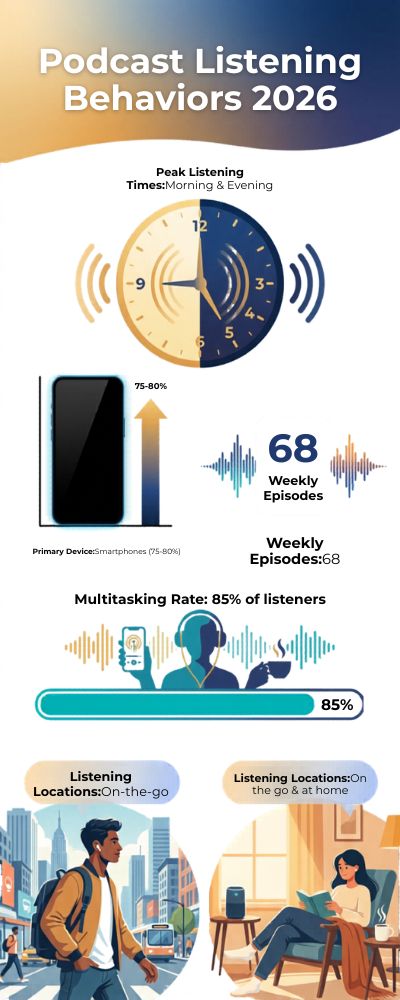
The most common hours for listening to podcasts are 6 to 10am and 7 to 10pm. We don’t really “listen to podcasts”. We listen while we do something else.
In fact, according to Edison Research, most people say they listen to podcasts while doing other things, not while devoting their full attention to the podcast. This makes sense. Who actually thinks, “I’m going to listen to a podcast now.”
Instead, we think, “I’ll listen to a podcast while brushing my teeth.” Before we know it, we’ve listened to half of a podcast episode and we’re pouring the coffee.
Where Are People Listening? Not Where You’d Expect
You might assume that most listening is done at home, perhaps on a couch. And you’re right, to an extent. But a significant portion of listening is done “on the go”. Whether that’s a commute, a walk, a drive, or even while grocery shopping.
According to Nielsen, more than 70% of podcast listening is done outside of “at-desk” listening. There’s something somewhat beautiful about that. Podcasts can travel with you.
They fill the gaps, grocery shopping, traffic, walking by yourself. It’s like having a conversation in your pocket. If you think about it too deeply, that’s a little weird. But also… pleasant?
Devices and Platforms: Where Are They Listening?
To no one’s surprise, a majority of the podcast consumption happens on a smartphone device. It is estimated that 75-80% of podcast consumption happens on a smartphone, with laptop and smart speaker being the next highest devices used.
According to Statista, this trend is expected to continue, especially as podcasting grows in developing countries. However, what is interesting to note is that platform loyalty is becoming more and more split.
Between Spotify, Apple Podcasts, YouTube and more, people are not necessarily dedicated to a single platform and some even switch between apps depending on the type of content they want to listen to or the accessibility of it. Personally, I switch between apps daily. I guess that is just the way people consume media these days, nomadic.
Multitasking: The Hidden Reason For Podcast Popularity
The reason that has been least discussed about the growth in popularity of podcasts is that they are not fully immersive. In fact, they are the exact opposite of immersive.
While there are certainly many people who listen to podcasts as their sole focus, research suggests that around 85% of people who listen to podcasts also do something else while they are listening.
Whether that is driving, working out or doing dishes, podcasts are meant to be consumed in the background. According to PwC, this is a key reason for their success.
This is because unlike other types of content such as Netflix or YouTube, you can consume podcasts while doing other things. While you certainly can watch Netflix while you do the dishes, it is not the most efficient use of time. Podcasts offer the ability to consume content while still accomplishing other things, which has proven to be very popular.
Weekly Consumption: How Many Podcasts Do People Listen To?
While many people listen to podcasts daily, there are still those who only listen on certain days of the week. On average, people listen to 6-8 podcasts a week and spend around 5-7 hours listening.
According to Infinite Dial by Edison Research, this is a trend that has been increasing over the years as more podcasts become available. Of course, everyone always has that one podcast that they binge listen to and forget about all the others. But generally speaking, there is a trend towards regular listening habits.
Fast Facts: A Summary of Podcast Consumption Habits
| Behavior | Key Insight (2026) |
|---|---|
| Peak Listening Times | Morning & Evening |
| Primary Device | Smartphones (75–80%) |
| Multitasking Rate | ~85% of listeners |
| Weekly Episodes | 6–8 episodes |
| Listening Locations | On-the-go & at home |
Why These Habits Matter More Than You Think
What stands out to me isn’t just when or where people listen, it’s that they’re tuning in at all. They don’t demand attention. They earn it quietly.
And perhaps that’s the real secret to their success. In a digital economy where everyone is screaming for your attention, podcasts quietly take a backseat, patiently awaiting a return listen. And, in turn, listeners keep coming back.
It’s no longer just a habit, it’s ritual.
Average Podcast Consumption: Time Spent, Episodes per Week, and Completion Rates
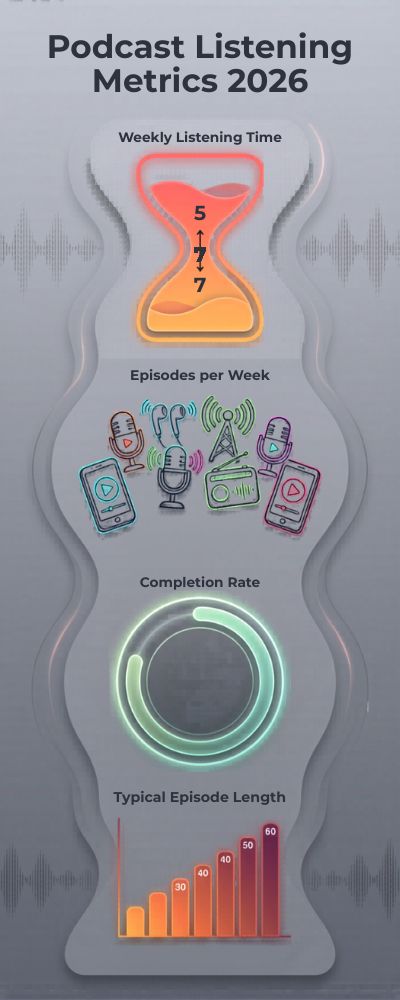
How long do people listen to podcasts? Turns out, it is a lot. The average podcast listener consumes 5-7 hours of podcasts per week. Yes, per week. That’s a part-time job! According to a survey by Edison Research, weekly time spent listening to podcasts is increasing as more and more people begin to listen to podcasts.
I think it is higher, but I am not sure. I think people listen to one episode and before they know it they have listened to three hours of a podcast about a missing hiker, for example.
How many podcasts do people listen to? The average number of podcasts people listen to per week is 6-8. This number doesn’t tell the whole story. Some people listen to only one or two podcasts a week while others listen to a ton.
According to Statista, the number of people who listen to podcasts more than once a week (or even daily) is growing. To me, this is interesting. Some weeks I listen to a few different podcasts while other weeks I listen to every episode of the same podcast as if it’s my identity.
Episode Completion Rate: How many episodes do people complete?
Now we are getting somewhere. Just because someone starts listening, doesn’t mean they will listen to the whole thing. The average completion rate for podcast episodes is 70 to 80%. That is a higher completion rate than many other forms of digital content.
Nielsen found that people are more likely to listen to a whole episode if the content is narrative or story based.
It means a lot, really. Podcasts don’t compete for your attention like video does. They have to earn it. If you listen to a 40 minute episode, you are not listening because you can’t escape. You are listening because you want to. There is a difference.
Episode Length: How does length affect engagement?
Common sense would say that shorter episodes perform better, but they don’t always. Many podcasts are 30 to 60 minutes, and some even longer. PwC found that longer form content has a higher completion rate when it appeals to listeners.
It all depends on value. If you feel like you are getting value from the content, you don’t care about the length. If not, even a 10 minute episode is too long. We have all done it. Looking at the length of the episode, and wondering if we should just stop listening.
| Metric | Average (2026) |
|---|---|
| Weekly Listening Time | 5–7 hours |
| Episodes per Week | 6–8 episodes |
| Completion Rate | 70–80% |
| Typical Episode Length | 30–60 minutes |
Why These Numbers Are Important (Even if They Don’t Feel Like They Should Be)
There’s a reason I point these statistics out. They’re not just mere data points. They represent actions. They represent commitments. They represent decisions. And you know what they also represent? Time. Investment. Effort. That’s something you cannot trick someone into giving you.
And in a world where everyone is competing for everyone else’s attention, podcasts are actually getting it. Not every time. Not all the time. But enough of the time. And I think that might actually be the story.
Not necessarily the quantity of what people are listening to, or even the duration. But the frequency. The repeat business. You don’t see that in a lot of places.
Podcast Advertising Revenue Statistics: What’s the Current State of the Industry?
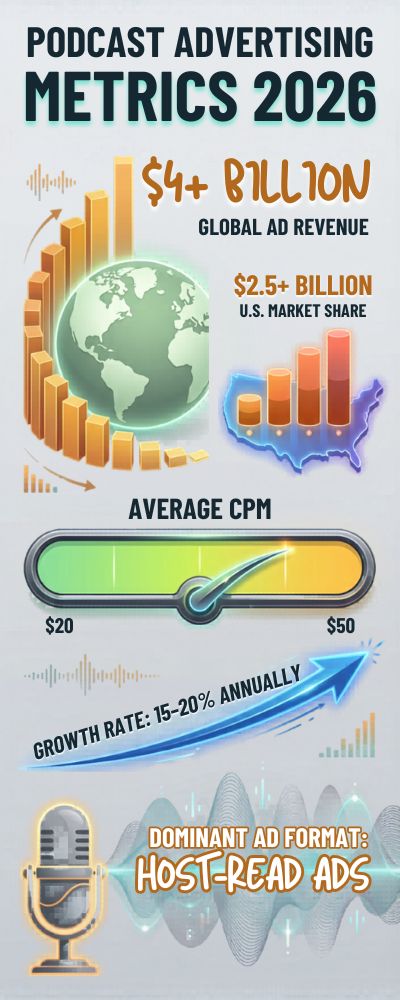
What was once a novel way to test the waters of a new ad channel has blossomed into a full-fledged industry. By 2026, the global podcast ad market is predicted to top $4 billion and potentially climb even higher. Compared to TV and display advertising, that’s still a drop in the bucket, but let that sink in for a second.
We’re talking about a medium where only a few years ago, most advertisers weren’t even sure how to measure. According to the Interactive Advertising Bureau, year-over-year growth in podcast ad revenue has been in the double-digits.
And, frankly, it makes sense. Unlike display ads, podcasts don’t shout at you from the rooftops. Ads are woven into the conversation. Sometimes you don’t even realize you’re being pitched a product until you’re already considering buying it. Deceptive? Possibly. Does it work? Absolutely.
The US vs The Rest of the World: Where is the Most Revenue Being Generated?
The US still generates the majority of global podcast ad revenue. In fact, it accounts for more than half of the overall total, with the US market alone topping $2.5 billion annually.
According to PwC’s Global Entertainment & Media Outlook, the US remains the most developed market for podcast advertising, boasting standardized measurement protocols and high advertiser demand.
But this is where things start to get intriguing. International markets are starting to gain traction. Europe, Latin America, and Asia-Pacific are becoming increasingly attractive markets for brands as they begin to realize that podcast audiences are not only massive but highly engaged. And that’s what advertisers care most about.
Ad formats: Which ones are bringing home the bacon?
Host-read ads are the cash cow, and they’re the most common type of podcast advertising, due to their personal nature (they don’t feel like ads). As a matter of fact, a study done by Nielsen found that host-read ads outperform traditional digital ads in both trust and recall.
The second type is programmatic ads, which are gaining traction. Programmatic ads are dynamically inserted ads that are targeted to the audience. The trade-off here is that they’re less personal but more scalable. And the industry hasn’t quite figured that balance out yet.
CPM rates: Why are brands are going crazy for podcast ads?
There’s a reason why brands are pouring millions into podcast ads. Compared to other digital media, the cost per thousand impressions (CPMs) of podcast ads is relatively high. Podcast ads CPM is in the $20-$50 range depending on the audience and ad format.
Based on a study done by Statista, the higher CPM rate is due to the high engagement rate and niche targeting. Yes, it’s pricey, but brands are willing to pay for it. Because when people listen to podcasts, they actually listen. Unlike other digital ads, they’re not scrolling past or muting ads.
Revenue growth: Are we still in the growth phase or is it slowing down?
Yes, we’re still in the growth phase. According to eMarketer, global growth rates for podcast advertising is in the range of 15-20% per year. Brands are shifting budgets to podcast ads to escape ad clutter in digital media.
However, growth isn’t without its challenges. Measurement challenges, ad fatigue, and platform fragmentation are all major concerns. But the industry is evolving, albeit slowly and sometimes awkwardly. At any rate, it’s moving forward.
Quick overview: Podcast advertising revenue (2026)
| Metric | Estimated Value (2026) |
|---|---|
| Global Ad Revenue | $4+ billion |
| U.S. Market Share | $2.5+ billion |
| Average CPM | $20–$50 |
| Growth Rate | 15–20% annually |
| Dominant Ad Format | Host-read ads |
The Power of Podcast Advertising
Despite the lack of standardization, longwindedness, awkwardness, or even going off script, podcast ads are actually successful. Perhaps it’s because they seem so human.
So conversational. So slightly off-script and rambling. I think the reason consumers don’t mind ads in podcasts is because they don’t feel like interruptions. The ad is baked into the content, and it makes all the difference. Yes, podcast advertising is a quiet giant. But it’s here to stay.
CPM Rates, Ad Formats, and ROI: What Brands Are Paying for Podcast Ads
How much does it cost to advertise on a podcast? What are the CPM rates for podcast ads? What kind of return on investment (ROI) can you expect from podcast advertising? How do pre-roll, mid-roll and post-roll ads compare on podcasts?
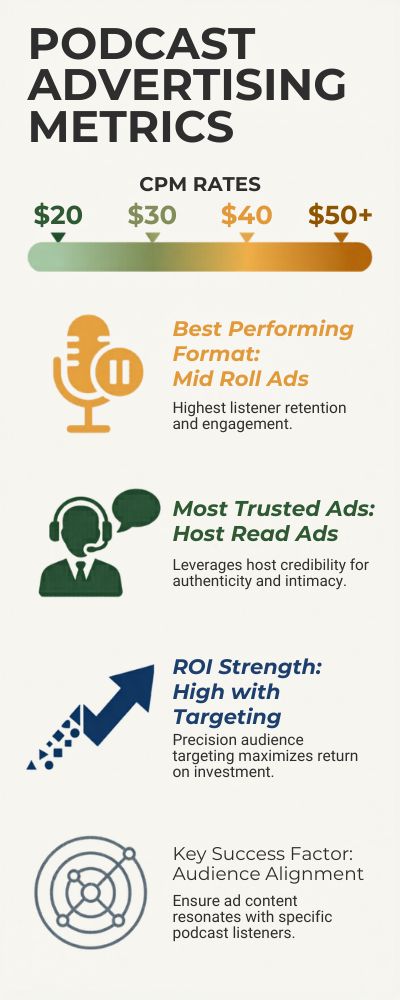
The cost of podcast advertising can be steep for marketers accustomed to digital advertising. Most CPMs for podcast ads range between $20-$50. But the good news is that these ads work incredibly well.
AdvertiseCast reports that the average CPM for a mid-roll ad (more on ad positions below) is higher than other positions because of better audience engagement. I’ll let you in on a little secret.
This is where podcasts thrive. It’s not just about how many people hear your ad. It’s about how well they pay attention to your ad. You aren’t interrupting people. You aren’t interrupting people who don’t want to hear from you. That makes all the difference.
What’s the difference between a pre-roll, mid-roll and post-roll ad?
There are three different types of ad positions on a podcast. Advertisers and podcasters frequently refer to them as follows:
- Pre-roll: Before the content begins
- Mid-roll: Middle of the content
- Post-roll: After the content
Mid-roll ads are the most desirable and valuable. I probably don’t have to explain why. The listener is engaged at that point. According to the IAB, mid-roll ads deliver the highest brand recall and ad effectiveness. What isn’t discussed as often is how timing matters.
When you run an ad right after an emotional moment in a story it can be impactful…or it can be awkward. There is a little bit of an art to this. Some podcasts do it better than others.
Host-Read vs Programmatic Ads: The Trust Factor
This is where it gets interesting. There are two types of podcast ads: host-read ads and programmatic ads. Host-read ads are read by the host of the show, often in an informal and sometimes improvised way.
Programmatic ads are dynamically inserted ads that sound more like digital ads. And the winner is… host-read ads. By a long shot. Listeners are more likely to trust and respond to host read ads, according to Nielsen.
This makes total sense. If you’ve been listening to the same person for weeks or even months, you feel like you know them. When they tell you to buy something, it feels less like an ad and more like advice. Kind of scary, when you think about it.
ROI: Are Podcast Ads Actually Worth It?
This is the million-dollar question. Literally. Do podcast ads work? Well, yes and no. Yes, in the sense that podcast ads tend to have higher conversion rates than other forms of digital advertising, particularly when it comes to niche audiences.
According to eMarketer, brands are moving budget into podcasts due to its high returns and audience loyalty. But no, in the sense that it’s not something you can just throw money at and expect to work.
Throwing money at a bunch of different shows and hoping for the best is not a great strategy. The best outcomes happen when there is a strong fit between the brand, the host and the audience. When it works, it works well. When it doesn’t… meh.
Quick Breakdown: Podcast Ad Economics
| Metric | Typical Range / Insight |
|---|---|
| CPM Rates | $20–$50+ |
| Best Performing Format | Mid-roll ads |
| Most Trusted Ads | Host-read ads |
| ROI Strength | High (with targeting) |
| Key Success Factor | Audience alignment |
So, What Are Brands Really Paying For?
You could argue it’s impressions, or downloads, but it’s not really either of those things. They’re paying for attention. Real, sustained, human attention.
And that’s a precious commodity these days. We scroll right past ads without a second thought, mute videos, and skip prerolls. But when it comes to podcasts? They create space. They build trust almost quietly, over time.
So yeah, CPMs are higher. But perhaps the more compelling question is, what is attention worth anymore? Because podcasting might have figured it out before the rest of the internet.
Top Podcast Genres by Revenue and Audience Size
Most Profitable and Popular Podcast Genres
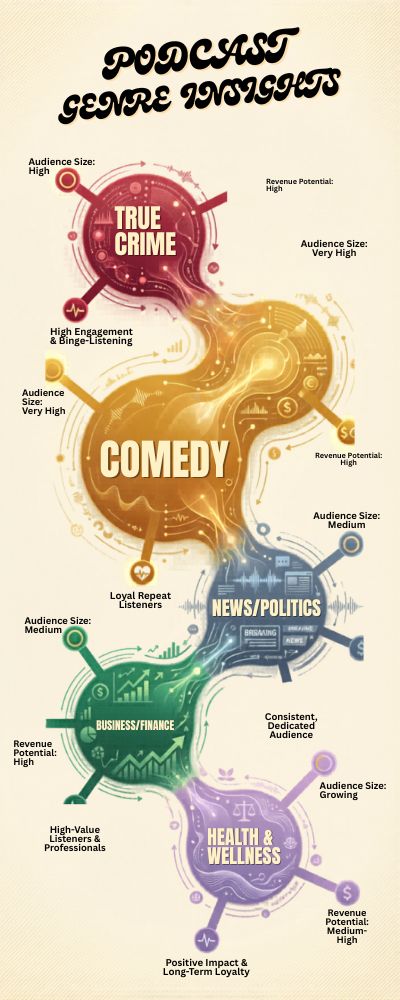
It is clear that not all podcasts are equal. If you glance at any of the charts, you will see that certain types of podcasts are more popular (in terms of listeners and revenue) than others. Usually, the top podcast categories include Comedy, True Crime, News, and Business.
In fact, these are the most popular categories on most platforms. According to Statista, comedy accounts for one of the largest shares of podcast listeners worldwide.
This is no surprise. People want to be entertained, informed, or educated. Essentially, they are looking for a combination of escapism and usefulness. A podcast that provides one (or both) of these will be successful and attract a large audience.
Profitable Comedy Podcasts
You may not realize this, but comedy podcasts are some of the most popular types of po In fact, according to Edison Research, comedy is the most popular type of podcast among listeners.
Interestingly, many comedy podcasts are also very profitable. Why? Because they attract loyal listeners. Not only do people tune in to hear the jokes and funny stories, but they also tune in because they like the hosts.
This loyalty means that advertisements on these podcasts perform well.dcasts. While they may not get the same level of respect as news or business podcasts, they do attract a significant number of listeners.
I mean, let’s be real. Who doesn’t like hearing an ad that is read in a funny way rather than a straight-laced reading of a script?
True Crime: High Engagement, High Revenue
True crime is a genre that will never fade out, and its audience engagement is through the roof. According to Nielsen, true crime podcasts have some of the highest engagement rates, with users binge listening to multiple episodes at a time. It’s the way that the story is told, creating an emotional response in the listener.
The story is almost palpable, it’s suspenseful, intriguing, sometimes uncomfortable. It leaves users wanting more, and advertisers are catching on. I’ll be the first to admit, it’s a little odd that we’re listening to crime stories while folding our laundry, but humans are strange.
News and Politics: Big Audience, Strong Advertiser Interest
News podcasts have seen a significant rise over the years. Users are hungry for news, commentary and analysis, just on their own terms. Not everyone wants to sit down and watch the evening news, and podcasts give users an outlet to consume news.
The Pew Research Center says news podcasts reach an educated and engaged audience, highly sought after by advertisers. No surprise here, they’re more engaged and actually care about the content that they’re consuming. They aren’t mindlessly scrolling, they want to be informed.
Business and Finance: Lower Listenership, Higher Ad Spend
The audience size for these podcasts isn’t always the largest, but the ad revenue per user is often higher. This is because business and finance listeners tend to be worth more. Advertisers will pay more for each listener.
In some cases, quality trumps quantity. Smaller, more targeted audiences can be worth more than a larger broader group. Not the most exciting thing, but it works.
At a Glance: The Most Popular Podcast Genres in 2026
| Genre | Audience Size | Revenue Potential | Key Strength |
|---|---|---|---|
| Comedy | Very High | High | Loyal, repeat listeners |
| True Crime | High | High | Strong engagement & bingeing |
| News/Politics | High | High | Educated, attentive audience |
| Business/Finance | Medium | Very High | High-value audience |
| Health & Wellness | Growing | Medium–High | Niche but expanding |
So, What Makes a Genre “Successful”?
The obvious assumption might be that it’s just about the size of the audience. But it’s not quite that easy. Some genres are winning because they’re fun. Other genres are winning because they’re helpful. The best genres are doing both. And perhaps that’s the real lesson here.
Listeners aren’t just coming to podcasts for data, they’re coming for companionship. For a personality they like. For something that can fit into their lives without taking over.
Different genres offer that in different ways. Which means that there’s no real winner here, just different successes unfolding concurrently.
Spotify vs Apple Podcasts vs YouTube: Platform Market Share and Growth Trends
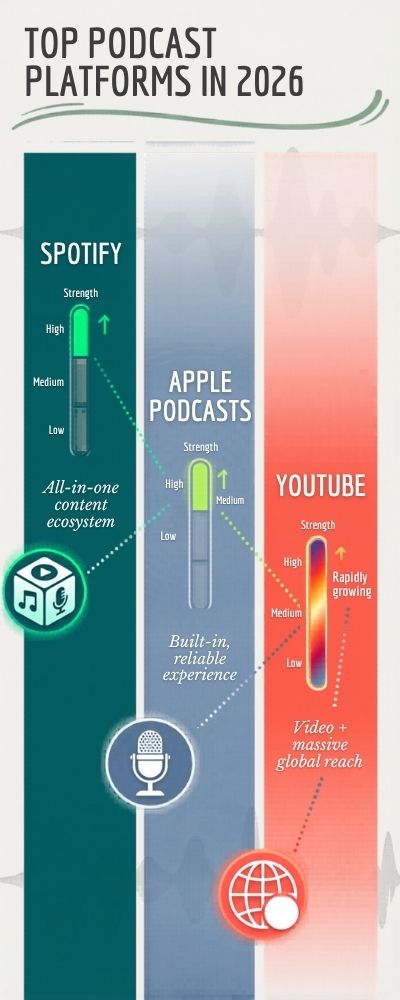
It wasn’t that long ago that Apple dominated the world of podcasting. If you listened to podcasts, you listened on Apple Podcasts. Period. Today though, that’s no longer the case. Today, the world of podcasting is dominated by a trio of platforms: Spotify, Apple Podcasts, and YouTube.
The thing is, depending on who you ask, one of those platforms is ahead of the others. For instance, Edison Research found that Spotify has surpassed Apple Podcasts in terms of listener share in several countries, particularly amongst those under the age of 35. Confused yet? Yeah, it’s a real thing. Exciting, but real. Let’s take a look.
Spotify: The New Kid on the Block Who’s Here to Stay
Spotify didn’t just dip its toes into the world of podcasting; it cannonballed into the deep end. From acquiring popular platforms to brokering exclusive deals with some of the industry’s most popular shows to investing heavily in original content, Spotify has made it very clear that it’s taking the medium very seriously.
And it shows. Not only does Spotify now account for a sizeable percentage of all podcast listening, particularly amongst its younger users, but according to Statista, it’s been steadily growing its share of the market in recent years: One of Spotify’s greatest strengths is the fact that it offers users a one-stop-shop for all of their digital audio needs, be that music, podcasts or even audiobooks.
And while that’s certainly convenient, I sometimes can’t help but feel that we’re reaching a point where perhaps the streaming giant is spreading itself a bit too thin. It’s a bit like walking into a store that sells everything: often, you end up forgetting what you originally went in for in the first place.
Apple Podcasts:
Still a giant, just… quieter about it. As mentioned, it’s easy to overlook Apple these days. They’re not touting big exclusives and they’re not spending a ton of money to promote the service. But Apple remains one of the largest players in the space.
According to Podtrac, Apple still commands a significant share of total podcast downloads, at least in the U.S. What Apple has going for it is legacy.
The app comes with every iOS device, many listeners are used to it, and for many, it simply works. No need to try a new app, no need to change behavior. That stability is also a drawback of sorts, while others are innovating, Apple seems a bit stagnant.
YouTube:
The unlikely giant. As alluded to above, YouTube was not typically included in the podcast landscape discussion. But it probably should be these days. The Google-owned video platform is becoming a major force in the podcast world, particularly when it comes to video podcasts.
According to the Pew Research Center, a rising percentage of respondents say they listen to podcasts on YouTube rather than an audio-focused podcast app. This isn’t terribly surprising, of course: most people are already on YouTube.
No need to download an app. And video does add an extra dimension, you can see facial expressions, you can see reactions, you get a bit of that human element back.
Of course, this also feels a bit counter to the original point of the podcast. It’s supposed to be a screen-less medium. Now we’re watching them.
Market Share
Before I wrap up, here’s a rough snapshot of where the market currently stands (via Voxnest (https://www.voxnest.com/), which owns top podcast monetization platform Spreaker. But again: this is all a bit fuzzy.
| Platform | Estimated Strength (2026) | Key Advantage |
|---|---|---|
| Spotify | High (especially younger users) | All-in-one content ecosystem |
| Apple Podcasts | High (legacy + loyal base) | Built-in, reliable experience |
| YouTube | Rapidly growing | Video + massive global reach |
Trend Lines: Where’s This Going?
Want to bet on a clear winner? Good luck. That’s not the trend; it’s the opposite. Fragmentation is what’s happening here. People are listening on multiple platforms, and for different reasons: Spotify for ease of use, Apple out of inertia, YouTube for discovery.
The competition between platforms will continue to heat up as their monetization models mature and more content becomes exclusive.
Which could be a problem. Exclusives can lead to more fragmentation, and, let’s be clear, users generally hate that. Nobody wants to have to juggle five different apps to keep track of their favorite podcasts.
Who’s Winning?
Want a tidy answer to this? Sorry, nope. Spotify’s on a tear. Apple’s steady. YouTube’s doing its level best to disrupt the whole business.
Which may in fact be the real answer here: there isn’t going to be a clear winner because podcasting isn’t just one thing anymore. It’s audio. It’s video. It’s entertainment. It’s educational content. It’s all those things, and more.
My guess? YouTube’s gonna surprise a lot of people in the long run. But hey, this is a field that’s always managed to defy predictions. That’s what it does.
The Rise of Video Podcasting: Why YouTube Is Dominating Podcast Consumption
Somehow, that feels both ironic and completely natural. For example, I can hear a lot of podcasters commenting on their listeners’ tendency to listen to video podcasts. It’s like this: Podcasts originally became so popular because they could be consumed without screens.
Now we’re moving into a phase where they’re being watched. Not just listened to. And somehow, that shift feels both ironic and completely natural. A growing share of podcast listeners are accessing content on video platforms, and even when they are just listening to the audio, many are listening on YouTube.
There are some situations where I can see myself choosing to watch a video over just listening to a podcast. Sometimes you want to see people’s faces, or watch them squirm a little.
Sometimes you want to catch the reactions on their faces, even if you’re mostly just listening. Sometimes you want to feel like you’re getting the full experience. It feels a little more real that way.
The Silent Conquest of Podcasting by YouTube
YouTube was not originally designed as a platform for podcasts, yet is increasingly among the largest destinations for podcast consumption. Actually, in one regard it already is the largest: reach.
With over 2.5 billion monthly users, YouTube provides something that most dedicated podcasting apps cannot: discovery at scale. As of this writing, according to Statista, YouTube remains the most popular online video platform in the world, and this extends to podcasts.
This is important. The reason for this is you do not go to YouTube to listen to a podcast. You end up on YouTube. You click on one video, and then the next, and the next thing you know you are watching a two hour conversation you never intended to watch. It is not deliberate. It is accidental. But it works.
Discovery vs. Loyalty
YouTube has an algorithm that suggests content based on how you interact with the platform. That’s how you find new content. On the other hand, traditional podcasting platforms like Apple or Spotify rely on your loyalty. You have to search for a show, subscribe to it, and that’s how you listen to new episodes.
Here’s what Google says about this: “Users often come across a podcast while browsing YouTube rather than searching for a specific podcast.” That’s the beauty of it. You don’t need to know that a podcast exists to find it.
It’s just suggested to you at the right time. Sometimes you don’t even know that you need it until you stumble upon it. There’s a reason why the phrase “you don’t know what you don’t know” exists.
Engagement: Watching vs. Listening
Here’s the next logical question: Do people watch video podcasts or just listen to them? The answer is yes. Both. Many people consume video podcasts like regular podcasts. They play them in the background and do other stuff. However, when the hosts get into an interesting conversation, they pause whatever they’re doing to watch what’s happening.
According to Nielsen, “Viewers are more likely to engage with and retain video-enhanced content than plain audio content.” I experience this all the time. I don’t sit down and watch an entire episode, but if I hear something interesting, I pause whatever I’m doing to take a look.
If the hosts laugh at something, I look to see what’s so funny. If they pause the conversation because it got awkward, I want to see why. If they react to something, I want to see how they react. It’s a different experience.
Monetization: Why Creators Are Switching to Video
One last thing. Creators get paid on YouTube. It’s easy to monetize a channel with AdSense, members, etc. PwC says video commands more ad dollars than audio. For creators, it’s not just about getting more eyeballs. It’s about making more money.
And YouTube provides more tools to make money than traditional podcasting platforms. That’s why creators are switching to video. It’s not just about the money, though. They want to be where their audience is. And the audience is on YouTube.
Quick Comparison: Audio vs. Video Podcasting
Here’s a quick comparison of the two:
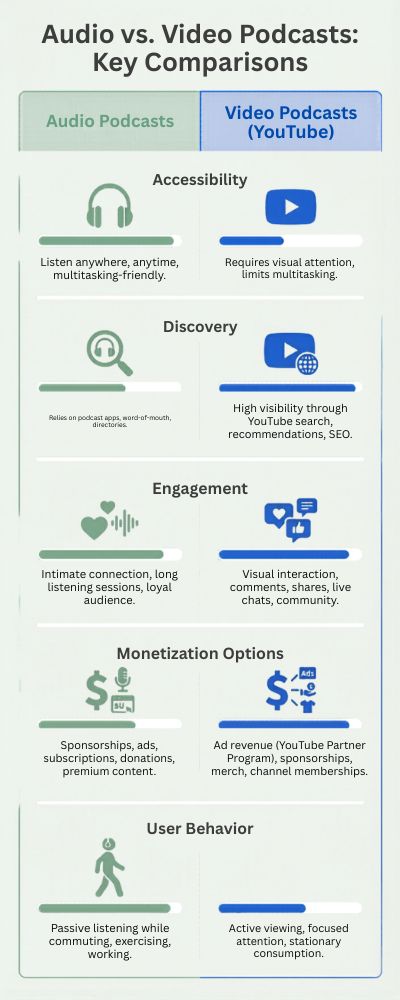
| Factor | Audio Podcasts | Video Podcasts (YouTube) |
|---|---|---|
| Accessibility | High (no screen needed) | Medium (screen optional) |
| Discovery | Limited (search-based) | High (algorithm-driven) |
| Engagement | Strong | Very strong (visual boost) |
| Monetization Options | Moderate | High |
| User Behavior | Intentional listening | Passive + active viewing |
So… Is Audio Podcasting Being Replaced?
No. It’s evolving. Audio isn’t going anywhere, it’s just being enhanced with video. Some will always want to listen without a screen. Some will want the added video layer. And some will do both at different times. This isn’t a replacement, it’s an evolution.
Podcasting is expanding to different formats, different behaviors, different expectations. And if I had to predict where this goes? My guess is we end up at some sort of hybrid model where we do audio, and offer video, but not always.
Because let’s be real, it’s not ideal… but it offers choice, and in the modern world, that’s pretty much the only thing that really matters.
The New World of Podcast Discovery: AI and Personalization
In recent years, the number of available podcasts and episodes has skyrocketed. Today, there are over 5 million podcasts and 70 million episodes worldwide. Yes, you read that right. It’s a staggering number. In fact, it can be downright daunting when you think about it.
You fire up your favorite podcast app and start scrolling through the episodes, you do this for a minute or two and boom! All of a sudden, you can’t even remember what you are searching for.
The number of podcasts and episodes available has grown significantly over the past few years according to Podcast Index, and discovery is one of the major challenges facing the industry today.
Truthfully, there’s such a thing as too many options. Most of us don’t want more choices. What we want are better choices… or at least better recommendations. AI is changing that for us.
AI-driven recommendations
Platforms are leveraging AI to suggest new podcasts or episodes to you based on your listening history and behavior. AI can even take into account patterns such as the time of day you typically listen to podcasts or how long you listen to each episode.
According to McKinsey & Company, well-implemented personalization engines in digital media can generate up to a 40% increase in engagement. That’s pretty cool, right? The only problem is that AI isn’t perfect. Once in a while, the algorithm gets stuck in a cycle.
For example, you listened to one episode of a business podcast and now every suggestion the algorithm gives you is business podcasts. They all sound the same after a while. Granted, this isn’t a terrible problem to have but it’s still a problem nonetheless.
The discovery experience: Personalization vs. Surprise & delight
Personally, I’m obsessed with this question. Are we really discovering anything new, or are we simply being directed into smaller and smaller lanes of relevance? I love that personalization helps us cut through the noise, but I hate that it eliminates surprise.
Sometimes the best podcasts are ones I wasn’t searching for. According to Deloitte Digital Media Trends, consumers increasingly rely on algorithmic recommendations for content discovery, but many still value “unexpected finds” as part of the experience.
It’s a delicate balance, isn’t it? Too much AI, and things feel completely programmed. Too little, and you’re overwhelmed. Somewhere in between, there’s a sweet spot.
Smart speakers: The next frontier of discovery
Ok, now we get into the future a bit. Smart speakers are changing the discovery game. Instead of searching or scrolling, we can ask for what we want. “Alexa, play a great productivity podcast” or “Hey Siri, find a new true crime show.”
The number of digital voice assistants in use globally continues to grow rapidly, according to Statista. It’s efficient. But it’s also scary. Who controls what comes up in the results? Because removing the screen and putting the selection entirely on the AI seems like a whole new level.
Content created by AI
AI is not only aiding in the discovery of podcasts, but it’s also beginning to create them. We’re starting to see AI-generated voices, scripts, and even entire podcasts.
PwC reports that AI-assisted content creation is poised to increase as media outlets seek to find more efficient methods of creating audio content. Personally, I’m a bit dubious about this part.
More isn’t always better. If the discovery of great podcasts is a challenge, why add more noise to the room with AI-generated podcasts? On the other hand… perhaps AI will be able to better filter out that noise too. Chicken and egg.
Quick Snapshot: AI and Podcast Discovery Trends
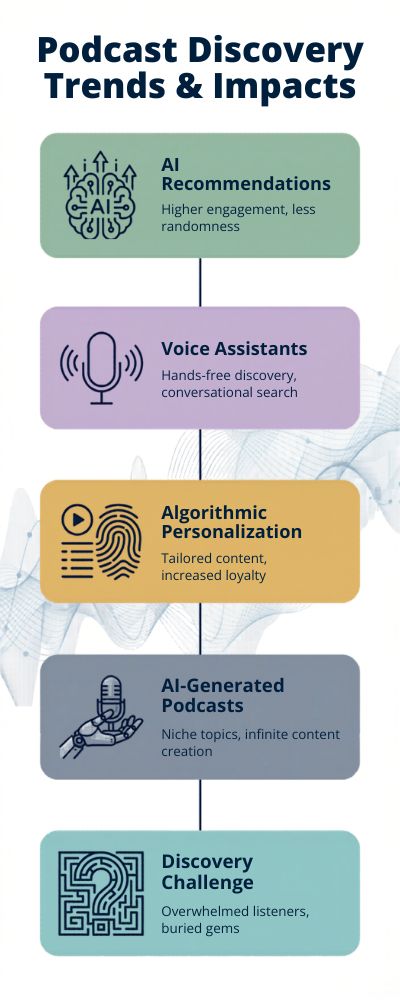
| Trend | Impact on Podcast Discovery |
|---|---|
| AI Recommendations | Higher engagement, less randomness |
| Voice Assistants | Easier, hands-free discovery |
| Algorithmic Personalization | More relevant content |
| AI-Generated Podcasts | Increased content supply |
| Discovery Challenge | Still unresolved |
So, What Does the Future Actually Look Like?
So, what does the future actually look like? I’m not sure, but here’s a guess. I think it will feel less like searching for something, and more like being nudged in the right direction. Quietly. Behind the scenes. The best recommendations will feel less like “recommendations” and more like “this is just how it is.”
I just hope that, along the way, we don’t lose the joy of stumbling upon something for no good reason. The joy of hearing a podcast that shouldn’t have matched you, but somehow did. Algorithms are very smart. They just don’t always know what we want.
And, I suppose, that’s OK. Maybe the future of discovery isn’t about getting it just right. Maybe it’s about giving people just enough of a push… and then letting them roam.
The Future of Podcasting: What to Expect by 2030
As we move into 2030, the podcasting industry is predicted to undergo significant changes. Gone are the days of rapid audience acquisition; instead, the industry will experience a transformation. Expect more intelligent ways of monetization, improved content, and increased competition.
PwC Global Entertainment & Media Outlook suggests that the global podcasting market will continue to see steady growth throughout the decade, reaching higher revenue levels than today.
This growth, however, will not be as rapid as we have witnessed in the past. Instead, the industry will seem more… thoughtful. The industry will be maturing, having somewhat adjusted after a rather tumultuous teenage phase.
Increased Audience: Growing, yet Still Global
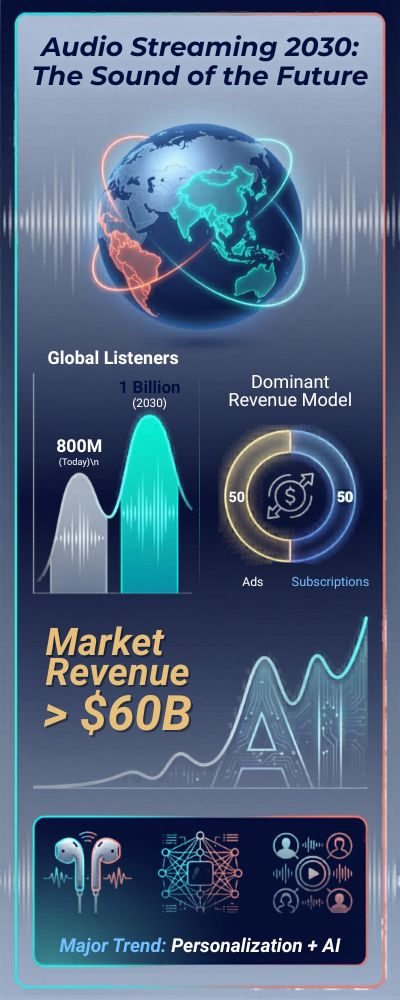
By 2030, the number of global podcast listeners will reach 800 million to 1 billion. That’s massive! However, the rate of growth will probably be lower in already matured markets such as the US and European countries.
The majority of the growth will come from other markets. According to Statista, Asia-Pacific, Latin America, and Africa will account for most of the growth in global podcast listeners in the future.
This will have implications. Different markets speak different languages and listen to different types of content. The industry will no longer be as concentrated. Instead, the industry will be more scattered and, at the same time, more diverse.
Monetization: Beyond Ads, Finally
Advertising will still be a big monetization channel, of course. By 2030 though, I doubt it will be as big of a deal. Subscriptions, premium content, and listener support will gain more traction.
According to Deloitte Digital Media Trends, consumers are increasingly willing to pay for ad-free or exclusive content experiences. And frankly, it’s about time.
Ad revenue can only take you so far. At some point, consumers get exhausted. Creators want reliability. Subscriptions won’t replace ad revenue, but they’ll make up for it.
Content Evolution: More Professional… or More Personal?
I’m a little divided on this one. On one hand, the quality of podcasts is improving, better sound, better editing, bigger budgets. On the other hand, there is still a ton of demand for rough around the edges, unedited content.
According to Nielsen, consumers rate authenticity just as important as production quality. So which one will reign supreme? Well, both. I think the industry will bifurcate into two categories, ultra-professional “almost studio quality” podcasts and ultra-personal podcasts. And ironically, I think both will succeed.
Technology: AI, Voice, and Hyper-Personalization
Voice search, AI recommendations, and personalization will be the norm. We’ll see more of this kind of technology as personalization can increase user engagement. According to a study by McKinsey, The value of getting personalization right or wrong is multiplying.
We’re seeing personalization more and more in the media we consume. However, the problem with personalization is that we may be creating less of a “shared experience.” We’ll all be listening to slightly different things. It’s efficient but isolating at the same time.
Platform Wars: Still Ongoing (And Probably Messier)
This battle is far from over. In fact, it’s going to get worse. There will be more exclusives, platform-specific content, and fragmentation.
According to eMarketer, Platform wars will continue to influence how podcast content is distributed and monetized in the next few years. As a consumer, this is frustrating.
You’ll have to manage multiple apps to keep up with your favorite podcasts. However, this is the name of the game. Everyone is fighting for a slice of the pie.
Quick Forecast Snapshot: Podcast Industry in 2030
| Metric | Projection (2030) |
|---|---|
| Global Listeners | 800M – 1 Billion |
| Market Revenue | $60B+ (estimated) |
| Dominant Revenue Model | Ads + Subscriptions |
| Key Growth Regions | Asia-Pacific, Latin America |
| Major Trend | Personalization + AI |
So… What Will Podcasting Feel Like in 2030?
That’s probably the more interesting question. Not just what it will be, but what it will feel like.
My guess? More integrated into everyday life, but also more invisible. You won’t “open a podcast app” as much—you’ll just… get content. Suggested, queued, ready to go before you even think about it.
And hopefully—this part matters—it still feels human. Because that’s the whole reason podcasts worked in the first place. Not the tech, not the platforms, not even the scale.
Just voices. Talking. And someone, somewhere, choosing to listen.
There are over 5M podcasts worldwide
With tens of millions of episodes published. But only a small percentage are currently active. This is a sign of a saturated market and shows how easy it is to create a show.
This is how many active podcasts are out there
The rest are inactive after a few episodes. Fewer than 40% of all podcasts publish new episodes. Consistency is key to a successful show.
This is how many podcasts the average listener subscribes to
6-10 podcasts per listener. This is why discoverability is a challenge, but it’s also why there’s so much content available. This is also why you need to stand out as a content creator.
Percentage of internet users who listen to podcasts
Over 40% of adults in some countries listen to podcasts. This is huge. It shows just how popular the medium has become.
The average number of podcast episodes listened to per week
This is how many episodes the average listener consumes weekly. 5-8 episodes per week. Some people listen daily. This is why podcasts are so powerful. They’re a daily medium.
When do people listen to podcasts?
Peak listening hours. Morning and evening are the peak listening hours. People listen while commuting, or before bed. Midday is becoming more popular with remote work. If you have a daily show, this is something to consider.
Are people using podcasts for education?
This is one of the most popular categories. Educational content is huge. People are using it to learn new skills. This is the future of learning.
Why do people love true crime podcasts?
This is one of the most popular genres. True crime. People love a good story, suspense. This is why serialised content is so popular.
Is it better to have a niche podcast?
Niche podcasts are more popular now. Smaller audience, but more engaged. Less competition. This is a great strategy if you’re just starting out.
Why do people tune out of podcast episodes?
Many listeners drop off within the first few minutes. You need a strong opening to your show. Most people will tune out if you don’t grab their attention.
Do people skip ads on podcasts?
Some do, but most don’t. Host read ads are popular. People don’t mind them as much as traditional ads.
Do people download or stream podcasts?
Both. People download for commutes, or if they’re going to be offline. Otherwise they stream. This depends on the listener.
Do people listen to podcasts across multiple platforms?
Yes, most people do. Some people consume across multiple platforms. This is why it’s hard to track listeners.
Conclusion
Take a step back and try to look at the entire landscape and you may see that podcasting doesn’t really seem like a trend any longer, it’s more of an infrastructure, a medium that people turn to when they want to absorb something informative, entertaining or even as a companion.
To be sure, the amount of listeners is increasing, revenue is growing, and there’s more platforms than ever that are trying to get a piece of the action. But the deeper story is a bit messier, and maybe more interesting.
For the real story here is that in spite of all that growth, the algorithms, the various ways to make money, and the platform battles, it still boils down to something very basic. A person talking and someone else deciding to listen.
That hasn’t changed. The only thing that has changed is everything that surrounds it. The scale. The ease of access. The expectations.
By 2030, it’s unlikely the industry will slow down, but it will still be plugging along. It will likely be more personalized, and more global and perhaps a bit more fractured.
But as long as it retains a certain level of that homemade, slightly flawed, connection, then it will still have a certain kind of magic. If not, it’s just more content, and we already have a lot of that.


