Midjourney became a thing and it wasn’t always clear how it happened. At one point it was a niche project for enthusiasts, the next it was all over our social media feeds, our ads, and even in our work whenever a client was in a rush.
Table of Contents
You’ve likely seen it already, even if you didn’t realize it. That really nice photo, that fantasy movie poster, that dreamlike cityscape that looks a bit too good to be true? It was probably made with Midjourney.
So what’s going on? This post is about numbers, but not just that. I will write about users, retention, use cases, and all those little details that you don’t see in a graph. Who uses Midjourney? What do they use it for? How is the community doing?
And what happens when millions of people start generating beautiful images with a single sentence? If you’re thrilled, puzzled, or a little concerned about AI-generated art, you are not alone. That is part of the story.
Midjourney by the Numbers: 2026 Growth Statistics That Are Redefining Digital Creativity
The Quiet Explosion No One Fully Saw Coming
Something strange happened over the last couple of years. One minute, Midjourney was this quirky Discord bot that designers whispered about. Next thing you know, it’s sitting at the center of conversations about the future of creativity. If that feels sudden, it’s because the numbers really are that dramatic.
By early 2026, Midjourney is estimated to have over 20 million registered users, with several million active monthly users generating images at scale. That’s not just growth-it’s a cultural shift.
To put it into perspective, the platform reportedly crossed 1 million users within its first year, then snowballed as AI art went mainstream. It’s the kind of hockey-stick curve startups dream about but rarely achieve, according to Exploding Topics.
What’s even more interesting is how people are using it. It’s not just designers anymore. Writers, marketers, indie game devs, even small business owners-everyone seems to be dabbling. You could argue Midjourney didn’t just grow; it escaped its niche. And once that happens, there’s no putting the genie back in the bottle.
User Growth: From Discord Experiment to Creative Powerhouse
This is crazy. Midjourney is basically Discord-based. Which is, shall we say, not the most user-friendly platform. Still, it didn’t deter people from signing up. In fact, it probably helped. It felt like some sort of exclusive club back then.
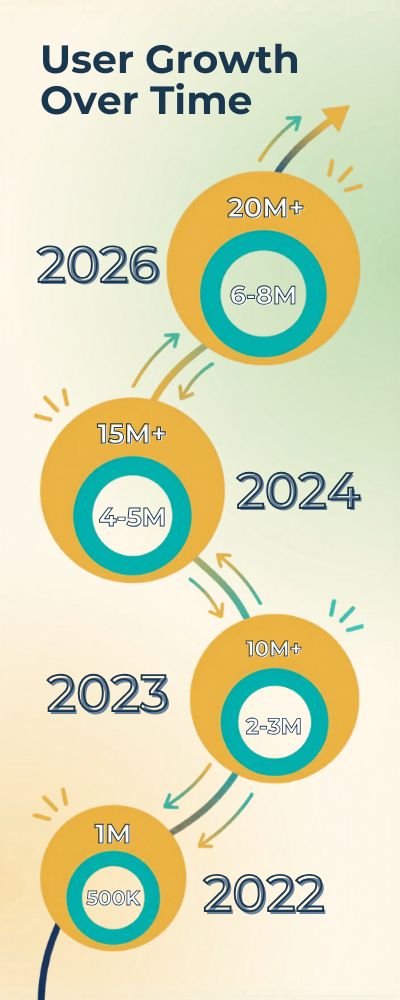
As of 2024, Midjourney already had over 15 million registered users, and the number kept rising in 2025 and 2026. Why? Because it’s easy, and because the results are great.
No design background needed. No coding skills required. You only need an imagination, and perhaps some endurance for those first few results that will look… well, let’s say not so good.
Year
Estimated Users
Monthly Active Users
2022
1 million
~500,000
2023
10 million
~2–3 million
2024
15+ million
~4–5 million
2026
20+ million
~6–8 million
Those stats don’t just indicate usage; they indicate sustained usage. Folks aren’t just doing a single session and bailing. They’re coming back, tweaking their prompts, creating workflows, etc. That’s a big deal, via DemandSage.
Image Generation at Scale: Billions of Creations and Counting
Okay, now let’s talk volume, because this is where things get a little nuts. Midjourney users are generating millions of images every day, totaling billions of images since launch. BILLIONS.
Take a moment to wrap your head around that. Before AI tools, creating that many pieces of art would’ve taken decades, if not centuries. Now it’s happening in real-time, prompted by strings like “cyberpunk cat detective in neon Tokyo rain.”
I find that…poetic. A bit chaotic, as well.
Tens of thousands of Midjourney prompts are reportedly processed per minute at peak times, putting Midjourney’s architecture on par with a social media platform, not a niche art tool, via EarthWeb.
Oh, and most of those generated images never see the light of day. They’re sketches. Tests. Shitty attempts. Which means all the art we actually DO see is merely the tip of the iceberg.
Revenue and Business Model: A Subscription Giant in Disguise
Midjourney doesn’t show ads. It doesn’t sell your data (at least not in the usual way). It’s a subscription business. And it’s doing great.
According to estimates, Midjourney broke $200 million in annual revenue by 2025, largely thanks to its paid plans for both hobbyists and power users. Not bad for a pretty lean company without the Silicon Valley glitz, via Business of Apps.
Plan Type
Monthly Cost
Key Features
Basic
~$10
Limited generations
Standard
~$30
Faster rendering, more jobs
Pro
~$60
Heavy usage, stealth mode
Mega
~$120
High-volume creators
The genius part? Once you begin, you kinda can’t stop. You play around with prompts, try to get better results, experiment with different styles, and the next thing you know, it doesn’t feel like you’re paying for a membership, it just feels like… well, that’s just what you do.
Who’s Actually Using Midjourney? (Spoiler: Not Who You Think)
When you think of a Midjourney user, you might imagine a designer working on a PC with two monitors:
User Group
Estimated Share
Hobbyists
35%
Designers
25%
Marketers
15%
Content Creators
15%
Developers/Other
10%
What’s most remarkable, however, is the prevalence of hobbyists. Midjourney is used as a hobby, for a gig, for content, for social media content, for a family story. For art, Coolest Gadgets reports.
User-generated content: types of things being made
When you browse a midjourney art channel, or a Discord channel, you will begin to notice that certain types of art are more common than others. These include:
Realistic images of people
Anime/manga images
Cinematic scenes (think movie stills that don’t exist)
Fantasy images
retro-futurism
The style of art that is popular changes over time. It was all Wes Anderson for a while. Now it’s all dark, surreal, and dramatic lighting. It’s fascinating to watch the internet culture develop. Another recent trend is that the prompts themselves have become more complex.
At the start, people typed in a couple of words. Now they write multi-line descriptions, complete with lighting, lenses, and mood. It’s a language of its own. Sometimes it’s a bit over the top. But that’s half the fun.
The Bigger Picture: Is This the New Creative Normal?
The scary thought: are we just using Midjourney as a tool, or is it changing the nature of creativity?
The numbers imply that it’s the latter. When anyone can produce professional grade visuals at the push of a button, then the meaning of “to be creative” changes. It becomes less about the ability to create something, and more about the ability to guide that creation. Less “can you draw this?” and more “do you even know what to draw?”
Now, that doesn’t mean the role of the artist has been removed from the equation. Not at all. In fact, I’d argue that the need for taste and innovation is actually increasing. Because in a world where everyone has the same tool, then all that’s left is how you wield it.
If you’ve ever agonized over a prompt for 20 minutes, only to have gotten something that’s just shy of perfect, you’ll know what I’m talking about.
From Niche Tool to Global Phenomenon: How Midjourney’s User Base Exploded
Midjourney Users Statistics: Wait… What Is This?
Until not that long ago, Midjourney was one of those phenomena that you hear about in a design group chat or a Discord server, and you’re like, “Oh, a new AI thingy, nice.” Then you try it out… and the next thing you know, it’s 2 a.m. and you’re creating astronauts in the Renaissance style. It all started small and wild and somewhat disorganized.
Midjourney launched in 2022 and a few thousand people started playing around with it. Then a few months later, it had over 1 million users, even though it doesn’t even have an app (yet), according to Exploding Topics.
The ironic thing is that nobody planned for Midjourney to go viral like this. They didn’t invest in giant ad campaigns. They didn’t create elaborate sign-up flows. It just happened. Like that one really cool meme that won’t die.
Discord
People are still surprised about this, so I thought I should mention it. Most consumer applications aim to decrease the number of steps it takes to start using them. Midjourney did the opposite: it made you use Discord, which for those who are not into it, is scary.
However, this worked out for them. Users felt like they were part of a gang, not customers. You get into a channel, you see what others are prompting, you try to adjust yours, maybe you copy someone else’s (don’t even try to deny it) and you are done.
You are already learning. Today, in 2023, Midjourney’s discord channel is one of the largest and most active creative communities in the web, with millions of users generating and sharing millions of images per day according to DemandSage.
The paradox. Something that could have been a hurdle in the journey, a non-standard interface, turned out to be a wind at their backs. People enjoy the feeling of belonging.
The Viral Loop: Why Everyone Started Talking About It
You know that moment when your feed suddenly fills up with something and you think, “Wait, when did this become a thing?” That was Midjourney around late 2023.
Artists were posting jaw-dropping visuals. Marketers were quietly using it for campaigns. Even people who had never touched design tools were sharing AI-generated portraits like proud parents.
This created a feedback loop:
Someone posts an image
People ask, “How did you make this?”
They discover Midjourney
Repeat… endlessly
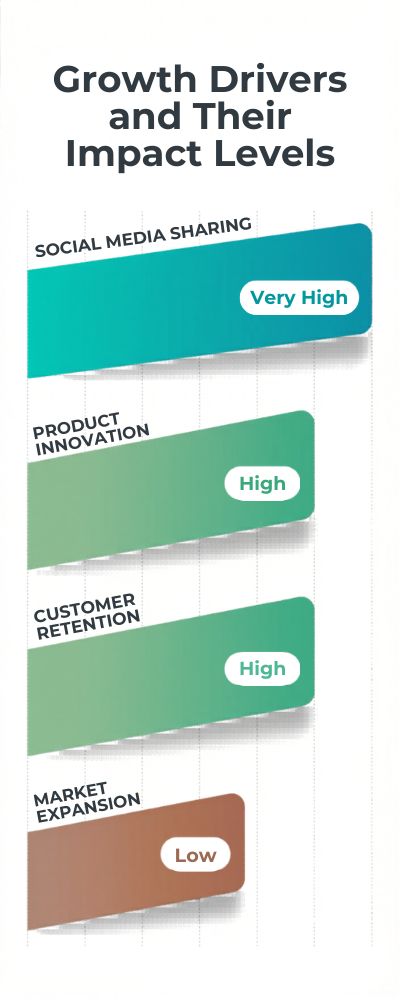
By 2024, the platform had surpassed 15 million users, driven largely by organic sharing and word-of-mouth rather than paid acquisition, according to EarthWeb.
Growth Driver
Impact Level
Social Media Sharing
Very High
Word of Mouth
Very High
Community Learning
High
Paid Marketing
Low
The takeaway here: sometimes the best growth hack is to create something people can’t help but talk about.
Not Just Designers Anymore: The Audience Shift
As things picked up, Midjourney drew in designers and digital artists. Understandably. However, the floodgates then opened up.
It became a tool for writers to tell stories. For entrepreneurs to mock up brand identities. For teachers, students, hobbyists, etc. to create. All of a sudden, creativity was no longer bound by one’s ability to hold a mouse.
As of recently, more than 60% of Midjourney users are non-professionals, or people who do not have a full-time job in the design or creative field, according to Coolest Gadgets.
User Type
Percentage
Non-professionals
60%
Professionals
40%
It’s Not a Western-Only Phenomenon
You might think that Midjourney is only popular in the United States and Europe, but you’d be wrong. The tool is gaining traction all around the world, including Asia, South America, and Africa.
The nations with the highest adoption rates are those with emerging digital markets and large youth populations. That’s because there are fewer obstacles. You don’t need to purchase software or spend years learning skills. All you need is access and interest.
It seems that non-American users now account for a large percentage of Midjourney’s community, which is partly why the platform has grown so fast and why its community is so diverse, according to Statista.
That shift matters. It means Midjourney didn’t just grow-it expanded the definition of who gets to create. And honestly, that’s where things start to feel a bit emotional. Because for a lot of people, this was their first time making something visual they were actually proud of.
Speed + Quality = Obsession
Let’s be real for a second. People don’t stick around just because something is new. They stay because it’s good.
Midjourney improved fast-almost suspiciously fast. Each version upgrade brought sharper images, better lighting, more realistic textures. You could literally see the progress in real time.
By 2025, Midjourney was generating millions of images daily, with users producing everything from commercial-grade visuals to pure experimental art, according to Business of Apps.
And here’s the part people don’t always say out loud: it’s addictive. Not in a bad way, necessarily, but in that “just one more prompt” kind of way. You tweak a word, change a style, rerun the generation. It’s like creative slot machines, except you occasionally hit something genuinely beautiful.
It’s not only about the US or Europe
While you might think that Midjourney’s user base is mostly from the US or Europe, the truth is that the platform has gained traction in Asia, South America, and even Africa. Developing markets with high access rates and a relatively young population are seeing the most traction.
The reason is simple. No licenses, nor degrees required. Only internet access. Reportedly, international users account for a large proportion of Midjourney users, driving growth and diversification, according to Statista.
Region
Estimated Share
North America
30%
Europe
25%
Asia-Pacific
30%
Other Regions
15%
And, honestly, this is part of why Midjourney is so much fun. You’re not just seeing one style of creativity, you’re seeing hundreds, crashing into each other, mixing, morphing.
Why Did This Blow Up?
In the end, I don’t think the explosion of Midjourney has much to do with the technology at all. I think it’s a combination of timing, access, and, yes, a bit of magic. Midjourney arrived when people were curious about AI.
It removed barriers to creativity. It was social, not isolated. But most importantly, it scratched an itch that people didn’t know they had: visual feedback on their creativity in the moment. Once you have that, it’s hard to go back.
How Many Digital Creators Use Midjourney? The Answer Will Surprise You (And It’s Still Kind of a Taboo Topic)
When I first started in digital media, it was pretty standard that you needed to have at least a little bit of experience with the Adobe Creative Suite to qualify as a digital creator.
Fast forward a few years, and you could be a total newbie who has never so much as opened Photoshop before in their life and now creates stunning visuals with nothing more than a few typed Midjourney prompts.
So how many digital creators are actually using Midjourney these days? Somewhere between 35% to 50% of digital creators have used an AI image generation tool of some sort, with Midjourney being one of the more popular options, according to DemandSage.
That is no longer a niche little side community. That is a legitimate wave of adoption. And if you’ve been on platforms like X, Instagram, or even LinkedIn (yes, you read that right, LinkedIn), you’ve probably already seen this in action. Sometimes you’ll notice, and sometimes you won’t. And that’s the real magic of it.
Market share of Midjourney: Not only popular, but dominant
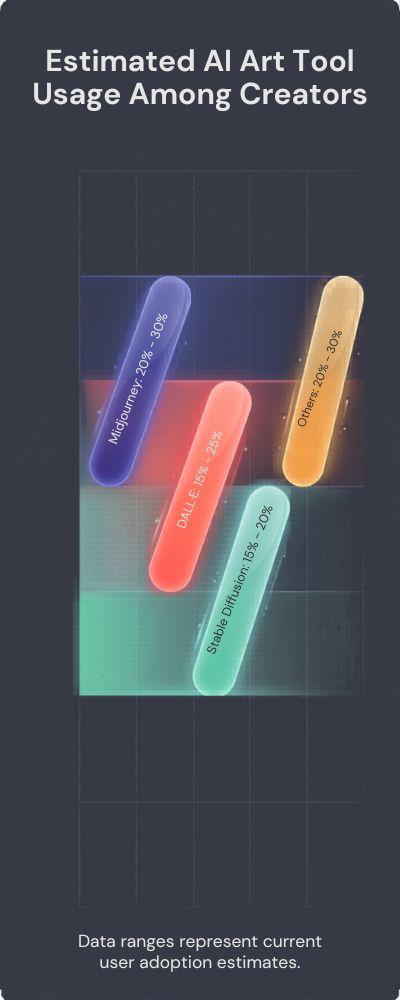
Now, lets take a closer look. Within AI-generated content creators, Midjourney is often in the top of the list. It has been reported that 20-30% of people who are creating AI-generated art prefer Midjourney over DALL-E or Stable Diffusion, according to Coolest Gadgets.
This figure may not seem like much, but remember that there are 30+ AI-platforms. 20-30% is quite a lot.
AI Art Tool
Estimated Usage Among Creators
Midjourney
20%–30%
DALL·E
15%–25%
Stable Diffusion
15%–20%
Others
20%–30%
So why would anyone use Midjourney? It’s not the easiest. It’s not the cheapest. But the quality? Yeah, that’s the draw. Artists tend to be connoisseurs. They can tell crap when they see it. Midjourney seems to pass that “f*** test” more frequently.
Professionals vs Hobbyists: A Tale of Two Worlds
Now things get a little murky. Because artists aren’t all alike, at least in how (and whether) they’re using Midjourney. Graphic designers, for example? They’re a little more… cautious. Some are all over it. Some despise it. There’s still a lot of distrust, especially around the ownership issue.
But, you know, hobbyists? Content creators? They’re not so shy. Full speed ahead and damn the torpedoes, as they say. According to Statista, over 60% of non-professional artists have already experimented with AI art, while the rate of adoption is lower among professionals (but growing).
Creator Type
AI Tool Adoption Rate
Hobbyists
60%+
Content Creators
50%+
Professional Designers
30%–40%
Truthfully, I get that. If you make a living off of what you create, you might be a bit more hesitant to start messing around with something that could potentially replace you. If you create for leisure or for speed, that’s a different situation entirely.
The “I’ll Just Try It” Effect
I think a big part of Midjourney’s users aren’t so much purposeful, but exploratory. Someone sees an image, “how was this made?” and decides “I’ll just try it one time.”
That one time rarely stays one time.
I think there’s something mildly addictive about seeing your concept come to life in a matter of seconds. Even if it’s not what you want, especially if it’s not what you want, there’s this sort of compulsion to go back and fix it. Tinker with the prompt, add some more detail, go again.
Surveys show that a high number of users continue to use AI tools after their first time, with retention increasing as users become more confident in prompt building, according to EarthWeb.
That’s the trap. It’s not just availability, it’s the ability to go back and iterate. You’re not just creating something, you’re in a weird sort of way, working with it, yeah, that sounds a bit absurd.
Though nobody is talking about it, Midjourney has already seen extensive adoption among businesses.
Agencies have started using Midjourney for concept art, startups for branding mockups, and publishers for graphic development. Although it’s not commonly discussed, it is happening.
According to HubSpot, more than 40% of marketers have already used AI-generated content, including graphics.
Industry
AI Art Usage Rate
Marketing
40%+
Media & Publishing
30%+
Gaming
25%+
E-commerce
35%+
You don’t always hear about this adoption. You don’t even always see it. But it’s happening. And once something like this makes its way into a workflow, it’s very hard to get rid of.
What Does This Actually Mean for Creativity?
This gets a little more subjective. Because those numbers are one thing, but they don’t tell the whole story. When nearly half of digital creators are already experimenting with AI, it starts to move the needle on creativity. It doesn’t happen overnight. It doesn’t happen all at once.
But it happens. Some people feel inspired. Some people feel threatened. Both responses are okay. What I’ve been seeing (and maybe you’ve been seeing this too) is that creativity isn’t going anywhere. It’s evolving. The gates are a little wider, which means more voices, more visions, more crap… but also more potential.
And yeah, it can be a little scary. But it can also feel like you just found a door you didn’t know was there. So if you’re still wondering if Midjourney is a fad or a movement, I think the stats are answering that for us. The bigger question is what we’re going to do with it from here.
Midjourney vs Competitors: Market Share, Usage Trends, and Who’s Winning the AI Art Race
Who is winning in the AI art race? It’s complicated. You want a simple answer, I know. Just give me a name. But the reality is the AI art market isn’t like that. We’re not just racing one race, we’re racing like… four races at once on different tracks.
Midjourney is winning the image quality race.
DALL·E is winning the ease-of-use and integration race.
Stable Diffusion is winning the flexibility race.
Firefly is winning the commercial use race.
So, before I give you an answer, we have to clarify what we are measuring. Number of users? Revenue? Cultural impact? Quality of images? Because depending on which one you care about, the answer is going to be different. (See more statistics like this over at DemandSage.)
Market share
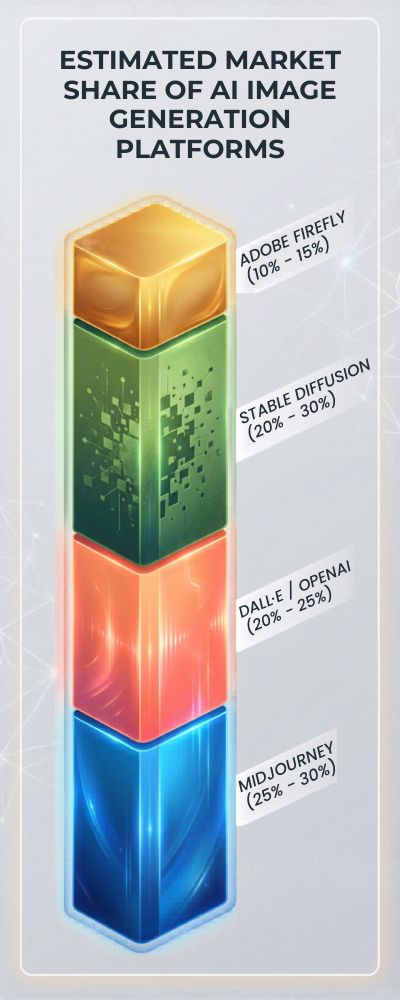
Midjourney still has strong position, but not a monopoly. Midjourney is usually mentioned as one of the most prominent proprietary AI-image solutions. According to Quantumrun, it has around 25-30% of market share among paid AI art generators, which is impressive considering how crowded the space has become.
It is said that share of OpenAI image generators (including DALL·E) is around the same, depending on market definition. Stable Diffusion complicates everything because it’s open-source and its “market share” is more like a shadow that is spread across thousands of apps and tools.
Platform
Estimated Market Share
Midjourney
25%–30%
DALL·E / OpenAI
20%–25%
Stable Diffusion
20%–30% (fragmented)
Adobe Firefly
10%–15%
None of these figures are directly comparable, of course. Each of them is counting something slightly different. But you get the idea. Nobody has a monopoly on this market. It’s a free-for-all. A bit of a mess, to be honest.
2. Usage patterns: Who people use vs who they discuss
I think you might have noticed this too. The tools people discuss the most aren’t necessarily the tools they use.
People talk about Midjourney because the results are gorgeous. It’s what they share. But when it comes to daily workflow, particularly when collaborating with others, DALL·E and Adobe Firefly often get used because they’re more straightforward to work with.
According to HubSpot, some 40%+ of companies exploring AI-powered visual content are using features inside other tools/products (not dedicated tools) these days.
Use Case
Most Common Tool Type
Social media visuals
Midjourney
Marketing workflows
DALL·E / Firefly
Custom pipelines
Stable Diffusion
Enterprise design
Adobe Firefly
So sure, maybe Midjourney is going to be the clear winner when it comes to people making art, but what about in a business environment? Well… different priorities come into play.
Quality vs Control: The silent trade-off truth bomb
I mean don’t get me wrong here. Midjourney’s strong point is also its weakness. The results are often really good out of the box, but you have less control than you do with Stable Diffusion. You’re just giving the model directions, rather than holding the wheel.
Stable Diffusion is more like giving someone the keys to your garage and telling them to do whatever they want. You can train models, custom data, parameters etc, etc. But there’s a lot more complexity involved.
They pretty much always rate Midjourney the highest when it comes to quality, and Stable Diffusion the highest when it comes to control and customizability, at least according to this one AI review page I can find that is comparing midjourney, DALL-E, and Stable Diffusion.
Feature
Midjourney
Stable Diffusion
DALL·E
Image Quality
⭐⭐⭐⭐⭐
⭐⭐⭐⭐
⭐⭐⭐⭐
Customization
⭐⭐⭐
⭐⭐⭐⭐⭐
⭐⭐⭐
Ease of Use
⭐⭐⭐⭐
⭐⭐
⭐⭐⭐⭐⭐
We have the simplicity and beauty, or control and flexibility. Rarely both.
Revenue and business models: Who’s actually making money
This is one that doesn’t get nearly enough attention. Popularity is great, but revenue paints a different picture.
Midjourney is said to have generated over $200 million a year in revenue, purely from subscriptions. That’s wild when you think about it, as there are no ads, no enterprise licensing at scale, just people paying to create, according to Business of Apps.
Adobe monetizes Firefly as part of their ecosystem. OpenAI bundles image generation into a broader API economy. Stable Diffusion is monetized in pieces, through hosting platforms, enterprise deals, and custom implementations.
Platform
Monetization Model
Midjourney
Subscription-based
OpenAI / DALL·E
API + subscription
Stable Diffusion
Open-source + enterprise
Adobe Firefly
SaaS ecosystem
Different strategies, different advantages. Nothing has yet emerged as a clear winner.
So, what does the current score look like? It depends on whom you ask.
Ask artists: Midjourney. The results just have a certain shine that they can’t deny.
Ask developers: Stable Diffusion. Flexibility ultimately beats out the competition.
Ask corporate: Adobe and OpenAI are increasingly compelling. Reliability, stability, and scalability count for a lot.
Ask me? I think Midjourney has won the current battle. It is the tool most closely associated with AI art in the zeitgeist. But a long term winner? There’s still a long way to go yet.
The Economics of AI Creativity: How Midjourney Is Changing the Value of Art and Design
Creativity used to be expensive-now it’s… complicated
There’s a moment a lot of people don’t talk about openly. You generate an image in Midjourney that would have taken hours-maybe days-for a human artist to create. And you sit there thinking, “Wait… what does this mean for the value of that work?”
That question is uncomfortable. Not because there’s a simple answer, but because there isn’t one.
Traditionally, high-quality visual design came with a price tag-software, training, time, experience. Now, tools like Midjourney compress all of that into a prompt and a few seconds of rendering.
The economics of production are imploding (and this is what that means)
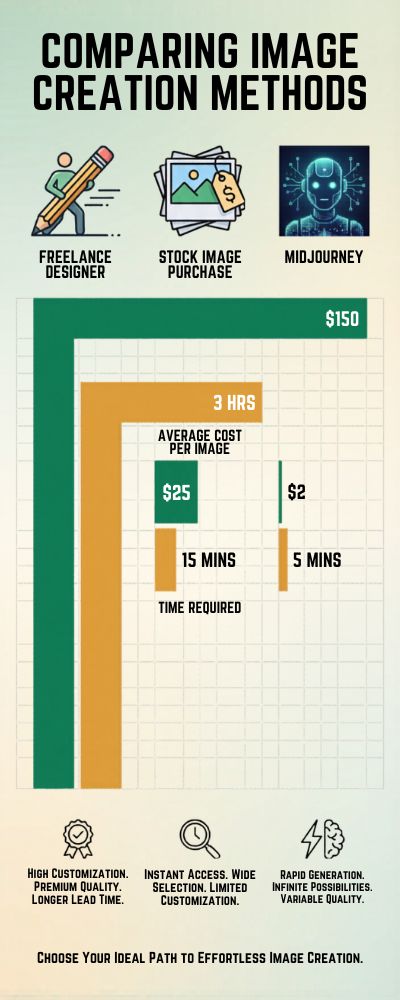
Let’s throw some rough figures on that. When you commission a professional designer to create an illustration for you, you’re likely to pay anywhere from $100 to $1000+ (depending on the intricacy of the design). With Midjourney, you pay a monthly subscription fee, usually between $10 and $60, and create tens or even hundreds of images a month.
This is not just a reduction in price. This is a fundamentally different business model.
According to Business of Apps, Midjourney is already making over $200 million a year in subscription fees. This illustrates just how powerful the low-cost, high-volume business model can be.
And yeah, that table does seem pretty harsh. But that’s why companies care. Supply is exploding… and that’s not always a good thing
Now, here’s the other side of the coin. When something becomes cheap and easy to produce, supply goes up. A LOT. For example, Midjourney users produce millions of images per day, which contribute to a huge supply of images on the web.
So what happens if anyone can make a high quality image? The value of any single image decreases. Not because the image is lower quality, just because there are so many other images. This is just simple economics.
When supply goes up, price (or value) tends to decrease. And if you’re an artist trying to make a living, that’s, to be honest… a bit frightening. It’s not just a matter of competition. It’s a matter of oversaturation.
But here’s the twist: demand is growing too
This is where things get interesting. While supply is exploding, demand for visual content is also rising. Businesses need more content than ever, social media posts, ads, thumbnails, product visuals.
HubSpot reports that over 40% of marketers now use AI tools for content creation, including visuals, as per HubSpot. So yes, individual images might be worth less. But the total volume of work is increasing.
Factor
Trend Direction
Supply of images
↑ Increasing
Demand for visuals
↑ Increasing
Cost per image
↓ Decreasing
Speed of production
↑ Increasing
An odd equilibrium. Increased competition, but more opportunities as well, even if not necessarily in the exact same way as in the past.
The artist’s position is evolving, not going extinct
I keep seeing the idea floating around that AI will completely take over the jobs of artists. That I don’t believe. I do believe, however, that the value proposition of artists will change.
How to execute used to be the big question. Now? Taste, direction, and originality are more valuable. Anyone can create an image. Not anyone can create a meaningful one.
Indeed, professionals are increasingly using Midjourney as a tool, not as a replacement, for accelerating idea development, testing concepts, testing visual styles.
Research shows a steady increase in the number of designers incorporating AI into their design processes, not replacing their design processes, (according to Statista.
Honestly, I think that’s a much more constructive way to approach the matter. Not “AI or artists.” But “AI and artists.”\
Pricing models are being rewritten in real time
One more silent change, pricing of creative services.
If clients know you can draft things rapidly with AI, they will expect more efficient turnarounds… and sometimes lower prices. That’s the scary part.
However there is an upside. Creators who can leverage AI tools can provide even more value, more rapid iterations, wider exploration, and hybrid processes.
It’s like this:
Traditional Model
Emerging Model
Pay per final artwork
Pay for creative direction
Time-based pricing
Value-based pricing
Manual execution focus
AI-assisted workflow
It’s not simple. It takes adjusting, it takes learning new things and sometimes it takes scrapping the way you have done things for years. But what’s the real risk? Ignoring it?
So what is art “worth” now?
That’s the question that seems to keep coming up and my answer to that is… it depends. Are you determining the value of it based on the amount of time or effort it takes to create it? That seems to be where AI will upset the apple cart.
Are you determining the value of something based on how it makes you feel, the originality of it or the message it conveys? Then I don’t think AI has changed anything. That picture that was made with Midjourney may be amazing… but does it have a message?
Does it evoke emotion in people who look at it? Is it original or is it one of 1000 pieces that look just like it? That’s where I think the real value of human artists still lie. Perhaps that’s the point. I don’t think AI has made art worthless, I think it has made us reevaluate what it is that we value about it.
Global Usage Breakdown: Where Midjourney Is Growing Fastest (By Country & Industry)
Global Adoption: The Countries and Industries Most Embracing Midjourney
Beyond Silicon Valley
There was a time when you could safely assume that Midjourney was a Silicon Valley phenomenon. That’s where all the tech originates and then disperses, right? Well, not so much these days.
Adoption of Midjourney has become more global. Not just in some nebulous sense that “there’s lots of international users” but in the more concrete sense that there are whole countries that have grabbed onto it and started running.
More than 60% of Midjourney users are outside North America, according to DemandSage.
But you could already tell that based on some of the prompts and styles and cultural influences. It’s less dominated by Silicon Valley than it used to be, and more, well, distributed.
Countries most engaged with Midjourney
Here is a country by country look at Midjourney use. The base is fairly wide, though there are some countries that are growing faster than others.
Region
Estimated User Share
North America
30%
Europe
25%
Asia-Pacific
30%
Latin America
10%
Africa & Others
5%
APAC region
APAC is really interesting. India, Indonesia, South Korea, etc. are all growing really fast. Partially because they skew a bit younger and are more digitally active. Europe is 2nd, led by creative and freelance communities.
North America is a big chunk, but we’re no longer the epicenter. The center of gravity is moving. See Statista’s larger AI adoption data here.
Fastest growing countries
Not what you’d expect. Obviously, you’d think that the US, UK, Germany, etc. are all growing really fast. That is true. But there are a number of countries that aren’t usually in the headlines that are growing even faster. For example:
India
Brazil
Philippines
Turkey
These countries are all growing really fast, particularly among young creatives and freelancers. Why? Lower friction. You don’t need a fast computer or go to school for two years. You just need a web browser and a curiosity.
“Emerging markets are adopting generative-AI applications faster than some developed markets, driven by the greater availability of these tools and the stronger need for additional digital-income streams,” according to a report by consulting firm McKinsey. I dunno. That’s sort of cool to me. Less gatekeeping in the creative world.
Industry breakdown: Who’s actually using it at scale
Now here’s where things get more practical. Which industries are actually using Midjourney regularly-not just experimenting, but integrating it into workflows?
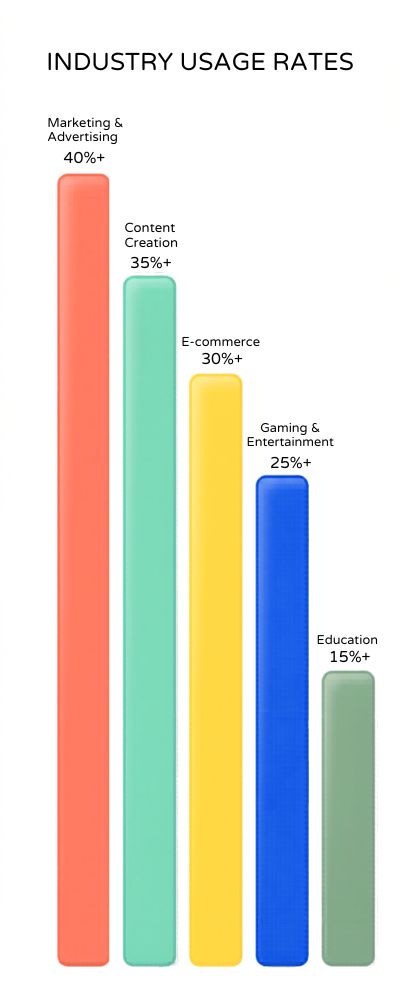
Industry
Estimated Usage Rate
Marketing & Advertising
40%+
Content Creation
35%+
Gaming & Entertainment
25%+
E-commerce
30%+
Education
15%+
Marketing is the obvious frontrunner here. There’s a never-ending appetite for visual content. Social media alone is hungry for images. Over 40% of marketers now use AI for visual content creation, as per HubSpot.
As soon as something saves you time (and money) it becomes the new normal. No-one is going to go back to something that is slower than that.
Freelancers and solo creators: The real growth engine
This is where I don’t see enough being said. Businesses are using Midjourney of course, but a lot of growth is coming from individuals. Freelancers, side hustlers, content creators. People who don’t have budgets, people who don’t have a team. Midjourney helps.
Now one person can do the work of a designer, an illustrator and a concept artist. The majority of AI tool users are independent or small-scale creators, as per Coolest Gadgets.
And if you have ever had to try and do all those things by yourself, you’ll appreciate how valuable that is. It’s not just a time-saver, it’s an enabler.
Localised Cultures: Style is dependent on the region of the world you are in
It is underappreciated the fact that culture and geography also play a massive part in what people are creating. It isn’t just the spread of midjourney that is happening, it is diverging in different regions of the world:
Asia: Anime, videogames and stylised art
Europe: Arty, experimental, surreal
North America: Commercial, polished, advertorials
LatAm: Colourful, lively, culturally strong
This is part of the reason why I find the platform fascinating. It isn’t just that there is more of everything, it is that you are seeing more varied ideas. Sometimes they collide and combine in weird ways, but that is the nature of the beast. It is human and unpredictable.
Where is Midjourney gaining the most traction then?
The simple answer is: emerging markets and the creative fields. Regions where the opportunity to make a living is vast, where digital competencies are the fastest route to a paycheck and where the means to create are not restricted by the ability to afford expensive tools.
That’s where Midjourney is making the biggest inroads.
Commercially, the early adopters are in time-sensitive fields such as marketing, content, and commerce. In a broader sense, the creative economy is globalizing, decentralizing, and, well, becoming more democratized. And that seems to be more significant than one tool.
Most popular Midjourney styles, keywords, and creative trends
Prompt Power
It always starts with a bad prompt. We’re just going to get that out of the way. No one writes the perfect prompt first try. You type in something like “cool futuristic city” and hope for the best… and what you get is either genius… or hot garbage. Sometimes both.
Then you tweak it. Add “cinematic lighting.” Maybe “ultra realistic.” Suddenly it’s better. You feel like you’ve unlocked some kind of cheat code. Truth is, Midjourney is just a prompt game. And the better and better people get at it, the more trends you start to see.
According to various AI usage reports, people are using multi-keyword prompts with style modifiers more than simple descriptions, as is clear when you compare Midjourney vs Dalle vs Stable Diffusion.
The most popular styles (and why they won’t go away)
Take a look through Midjourney galleries for five minutes and you’ll start to see the same styles repeated over and over again. Not because people aren’t creative, but because some styles just slap.
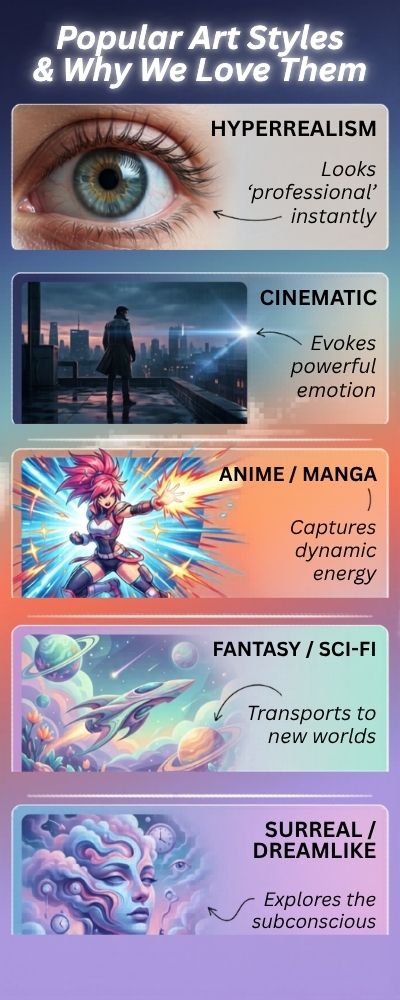
Here are some of the most popular styles:
Style Type
Why It’s Popular
Hyperrealism
Looks “professional” instantly
Cinematic
Feels like a movie still
Anime / Manga
Strong global fanbase
Fantasy / Sci-fi
Escapism, world-building
Surreal / Dreamlike
Emotional and abstract appeal
Hyperrealism is king. This is the most obvious of all the trends. The truth is, humans are suckers for photorealistic images. It’s a really simple trick to get people to get excited about an image. “Whoa, look at that! It’s so photorealistic! That’s so cool!” Hyperrealism will always get a higher wow factor than anything else.
Stylized visuals, anime, cartoon, all that stuff is still huge. Especially in Asia, especially among younger generations, as Statista reported in their digital culture survey. . Anime, cartoon and especially cyberpunk are all still huge, but I’m just giving you the most popular stuff.
Hyperrealism is the most popular. We talked about anime being huge and there’s a lot of overlap between the different trends. “Hyperrealistic anime cyberpunk portrait” is a thing and it works.
Overused keywords
Now I’m going to share with you some keywords that are used so frequently that they are now basically part of the Midjourney language. I’m sure you’ve probably used many of these without even realizing it. Keywords like:
cinematic lighting
ultra detailed
8k
photorealistic
sharp focus
dramatic shadows
depth of field
These are not accidents. These are tools that help push the AI in a certain direction. Data suggests that prompt complexity and length have increased significantly over time, with users stacking multiple modifiers to refine outputs, according to EarthWeb.
Keyword Type
Purpose
Quality modifiers
“8k”, “ultra detailed”
Lighting terms
“cinematic”, “soft light”
Camera terms
“depth of field”, “bokeh”
Mood descriptors
“dark”, “epic”, “moody”
It’s kinda ironic, really. We had to develop a whole language just to communicate with a robot.
Trends come and go… fast
One week it’s “Wes Anderson style.” Next week it’s “AI-generated fashion models.” Then suddenly everyone’s doing “ancient statues in modern settings.” Trends in the Midjourney community move at an insane pace. Even faster than in the rest of the art world.
Because iteration happens in real-time. Social media is a big part of this. When one popular post goes viral, it creates thousands of copy-cat prompts in a matter of hours.
According to HubSpot’s social media trend analysis, AI-generated visual trends spread across social media platforms in a matter of days not months. Sometimes it gets boring. But then something new comes along and changes the game all over again.
The rise of “prompt engineering” (yes, it’s a thing now)
This is something that still feels a little awkward to say aloud: writing prompts has become a skill.
People share prompt templates, sell prompt packs, even offer courses. And before you roll your eyes, it actually makes sense.
The difference between a basic prompt and a well-crafted one can be massive.
Prompt Type
Example Outcome
Simple
Generic image
Detailed
Polished result
Structured prompt
Highly refined, consistent output
Some artists are able to regularly generate amazing images, not because the tool is different, but because they know how to communicate with it.
Now this, I think, is where it gets a bit more human again. The role of skill hasn’t vanished. It has simply changed.
What does that tell us about creativity?
From a distance, I think it is quite remarkable. We are seeing the birth of a new language in action. Not painting, not coding, but something inbetween.
We’re not just generating images, we are learning to speak in ideas, more accurately, more visually, more emotionally.
And yes, sometimes it feels a bit mechanical. Trial and error, repeating words, fiddling with phrases. But other times, it feels like working together. Guiding the machine.
If you ever spent 15 minutes editing a prompt just to get the lighting right, you know what I mean.
Perhaps the trend isn’t a style or a keyword at all. Perhaps the trend is simply this transition. From designing with your hands to designing with your mind first. And honestly, that’s no minor thing.
Inside the Algorithm: How Midjourney Generates Images and Why It Keeps Improving
The Magic in the Machine
It’s a mind-blowing feeling… until you have to describe it.
You input a prompt. Then you wait a few seconds and an image is returned that resembles something a professional photography studio would produce. The initial thought is: this is insane, how does this work?
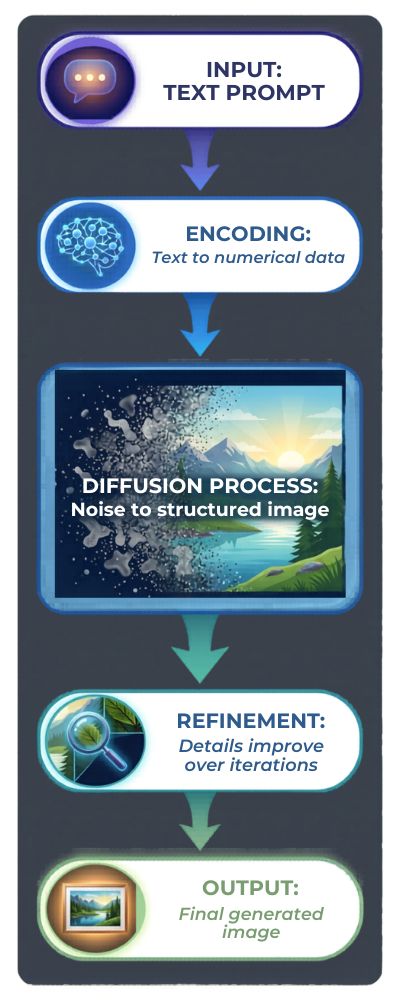
The short answer is that it’s not magic. The longer answer is a bit more complicated. MJ uses something called a “diffusion model”. A diffusion model starts with pure noise and iteratively refines it until it creates an image based on the prompt you input. Think of it as chiseling a sculpture out of white noise.
The model itself is trained on a dataset of image-text pairs, so it understands the relationship between certain words and visuals. When you input “a cinematic portrait with soft lighting” the model isn’t just making something up, it’s based on its understanding of a million (or a billion) examples for a summary on generative AI models.)
Noise to Image: A Step-By-Step Explanation
Here is a more simplified explanation that doesn’t require a Doctorate:
You input text
The model interprets the text into a mathematical equation
It begins with noise
It slowly denoises and refines the image
The process is repeated, and eventually, you have an output.
Step
What Happens
Input
Text prompt
Encoding
Text → numerical data
Diffusion process
Noise → structured image
Refinement
Details improve over iterations
Output
Final generated image
This happens nearly instantaneously…often in seconds. It’s a bit ridiculous when you think about it. Complex math, probability, and pattern recognition…distilled into a progress bar. And yeah, it still feels a bit like cheating sometimes.
Why the results keep getting better
Now this is the part that’s really interesting. The first few versions of Midjourney were great…but you could tell they were AI generated. The faces weren’t quite right, the hands were…well we don’t even talk about the hands.
Now? You can see the difference. The images are sharper, the anatomy is better, the style is more consistent. So what changed? Three big things:
Better training data
Improved model architecture
User feedback loops
AI models improve as they are trained on more diverse and higher-quality datasets, and as developers refine how the models interpret prompts, according to McKinsey’s analysis of generative AI development.
But there’s also something else…users themselves. Every prompt, every selection, every preference feeds back into the system in some way. It’s millions of tiny corrections happening all the time.
The power of iteration: the importance of versioning
When you’ve been around for a while and seen Midjourney go through multiple version upgrades, you start to feel it when they happen. Going from version 4 to version 5 was a big step. Going from version 5 to version 6 was another one. This isn’t a coincidence. The tool is being continually trained and improved.
Version
Key Improvement
V4
Better composition
V5
Improved realism
V6
Higher consistency & detail
Each new iteration gets closer, with fewer mistakes and a better understanding of the prompt. It isn’t there yet, but it is getting closer very quickly. To be honest, that can be a little disconcerting at times. You get used to a certain level of quality, and then it improves again.
Why prompts are more important than you realise
One thing that people often seem to forget is that it’s not all the algorithm. The prompt matters. If you ask for something vaguely, you’ll get something vague. If you ask for something specific, you’ll get something more specific.
According to EarthWeb, researchers found that the quality of text prompts had a direct effect on the quality of the results, with more detailed text prompts leading to more accurate results that were more visually pleasing.
So when you say “AI did it,” well, that isn’t strictly true. AI assisted. But you told it what to do. Sometimes you have to fight with it, but you told it.
Those imperfections are a feature of the product
I’ve mentioned a few ways that Midjourney v5 improves on v4. But it is still far from perfect. It can’t get text right, or handle multi-part actions, or follow highly specific directions.
Perhaps that’s okay.
The imperfections serve as a reminder that there is still a distance between the imagined and the realized. A distance in which humans can play a role. We can’t lose sight of what the AI can’t do.
So… is the algorithm “creative”?
Regardless of whether we want to, we have to get philosophical here.
Midjourney isn’t imaginative in the way that humans are. It doesn’t have emotions. It doesn’t “desire” to make things.
But it can synthesize concepts in creative ways. Sometimes, that can be enough to make the distinction fuzzy.
Ever seen a generated image and thought, “I didn’t ask for this, but I kinda like it?” You’ve lived the fuzziness.
Perhaps the real question isn’t whether the algorithm is creative, then. Maybe it’s how it alters our own creativity.
Who is using Midjourney? Demographics, Occupations and Other Interesting User Behavior
It’s not just the “tech folks” anymore
When people would have been asked who is going to use Midjourney back in 2022, they would probably have guessed designers, possibly some developers and the odd digital artist. A fair guess… except that that’s so last season. We are in a new season. The user base has long since expanded beyond its original niches.
Midjourney nowadays doesn’t feel like a tool and users feel like a digital art studio that you can visit and in which you can tinker. Estimates tell us that the majority of Midjourney users are non-professionals.
That is, they don’t work as designers or in the creative industries full time. And well… that’s the story. The tool didn’t just scale, it democratized.
Demographics: Age
Young, but not entirely so
You would think this is a Gen Z platform. It is, but not as much as you think.
Age Group
Estimated Share
18–24
30%
25–34
35%
35–44
20%
45+
15%
25 to 34: No surprises here. They were born with the internet and are heavily invested in creative and professional applications. But here’s a fascinating age group. People who didn’t grow up with design tools are now experimenting with visual creation for the first time.
So that’s exciting. Overall AI adoption follows a similar pattern, reaching beyond younger generations. Occupations: Not what you’d think. It’s not all “creative types”.
Professions: Not what you’d expect
This one’s a bit of a twist. The jobs of Midjourney users don’t really fall into a single bucket. It’s a melting pot of creatives and non-creatives.
Profession Type
Estimated Share
Hobbyists
35%
Designers
25%
Marketers
15%
Content Creators
15%
Developers/Other
10%
Hobbyists are actually the biggest group. That still surprises a lot of people. Designers are obvious. But they are not the dominant type of user any more. Marketers and content creators are coming on pretty strong too.
We have a lot of users who use it for marketing campaigns and image for thumbnails and branding ideas. And then there’s just “other” that’s teachers, writers, entrepreneurs, that kind of thing.
People who never identified as visual artists before. It seems that AI software is being used by most professions, particularly those in content, says HubSpot.
Behavioral change: They don’t just use it, they tinker
This one’s a bit harder to measure, but you can kinda tell when you use the platform. They’re not just making images, they’re tinkering, messing around, exploring.
A typical use session doesn’t go like this: “Generate image → done.” Instead it looks more like “Generate → tweak → regen → fiddle with settings → try different style → get sidetracked → try something completely different.”
According to reports, most users make multiple attempts per prompt, showing a pronounced pattern of tinkering and iteration. And honestly, that’s where a lot of the engagement value is coming from. The journey, not the destination.
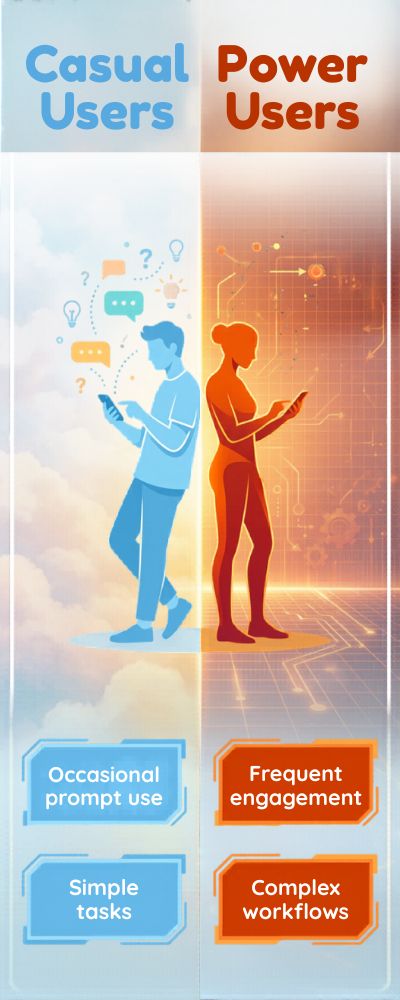
Power users vs casual users: Separate ecosystems
Turns out not all users are the same. There’s a chasm between power users and casual users.
User Type
Behavior Pattern
Casual Users
Occasional use, simple prompts
Power Users
Frequent use, complex prompts, workflows
Power users approach it more as a discipline. They polish prompts, explore aesthetics, standardize results. Some even make money from it, designing, offering prompts, content creation, etc.
Casual users don’t take it that far. They create a few images, share them, and then just drop it.
Both are important. One is for depth and the other for breadth.
The emotional part: Why users come back
It’s not only about demographics and occupations. There’s a human aspect to this, that we easily lose sight of.
For many people, Midjourney is the first time that they produce a visual image that actually looks good. Not “good for a beginner”. Just good.
The feeling lingers.
It’s not just about being productive or efficient. It’s about confidence, curiosity, or sometimes even a touch of vanity.
Yeah, I know it sounds a little sappy. But if you have generated an image and thought, “Wait, did I do this?”, you know exactly what I’m talking about.
So who is actually using Midjourney?
Short answer: everyone.
Longer answer: anyone with a concept and curiosity to try.
It’s designers, sure. But it’s also marketers, students, freelancers, hobbyists and people who never thought of themselves as creative.
And I think that’s the most surprising thing. Not the tech itself, but the types of people it’s impacting.
The Future of AI Art: Midjourney Predictions for 2030 and Beyond
We’re not even close to the “final version” yet
It’s tempting to look at Midjourney today and think, “Wow, this is already peak.” But that’s probably the same thing people thought a couple of versions ago, and then everything improved again.
The reality is, we’re still early. Like… early early.
Generative AI is expected to contribute trillions of dollars annually to the global economy by 2030, which includes creative industries like design, marketing, and media, according to McKinsey.
That kind of scale doesn’t happen unless the technology keeps evolving. And if it keeps evolving, Midjourney (and tools like it) won’t look the same in five years, let alone ten.
1st prediction: Generated images will be photo-realistic
We can already see that some AI generated images are already tricking people into thinking they are real. I predict this will be even harder to distinguish in 2030, if at all.
More specifically, we can expect future models to excel at:
Detail: faces, hands, textures, reflections, etc
Multi-image consistency
Complex scenes
Feature
Today
By 2030 (Expected)
Realism
High
Nearly perfect
Consistency
Moderate
Very high
Text rendering
Limited
Accurate
The quality of the output will only increase in the future as the training of AI models and the power of the computers improve. Yes, that does create some uncomfortable questions around authenticity. But let’s deal with that later on.
Prediction #2: AI art will no longer be just images
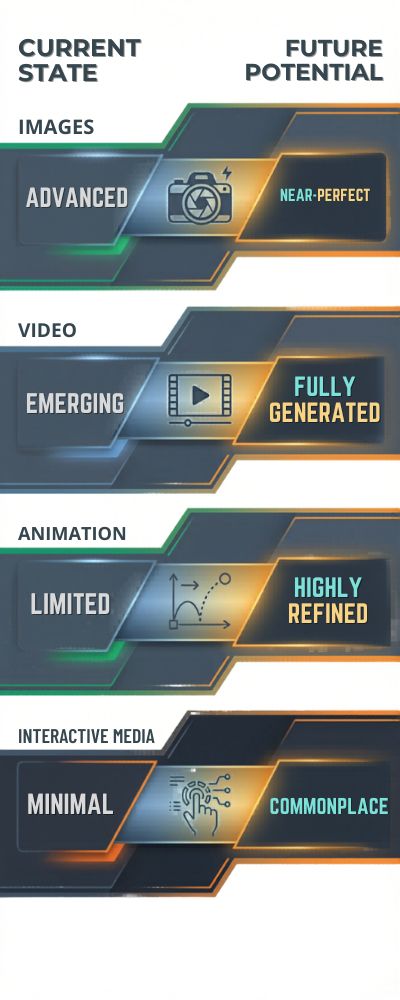
Midjourney at present is an image-based service. I suspect that the future will be multimodal: images, videos, animations and possibly even interactive work. Think being able to generate a short movie.
Including movement, sound and editing. I’m seeing AI tools already moving in this direction, as they integrate with other media types.
Content Type
Current Capability
Future Potential
Images
Advanced
Near-perfect
Video
Emerging
Fully generated
Animation
Limited
Highly refined
Interactive media
Minimal
Commonplace
It feels a little futuristic, but AI-generated art felt like that a few years ago too.
Prediction #3: Creativity will become more about ideas than execution
This is already underway, but it will probably accelerate.
If anyone can create top-notch imagery in a split second, the emphasis shifts from execution to idea generation. Ideas, narrative, innovation.
According to surveys, AI adoption is forcing professionals to spend more time on strategy and creativity and less on production, HubSpot reports.
Honestly, that’s both exciting and a little daunting. Because thinking of good ideas? That’s not as easy as it sounds.
Prediction #4: New careers will emerge (and old ones will adapt)
Whenever technology advances, so do occupations. AI art is no exception. We’re already seeing positions like:
Prompt engineer
AI-assisted designers
Creative directors for AI workflows
By 2030, these positions may become more established…and widespread.
Role Type
Status Today
Future Outlook
Prompt Engineer
Emerging
Established
AI Creative Director
Niche
Mainstream
Traditional Illustrator
Adapting
Hybrid role
The states that AI will both replace and generate jobs, especially in the creative and knowledge-based sectors. So, it is not only about loss, it is about transformation. Messy, but not necessarily negative.
Prediction #5: Ethical concerns will be raised
This one is inevitable. The better AI-generated art gets, the louder the discussions around copyright, ownership and authenticity will become. Who owns the rights to an AI generated image? What about copying styles? How do we tell what is real and what is not?
These are not hypothetical questions anymore. They are being discussed, and they will probably influence the way Midjourney and similar tools will develop. According to experts, regulation and ethics will become increasingly important as the use of AI expands .
And, to be frank, this is where it gets ugly. Technology is fast. Regulation… less so.
So, what will 2030 be like?
I would describe it as: more powerful, more convenient, more nuanced. Midjourney, and similar instruments, will probably be:
Faster
More accurate
More woven into our routines
But also more controversial, more critical, more… human, in that it will bear the imprint of our priorities and decisions. Perhaps that is the lesson. The future of AI art is less about the quality of the output and more about how we decide to engage with it.
Ultimately, the instrument will only be able to take us so far. What we do with it is still up to us.
How many images are being created every day?
Millions. This is the number of images (from concept art, to ads) being created every day.
How long does it take to create an image?
Less than a minute. This is the typical time it takes to create a finished image. In contrast, a human artist might take anywhere from a few hours to a few days to create the same image.
How long are people’s prompts getting?
Really long. People are writing enormous prompts to customize their results. For advanced creators this might include references, lighting information, composition, etc.
How many attempts does the typical person take?
Most users generate multiple variations before settling on a final image. This is consistent with how other design tools are used.
Are people using the upscale (enhancement) features?
Yes. The majority of our users rely on at least one upscalse. Many rely on multiple.
Commercial vs. personal usage?
A significant portion of generated images are used for commercial purposes, including marketing, branding, and content creation. Others use the platform for personal projects or experimentation.
Is this cheaper than a designer?
Access to Midjourney is priced at a fraction of the day rate of a professional designer. But, for more complex applications, humans will be needed. Cost savings are a major factor for adoption.
Number of paying customers of Midjourney
Midjourney’s revenue model is based on paid subscriptions. Many people upgrade to Midjourney’s paid plans to generate more images and get them faster. Number of paid users will give us an idea about the demand for the tool. Monetization will grow as the user base grows.
Discord based interface
Midjourney is built on top of discord, and that is how you will use it. The use of discord will give you a different experience. You will use the tool in discord public channels. That way, you will see what others are generating. It gives a lot of room for experimentation and learning. You will learn from others and that will speed up your learning curve.
Learning curve
Midjourney has a good learning curve. The community is playing a big role in learning. People are sharing their prompts, techniques and generated images, etc. So, the learning for beginners will be much easier.
Copyright issues
Copyright laws are yet to be established for AI generated images. Users typically have rights to their creations, but legal frameworks are still evolving. There is a lot of discussion on the topic.
Ethical concerns
AI generated images can be used for unethical purposes. For example, deepfakes. Deepfakes are a form of manipulated media wherein a person in an existing image or video is replaced with someone else’s likeness. Though deepfakes are AI generated, the use of AI is not the issue here. Platforms are working to avoid misuse.
Frequency of correct output
Midjourney may not always give you the expected output. Sometimes the hands will be distorted. Sometimes, the image will be unrealistic. There are ways to avoid such issues. With better prompts, and advanced models, we can avoid them.
Improvement in rendering quality
You will see an improvement in rendering quality over time. With every new version of the model, you will see an improvement in quality. The output will have better details, lighting, and composition. Improving quality is one of the reasons people are coming back.
Time saving for artists
An artist’s job is faster with Midjourney. With traditional methods, it may take a few days to generate an image. With Midjourney, it will take a few minutes. This is one of the reasons for its adoption.
AI generated images vs stock photos
For some use cases, AI generated images are replacing stock photos. AI generated images give more control and originality over stock photos. This may impact stock photo industry. But, both will co-exist.
Integration with other tools
Most of the users are integrating Midjourney with other tools. For example, with adobe photoshop for post processing. With this, the final output will be improved. AI will take care of the ideation and traditional tools will take care of post-processing.
Prompt engineering
Writing a prompt is a skill now. Based on how you write the prompt, the output will vary. Skilled prompt writers can generate better images. That is why, a new role called prompt engineer has evolved. This is a new skill in town.
Too many AI generated images
Too many AI generated images are being generated. Standing out of the crowd will be a challenge. With a number of AI generated images, originality and uniqueness will be a challenge. It is like any other content in the digital world.
Impact on creative jobs
AI image generation will impact a few jobs in the creative industry. Some jobs will be lost and some new jobs will evolve. Humans and AI will work together in the creative industry.
Conclusion
All the numbers, trends, and patterns considered, what can we conclude? Midjourney is not a tool. It’s a movement. And like all movements, it’s hard to grasp while you’re in the thick of it.
We know it’s growing, we know it’s becoming more international, we know it’s having a widespread impact on various industries, but that doesn’t quite explain what it’s like to actually use Midjourney, with all its experimentation and little victories and sometimes throwing your hands up in the air because the results are almost, almost, almost right, but just… not… quite.
But perhaps that’s the nature of this particular beast. We don’t know how it will all play out yet, because it hasn’t played out yet.
Art is becoming devalued. Creativity is expanding. What is possible by a human vs. a machine is blurring and blurring and blurring. To some, this is a huge plus. To others, it’s a huge negative. And to most of us, it’s a mixed bag, as we muddle through. So where does this leave us?
Well, in a bit of a murky spot, I suppose, but a potentially exciting one, too, depending on how you choose to approach it. Because even if we don’t know what this will all ultimately mean, one thing seems pretty clear: creativity is not going away. It’s shifting. And whether you like that or not, it’s something we can no longer ignore.