

Some time over the last few years, something shifted in the way we write. We might not have noticed the moment it happened, because it wasn’t a moment as much as a slope. It was a day when you wrote an email or a report or an article the way you always did, and then it was a day when you wrote one and a machine offered to help.
It was a day when you wrote a sentence or two, then paused for a suggestion or a summary, then a day when you wrote a whole paragraph without breaking stride.
Table of Contents
This isn’t a piece about visions of the future or paranoid fears about what might be. It’s about today. It’s about who’s using AI writing tools, and how often.
It’s about how much time they’re saving and whether they’re making money. Most of all, it’s about what all of that means for the way we work and communicate.
Some of the results are counterintuitive. Others might seem obvious. But they all point toward the same fact: AI writing isn’t a fad or a trend. It’s becoming a standard part of how we work.
From Novelty to Necessity: How Fast Is AI Writing Actually Growing?
Fast? How Fast? is The Overnight Mainstream Trend
There was a time when AI writing was a fad. It was something you played around with on a rainy day or used to amuse your friends.
And then suddenly, it was a standard tool in everybody’s toolkit, embedded in workflows across marketing teams, newsrooms, and even your colleague’s email drafts. When did this happen?
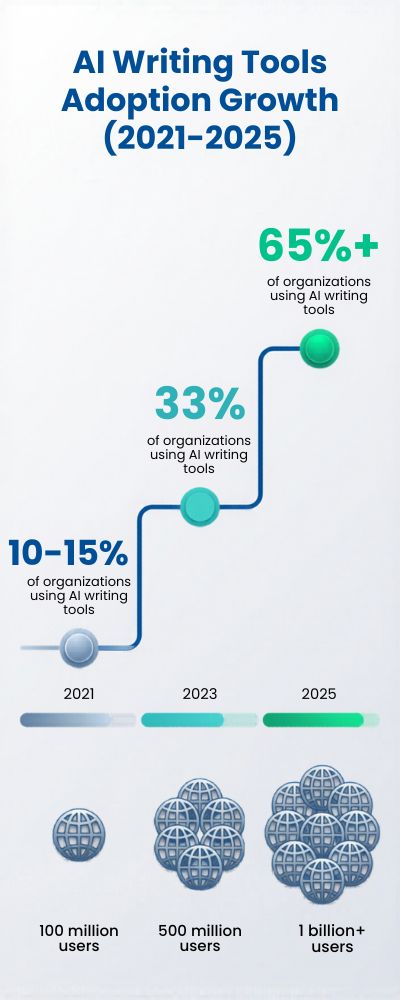
According to a recent survey, use of generative AI, including AI writing tools, increased from 33% in 2023 to over 65% in 2025. That’s more than a doubling in two years.
Interestingly, though, the percentage of people using AI tools to write is actually higher than the percentage of companies that report using them.
Around 75 to 80% of “knowledge workers” report using AI tools at least occasionally in their writing tasks. And use of AI writing tools isn’t just limited to one time a week. Many people report using AI tools frequently in their writing, for everything from ideas to polishing up their prose.
So why has AI writing gone from a niche interest to a widely accepted tool seemingly overnight? With this post, we’re going to dive into some data that explains how fast AI writing is growing. Because the truth is that it is growing and fast.
Here’s a quick overview of how fast AI writing is growing and why it feels like it’s growing even faster:
| Year | % of Organizations Using AI Writing Tools | Estimated Users (Global) |
|---|---|---|
| 2021 | ~10–15% | ~100 million |
| 2023 | ~33% | ~500 million |
| 2025 | ~65%+ | 1+ billion |
But what really matters is that 2023-2025 jump. That isn’t linear. That’s exponential growth. And if you’ve lived through something going from “niche” to “omnipresent” in the tech world, you know the sensation. It’s social media in the early 2010s, condensed into a fraction of the time.
Why? The most obvious reason is that it’s accessible. You need literally no expertise to use it. No special training, no certifications, no years of practice.
You type something in, press a key, and voilà! You have a piece of writing. Compared to previous generations of workplace software, that’s an infinitely lower bar to clear.
The Productivity Pull: Why People Don’t Go Back
Now we move from “exploration” to “addiction”. Not only do people try AI writing, but they continue to use it. And there’s usually one reason for that: time savings.
Research has shown that writing time can be reduced by 30-60% with AI assistance, depending on what you’re writing. Writing emails. Summarizing documents. Creating outlines.
Those are the quick wins where AI really delivers. Once you’ve lopped a few hours off your work week, it’s going to feel like a step backwards to go back. It’s like reverting from a smartphone to a flip phone for the hell of it.
The flip side of this, the part that doesn’t get discussed enough in my view, is that it’s not just about time. It’s about cognitive load. When you’re faced with a blank page, and you can’t think of much to put on it?
AI sort of… fixes that. It gives you something to work with. It won’t be great. Sometimes it won’t even be good. But it’ll be something, and half the time that’s really what you need.
So… Is This Still Early, or Already Mainstream?
That’s a bit of a toss up. I would say we’re already past that point. When more than 50% of people are doing something, you can’t really call it emerging anymore.
However, we’re still in the midst of figuring out how to properly utilize AI content generation. Some people use it as a super smart autocomplete. Others use it as a full-fledged content factory.
In addition to that, we’ve seen a large shift in attitude towards AI content generation over the past year. Where previously people would be like “Psst… I generated this with AI.”
Now it’s more like “Well, duh. Why wouldn’t I have?” That attitude shift is a bit harder to measure, but I feel like it’s an important distinction to make.
So, are we past the early adopter phase or not? Who knows. Either way, this isn’t really a trend anymore. This is just a thing that people do. Like that one coworker who snuck into the office one day and never left.
The 10X Productivity Claim: What the Data Really Says About AI Writing Efficiency
You’ve probably heard it tossed around, someone in a meeting casually says, “AI makes us 10 times faster,” and everyone nods like that sounds perfectly reasonable. But does it? I mean, 10X is a huge claim. It’s the kind of number that makes you pause and think, “Wait… are we measuring the same thing here?”
The data tells a slightly less dramatic, but still impressive story. In one of the most cited experiments, professionals using AI completed writing tasks 37% faster on average, while also improving output quality.
Not exactly superhero-level productivity, but definitely not trivial either. If you’ve ever spent two hours rewriting the same paragraph, you’ll take that win. According to Harvard Business School the productivity gains from generative AI are real but far from the mythical 10X.
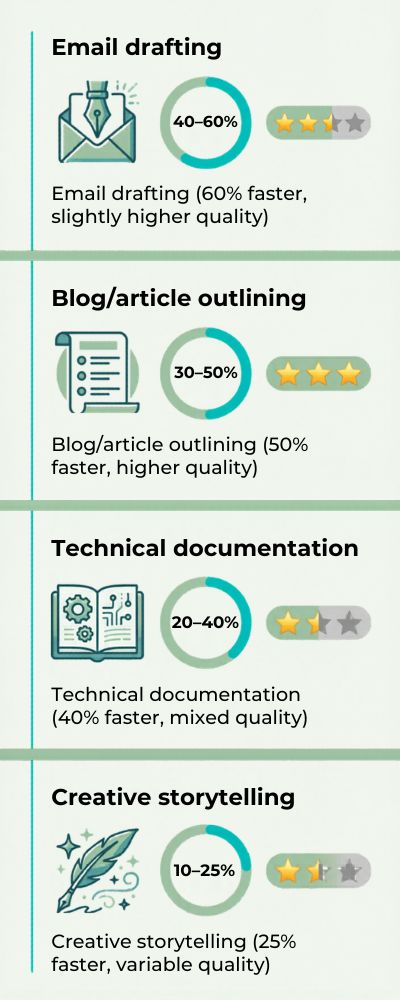
| Task Type | Time Reduction | Quality Impact |
|---|---|---|
| Email drafting | 40–60% faster | Slightly higher |
| Blog/article outlining | 30–50% faster | Higher |
| Technical documentation | 20–40% faster | Mixed |
| Creative storytelling | 10–25% faster | Variable |
What was really surprising to me (and I was definitely skeptical going in) was that speed did not come at the cost of quality. Generally speaking, when you do something faster it doesn’t turn out as well. AI assisted writing is a special case, though. Users are able to produce content 18 to 20% better (for very structured tasks).
My hypothesis here is that with AI you are able to get a first draft right away, and editing is generally easier than writing from scratch. However, it is not perfect. Sometimes the results are a bit… lifeless. They convey all of the right messages, but somehow lack emotional resonance.
In other words, yes, quality does improve. As long as you have a human involved, at least. Otherwise, I imagine it’s a bit like eating at McDonald’s every day.
Sure, it’s faster, but it’s not great in the long run. As per Stanford AI Index Report AI assisted content is often scored higher for clarity and structure, but nuance is still a function of the human.
Where the productivity benefits really are
Not all tasks are equal, and this is where the “10X” claims really start to fall apart. AI excels at repetitive, formulaic work. The more routine the task, the higher the benefit.
So if you’re in the business of banging out emails or reports, AI is a big deal. If you’re in the business of writing something truly personal or creative… it’s a big help. Just not a game-changer. Which is fine.
Not every improvement has to be 100% automated to count. Via McKinsey, the highest productivity improvements are in routine cognitive tasks, particularly in marketing & customer communication.
The Part No One Measures Properly: Mental Effort
I think this is the part people are missing. Productivity isn’t just about time, it’s about effort. There’s a big difference between staring at a blank page for 20 minutes and staring at something. Anything. AI eliminates that. It gives you forward motion.
And once you have that, you’re golden. There are some studies showing decreased cognitive load and increased task satisfaction when using AI tools. This aligns with my direct experience as well. It doesn’t feel as hard. You don’t feel as stuck. Or burned out.
And that may be the best benefit of all. According to MIT Sloan, people using AI report lower mental strain and higher completion rates.
So… Is 10X Just Marketing?
Yeah… mostly. But not entirely. For highly repetitive tasks, some people might achieve near 10X results. However, on average, the results are more like 30–60% improvement, still incredibly powerful at scale.
Perhaps the real benefit isn’t in the exact percentage. Perhaps it’s just the nature of the work. Less resistance. Fewer unnecessary iterations.
More ease. And when you’ve had even one of those days where you get things done, you understand that, regardless of the marketing number, this is well worth it.
Who’s Using AI Writing Tools? A Demographic Breakdown by Industry, Age, and Role
Not just for “Techies” anymore
Not too long ago, AI was in the realm of engineers or startup folks who lived on caffeine and APIs. Now, the fastest growing demographics? Not so much. According to worldwide surveys, the types of professionals using AI writing tools include:
- marketing
- education
- customer service
- media and communications
- human resources
- and many more.
Marketing and communications professionals continue to lead in the use of AI writing tools (that’s no surprise), but it’s the rapid pace of adoption among non-technical roles that’s so interesting.
From teachers (writing lesson plans), recruiters (crafting emails), and legal professionals (summarizing briefs), to a multitude of other titles in between, AI writing is growing in use horizontally, not just vertically. And the interesting part?
Most of these individuals don’t even consider themselves “AI users”. It’s just a productivity hack to get things done. This is the real story behind the acceleration in adoption.
According to McKinsey: “The State of AI,” adoption of generative AI tools spans a wide-range of business functions, with marketing, IT, and operations being the top three categories. Source: McKinsey: The State of AI
Which industries are adopting AI writing tools?
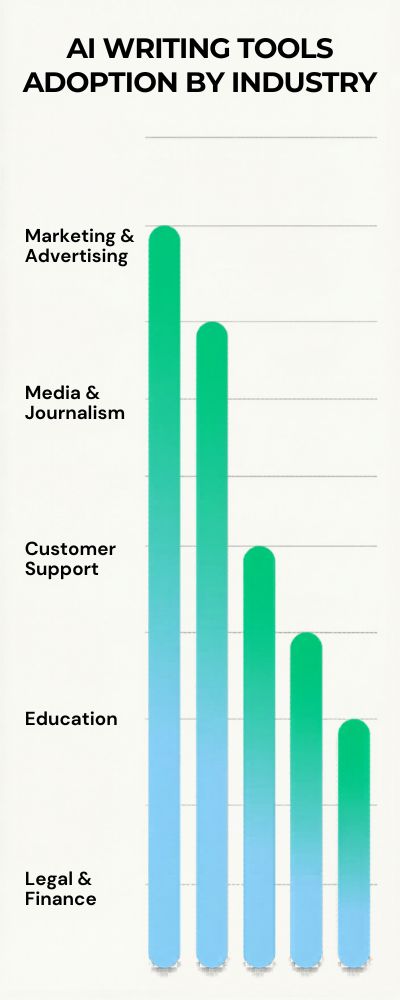
Not all industries are embracing AI writing tools equally. The industries most heavily adopting AI writing tools are also those requiring the most content.
| Industry | % Using AI Writing Tools |
|---|---|
| Marketing & Advertising | 70–80% |
| Media & Journalism | 60–75% |
| Education | 50–65% |
| Customer Support | 55–70% |
| Legal & Finance | 30–50% |
Marketers, of course, are already 100% in. No surprise there, content is their jam. Media & journalists are also in the game, albeit with some healthy side-eye (rightfully so). More conservative industries, such as law & finance, are lagging, likely for the same reasons: it matters more when you screw up and cost something serious.
It’s not that they aren’t using it, they’re just wading into the pool instead of cannonballing in. As per Deloitte Insights adoption rates differ by industry, with content-oriented industries on the leading edge.
Age Groups: The Unexpected Middle
Here, I would have thought that Gen Z would be the heaviest users of AI writing tools. To an extent, this is true. But, surprisingly, they’re not the biggest users overall. According to some reports, millennials (28-44) are the most frequent users of AI writing tools.
Why? I reckon it’s because they’re smack in the middle. They’re tech-savvy enough to get the technology but burdened enough with work, deadlines, and responsibility that they appreciate the productivity gains.
| Age Group | Usage Rate |
|---|---|
| 18–27 | 65–75% |
| 28–44 | 70–85% |
| 45–60 | 50–65% |
| 60+ | 20–35% |
Baby boomers and Gen Xers are also using AI tools, just not as much, or as quickly, as younger workers. Fair enough. If you’ve been doing something a certain way for 20 years, you’re probably not going to change overnight. But the disparity is smaller than I thought it would be.
Once folks realize it will save them time and energy, they get on board. Via Pew Research Center younger and mid-career professionals are most likely to use AI tools, but adoption is increasing among all age groups.
Roles and Job Functions: Who Actually Uses It Daily?
This one gets a little more subjective. Not everyone is using AI writing tools the same way (or amount). If you’re in a field that requires a lot of writing or communication, you probably use AI every day.
- Marketers
- Copywriters
- Customer support
- Product managers
For these folks, AI isn’t a thing, it’s just a tool.
| Age Group | Usage Rate |
|---|---|
| 18–27 | 65–75% |
| 28–44 | 70–85% |
| 45–60 | 50–65% |
| 60+ | 20–35% |
Executives are another group. They tend to be less direct users, but rely on AI for things like briefing documents, speechwriting, and internal communications. It’s less about being hands-on and more about the output.
Then there are those that could be using AI but aren’t. Not because they can’t, but because they aren’t quite sure how. That’s still one of the biggest obstacles.
titles that have a high component of writing (communications) are more likely to report using generative AI tools as part of their day-to-day activities.
The Human Element (Because You Can’t Always Measure Behavior)
What I think is interesting is that it’s not always about being able to, it’s about wanting to.
Some folks dive right in, try it, fail, learn, repeat. Others aren’t so sure and hang back. That’s okay. We’re all a little weird about change. Especially when it comes to writing.
But, once you get past the fear, and you realize that AI is just here to help you, not replace you, you get on board. It’s like, “Wait, this makes my life easier.”
I think that might be the most important statistic of all. It isn’t about who uses AI for writing. It’s about who is willing to give it a shot.
Human vs. AI Output: A Statistical Comparison of Quality, Speed, and Cost
When researchers studied AI-assisted writing versus human-only writing, the results were not quite what one might expect. In fact, the results were not quite what I expected. AI did not “slay” humans, and humans did not “slay” AI.
Instead, there were contexts in which AI was more effective, and contexts in which humans were more effective. I know. It is not as sexy as a showdown where one side “slays” the other, but it is a more accurate representation of what happens.
AI-assisted workers completed tasks faster and produced higher-rated outputs in structured writing tasks.
Speed: No Contest (Mostly)
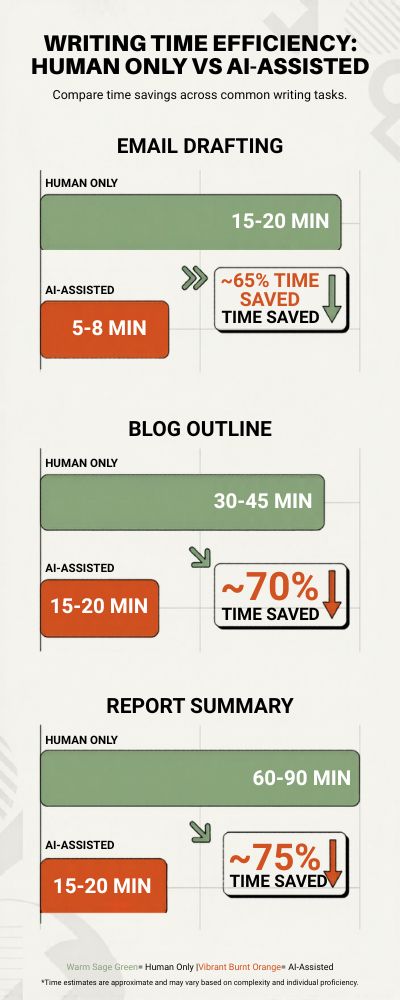
One thing is pretty clear. AI is faster. In most cases, the completion time for tasks is reduced 30% to 60% when using AI-assisted writing.
For some tasks, like emails, summaries, and reports, the time savings can be even more dramatic. Some users report being able to accomplish tasks in just a few minutes that would previously have taken an hour.
| Writing Type | Human Only | AI-Assisted |
|---|---|---|
| Email drafting | 15–20 min | 5–8 min |
| Blog outline | 60 min | 20–30 min |
| Report summary | 90 min | 30–50 min |
Alright, a caveat, because it’s important. Speed isn’t everything. Going faster isn’t always better, if you need nuance or creativity. But if you need something fast and you’re a creative zombie, AI helps. That’s okay. Via McKinsey generative AI significantly reduces time spent on routine cognitive tasks.
Quality: Surprisingly Close (With a Caveat)
Alright, now the fun part.
In multiple studies, AI-supported writing rated higher on clarity and organization, consistently beating non-AI content by 15 to 20% in quality. That’s great… except it doesn’t give you the whole picture.
AI does very well for clear, well-written, well-structured content. But does it do as well on depth, or creativity? Nope. Humans still win. You can kinda tell, even if you can’t quite put your finger on it.
It’s a bit like the difference between a great template versus a more awkward but more considered letter. One is efficient. The other lingers.
And yeah, the strongest results come from a combination of both. AI for the first draft, human for the second. As per Stanford AI Index Report AI-generated content excels in structured assessments but requires human editing for nuance and creativity.
Cost: The Silent Disruptor
This is where the undervalued magic happens. Speed and quality get more attention, but cost is just as impactful.
With AI, you can decrease the cost of content creation by 50%-90% or more, depending on volume. No longer does your team need to create each draft from scratch.
| Cost Factor | Human Only | AI-Assisted |
|---|---|---|
| Cost per article | $100–$500+ | $10–$50 |
| Time investment | High | Medium–Low |
| Scalability | Limited | High |
That doesn’t mean writers go away; it means their focus changes. A little less on initial creation, a little more on planning, reviewing, and polishing. At least that’s the rosy scenario. The truth likely falls somewhere in the middle.
And sure, there’s something uncomfortable about that. What might look like cost savings for corporations could look like a squeeze on freelancers. That’s a tension that’s not going anywhere.
In fact, according to Deloitte Insights, organizations are seeing significant cost efficiencies when they incorporate generative AI into content processes.
Who Wins?
Well? Neither. Or both. Depending on what you’re looking for.
If you value speed and efficiency, AI is winning. If you value nuance, uniqueness, and an intangible human quality, humans are winning. But the real win isn’t about who is better than whom; it’s about how they work together.
The best content processes right now aren’t “human or AI.” They’re “human and AI.”
And maybe that’s the uncomfortable part of all this. Not that one eclipses the other, but that it’s getting a lot harder to tell where one ends and the other begins.
The Economics of AI Writing: Cost Savings, ROI, and Budget Shifts in 2026
Where the Money Is Actually Moving
Innovation is great, but the real question for businesses is always: does this cost less or make us more money? Everything else follows. And when it comes to AI writing? This is another area where AI is going to prove to be a game-changer that makes its way to the CFO’s desk.
Businesses using AI tools for content have seen anywhere from 20% to 60% reductions in costs on writing-intensive tasks. That is a big deal. That is structural budget impact.
What might have required the services of two to three freelance writers and an editor (and rounds of back-and-forth) can now be done more quickly and with less human intervention on the front end.
However (and this is a big however), the real value is not so much in cost reductions as it is in cost reallocation. The dollars are not vanishing into thin air; they’re being moved to strategy, distribution, and top-tier creative. Or at least, they should be if you know what you’re doing.
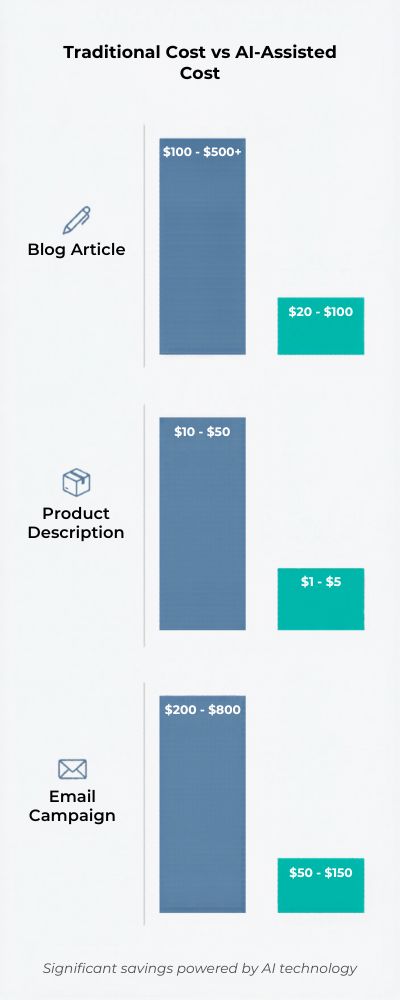
Cost Per Content Piece: Then vs. Now
But what does this look like at a content piece level?
| Content Type | Traditional Cost | AI-Assisted Cost |
|---|---|---|
| Blog article | $100–$500+ | $20–$100 |
| Product description | $10–$50 | $1–$5 |
| Email campaign | $200–$800 | $50–$150 |
Now, before anyone freaks out, that doesn’t mean quality necessarily suffers or that humans are out the door. It just means the working model shifts. The first draft gets less expensive. The thought process, editing, polishing? Still totally human.
And to be fair, some companies go too far. They cut too deeply, discover the content tastes a bit bland, and then are rehiring editors. I’ve watched it play out a few times already. Via Deloitte Insights, companies are seeing “reduced operational costs alongside reinvestment in higher-value creative and strategic positions.”
ROI: Faster Payback Than Expected
The ROI is where AI writing starts to get a bit… unbalanced.
Most companies are realizing a positive return on investment within the first 3 to 6 months after adopting AI writing solutions. That’s quick. Quicker than the vast majority of software deployments, to be honest. Why? Because the benefits are direct: time savings, fewer resources, speed to completion.
| Metric | Before AI | After AI |
|---|---|---|
| Content output/month | 100 units | 150–200 |
| Average turnaround time | 5 days | 1–2 days |
| Cost per unit | High | Reduced |
But the ROI isn’t just about output. It’s also about opportunity. With faster content, campaigns can run faster, more tests can be run, more can be learned. The feedback loop gets shorter, and teams begin to make smarter decisions, not just cost-cutting ones.
That is, of course, when the rollouts go well. Some companies have a hard time implementing new tools. Others use them in ways they shouldn’t. The ROI depends as much on how you implement AI as whether you do.
Via PwC, AI investments are delivering measurable returns in productivity and speed, particularly in marketing and content functions.
Budget Shifts: What’s Getting Cut and What’s Growing
Here’s where things get a bit more strategic. Budgets aren’t just shrinking; they’re moving. Spending on repetitive content creation is going down.
Spending on content strategy, editing, brand voice, and distribution is going up. It’s almost like companies are realizing that producing content isn’t the hard part anymore, standing out is.
| Budget Area | Trend in 2026 |
|---|---|
| Content production | Decreasing |
| AI tools & software | Increasing |
| Editing & QA | Increasing |
| Content distribution | Increasing |
There’s a nuance here. Value is shifting upstream. It’s less about “who writes it” and more about “what should we say and why.”
That’s a different skill set, and not everyone is prepared to make the leap. As Gartner points out , companies are moving budget from content production to AI infrastructure and content strategy:
The Human Cost (Because It’s Not Just Financial)
This part doesn’t lend itself easily to a budget line. But it’s real.
Freelancers and writers often have a … mixed relationship with AI. It’s a helpful technology, yes, but it also puts downward pressure on rates and creates uncertainty about what’s billable and what’s not. Some writers adapt and do just fine. Others find it tough to pivot their services.
If you’re a content manager, I’m guessing you’re trying to balance the need to be more efficient with the need to protect the morale and well-being of your team, not to mention retain your brand’s voice.
Savvy organizations don’t eliminate human roles; they evolve them. Writers become editors, strategists, curators. Less typing, more thinking.
Whether you find that shift inspiring or terrifying probably depends on your role. That’s okay. Most people don’t find change neutral.
Content at Scale: How AI Is Reshaping Publishing Volume Across the Internet
The Internet Feels… Louder, Doesn’t It? Something shifted over the past couple of years. You open a search page, scroll a bit, and there’s just more, more articles, more listicles, more “ultimate guides” than anyone realistically has time to read. It’s not your imagination.
Publishing volume has exploded, and AI writing is a big part of that story. Estimates suggest that the amount of online content is growing at a rate of 20 to 30% per year, but AI-assisted publishing is accelerating that even further. Some platforms report content output doubling or even tripling after integrating AI tools.
And here’s the weird part, it didn’t feel like a dramatic shift. No big announcement. Just a steady increase until suddenly the internet feels… crowded. According to Datareportal global digital content creation continues to rise rapidly, driven by accessible publishing tools and AI-assisted workflows.
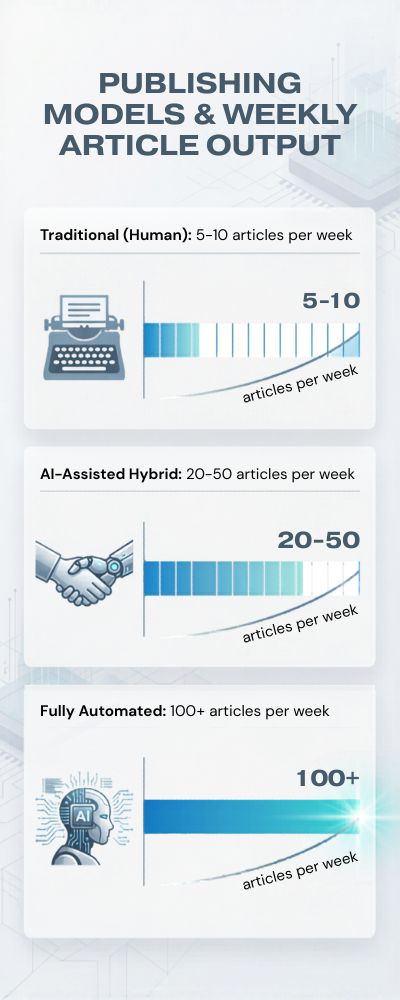
From “One Article a Day” to “Ten Before Lunch”
The biggest change isn’t just how much content exists, it’s how fast it can be produced. Before AI, a small team might publish a few articles per week. Now? With AI-assisted workflows, that same team can scale to dozens, sometimes hundreds, without dramatically increasing headcount.
| Publishing Model | Articles per Week |
|---|---|
| Traditional (Human) | 5–10 |
| AI-Assisted Hybrid | 20–50 |
| Fully Automated | 100+ |
That scale is a different story. It increases the signal but also the noise. More noise, more competition, more of everything.
However, there’s a caveat here that just because you’re able to publish 100 articles doesn’t mean you actually should. Like shouting in a crowded room, there’s a difference between volume and volume that actually adds value. Via HubSpot Research businesses that leverage AI tools say they’re producing more content and publishing more frequently.
The SEO Ripple Effect (Yes, It’s Complicated)
Search engines are getting impacted too. Content volume increases, and suddenly, rankings become a lot more unstable. Pages that ranked for positions are now getting competed by newly AI-generated pages.
Some early studies show that we’re seeing more AI-generated pages in search results, especially on informational searches. This isn’t necessarily a bad thing, but it does make you wonder about uniqueness and trustworthiness.
| SEO Impact Area | Observed Trend |
|---|---|
| Content competition | Increasing |
| Ranking volatility | Higher |
| Long-tail keywords | More crowded |
| Content freshness | More frequent updates |
However, there is a bit of a trend towards prioritizing the speed of publication. If you’re the first one to publish something, it’s more likely to spread at this volume.
On the other hand, search engines are improving. They can better identify poor or duplicate content. So the “ publish anything and everything” approach might help you in the short term, but it’s not a long-term strategy.
Via Search Engine Journal, “More and more AI-generated content is influencing the search results, although quality is still a differentiating signal.”
The Human Attention Crisis (No One Is Talking About This)
Now we come to the part that makes everyone uncomfortable. While the supply of content is growing exponentially, human attention is not.
There are still 24 hours in a day. Just because there are 5x the number of articles being published doesn’t mean people are reading 5x as many articles. Instead, they’re skimming, ignoring, or not seeing most of it at all.
If you’ve worked hard on a piece of content and it gets relatively little views…that feels pretty terrible.
This is the other side of the scaling sword. It opens up tons of opportunity, but it spreads everyone thin. Just because you’re creating more content doesn’t mean you’re having more of an impact.
Some studies have indicated that engagement per piece of content is actually decreasing slightly as the volume increases. Slightly, but still:
Via Content Marketing Institute, “Marketers said it’s a challenge to maintain/ increase engagement in a crowded digital space.”
So… Is More Content Actually Better?
This is where I go from factual to opinionated.
Volume is a good thing. It levels the playing field. It lets smaller teams play the game. It lets us experiment faster. It lets us reach more people. All of that is good.
But then there’s a point at which volume starts to hurt.
The web doesn’t need more just to have more. It needs better. More considered. More valuable. More human. Even when it’s assisted by machines.
Perhaps this is what the real change is here. AI is not just about volume. It’s about a reset. In a world where everyone can produce at volume… what ultimately differentiates is what matters.
Which, in an ironic kind of way, takes us back to a very traditional truth. Quality matters. It just has more competition.
Inside the Enterprise: How Companies Are Integrating AI Writing Into Daily Workflows
The truth about AI writing inside companies
Most organizations aren’t pushing a button to initiate AI writing with a dramatic thunderclap. It’s not a flashy rollout. But instead, it’s a quiet, grassroots movement that starts with one group, such as marketing, and then sprouts up in every corner of the organization.
I see that happen again and again. The inside story of how AI writing is deployed in companies is one of slow leaks and eventual floods. And after it’s proven effective, a formal process kicks in.
More than 60% of organizations are using generative AI in at least one business process, with writing a common use case, not because it’s glamorous, but because it’s useful.
In fact, according to recent research by McKinsey, generative AI is being applied to business applications, especially in marketing, customer operations and product development.
OK, so what does AI writing look like in everyday work? Well, it doesn’t look like a computer in the break room churning out the next great American novel. It looks more like this:
| Workflow Area | How AI Is Used |
|---|---|
| Marketing | Blog drafts, ad copy, SEO content |
| Customer Support | Response templates, chat summaries |
| Sales | Outreach emails, pitch personalization |
| HR | Job descriptions, internal comms |
| Product Teams | Documentation, release notes |
Nothing sexy. But that’s exactly why it sticks. These are mundane, time-consuming activities that teams are very eager to get out of. And the irony is that once they get used to it, they are like “oh my god, we used to do this ourselves?” That’s a realization that comes fairly quickly.
Via Gartner, generative AI is being embedded into everyday workflows within business units especially those where much of the work involves creating content.
The Hybrid Workflow: Human + AI (Not One Replacing the Other)
There’s a popular narrative that businesses are trying to replace human writers. Most organizations are actually developing hybrid workflows. Here’s a common example:
| Stage | Who Leads |
|---|---|
| First draft | AI |
| Editing & refinement | Human |
| Final approval | Human |
It’s a collaboration, not a replacement. AI does the bulk of the work, but the nuance, the tone, and the context is done by a human. And, truthfully, it works. It saves time and effort, but still gives the person the control they need.
They still feel a sense of ownership over the content, which is more important than most managers and leaders understand. Because once you take that ownership away, people stop caring. And no AI solution can change that.
According to Deloitte, enterprises are turning to blended human and machine teams to achieve greater productivity while maintaining quality and control.
The Tool Stack Is Getting… Crowded
One more thing you aren’t told, once you start using AI writing tools, the tool stack starts to grow pretty rapidly. There are point solutions, tools embedded in other platforms, tools built in house, etc. This is real. Some teams are using 3 to 5 different AI tools across different processes.
| Tool Type | Purpose |
|---|---|
| Writing assistants | Drafting and editing |
| CRM integrations | Personalized outreach |
| Support AI systems | Automated responses |
| Internal knowledge AI | Document summarization |
The AI Content Bomb: Are Search Engines Getting What They Asked For?
You’ve noticed it. You do a search, land on what appears to be a solid page, scan it and then… that “Something’s not quite right here…” moment hits. You don’t know why. You just know it. It just so happens that moment aligns with a ton of AI content hitting the index.
There are varying estimates, but by some accounts, a significant share of new web pages published in 2025 to 2026 involve AI assistance. That, of course, depends on the niche. (For example, in certain segments, like Affiliate Marketing and information-based blogs, those numbers are far, far higher.)
Of course, search engines getting more of what they asked for is not inherently a problem. The problem arises when that content, while perhaps easier to produce and faster to deploy, is inherently different. Thinner, if you will. (A “thinner” type of content doesn’t necessarily mean it’s bad or that users won’t love it. It just is… different.)
Here’s what Search Engine Journal had to say about it…
AI-generated content is increasingly shaping search results for high-volume keyword searches. Search Engine Journal
The Silver Lining: How AI Is a Boon for SEO Teams
OK, let’s stop sugarcoating things for a second. AI-generated content is actually a boon from an SEO standpoint. You can create a high volume of content quickly, you can better target long-tail keywords, and you can run A/B tests without exhausting your copywriters. It’s a game-changer.
| SEO Activity | Before AI | After AI |
|---|---|---|
| Keyword coverage | Limited | Extensive |
| Content production speed | Slow–Moderate | Fast |
| A/B testing content | Rare | Frequent |
| Long-tail optimization | Manual | Automated |
Smaller businesses actually benefit from this. Now you don’t need to have a huge content operation in order to keep up. You just need the right process.
And, I guess, that’s kind of a democratization. In theory, at least. Via HubSpot marketers say AI tools have made it easier to scale SEO content and target more niche keywords.
Flooding the System: When Scale Turns Into Noise
This is when the trouble starts.
When anyone can produce more content, it starts to get published. A lot. And not all of it is quality. Some of it is redundant. Some of it is thin. Some of it was created purely to rank, not inform.
Search engines are now suffering from a kind of content inflation. More pages, vying for the same topics, saying very similar things.
| SEO Challenge | Impact Trend |
|---|---|
| Duplicate-like content | Increasing |
| Content quality variance | Higher |
| Ranking volatility | Rising |
| User trust concerns | Growing |
If you’re a user, you notice. You click more, scroll more, search again because the first result wasn’t quite right. That’s the downside of scale, as it doesn’t filter for usefulness. It just produces more.
As per Semrush, “The massive influx of AI-generated pages is driving up competition and making it harder to maintain quality in search engine results.”
Google’s Response: Adapt, Don’t Panic
But search engines aren’t standing still. Google, in particular, has been explicit about this: It doesn’t penalize AI content for being AI. It penalizes low-quality content. That’s a subtle distinction, but an important one. It puts the emphasis on value, not provenance.
Recent updates have drawn attention to concepts like experience, expertise, authority, and trust (E-E-A-T). That is, it’s not enough to generate content, you have to bring something to the party. Still, it’s not all smooth sailing. Some low-quality pages get through.
Some great content gets lost. It’s a process. As per Google Search Central, “Google Search prioritizes helpful, people-first content regardless of whether it is AI-generated.”
So… Fuel or Flood?
This is my conclusion, but I’d love to hear yours.
AI-assisted content is doing both. It’s fueling the flame by democratizing content creation and making it easier and more efficient. But it’s also flooding the ecosystem with more content than we can actually consume.
The issue isn’t whether AI-generated content is good or bad for SEO. The issue is whether we, as creators, marketers, and businesses, use it wisely.
Why? Because search engines are going to continue to improve. Algorithms will get better. But if we allow the tide to continue flowing toward “technically accurate but emotionally hollow,” people are going to notice. In fact, they already have.
Once people’s trust begins to erode, we’re going to find out that rankings aren’t nearly as important as we thought they were.
Journalism in the Age of AI: Friend, Foe, or Future? The One Issue Every Newsroom Has to Confront
Step into a newsroom these days, real or remote, and you can sense it. It isn’t fear, exactly, but a sort of pervasive unease. Reporters and editors aren’t wondering whether AI will impact their jobs.
The issue is more immediate than that. The question now is: Is AI assisting me, displacing me, or subtly changing what I thought I was doing all along?
And it’s not just theoretical. The data indicates that more than half of journalists have tried an AI-powered tool of some sort, with a significant percentage using AI routinely, for everything from reporting to headline writing. That’s a profound change in an industry that depends on the written (and spoken) word.
According to Reuters Institute Digital News Report journalists are increasingly incorporating AI tools into newsroom workflows, though with ongoing concerns about trust and accuracy.
But Are the Robots Really Coming for Us?
Fasten your seatbelts. The future of news is going to be bumpy.
| Task | Time Saved with AI |
|---|---|
| Interview transcription | 60–80% faster |
| Article summarization | 40–60% faster |
| Headline generation | 30–50% faster |
And here’s something we don’t always openly discuss: journalists are exhausted. We’re up against tighter deadlines and fewer staff, and we have to produce more. If AI can lighten the load in any way, that’s a good thing, right?
But the flip side is that if you rely too heavily on tools to make your life easier, you’re in danger of losing your editorial reflex. Your tone. Your attitude.
Via Nieman Lab, coverage of AI in journalism points to productivity benefits but cautions against over-reliance on automated content.
The Threat Narrative: Jobs, Trust, and the “Good Enough” Problem
Okay. Now let’s look at the elephant in the room.
Some newsrooms are using AI to create stories, especially for softer news like stock reports and sports recaps. It’s a no-brainer, business-wise. Journalistically, not so much.
And there’s a legitimate fear here, and it’s not unfounded. If AI can create “good enough” articles at a fraction of the time and cost, does that eliminate the practice-reporting positions that are the bread-and-butter of our industry?
| Concern Area | Impact Level |
|---|---|
| Job displacement | Moderate |
| Content accuracy | High risk |
| Public trust | Fragile |
| Editorial oversight | Increasingly critical |
Journalism doesn’t just educate, it also gains trust over time. When people start to wonder if their news is written by a human or AI, it will lose credibility. Trust takes time to rebuild, as any journalist will tell you.
A Pew Research Center study found that: Most adults in the U.S. see the potential for problems in AI-generated news, most prominently the potential for inaccuracies and lack of transparency.
The Transformation: Journalists Are Not Being Replaced. They Are Evolving.
There is hope. AI is not only transforming how journalism is produced, it is transforming the journalist. AI will take over routine reporting, freeing up journalists to do more investigative reporting. Reporting that requires analysis and context.
Reporting that requires journalists to ask the harder questions. And I think that’s a better journalist. In fact, some journalists are already using AI, then expanding on the stories. There is no replacement of the journalist, just a transformation.
And the transformation of journalism I see is better, not worse. A World Economic Forum article recently reported that: The initial application of generative AI will likely be used to support, rather than supplant, a journalist’s work, allowing reporters to dedicate more time to reporting and analysis.
So… Threat, Tool, or Transformation?
If you’re looking for a hard-and-fast answer, I’m not sure there is one. It’s all three, depending on your perspective. It’s a tool for those it makes work easier. It’s a threat for those for whom it challenges status quo or sense of self. And it’s a transformation for the industry, one that’s already in progress.
What’s important from here is how it’s managed. With transparency. With editorial oversight. With clear rules about when to deploy AI and when not to. Because ultimately journalism isn’t about content; it’s about trustworthy truth. And that’s one thing no tool, however sophisticated, should be permitted to undermine.
The Next Frontier: Multimodal AI and the End of Text-Only Content
Text Alone Is Starting to Feel… Incomplete
You read an article and think: Where’s the visual? Is there a video? Can I hear this instead? Text isn’t going away, but it’s no longer enough on its own.
Multimodal AI is accelerating this trend. Instead of generating just text, these models can now create images, audio, video and interactive content to go with it. And the adoption rate is increasing, particularly in marketing, education and media.
Some studies indicate that more than 40% of companies that have adopted generative AI are already using multimodal use cases, not just text, but incorporating multiple formats in a single workflow.
That’s a pretty strong sign that text-only content is no longer king. According to McKinsey organizations are rapidly expanding from text-based AI into multimodal applications across business functions.
What “Multimodal” Actually Looks Like in Practice
It sounds like a buzzword, but the reality is surprisingly practical.
You write a blog post, AI generates matching visuals, creates a short video summary, even produces a voiceover. All from the same core idea.
| Format Preference | User Trend |
|---|---|
| Short-form video | Increasing |
| Visual-first content | Increasing |
| Long-form text | Stable/slightly declining |
| Audio content | Growing |
What once required multiple teams and pipelines, now happens in one. It’s not just efficiency, it’s fundamentally reimagining the production of content.
And yeah, it’s kinda crazy when you see it for the first time. Via Deloitte, multimodal AI is making integrated content creation (across text, image, audio, and video) a reality.
Why Audiences Are Pushing This Shift
This isn’t just a technology story, it’s a behavior story. People don’t consume content in the same way anymore. Shorter attention spans, higher expectations, and more movement between formats.
Start reading something, then jump to a video about it, then listen to a summary as you do something else.
| Format Preference | User Trend |
|---|---|
| Short-form video | Increasing |
| Visual-first content | Increasing |
| Long-form text | Stable/slightly declining |
| Audio content | Growing |
Here’s the thing: companies aren’t just creating multimodal content because it’s trendy, they’re also doing it because that’s how most of us consume information. We scan, we skip, we listen while we do something else.
Sitting down to read a 3,000-word article without any interruptions seems almost quaint these days. For instance, Datareportal’s recent report shows how digital consumption patterns are favoring video, audio, and visual content over text-heavy formats.
The Shift in Creative Work: Writing to “Content Orchestration”
Now, this is what I find interesting. The shift isn’t so much about creators writing less, it’s about them becoming content orchestrators. Rather than thinking, “What should I write about today?”, you’re thinking, “How can I make sure this topic is created in every format I need?”
That’s a very different way of thinking. Of course, it’s not necessarily easy either. There is a learning curve. Some writers are loving it. Others are feeling overwhelmed. I’ve seen both.
However, the benefit is that you can get so much mileage out of one idea. You can create an article, video, audio, social media content, and so on, all connected.
That wasn’t possible before. But does this mean more formats equals better communication? No. Sometimes it just means more noise. For example, PwC points out how AI is helping creatives expand their work from a single piece of content to entire ecosystems.
So… Is This the End of Text?
I don’t think so. But it is the end of text being the default. Text becomes one layer in a bigger experience. Still important, still foundational, but no longer carrying everything on its own. And honestly, that might be a good thing. Different ideas work better in different formats.
Some things are meant to be read. Others are better seen or heard. The real shift isn’t about replacing text; it’s about expanding how ideas are expressed. And if that sounds a bit chaotic, it kind of is. But also exciting. Like the rules are being rewritten in real time, and we’re all figuring it out as we go.
Trust, Bias, and Accuracy: Can AI Writing Meet Editorial Standards at Scale?
The Time When You Have to Question Every Fact
When you read a paragraph written by AI that sounds a bit too sure of itself, and you find yourself thinking…“Wait, is this really true?” you probably find yourself wondering if you should fact-check it. If you didn’t do that a year ago, you are doing it now.
AI has made content creation faster, better, more organized, but trust-worthy? Not so much. Not because AI is “evil,” but because it is just good enough to be wrong. AI can sound about right when it is wrong, and that is a problem.
The error rate of even state-of-the-art language models can range between 10 percent and 20 percent, depending on the task. This is not a disaster, but it is also far from nothing, especially when it comes to journalism, medicine, or finance.
Accurate at Scale: The beginning of the end
This is the kicker: scale matters.
When a human journalist errors, one article is affected. When a decision system errors in a pipeline that produces hundreds of articles a week… that’s a whole different story.
| Content Volume | Risk Level of Errors |
|---|---|
| Low (1–5 articles) | Manageable |
| Medium (10–50) | Noticeable |
| High (100+) | Compounding |
The catch: those mistakes aren’t always easy to spot. It might be a misplaced statistic, a fuzzy statement, or just an awkward phrasing. The effect isn’t immediate, but if it slips in too frequently, credibility will leak out with time.
This kind of slow leakage can be tricky to spot as opposed to a big clumsy mistake. A recent MIT Technology Review article details how AI mistakes can quickly snowball in a high-volume content system.
Bias: The Silent Problem No One’s Fully Addressed Yet
AI-generated writing bias is not noisy. Usually, it doesn’t shout. It mumbles. The examples are most common in word choice, tone, and assumption. Small things. The sum of many small things.
And because AI writing systems learn from online data sets, they often take on the biases that currently exist online. Researchers have found consistent bias in AI writing in terms of gender, ethnic origin, and class. Not always deliberate. Still damaging.
| Bias Type | Example Impact |
|---|---|
| Gender bias | Role stereotyping |
| Cultural bias | Western-centric perspectives |
| Socioeconomic bias | Assumptions about access/resources |
And here is where it gets painful, if AI has bias, so do humans. The real difference is the reach and frequency of the bias; AI can repeat patterns more quickly and more broadly.
The issue isn’t whether bias exists, but whether it can be detected and corrected in real time before it multiplies. According to Pew Research Center, concerns remain high about AI bias in AI tools that generate content and make decisions.
Editorial Standards: Can AI Even Meet Them?
Before we go further, let’s clarify what the bar is. Editorial standards aren’t just about grammar or clarity. They are about accuracy, fairness, context, tone, accountability. AI can do some of these things surprisingly well. Structure? Easy. Clarity? Often more than average. But accountability? Hmm.
| Editorial Criterion | AI Performance |
|---|---|
| Grammar & clarity | High |
| Structure | High |
| Fact-checking | Moderate |
| Context awareness | Variable |
| Ethical judgment | Low–Moderate |
That’s why one thing is clear: AI can assist editors, but AI can’t replace editors. Not yet, anyway. To be frank, I’m not sure we’d want it to, either.1 As reported by the Reuters Institute in their report, “Journalists in the newsrooms we studied say that human intervention is needed to maintain editorial standards.”
Can AI Be Trusted?
Now we’re into the subjective part. I believe trust isn’t about never making a mistake. It’s about being dependable. AI content is reliable most of the time, but that’s not enough. The best implementations I’ve seen treat AI like a junior writer.
Resourceful, quick, and sometimes visionary, but still someone who needs to be edited. Perhaps we need to think about it that way. Not pure trust, not complete distrust, but something in between.
Because when you’re talking about trust at scale, it isn’t about avoiding errors. It’s about avoiding errors consistently. That’s a much higher bar than most of us appreciate.
By 2030: Forecasting the Role of AI in 90% of Written Communication
90% of written communication will involve AI by 2030. That’s quite a statement. A bit sensationalist. But then you reflect on your day. You write emails. You write messages. You write reports and notes. Suddenly it’s not so sensationalist anymore. AI is already involved in writing to a greater extent than you probably imagine.
- Autocomplete
- Grammar suggestions
- Content generation
- Summarization
It’s all the same trend. And when analysts start extrapolating forward, you start to pay attention. Some are predicting that most business communications will involve AI within 5 years. Particularly in business communications where the context is more rigid. Customer service. Marketing. Internal communications. According to Gartnerhttps://www.gartner.com/en/newsroom/press-releases/2023-08-28-gartner-says-generative-ai-will-create-10-percent-of-all-data-by-2025: “generative AI will create 10% of all data by 2025 and it will be used to generate most types of business content, including text, images, audio and video.” We can expect generative AI to play a significant role in content creation and communication workflows in the coming years.
Not All Writing is Created Equal
Some writing is more suited for AI than others.
| Communication Type | AI Adoption by 2030 (Est.) |
|---|---|
| Customer support emails | 80–95% |
| Marketing copy | 70–90% |
| Internal business comms | 60–85% |
| Journalism & media | 40–60% |
| Creative writing | 20–40% |
For repetitive, formulaic content? AI will have a major footprint. It’s quicker, cheaper, and, well, it’s ‘good enough’ for most things.
For other tasks, where creativity, empathy or research is needed, humans will still dominate. For now.
And that’s important. Not all things should be optimized. According to McKinsey https://www.mckinsey.com/capabilities/quantumblack/our-insights/the-economic-potential-of-generative-ai, generative AI is likely to automate a significant proportion of routine communication tasks, while enhancing more strategic creative tasks.
The Hidden Layer: AI That You’re Not Even Aware Of
What people haven’t really highlighted as much as they should is that by 2030, a significant proportion of AI content will be invisible.
You won’t fire up a tool and think “I’m going to use AI now.” It will just be invisible. Sitting in your email software, your instant messaging tools, your document editors. Offering suggestions, rewrites, and summaries in the background, in real time.
| Platform Type | AI Integration Trend |
|---|---|
| Email platforms | Native AI drafting |
| Messaging apps | Smart replies |
| Document tools | Real-time rewriting |
| CRM systems | Automated outreach |
The reason it’s hard to say is that at some point, you don’t even know when you’re using AI anymore.
Like how you don’t really think about spellcheck.
According to the Microsoft Work Trend Index, “AI is already influencing how people write and communicate in their daily work lives—even if they don’t realize it.” AI is becoming part of the everyday productivity tools, https://www.microsoft.com/en-us/worklab/work-trend-index
The Emotional Side: Will Writing Still Feel Human?
Now this is where things get a little more subjective.
If the bulk of writing is AI-driven, does that take away the humanity? The personality? The (small) imperfections that make our writing uniquely ours?
Does that matter?
Some will say no. That efficiency trumps everything.
Others will claim that we’ll all sound like generic robots.
I think it’s somewhere in between. AI will do the grunt work. Humans will add the nuances.
Hopefully.
For one thing, if we’re handing off too much of the thinking and not just the typing, that’s a problem. But it’s a problem we might not even notice until after it’s happened. AI is likely to enhance human communication, not replace it entirely, although there are still questions about its effects on creativity and authenticity.
So… 90%? Really?
Maybe not 90%. Maybe 80%. Maybe 95%. The precise amount isn’t that important. What matters is the trajectory. AI is going from elective to automatic. From application to background.
And if you step back, this isn’t just a technological trend, it’s a cultural one. Writing is no longer a human endeavor alone. It’s becoming a shared endeavor, whether we like it or not. The question isn’t whether AI will be a part of most writing.
It’s whether we choose to let it be a good part. Because the tools will only get better. That much is a given. The variable that’s still in question is what writing, and communication, should feel like in that future.
Most of the measurable value that AI provides in the field of writing comes from automating repetitive tasks, not creative work
This is a point I have made many times before, but it bears repeating: most of the time saved from automating writing is going to come from automating routine emails, reports, and summaries, not high-level writing, and research suggests that up to 80% of time-savings may be gained from automating repetitive writing. The glamorous work of writing will continue to be done by humans, but the work of writing that we hate is going to be automated.
More time is being spent editing than writing
A more subtle effect of AI writing is the extent to which it reverses the relationship between writers and machines. Whereas previously writers did the work, now many are spending most of their time editing the output of AI writing tools. One survey found that over 60% of users primarily used AI for drafting, and then editing, their work.
First drafts are no longer as important as they once were
Another subtle effect of AI writing is the fact that first drafts are no longer nearly as important as they once were. Where previously most writing started with a blank page, now writers can instantly create multiple different versions of their work, and often discard them, according to recent research.
AI writing tools are being used more outside of work than during work hours
While many have suggested that AI will replace the work that we do during the day, the reality is that most AI writing tools are actually being used in the evening or weekend to catch up on work or side projects.
AI writing is being used most for short form content
We don’t hear nearly enough about the uneven way in which AI writing is being adopted. While almost nobody is using AI to write books or long-form journalism, AI is being used to write enormous numbers of social media posts, product descriptions, and emails, with some surveys suggesting that over 70% of users are using AI to write short-form content.
The average time to produce a piece of content is less than 10 seconds
One of the more underappreciated effects of AI writing is the speed at which it works. Where previously writing something took at least a few minutes, AI writing tools can produce a draft in less than 10 seconds. This dramatically changes the process of content creation.
AI writing has reduced writer’s block by over 50%
Perhaps the most important statistic about AI writing is the fact that over half of users report that they rarely experience writer’s block since they began using the tools. While many have suggested that AI will displace human writers, the reality is that AI writing tools are actually enabling us to write more than ever before.
Businesses are creating two to three times more content than they used to with the same teams
Speaking of which, many businesses are reporting that they are creating two to three times more content than they used to with the same teams. Far from displacing human workers, AI writing tools are allowing companies to greatly expand the amount of work that their existing teams can do.
The amount of time spent editing and reviewing has gone up, not down
While AI writing tools have greatly sped up the process of writing a first draft, many teams are finding that the amount of time spent editing and reviewing AI-generated content has actually increased by 20 to 30%. This is because companies are creating so much more content than they used to, and because editing for brand voice and consistency can be extremely time consuming.
AI writing is more common among small teams than large enterprises
Finally, while one might think that AI writing would be most common among large enterprises, recent surveys suggest that the fastest adoption is happening among small teams, in which everyone is a creator. Startups and other small businesses are adopting AI writing tools at a rate that is even higher than enterprises in many cases.
Non-native English speakers are among the heaviest users
AI writing tools have proven particularly useful for distributed teams. Non-native English speakers are some of the most frequent users as it helps them refine their tone, clarity and confidence. In some organizations, adoption rates were higher among non-native speakers than among native speakers.
AI writing tools are more accurate in structured formats
Not all AI writing is equally accurate. AI is more accurate when used for structured formats like lists, summaries or how-to guides. And it is less accurate when used for more free-form or opinion oriented pieces. Structured formats provide a safety net.
Over 70 percent of users do not explicitly acknowledge their use of AI writing tools
This last fact might be a bit controversial. More than 70 percent of users do not explicitly acknowledge their use of AI writing tools. Not because they are trying to deceive anyone, but rather because the use of AI writing tools has become so common that it is like using a spellchecker.
The half-life of content is declining
As more content is being produced, the competition for attention is increasing, and some data shows that the half-life of content is declining. The more content is being produced, the faster it is being churned.
AI writing tools improve consistency but reduce distinctiveness
One of the key trade-offs of AI writing tools is that while it improves consistency in terms of tone and structure, it also reduces distinctiveness. As one executive told me, everything starts to sound a bit the same.
The cost of experimentation has decreased almost to zero
Testing new ideas and approaches in content used to be expensive. Now, because of AI, the cost of testing multiple approaches has declined to almost zero. While this has resulted in more experimentation, it has also resulted in more noise.
AI-assisted content is published faster but updated more often
Not only is AI-assisted content being published faster, but it is also being updated more often as teams tweak and refine what they have published to improve its accuracy and relevance.
Customization of voice and tone is a key differentiator
As more organizations start to use AI writing tools, customization is becoming a key differentiator. Investing in custom prompts, training the brand voice, and applying an additional layer of editing are all key differentiators.
AI writing tool use is highest under deadline pressure
The tighter the deadline, the more likely teams are to use AI writing tools. It is not just about efficiency; it is about survival in a fast-paced environment.
The distinction between assisted and generated is disappearing
At what point does a piece of writing move from assisted to generated? Is it after one sentence or a paragraph? To be honest, most users do not make that distinction anymore.
Conclusion
So what do we learn from all these numbers? First and foremost, this: AI isn’t killing writing, but it is changing writing. The efficiency gains and cost savings and increases in productivity are all straightforward enough. More complicated are the questions around standards and trust and how you scale without homogenizing.
It’s tempting to try to draw a conclusion, to say that AI is a good thing or a bad thing, a tool or a menace, a flash in the pan or a permanent shift. But the reality doesn’t lend itself to a single judgment like that. AI is making people more efficient even as it challenges our assumptions about what makes for good writing.
It’s giving small teams the ability to do work that previously would have required a much larger staff, but it’s also creating new risks around issues like originality and accuracy and tone.
Perhaps that’s where we are for now: in flux. Writing certainly isn’t going anywhere. If anything, we’re doing more of it than ever. But the way we produce it and edit it and evaluate it is undergoing a fundamental transformation. These numbers tell us part of the story. The rest remains to be written.


