

Apple is one of those companies that you think you know… until you see the stats. You probably use an iPhone every day. You might work on a Mac. Listen to music on AirPods. It’s all pretty normal. Pretty familiar.
Table of Contents
But take a step back for a second and ask yourself… how big is Apple really? When you dig into the numbers, it’s not really a tech company at all. It’s more an ecosystem. An economy. Even (in some ways) a digital infrastructure that billions of people rely on.
This post is a collection of 25 Apple stats that go beyond just measuring its size, they help you feel its size. And warning: some of these stats will be seared into your brain for years to come.
25 Stunning Apple Statistics (Is This a $Trillion Company?)
Is Apple’s Size Even Comprehensible? Numbers are a peculiar creature. On the page, they’re obedient. They do their job and then get out of the way. Until you take a glance at Apple’s stats, that is. Then they kinda… ooze all over the place. You look at one statistic and shrug.
Look at another and pause for a second. Then, you start doing that weird thing where you re-read it to make sure your eyes didn’t misfire. That’s because it’s tough to feel a statistic like “trillions.” It’s not human. It’s not recognizable.
It’s kinda like trying to fathom how big the universe is, as it’s possible, but it’s not easy. Yet, these statistics are important. They reveal a narrative that Apple doesn’t always share from the stage.
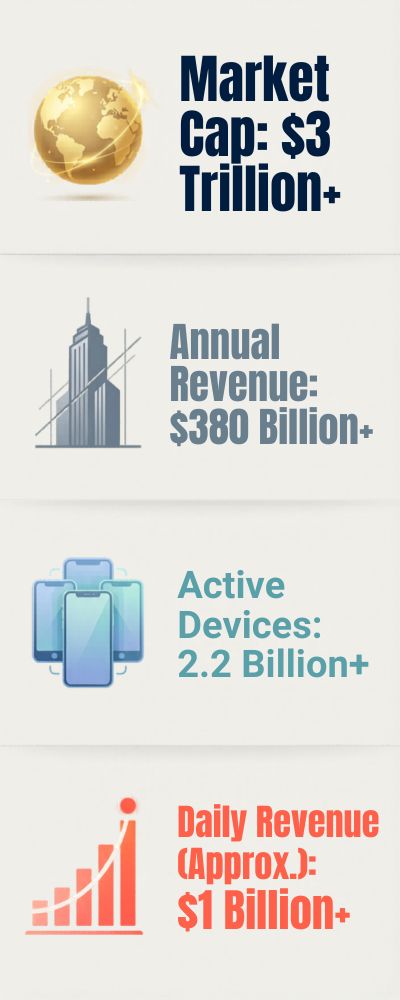
1. Apple’s Market Cap Has Crossed $3 Trillion
Apple became the first company ever to reach a $3 trillion market capitalization, a milestone widely reported by major outlets like Reuters.
That valuation puts Apple in the same economic conversation as entire countries as per Nadasq.
Yeah, that’s as surreal as it sounds.
2. Apple Makes Over $380,000,000,000 a Year
As you can see in their financial reports, Apple rakes in over $380 Billion every year according to Investor Relations.
That’s over $1,000,000,000 a day.
It’s no longer “cool”, it’s just ridiculous.
3. Over 2.2 Billion Active Apple Devices Worldwide
There are more than 2.2 billion active Apple devices worldwide today, industry reports say.
Now, that’s not just size, that’s ubiquity.
Once you start paying attention, you’ll notice it’s all around us.
Apple’s Key Statistics
| Metric | Value |
|---|---|
| Market Cap | $3 Trillion+ |
| Annual Revenue | $380+ Billion |
| Active Devices | 2.2 Billion+ |
| Daily Revenue (Approx.) | $1 Billion+ |
4. The iPhone Still Generates More than 50% of Revenue
The iPhone alone is still responsible for more than half of Apple’s revenue. Again, this is easily verifiable through earnings reports.
For the full details, check this out: Apple earnings reports
Half the business. One product. That’s either brilliant… or a very well managed addiction.
5. Apple’s Services Business Earns More Than $85 Billion Per Year
Today, Apple’s services business earns more than $85 billion annually.
Subscriptions don’t shout. They stack.
And Apple has become very, very good at stacking them.
Important (for your publishing step)
When you copy paste in your CMS:
- WordPress -> toggle “Open in new tab” (is already there with target=”_blank” )
- Webflow -> same with link settings
- HTML -> already done
25 Numbers that show you the history of Apple from garage to trillion-dollar company
It Started in a Garage… But That’s Only Half the Story
We know the garage story. It’s clean. It’s visual. It’s simple. The real growth stories? Not so much. Apple wasn’t a straight shot from garage to trillion-dollar company. It detoured. It tanked. It almost went out of business. And somehow, those twists make the stats cooler. That’s because when you think of Apple today, you’re not just thinking of success, you’re thinking of near-death turned resurrection.
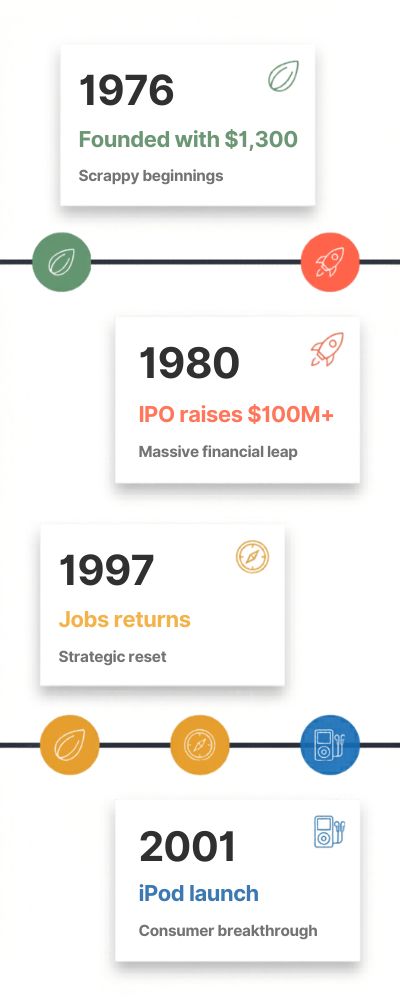
1. Apple Was Founded in 1976 With Just $1,300
Apple started with roughly $1,300 in capital, put together by Steve Jobs and Steve Wozniak, which, according to Britannica’s overview of Apple, came from selling personal belongings.
That number always sticks with me. Not because it’s small, but because it’s relatable.
No pitch deck. No investors circling. Just a belief that personal computers could actually be… personal.
And yeah, hindsight makes it look obvious. But back then? It probably sounded like a long shot.
2. Apple I Sold for $666.66 (Yes, Really)
The original Apple computer, the Apple I, was priced at $666.66, and according to this article from the Computer History Museum, the price was chosen because Wozniak “liked repeating digits.” That’s it. No pricing psychology.
No split testing. Just vibes. It’s kind of nice, actually. The early days of Apple weren’t about optimization. They were about creation. And perhaps that’s why those products are so iconic.
3. Apple Went Public in 1980 and Created Instant Millionaires
In 1980, Apple’s initial public offering (IPO) generated more than $100 million in capital, and more than 300 people became instant millionaires, according to this historical analysis by Nasdaq.
That sort of thing tends to make a company feel different.
All of a sudden, you’re not just making a product, you’re making a juggernaut. A legacy. A phenomenon.
Plus, I imagine, it made employees feel pretty darn good too. One day you’re toiling away at a startup; the next day, you never have to work again.
Such a phenomenon, it can only inspire you to push yourself in ways a budget just can’t.
4. Apple Nearly Went Bankrupt in the 1990s
In the mid-90s, Apple was within 90 days of bankruptcy, according to a study by Harvard Business Review.
This part of the story doesn’t get enough attention.
It’s uncomfortable.
We prefer clean, simple tales of success. Not the ones where a company almost imploded.
But this is where Apple’s personality was defined. When you’re that close to the abyss, things get defined. Decisions get defined. Priorities get defined.
It’s not sexy. But it’s the truth.
5. Steve Jobs Returned in 1997 and Changed Everything
Apple’s return with Steve Jobs in 1997 didn’t just revive the company; it transformed it. According to Apple’s official newsroom timeline (Apple leadership history), Steve Jobs quickly cut Apple’s product line and concentrated on innovating a smaller number of great products.
Sounds easy, right? Nope. Eliminating products is painful. Saying no is painful. Especially when you’re limping. But Steve Jobs committed to that focus. And succeeded. For some companies, growth is not about what to add, but rather what to choose to abandon.
Early Apple Growth Snapshot
| Year | Milestone | Impact |
|---|---|---|
| 1976 | Founded with $1,300 | Scrappy beginnings |
| 1980 | IPO raises $100M+ | Massive financial leap |
| 1997 | Jobs returns | Strategic reset |
| 2001 | iPod launch | Consumer breakthrough |
6. The iPod Sold Over 400 Million Units
The iPod went on to sell over 400 million units, and by that token according to this data from Statista, it is one of Apple’s most important products ever built:
What’s important here isn’t just the number. It’s the timing:
The iPod came well before the smartphone became the centre of everyone’s universe. It was a simple product. Focused. Almost minimalist.
But it drew people into the Apple ecosystem like nothing before it had. And once people were in… they largely stayed. Funny how that works.
How Big Is Apple Really? 25 Statistics That Put Its Scale Into Perspective
Big Numbers Are Easy to Say… Hard to Feel
“Apple is huge.” You’ve heard that a thousand times. I have too. But what does huge even mean anymore? A billion? A trillion? At some point, the words lose their punch. They blur together like background noise. You nod, maybe raise an eyebrow, and move on.
But every now and then, a number sneaks up on you and actually lands. And when it does, you kind of sit there for a second thinking… wait, that can’t be right. That’s the feeling we’re chasing here, not just throwing stats around, but actually understanding what they mean.
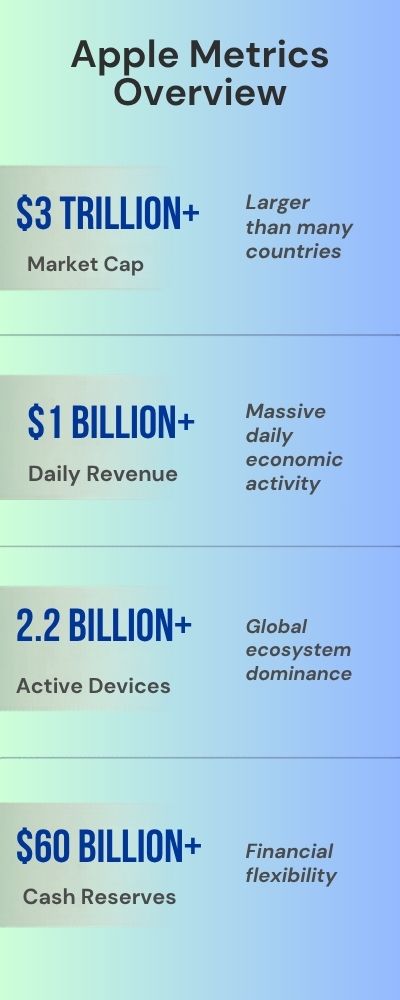
1. Apple Is Worth More Than Most Countries
Apple’s market capitalization has passed $3 trillion, and as per Nasdaq market data, it remains one of the most valuable companies of all time.
Here’s the part that plays with your mind a little.
That valuation makes Apple larger than the GDP of multiple countries. Not small countries either, sizable economies, depending on the year.
It’s a bit surreal to think that a company that makes phones, laptops, and services is bigger than whole nations.
But yeah… that’s a fact.
2. Apple Makes Over $1 Billion Per Day
Apple makes over $380 Billion per year. That’s over $1 Billion per day, according to Apple’s investor reports.
Take a moment to imagine that.
A billion dollars… before noon.
It almost doesn’t seem fair. Like they played the game on easy mode…but they didn’t. It took decades of compounding, iteration, and, to be fair, a few good gambles.
Regardless, the daily revenue alone should give you an idea: Apple isn’t just huge, they’re also moving fast.
3. There Are Over 2.2 Billion Active Apple Devices
More than 2.2 billion active Apple devices exist around the world. According to Statista, that number is increasing steadily. That’s not just market share; that’s presence.
Consider your day. Wake up? iPhone. Work? MacBook. Music? AirPods.
It’s not shoved in your face. It’s just… there.
I think that’s what makes Apple’s scale different. It doesn’t feel loud. It feels normal.
4. Apple has over $60 Billion in Cash
As seen in the various Apple earnings reports you can find on the investor page of Apple’s website, the company has over $60 Billion in cash on hand:
Not assets. Not valuation. Cash.
So the question becomes: what does one do with that much cash?
Well, you invest it, of course. And buy back stocks. And purchase other companies.
Eventually, though, it’s not really about having cash on hand. It’s about having options.
And Apple has lots of those.
Apple’s Scale in Simple Terms
| Metric | Apple Value | What It Means |
|---|---|---|
| Market Cap | $3 Trillion+ | Larger than many countries |
| Daily Revenue | $1 Billion+ | Massive daily economic activity |
| Active Devices | 2.2 Billion+ | Global ecosystem dominance |
| Cash Reserves | $60 Billion+ | Financial flexibility |
5. The iPhone Alone Generates Over $200 Billion Annually
The iPhone generates over $200 billion in revenue per year, which, according to this Statista revenue breakdown, is more than half of Apple’s business.
One product.
That’s what I always come back to.
You could take away everything else, Macs, services, wearables, and Apple would still be one of the biggest companies in the world.
It’s kind of ridiculous.
And yet, people line up every year for the next version.
Not because they need it. Because they want it.
6. Apple’s App Store Generates Over $85 Billion for Developers Annually
Apple’s App Store ecosystem generates over $85 billion annually for developers, as reported by Apple’s official newsroom. That number says something bigger than revenue. It’s not just Apple making money, it’s Apple enabling an entire economy. Millions of developers.
Businesses. Side hustles. Careers built on top of one platform. And yeah, there’s debate around fees and control. That’s fair. But you can’t deny the scale of opportunity it’s created.
25 Apple Statistics That Reveal Its Dominance Across Devices, Services, and Markets
Apple Isn’t Just Big; It’s Everywhere
You don’t really feel Apple’s ubiquity at first. It creeps up on you.
You’re sending a text. Blue bubbles. You pull out your computer. MacBook. You look around a coffee shop. Half the people look like a low-key Apple commercial.
And then it sinks in: this isn’t just popularity. This is… ubiquity.
The stats backing up that ubiquity? They’re not just impressive, they’re a bit unnerving in their ubiquity across devices, services, and even markets.
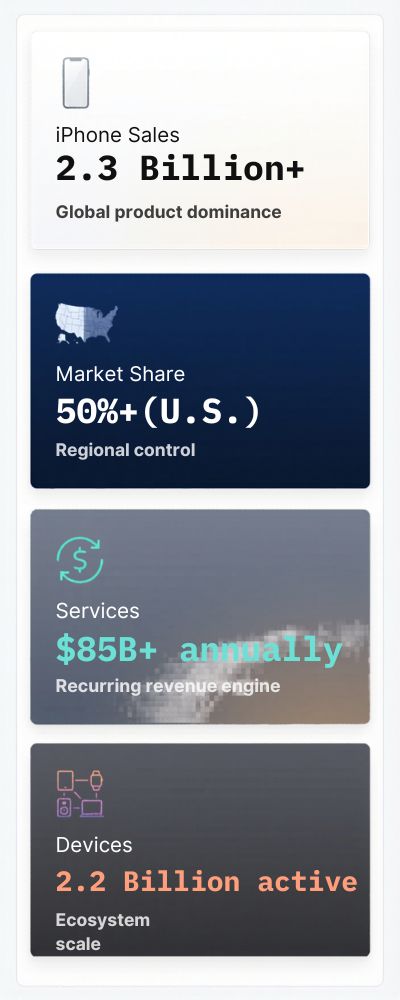
1. The iPhone Has Sold Over 2.3 Billion Units
Apple has sold more than 2.3 billion iPhones worldwide, and according to Statista’s iPhone sales data, it is one of the best-selling products of all time. That number is easy to gloss over. But take a moment. That’s one-third of the world population who owns or has owned an iPhone. It’s not just a successful product. It’s a cultural object at this point.
2. Apple Controls Over 50% of the U.S. Smartphone Market
In the United States, Apple has over 50% smartphone market share, according to Counterpoint Research. Half the country. That’s not competition, that’s dominance. And it creates a strange dynamic. If you’re outside that ecosystem, you feel it. Messaging differences, app behavior, even social perception. It’s subtle, but it’s there.
3. Apple Services Rakes in Over $85 Billion per Year
The Services sector of Apple is over $85 billion per year in revenue, according to Statista revenue segmentation.
And to be honest, this may be the most underappreciated asset of Apple.
You notice Hardware. You don’t notice Services.
Subscriptions don’t surge; they accumulate. Silently. Steadily.
And by the time you realize it, Apple isn’t just selling you a phone, it’s taking a piece of your monthly budget.
4. The App Store Handles Over $1 Trillion in Annual Transactions
The App Store ecosystem handled over $1 trillion in annual developer billings and sales, according to Apple’s official newsroom.
That’s not just a marketplace, that’s an entire economy.
Millions of developers depend on it. Entire companies exist because of it.
And yes, there’s a lot of controversy over Apple’s fees and control. Fair enough.
But you can’t deny the sheer scope of what’s been created here. It’s enormous.
5. Apple Has Over 2.2 Billion Active Devices Worldwide
The total number of active Apple devices worldwide is over 2.2 billion, reports Statista.
And that’s when it starts to get… a little hard to notice.
That’s because Apple isn’t just a category. Apple is a series of categories: phones, laptops, watches, tablets, services, all connected.
You don’t really “use Apple” anymore. You kinda live inside it.
Apple Ecosystem Snapshot
| Category | Key Stat | What It Means |
|---|---|---|
| iPhone Sales | 2.3 Billion+ | Global product dominance |
| Market Share | 50%+ (U.S.) | Regional control |
| Services | $85B+ annually | Recurring revenue engine |
| Devices | 2.2 Billion active | Ecosystem scale |
6. Apple Watch Is the World’s Best-Selling Watch
Apple Watch is now the world’s best-selling watch, selling more than all the Swiss watch manufacturers, combined. (Counterpoint Research) This was a surprise to me the first time I saw it. A technology company… outselling a couple centuries worth of watch brands? That tells you a lot about how Apple moves into markets. It doesn’t just enter them. It fundamentally transforms them.
7. Apple’s Mac Market Share Is Growing Steadily
Apple Mac shipments have been rising, and according to IDC, Apple continues to take share of the global PC market. This one is flying under the radar, but it’s important. For a decade, Macs have been a rarity. Artists, writers, some staunch Apple fans, students, etc.
Now, however, you see Macs everywhere. And Apple Silicon? That’s proven to be more transformative than many predicted.
8. Apple Takes Home Most of the Smartphone Profits
According to Counterpoint Research, Apple takes home more than 80% of global smartphone profits.
The reality is that Apple isn’t the global leader in smartphone unit sales. That’s Samsung. But profits? All Apple.
It’s a good reminder that volume isn’t the only measure of scale. There’s value too.
The Economics of Apple: 25 Statistics on Revenue, Profit, and Market Power
Money Talks, But Apple Practically Shouts
There are profitable companies in the world. Then there’s Apple. Apple doesn’t just generate income. It creates it, like it has its own money printer. This is a bit of an overstatement. But when you see these Apple stats, it won’t feel like an overstatement.
It will feel like a well-oiled machine. A money-making machine. And I’m not saying that just because of how much money Apple makes. I’m saying it because of how consistently it makes that money. With each quarter. With each year. The machine continues to churn.
So we shouldn’t be asking if Apple makes money. We should be asking how. Here are 25 Apple revenue statistics that paint a pretty good picture.
Apple Generates Over $380 Billion in Annual Revenue
You know Apple makes a lot of money. But did you know it rakes in over $380 billion in revenue every year? In fact, Apple’s investor relations reports show they’re consistently one of the highest-grossing companies in the world. Yes, that’s a big number. But what’s even bigger is the consistency.
It’s not a one-time thing. It’s not a good year. It’s every year. That works out to over a billion dollars per day. And while that does feel like cheating, it’s also important to remember that’s the total across a ton of different products, services, and markets. But still… a billion dollars a day. That’s tough to dismiss.
Apple’s Net Profit Exceeds $90 Billion Annually
Revenue is one thing, but profit is another story altogether. Apple makes over $90 billion in net income annually, according to financial statements on Macrotrends. That’s not just making money, that’s an absolute monopoly. There are a lot of companies making a lot of revenue.
There are far fewer companies making that revenue and then turning it into profit on this scale. So the question has to be… how are they doing it? Price control? Brand loyalty? Supply chain dominance? Probably some combination of all three that’s hard to copy.
Apple’s Gross Margin is ~40%
Apple has a gross margin of around 40% as per the segment reporting in their quarterly earnings reports. Now, for a hardware company, this is…kinda ridiculous. Most hardware companies are plagued by thin margins.
Between production costs, logistics, competition, etc. it can be hard to squeeze out any real profits. Not Apple. They don’t compete on price, they compete on perception, ecosystem and experience. And people are willing to pay for it.
iPhone Accounts for >50% of Revenue
iPhone revenues account for more than 50% of Apple’s revenues as per the segment reporting by Statista. One product, half the company. This is either really efficient…or kinda risky depending on your interpretation.
But Apple has consistently kept the iPhone fresh for over a decade. Most products die, the iPhone is constantly evolving. And customers keep coming back.
Apple Financial Snapshot
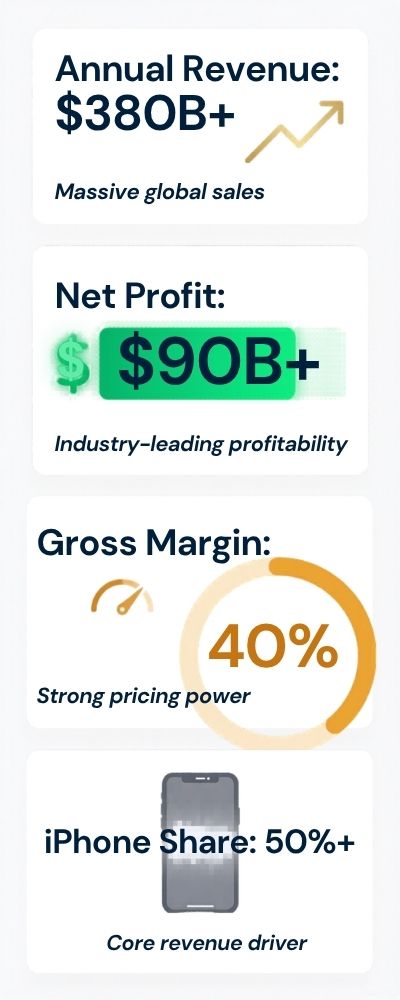
| Metric | Value | Insight |
|---|---|---|
| Annual Revenue | $380B+ | Massive global sales |
| Net Profit | $90B+ | Industry-leading profitability |
| Gross Margin | ~40% | Strong pricing power |
| iPhone Share | 50%+ | Core revenue driver |
Apple has over $60 billion in cash
From what I can see from the data, Apple has over $60 billion cash on hand.
Now, cash isn’t the sexiest thing. But it’s powerful. You can do things with it. Invest it. Acquire things. Fund new things. Make it through hard times.
And Apple has more than most companies ever thought of.
Apple has tens of billions of dollars each year in share buybacks
From EDGAR Company Search results, it seems Apple is spending tens of billions per year on share buybacks
This is a bit more subtle. But this matters. It reduces the amount of outstanding shares and increases earnings per share. Shareholders like that. It’s a sign that they believe enough in their business to invest in themselves. And they do it at a massive scale.
Apple’s Services Are High Margin
Apple’s service arm, which includes iCloud, Apple Music, and the App Store, has a significantly higher margin compared to its hardware counterpart, per Statista.
Now, the strategy starts to come into focus.
Hardware gets you in the door. Services keep you there.
And once you’re there, it’s a different business. Recurring revenue, lower costs, high margins.
Not only is it smart, it’s sustainable.
Apple is One of the Most Valuable Brands in the World
Apple is regularly ranked as the world’s most valuable brand, and Interbrand says that Apple’s brand value is north of $500 billion.
Brand value is nebulous. It’s not tangible. You can’t count it like revenue.
But you can feel it.
It’s the reason why people sleep on the sidewalk for the new device launch. Why they staunchly defend their device to the end of the earth.
And to be honest, that kind of loyalty is priceless.
Apple vs. The World: 25 Stats Comparing Its Size to Countries, Industries, and Competitors
When a Company Starts Looking Like a Country
There comes a time when Apple comparison posts can get a bit ridiculous. You start needing bigger reference points, countries, entire industries, things that feel… stable and immovable. And even then, Apple somehow keeps up.
It’s a strange comparison, honestly. A tech company versus national economies. But the numbers don’t lie, even if they feel a bit surreal when you read them.
Apple’s Market Cap Equals the GDP of Entire Countries
As of this writing, Apple’s market capitalization is over $3 trillion, which puts it on a par with the GDP of either the UK or India, depending on the exchange rate and the business cycle, according to Nasdaq.
I find that a bit mind-boggling.
A company… being compared alongside a nation’s GDP?
It doesn’t seem right. Nations have factories, farms, people. Apple builds gadgets.
And yet, in terms of money, the two are closer than you’d think.
Apple Makes More in a Year Than Most Countries
Apple has annual revenues of over $380 billion, which exceeds the GDP of several smaller and mid-sized countries, according to Apple’s investor relations page.
Now, it’s not really a fair apples-to-apples comparison, since revenues are not the same thing as GDP. However, it does give you an idea of the scale of the situation.
When a single company does more “business” than a country, you’re not just talking about an enormously successful entity. You’re talking about a concentration of enormous power.
Apple vs. Microsoft: A Battle of Trillions
Apple and Microsoft consistently rank as the first or second most valuable company in the world, with valuations between $2-3 trillion via CompaniesMarketCap. These aren’t small potatoes; this is a giant game of tit for tat. They operate on different business models.
Apple on hardware and ecosystem lock-in. Microsoft on software and corporate support. Two different models, roughly equal results. Which is superior? Well, that depends on who you ask.
Apple Captures Most of the Smartphone Industry’s Profits
Apple captures over 80% of global smartphone industry profits (via Counterpoint Research). This always seems…unfair? Apple doesn’t sell the most smartphones in the world. That distinction goes to Samsung.
But when it comes to profits, Apple wins by a landslide. Like showing up fashionably late to the party and still taking home most of the prizes.
Apple vs. Samsung Electronics: Volume vs Value
Samsung has a higher global smartphone volume share, while Apple takes the lead in revenue and profit, per Counterpoint Research. And here is where the plot thickens. Samsung plays the volume game across all price points. Apple? It stays premium. Focused. Controlled.
It is basically quantity vs. quality… except that they are both extremely successful. Perhaps there isn’t just one secret to success, as there are just varying degrees of scaling.
Global Comparison Snapshot
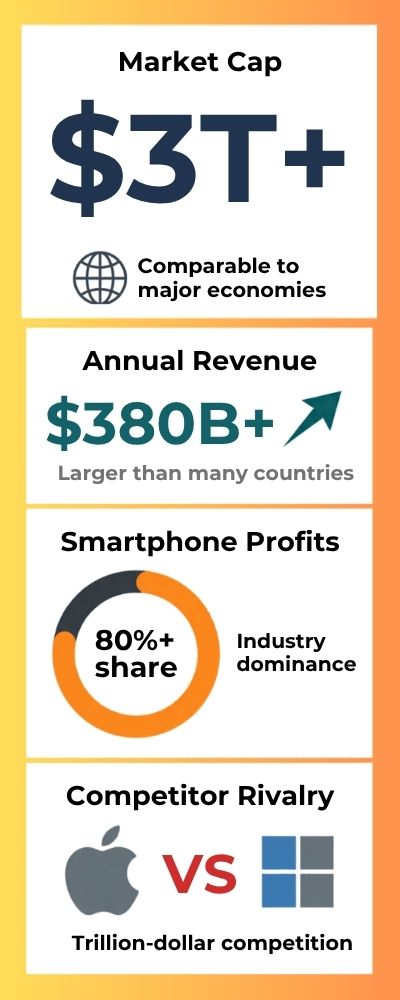
| Comparison Type | Apple Value | Equivalent Scale |
|---|---|---|
| Market Cap | $3 Trillion+ | Comparable to major economies |
| Annual Revenue | $380B+ | Larger than many countries |
| Smartphone Profits | 80%+ share | Industry dominance |
| Competitor Rivalry | vs Microsoft | Trillion-dollar competition |
Apple’s App Store Economy Is Bigger Than Some Entire Industries
Apple’s App Store economy topped $1 trillion in billings and sales in 2022, per Apple’s newsroom.
That’s not an ecosystem, that’s an economy.
Thousands of developers, startups, and full-blown companies operate entirely within Apple’s ecosystem.
In a sense, Apple didn’t just build a company, it built a platform for other companies to be built on.
Yes, there are issues of control and commissions. Sure.
But in terms of sheer scope? Hard to beat.
Apple’s Cash Pile Is One of the Biggest in Business
Apple’s cash balance is in the tens of billions of dollars, and per Apple financial filings, it’s almost always one of the most cash-rich companies in the world.
You don’t hear much about cash, but you should.
Because cash is freedom.
It means Apple can spend, acquire, try stuff, or just sit back and watch while others sweat.
That’s a subtle kind of power.
Apple Makes More Money Than Whole Industries
Apple’s yearly net income is over $90 billion, which, according to Macrotrends, is more than or comparable to the total net income of entire industries. This is where comparisons start to get a bit ridiculous. You’re not comparing companies anymore, you’re comparing worlds. And Apple is at the center of one of them.
Inside Apple’s Ecosystem: 25 Stats on iPhone, Mac, iPad, and Services Growth
It’s Not Just Products: It’s a System
Apple isn’t a company you buy from anymore. It’s a company you just kinda… wind up with.
You buy an iPhone. Then you get some AirPods. Then you get a Mac because, you know, they integrate so well together. Next thing you know, you’re paying a monthly fee for iCloud storage and trying to figure out why it’d be a hassle to leave.
It’s not a coincidence.
Apple didn’t just create products, it created the connections between those products. And the ecosystem those connections facilitate? Yeah. It’s kinda huge.
Apple Has Over 2.2 Billion Active Devices Worldwide
Today, Apple has over 2.2 billion active devices in the world, according to Statista. And that number keeps growing year-over-year.
I think that says a lot.
It’s no longer about individual product success. It’s about network effect. One device makes all the others more valuable. More desirable. A bit more difficult to abandon.
And yeah, once you get in, you feel like switching is a chore.
The iPhone Generates Over 50% of Apple’s Revenue
The iPhone still represents more than half of Apple’s revenue, according to Statista. Which is pretty amazing when you consider how many other products Apple sells.
Mac, iPads, Watches, Services… and yet, the iPhone still carries the bulk of the weight. Like it’s the center of gravity in the ecosystem. Everything else just circles around it.
Over 2.3 Billion iPhones Sold
Over 2.3 billion iPhones have been sold worldwide (according to Statista). That’s a big number. But it’s hard to put into perspective.
I like to think of it like this:
Billions of humans. All using the same operating system. The same design language. The same ecosystem. It’s not just the quantity that’s mind-boggling, it’s the uniformity.
Macs: $40 Billion/Year
Apple’s Mac business is a $40 Billion/year business according to Apple’s Investor News. The Mac used to feel niche. Macs were “for creatives” or “for college students”.
Not anymore. Macs are everywhere. In offices. In remote workspaces. In coffee shops. And when Apple transitioned Macs to Apple Silicon? Macs were given a new lease on life.
Ecosystem Breakdown Snapshot
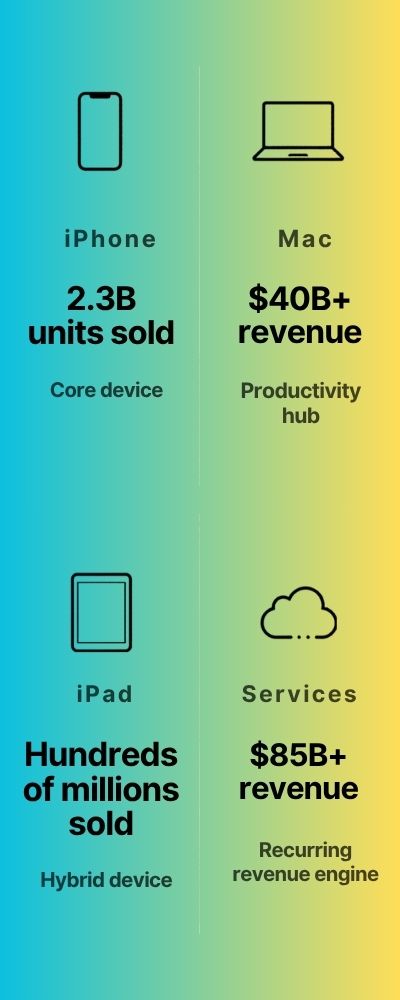
| Product/Segment | Key Stat | Role in Ecosystem |
|---|---|---|
| iPhone | 2.3B units sold | Core device |
| Mac | $40B+ revenue | Productivity hub |
| iPad | Hundreds of millions sold | Hybrid device |
| Services | $85B+ revenue | Recurring revenue engine |
Hundreds of Millions of iPads Sold
Hundreds of millions of iPads have been sold and as of last year, Apple was still the #1 tablet in the world, according to Statista. The iPad is a fascinating product. It’s in this “middle ground” position.
It’s not a laptop. It’s not a phone.
But it’s worked. At least in education, design, casual use. It doesn’t get as much press. But quietly, it’s the top player in its category.
Apple’s Services Business Runs Over $85 Billion a Year
The Apple services business (iCloud, Apple Music, Apple TV+, App Store) runs over $85 billion a year, according to Statista.
This is where the ecosystem really gets locked in. Because services are not “one time” purchases. They’re ongoing. You don’t “finish” using iCloud. You keep using it. Keep paying for it. Keep relying on it. And over time, it becomes routine.
Apple Music Has Over 90 Million Subscribers
As of 2022, Apple Music has more than 90 million subscribers, according to Statista. Even though it’s not the biggest music streaming platform (that’s still Spotify), it’s also deeply integrated. And that matters. You don’t have to look for an alternative when it’s already on your phone. Convenience usually wins.
iCloud Has Over 850 Million Users
There are over 850 million iCloud users across the world, reports Statista. But I don’t use iCloud, I thought. Except I do. iCloud is used by default for photos, backups, and notes. And when you’re out of storage, you just upgrade your plan. Once it becomes integral to your digital life, it becomes harder to migrate out of the ecosystem.
Over 2 Billion Devices: 25 Apple Statistics on Its Massive Global User Base
You Don’t Just Use Apple, You See It Everywhere
It’s funny how you stop noticing things once they become normal. AirPods in someone’s ears. A glowing Apple logo in a café. That one friend who insists on FaceTime instead of literally anything else. None of it feels unusual anymore.
But step back for a second and actually count it, or at least try to, and it gets a bit overwhelming. Because we’re not talking about millions of users. We’re talking billions.
Apple Has Over 2.2 Billion Active Devices Worldwide
Apple has more than 2.2 billion active devices globally, and according to Statista, that number continues to grow year after year. Two point two billion. That’s not just a user base, that’s a global layer of technology sitting on top of everyday life.
And what’s interesting is how invisible it feels. You don’t think, “I’m part of a massive ecosystem.” You just check your messages, scroll a bit, move on.
Apple’s User Base Is Equivalent To One Quarter Of The Earth’s Population
While it’s difficult to estimate the exact number of people using an Apple product, if you consider the active number of Apple devices in the world, as mentioned above, and the number of people living on the planet, according to World Bank estimates, it can be estimated that every 1 in 4 people in the world are using an Apple product of some sort.
Now, that is a serious number to take in. It’s one thing for Apple to be popular, but it’s another thing for it to be omnipresent throughout the world, across different cultures, and at different levels of income. Sure, not all of these people own an Apple product personally, but still. That’s a lot.
There Are Over 1 Billion Active iPhone Users
The number of active iPhone users has reached over 1 Billion, as announced by Apple themselves, as reported by their official newsroom. Let that sink in for a second. One Billion. That’s more than the population of most countries in the world.
And it’s not as if people just use their iPhones every now and then. We use them religiously. All. The. Time. From messaging, to payments, to navigation, to work, to entertainment. It’s all on the iPhone. At that point, it stops being a phone and starts being a utility.
Apple’s Installed Base Continues to Grow Year Over Year
For over a decade, Apple has reported an increase in its installed base and, as of the latest reports published on Apple investor relations , continues to reach record highs.
What I find even more astonishing is:
Sure, anyone can have growth.
But growth at that scale, for that long? That’s retention.
Not only are people coming. But people are sticking around too.
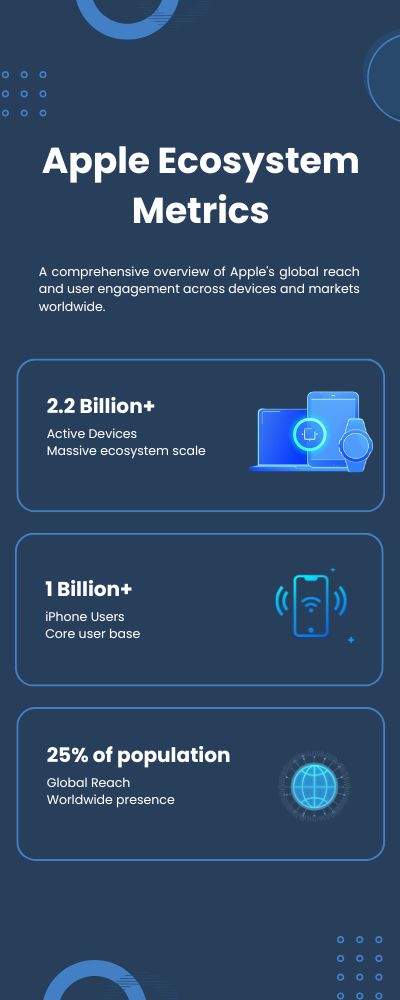
Here’s a quick snapshot of Apple’s global user base:
| Metric | Value | Perspective |
|---|---|---|
| Active Devices | 2.2 Billion+ | Massive ecosystem scale |
| iPhone Users | 1 Billion+ | Core user base |
| Global Reach | ~25% of population | Worldwide presence |
| Growth Trend | लगातार increasing | Strong retention |
Apple controls a significant share of the global premium smartphone market
As per the latest stats from Counterpoint research, Apple leads the global premium smartphone market share. What’s interesting is that, Apple doesn’t aim to conquer every market. Instead, it plays at the premium end.
Why? Because premium users spend more, they stay longer in the ecosystem and they engage more with the ecosystem. It’s not about acquiring as many customers as possible. It’s about acquiring the right customers.
Apple consistently scores over 90% in customer satisfaction
As per the data from the American Customer Satisfaction Index, Apple has consistently been scoring above 90 in customer satisfaction surveys. Now, this is one metric that speaks louder than the billions of dollars in revenue.
Because customer satisfaction ensures loyalty. And customer loyalty ensures everything else. You don’t clock a billion active devices unless your customers like what you have to offer.
Apple Users Are Loyal to the Brand
Apple has one of the highest customer retention rates in the industry, often above 90%, according to analysis by Counterpoint Research. This one feels personal. You know someone who’s been using iPhones for years.
Maybe you’re that person. Switching isn’t impossible, but it feels like effort. Like learning a new language you didn’t ask to learn. And most people? They stick with what they know.
Apple’s Ecosystem Encourages Multi-Device Ownership
A large percentage of Apple users own multiple Apple devices, according to consumer behavior studies referenced by Statista. That’s where the ecosystem really shows its strength. One device leads to another.
Then another. Not because you’re forced, but because it just works better together. And once you experience that… going back feels like a downgrade.
Apple’s Global Footprint: 25 Statistics on Its Reach Across Countries and Consumers
Apple isn’t available everywhere… But it seems like it is You can’t go far without seeing Apple Airports, cafes, co-working spaces, there’s always the glow of a Macbook screen or someone typing away on an iPhone like it’s muscle memory But the thing is, Apple isn’t truly global
It is dominant in some markets, but absent in others. And yet, it feels like it’s everywhere That’s the interesting thing about the contrast between the two. Apple’s international market share varies It’s not always the leading brand And yet, it feels like it is
That’s what we’re going to explore in this post Let’s dive in. Apple has a global presence, but not truly global market share Here’s the first Apple international market share stat. Apple products are sold in more than 175 countries. According to Apple’s retail page, the company has a presence in nearly every major market
That’s not just a matter of distribution
That’s logistics, partnerships, supply chains. All of that. You don’t think about that when you buy a phone. But getting a product into 175 countries is a different level of scale.
Apple has more than 500 retail stores globally, according to its Apple Store directory. And they’re not just stores, they’re an experience. You go into one and it doesn’t feel like a store. Everything is so clean and minimalist and …refined.
I guess that’s the idea. Apple doesn’t just sell you a product, it controls the way you experience it. And it translates across borders pretty well.
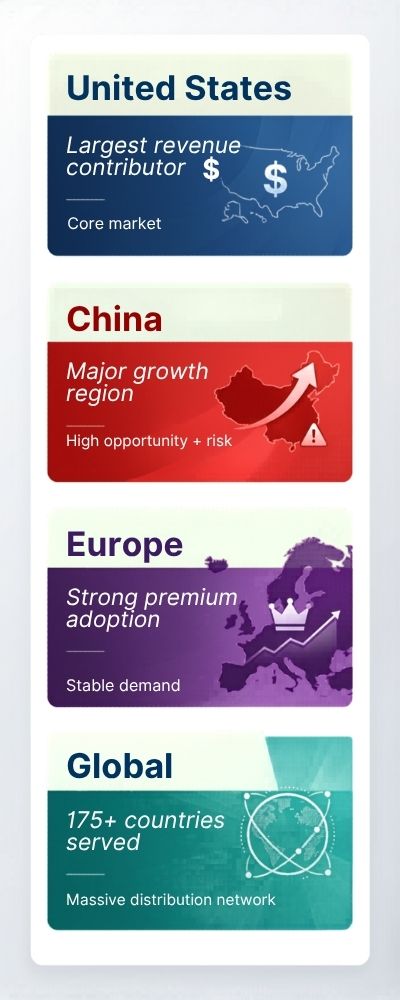
The United States Remains Apple’s Largest Market
The U.S. still remains Apple’s biggest market, accounting for a lion’s share of its sales, according to the country-by-country sales breakdown in Apple investor reports.
That shouldn’t be surprising. The company was born there. Its brand is still closely tied to U.S. tech. But interestingly, a good portion of its growth is coming from outside the U.S. Which takes us to …
China Is One of Apple’s Most Important Markets
China is one of the biggest contributors to Apple’s international sales, and according to Statista regional data, it is still one of Apple’s main growth markets. This is a double-edged sword. On the one side, huge demand.
On the other, regulatory hurdles and domestic competition. In other words, this isn’t a straight-line growth trajectory; it’s a tightrope. One which Apple is steadily navigating.
Global Reach Snapshot
| Region | Role in Apple’s Business | Insight |
|---|---|---|
| United States | Largest revenue contributor | Core market |
| China | Major growth region | High opportunity + risk |
| Europe | Strong premium adoption | Stable demand |
| Global | 175+ countries served | Massive distribution network |
Europe accounts for a large chunk of Apple’s revenues
As seen in Apple financial reports, Europe accounts for a significant portion of Apple’s revenues.
What’s unique about this one?
Europe is a relatively stable economy. It isn’t like emerging markets where there are surprises at every corner. It’s relatively stable. Apple does well in such an economy where branding, quality, and ecosystem take precedence over pricing.
Apple is growing aggressively in India
India has emerged as one of the top growth markets for Apple, with iPhone shipments increasing consistently as per Counterpoint Research.
What’s unique about this one?
India is a very price-sensitive economy, which hasn’t traditionally been Apple’s cup of tea.
However, Apple has been slowly addressing this problem, by manufacturing in India, offering financing options, and selling previous-generation models at discounted prices.
The growth isn’t spectacular yet, but it’s getting there.
Apple’s Supply Chain Reaches Across Dozens of Countries
The sheer number of countries that Apple has within its supply chain is enormous, as shown on their supplier reports page. Here is a part of Apple’s global footprint that the average user will never see.
From factories to component suppliers to logistics networks, nothing is visible. Without it, however, nothing happens. And being able to manage all that? That is a major operational advantage.
Apple’s Brand Is Recognized Globally
Apple is consistently one of the most recognized and valuable brands in the world, even at times reaching the #1 spot in the world according to Interbrand rankings. The recognition of a brand is a pretty broad term, but it is a potent one.
It means that whether you are in New York or Paris or Mumbai, you are able to recognize the same brand. Having a global identity like that is something unique. And to be honest, it is one of Apple’s best advantages.
The Cult of Apple: 25 Statistics on Brand Loyalty, Customer Behavior, and Influence
You’ve noticed it. There’s something vaguely … odd about Apple users. Not bad odd. Just, you know, consistent. Predictable. Pathologically loyal, if you want to look at it that way. If you ask someone why they use an iPhone, the response is almost never technical.
It’s not “processor speed” or “RAM.” Usually the answer is something like … “It just works.” Now that’s a phrase that does a ton of work. I mean, it’s simple. Almost dismissive. But look behind it, and you’ll find one of the most successful branding mechanisms in history.
Apple’s Customer Loyalty Rate Exceeds 90%
Apple has stated on multiple occasions that its customer retention rate is over 90%. And according to Counterpoint Research, it ranks highest in the smartphone industry for loyalty. That … is a pretty amazing number. If you think about it. Nine out of 10 customers remain with Apple at upgrade time.
That’s not typically how customers behave in any given industry. It implies something beyond customer satisfaction. It implies dependence. Affinity. Even identity.
iPhone Users Are More Likely to Upgrade Within the Ecosystem
iPhone users by and large upgrade to another iPhone, according to behavioral trends outlined by Statista. And honestly, that makes sense. Switching ecosystems isn’t just about buying a new phone.
It’s relearning everything, apps, settings, workflows. Most people don’t want that friction. So they stay. Not because they’re forced, but because it’s easier.
Apple Has One of the Highest Customer Satisfaction Scores in Tech
Apple consistently scores above 90% in customer satisfaction, according to surveys from the American Customer Satisfaction Index. This one feels less surprising. When something works smoothly, people notice. When it doesn’t, they notice even more.
Apple leans heavily into consistency. Same gestures, same design language, same ecosystem behavior. And over time, that builds trust.
Apple Users Spend More on Apps and Services
Apple users spend more on apps and digital services than other platforms, according to Statista app revenue comparisons.
What does this stat mean?
It’s not just about the number of users Apple has, it’s about how engaged they are.
Not just using their devices, but spending money on them.
- Subscriptions
- Apps
- Upgrades
It all adds up.
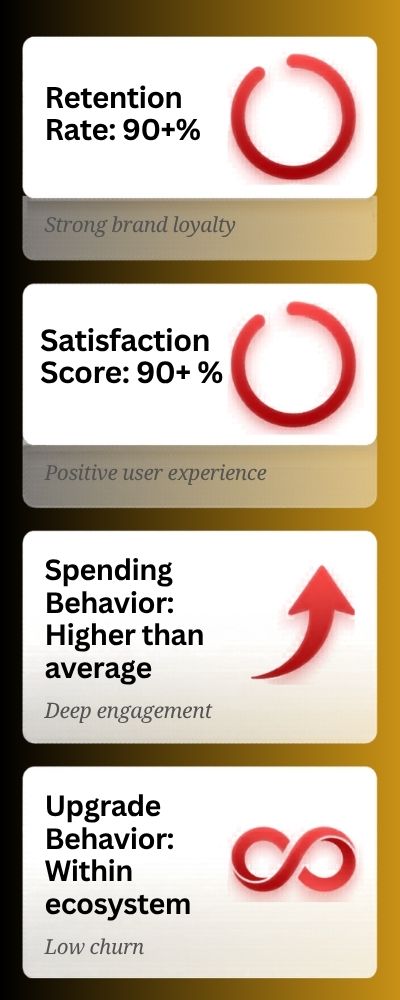
Loyalty Snapshot
| Metric | Apple Users | What It Suggests |
|---|---|---|
| Retention Rate | 90%+ | Strong brand loyalty |
| Satisfaction Score | 90%+ | Positive user experience |
| Spending Behavior | Higher than average | Deep engagement |
| Upgrade Behavior | Within ecosystem | Low churn |
The Apple Brand is #1 in the World
Apple has long been the #1 most valuable brand in the world, with a brand value of over $500 billion, according to Interbrand. Brand value is one of those funny things. You can’t put your finger on it. You can’t measure it like you would revenue.
But you know it when you see someone fighting for their phone choice like it’s personal. Let’s just say this happens a lot with Apple.
Apple’s Ecosystem Inspires Emotional Attachment
The majority of Apple customers experience strong emotional attachment to their devices, according to consumer studies cited by Statista. This one’s a bit harder to measure, but you see it every day. People don’t just use their phones. They need them.
Their personal photos, messages, memories… it’s all there. Changing devices starts to feel less like a technology choice and more like a life disruption. And that emotional piece is a big punch.
Apple Stores Foster Brand Loyalty
The purpose of Apple Stores is to improve the customer experience and, according to Apple’s retail overview, they are meant to be stores that also offer support services. Have you ever walked into an Apple Store? It doesn’t feel sales-y. It feels… purposeful.
People try out the products, ask for advice, linger for longer than they actually need to. This sort of thing creates a relationship, not just a sale.
Apple’s Marketing Strategy Favors Brand Over Price
It almost goes without saying that Apple never races to the bottom on price, and, according to industry analysis by Harvard Business Review, instead chooses to focus its marketing on branding.
It’s a small thing, but a significant one. The vast majority of companies focus on price, promotions, and special offers. Apple does not. It sells desire. Somehow, it works.
The Future of Apple: 25 Stats on AI, Wearables, and What’s Next
Apple’s Next Act Feels… Different
Apple’s not a first mover. Never has been. It waits and watches, then pounces when the time is right. The market is defined. The money is flowing. The thing is: this time it feels like it’s moving fast. AI is evolving quickly. Wearables are getting serious.
Other companies are throwing spaghetti at the wall, just to see what sticks. And Apple? Still playing it cool. Which means it’s either playing catch-up… or building something huge.
Apple Invests Billions in R&D Each Year
Apple invests over $30B annually in R&D. According to Macrotrends, that figure has been rising for a decade. That’s not someplace they’re dipping their toes. That’s where they’re planting a flag. AI. Chips. Wearables. The next big thing. We don’t hear much about it until it’s time. Which is what makes it fun.
Apple’s Wearables Segment Generates Over $40 Billion Annually
Apple’s wearables, home, and accessories segment brings in over $40 billion per year, as per Statista . That’s bigger than many standalone companies. And yet, people still talk about wearables like they’re “side products.” The Apple Watch, AirPods, these aren’t experiments anymore. They’re established revenue streams. And they’re still growing.
Apple Watch Is the World’s Most Popular Smartwatch
Apple Watch continues to lead the global smartwatch market, and according to Counterpoint Research , it consistently ranks #1 in shipments. What’s interesting is why people buy it. Not just for notifications, but for health tracking, fitness, even peace of mind.
It’s one of the few Apple products that feels… personal in a different way. Closer to your daily life, literally on your wrist.
AirPods Dominate the Wireless Earbuds Market
Apple’s AirPods line leads the global wireless earbuds market, as per Counterpoint Research.
This one still surprises me a bit.
They’re small. Simple. Easy to overlook.
But they’ve become almost a default choice.
And once again, it comes back to ecosystem. Pairing is seamless. Integration is tight.
Convenience wins.
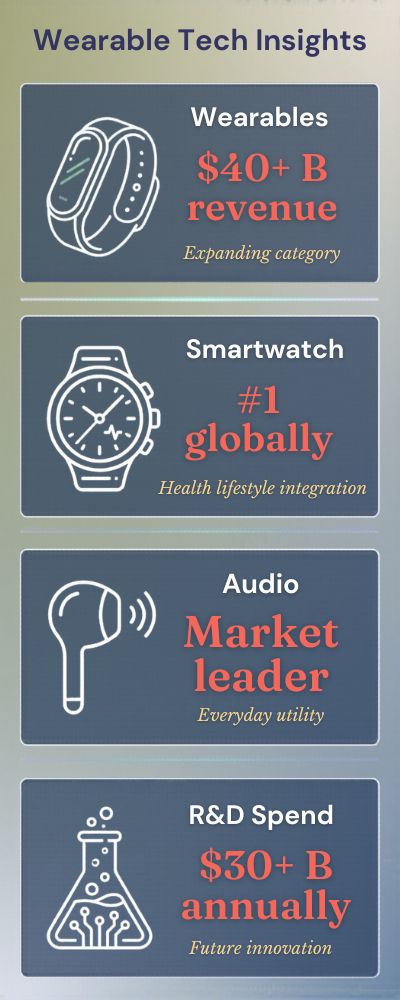
Future Product Snapshot
| Segment | Key Stat | Growth Signal |
|---|---|---|
| Wearables | $40B+ revenue | Expanding category |
| Smartwatch | #1 globally | Health + lifestyle integration |
| Audio | Market leader | Everyday utility |
| R&D Spend | $30B+ annually | Future innovation |
Apple Is Entering AI. Just Not with a Bang
Apple is ramping up its efforts around AI, which is predicted by consulting firm McKinsey to be a key technology in the next generation of consumer tech products.
I’d characterize what we’ve seen so far as … cautious.
No big reveals. No “AI will change the world” statements every other day.
Just incremental improvements: on-device processing, privacy-enhanced capabilities.
Not “Hey, look what we made” as much as “It just works.”
Will it be enough? We’ll have to wait and see.
Apple’s Homegrown Chips Are Delivering on Promises
Apple’s shift to in-house-designed chips, such as the M1, has significantly impacted the company’s product lineup. According to reports from chip analysis firm AnandTech, these chips are beating much of the competition in terms of power efficiency.
This is perhaps one of the better bets Apple has made in a long time.
By owning the entire stack, it gains the ability to tune performance, battery life, and support.
And in Apple’s business model, control almost always equates to leverage.
Apple Is Entering the AR/VR Market with Vision Pro
Apple has introduced the Vision Pro, marking its entry into spatial computing, as detailed in Apple’s official announcement. This one feels like a gamble. Not because the tech isn’t impressive, it is. But because adoption is uncertain.
Expensive. Early. Still, Apple has a history of entering markets late and redefining them. So the question isn’t “Will it work?” It’s more like… “When?”
Services Will Likely Drive Future Growth
Apple’s services segment continues to grow steadily, contributing over $85 billion annually, according to Statista. And this is where things start to feel inevitable. Hardware may evolve. New categories may emerge.
But services? They compound. Subscriptions, ecosystems, and recurring revenue are all building on itself. And Apple seems very aware of that.
Beyond the iPhone: 25 Apple Statistics That Hint at Its Next Trillion-Dollar Opportunity
The iPhone has been the engine of Apple’s business for more than a decade. That’s not even in question. The iPhone makes money, the iPhone drives upgrades, the iPhone powers the ecosystem. But you sense the change, don’t you? Not seismic. Not dramatic. Just… inexorable.
Because at some point even the greatest of products will reach a saturation point. And you know what? Apple knows that too. You can see it in the way it’s slowly grown everything around the iPhone. As if it’s preparing for a world where the iPhone is not the centrepiece.
The iPhone Still Accounts for Over 50% of Revenue
The iPhone accounted for more than half of Apple’s revenue and remains the company’s largest business segment, according to Statista. That’s great… but it’s also a little worrying. Because when a company depends on one product for more than 50% of its revenue? It’s great.
Until it’s not. Clearly Apple is not completely oblivious to this. It is not planning to suddenly just dump the iPhone. But it is slowly growing other elements of its business.
Apple’s Services Revenue Exceeds $85 Billion
Apple’s services revenue now exceeds $85 billion, according to Statista. This is where things start to get interesting. Specifically: Services don’t depend on hardware cycles. They don’t wait for upgrades.
They just run in the background, subscriptions, storage, apps, month after month. And over time, that kind of revenue becomes incredibly stable. Almost addictive, from a business perspective.
Wearables Exceed $40 Billion Per Year
Apple’s wearables segment exceeds $40 billion per year, according to Statista. Which still surprises people, I think. Because wearables don’t feel like a massive business. They feel like accessories. But the numbers say otherwise. Apple Watch, AirPods, they’ve quietly grown into something much bigger than side products.
Apple Watch Still Dominates Smartwatch Sales (Globally)
Apple Watch is still the number one smartwatch in the world (Source: Counterpoint Research).
But here’s the interesting thing, it’s no longer about technology.
It’s about heart rate monitoring, fitness tracking, health tracking.
It’s about having something tied to your body that helps you live a better life.
Once people get used to it, it’s going to be hard to get rid of.
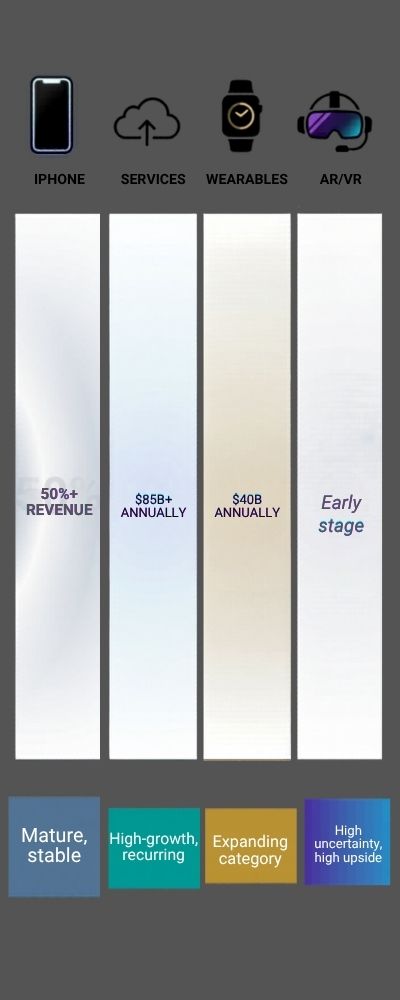
| Segment | Current Scale | Future Potential |
|---|---|---|
| iPhone | 50%+ revenue | Mature, stable |
| Services | $85B+ annually | High-growth, recurring |
| Wearables | $40B+ annually | Expanding category |
| AR/VR | Early stage | High uncertainty, high upside |
AirPods Own the Wireless Earbuds Game
Apple’s AirPods lead the global true wireless earbuds market, as reported by Counterpoint Research.
This one almost feels too obvious.
They’re earbuds. What’s the big deal?
But then you start to notice how many people use them. On phone calls. On the bus. At the gym.
They’ve just become something people use all the time in a way that feels… natural.
And Apple has a history of making simple products into huge businesses.
Apple’s Device Army Means Future Sales
Apple’s ecosystem now includes over 2.2 billion active devices, according to Statista.
This may be the most important number in the whole list.
That’s because each one of those devices is a chance to sell a service, or a new device, or a case.
It’s not just an audience, it’s a sales funnel. And Apple hasn’t squeezed everything out of it just yet.
Apple Is Betting Big on AR/VR
Apple’s Vision Pro is a significant investment in spatial computing, as detailed on Apple’s official product page. This one feels like a bet. Not guaranteed. Not immediate. But potentially huge.
Apple doesn’t typically enter new categories unless it believes there’s something bigger at play. So even if we don’t see widespread adoption overnight, it’s clear what this is all about: the next platform.
Apple’s Custom Silicon Powers New Product Categories
Apple’s custom silicon (M-series, A-series) is pushing the performance/efficiency envelope, as explained by the fine folks at AnandTech. And this is where things get quietly strategic.
When you own the hardware and the silicon, you’ve got options. You can create products that others can’t quite copy. And that allows you to do whatever is next.
Apple Makes More Profit Per Phone Than Any Competitor
Apple doesn’t just sell phones, it extracts more profit from each one than almost anyone else in the industry. While competitors fight for volume, Apple quietly dominates margins. That’s why it can sell fewer units than Android brands and still walk away with most of the profits. It’s less about winning the race… more about owning the finish line.
Apple’s Revenue Is Bigger Than Companies Like Nike and Coca-Cola Combined
Apple’s annual revenue surpasses the combined revenue of major global brands like Nike and Coca-Cola. That comparison always feels a bit unfair, but also revealing. It shows how Apple operates at a completely different scale than traditional consumer brands. You’re not just comparing categories anymore, you’re comparing ecosystems.
Apple Employs Over 160,000 People Worldwide
Apple has a workforce of more than 160,000 employees globally. That sounds big, but when you compare it to its revenue, it becomes even more impressive. The company generates enormous output with relatively lean staffing compared to other giants. It’s efficiency at a scale that feels almost engineered.
Apple Generates Over $2 Million in Revenue Per Employee
Apple earns more than $2 million per employee annually. That’s one of the highest productivity ratios in the world. It suggests something deeper than just good business, it points to systems, structure, and ruthless efficiency. Not always glamorous, but undeniably effective.
Apple’s App Store Has Over 1.8 Million Apps
The App Store hosts more than 1.8 million apps. That’s an entire digital economy living inside Apple’s ecosystem. From billion-dollar companies to side hustles, everything runs through that single gateway. It’s not just a store, it’s infrastructure.
Apple Pays Developers Tens of Billions Each Year
Apple pays developers tens of billions of dollars annually through the App Store. That number keeps climbing as the ecosystem grows. It’s easy to criticize Apple’s cut, but the size of the pie itself is enormous. And for many developers, it’s still the most profitable platform.
Apple Stores Generate More Revenue Per Square Foot Than Any Retailer
Apple retail stores consistently rank among the highest in revenue per square foot. Higher than luxury brands. Higher than most traditional retail chains. Which is kind of wild when you think about it, people don’t even go there just to buy things. They browse, explore, hang out… and still spend.
Apple Has Over 500 Retail Stores Worldwide
Apple operates more than 500 stores globally. Each one looks similar, feels similar, and reinforces the same brand experience. That consistency is intentional. It makes Apple feel familiar no matter where you are.
Apple’s Gross Profit Alone Exceeds Many Companies’ Total Revenue
Apple’s gross profit, just the profit before expenses, is larger than the total revenue of many companies. That’s a strange comparison, but a useful one. It shows how much value Apple extracts from its products. Not just sales, actual margin.
Apple’s Services Business Is Larger Than Many Tech Companies
Apple’s services division alone generates tens of billions annually. If it were a standalone company, it would still rank among major tech firms. That’s how far Apple has moved beyond hardware. It’s building recurring revenue at scale.
Apple Has Sold Hundreds of Millions of Macs
The Mac has sold hundreds of millions of units. The Mac may not be the world’s most popular computing platform, but it has a large and loyal market, which Apple Silicon has revitalized. Sometimes gradual growth is the best kind.
Apple’s iPad Still Dominates the Tablet Market
After more than a decade of alternatives, the iPad remains the world’s best-selling tablet. Apple defined the category and still leads it. It’s a rare product that can maintain its lead over that long.
Apple Owns a Massive Share of the Premium Smartphone Market
Apple has a majority share of the world’s premium smartphone market. That means the majority of the world’s premium smartphone buyers prefer an iPhone over any other brand. It’s not a matter of price, it’s a matter of perceived value.
Apple’s Cash Reserves Could Fund Entire Countries’ Budgets
Apple has tens of billions of dollars in cash reserves. Enough to fund a small country’s economy for a year. That liquidity gives Apple a lot of maneuverability. It can move very fast if it needs to.
Apple’s Brand Alone Is Worth Hundreds of Billions
The Apple brand is worth more than $500 billion. That’s not revenue, that’s brand value. Trust. Perception. Branding. In fact, it may be Apple’s most valuable asset.
Apple Users Spend More on Apps Than Android Users
iPhone users spend more money on apps than Android users. Not because they’re forced to, but because they’re willing to. That has profound implications for the app economy. Developers notice this. Investors notice this.
Apple’s Ecosystem Drives Multi-Device Ownership
Many Apple customers own multiple Apple devices, including an iPhone, a Mac, an iPad, and a Watch. That’s not a coincidence. Apple’s devices reinforce one another, and over time create a sort of gravity well around you.
Apple Has One of the Lowest Customer Churn Rates in Tech
Once an Apple customer, almost always an Apple customer. Apple has one of the lowest customer churn rates in tech. That customer loyalty is worth a lot. It creates revenue annuities.
Apple’s Supply Chain Spans Hundreds of Suppliers Worldwide
Apple has hundreds of suppliers across many different countries. It’s one of the most complicated supply chains in the world. And yet it generally hums along like clockwork. Most of the time.
Apple Launch Events Reach Millions of Viewers Globally
Apple launch events get millions of live viewers around the world. Not just Apple enthusiasts. Analysts, competitors, journalists, etc. It’s one part keynote, one part cultural phenomenon. Few companies command so much attention.
Apple’s Wearables Business Is Bigger Than Many Fortune 500 Companies
Apple’s wearables division is bigger than many standalone companies. And it’s still growing. What started out as accessories have become significant businesses in their own right. It kind of snuck up on us.
Apple Controls Both Hardware and Software, And That’s Rare
Apple designs both its hardware and software. That’s relatively rare. Most companies control one or the other. Apple’s vertical integration allows for an integrated user experience.
Apple Continues to Grow, Even at Massive Scale
Apple is still growing. Year after year after year. Even at scale. That may be the most astonishing statistic of all. Most growth slows down at that scale. Apple seems to still be chugging along just fine.
Conlusion
After all those numbers, you can’t help but look at Apple a little differently.
It’s not about iPhones, or nice-looking products, or huge profits, those are just the outward signs. It’s about ubiquity, in devices, services and in whole industries.
Perhaps that’s the story of Apple.
It didn’t just get big, it got embedded. Slowly, quietly and almost imperceptibly, until it’s everywhere and it’s easier to keep going than to stop.
Next time you pick up your smartphone or open your laptop, think about that.
Not really think about it. Just a thought. This small, mundane object is tied into something enormous.
And yet it feels totally normal.


