

You can dismiss Snapchat. I’ve heard it before. “Don’t we just use Snapchat in college?” Or “Hasn’t the world moved on to TikTok and Instagram?” Great questions. I used to ask them too. But then you look at the data. It doesn’t add up to that narrative.
Table of Contents
Snapchat isn’t trying to make news or change the world every other quarter. They are doing something more quietly… and perhaps more importantly. Hundreds of millions of humans still open up Snapchat daily… not to scroll, but to chat, to react, and to share moments that weren’t meant to stay permanent. That’s a big deal.
Rather than questioning if Snapchat is ‘winning’ in a conventional way, it makes sense to ask why this still exists. The stats below will not only answer that question, but illustrate an app that never really disappeared, even if we stopped covering it.
How Many People Use Snapchat in 2026? (Monthly and Daily Active Users)
Alright, Snapchat may not be singing like a canary anymore, but it’s not singing its swan song either. As of the early part of 2026, there are over 800 million monthly active users (MAUs) on Snapchat, and between 420-430 million daily active users (DAUs). It’s some pretty hard-to-ignore stats, if you ask me. Not to mention, it’s pretty funny.
For years now, we’ve been hearing that “Snapchat is dead”. Yet, it keeps on racking up users, and remains incredibly relevant. Based on official reports from Snap Inc. Investor Relations, the number of Snapchat users has been steadily rising, year after year, with no massive declines or crazy fluctuations.
That kind of continued, steady growth might not be flashy news headlines, but it often means that you’re doing something right.
The Growth of Snapchat Users
Take a step back and zoom out for a second and you’ll see the truth. Snapchat isn’t dying, it’s just growing up.
| Year | Daily Active Users (DAUs) | Monthly Active Users (MAUs) |
|---|---|---|
| 2020 | ~265 million | ~500 million |
| 2022 | ~375 million | ~700 million |
| 2024 | ~406 million | ~750 million |
| 2026 | ~420–430 million | ~800+ million |
There’s something almost… comforting about this graph. No meteoric spikes, no plummeting falls, just steady, straight-line growth. Industry data aggregators show that Snapchat has enjoyed considerable growth in international markets over the past few years.
And in my opinion, social media consistency is underappreciated. It usually means that users are not just showing up, but they’re also sticking around.
Daily Active Users: Where the Real Action Is
Let’s get real, monthly users sound impressive, but 420 million daily users is where it’s at.
The fact that those users open the app an average of over 30 times a day is almost Pavlovian at this point.
According to Snap’s own data, users are creating over 5 billion snaps per day. That’s a hell of a lot of usage, almost all of which self-destructs in seconds.
In a way, that’s kind of nice. No perpetual history, no need to present a highlight reel. Just ephemeral, raw communication.
Maybe that’s why it works.
Where Is All This Growth Coming From?
This isn’t a US or Europe story anymore, Snapchat has gone worldwide in a very real way.
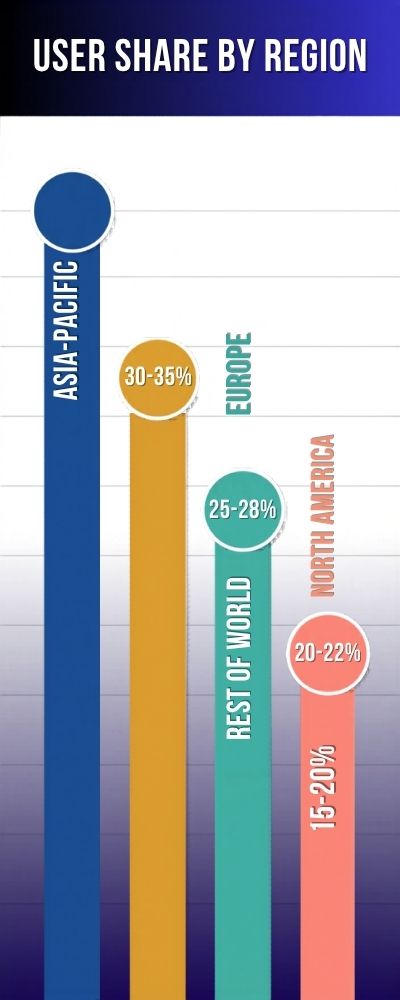
| Region | Share of Users |
|---|---|
| North America | ~20–22% |
| Europe | ~25–28% |
| Asia-Pacific | ~30–35% |
| Rest of World | ~15–20% |
Regionally, the Asia-Pacific region is now the fastest-growing region for Snapchat, with India being a key contributor to its growth.
And that’s important. Because it means that Snapchat’s growth isn’t reliant on a single market; it’s diversified, which is generally a strong indicator for the future.
Why Does Snapchat Still Matter?
Ok, this is where I get a little subjective.
Snapchat never became a performance platform. It never pursued perfection. It never lost its casual, messy, sometimes clumsy charm, and that’s why people like using it.
Via its own research, Snap has found that Snapchat users generally feel more authentic and less judged than on other platforms (according to Snap Inc. Insights).
Ok, so it’s not a “hard” metric like DAU, but it helps explain the “why” behind those numbers.
So when you see that there are now over 400 million daily active users on Snapchat, that’s not just a function of reach, it’s a function of routine, of comfort, of a digital environment that doesn’t feel artificial.
And in a digital landscape where almost everything feels staged and manicured, that’s probably more important than we realize.
Snapchat vs Instagram vs TikTok: The figures that show who’s REALLY winning
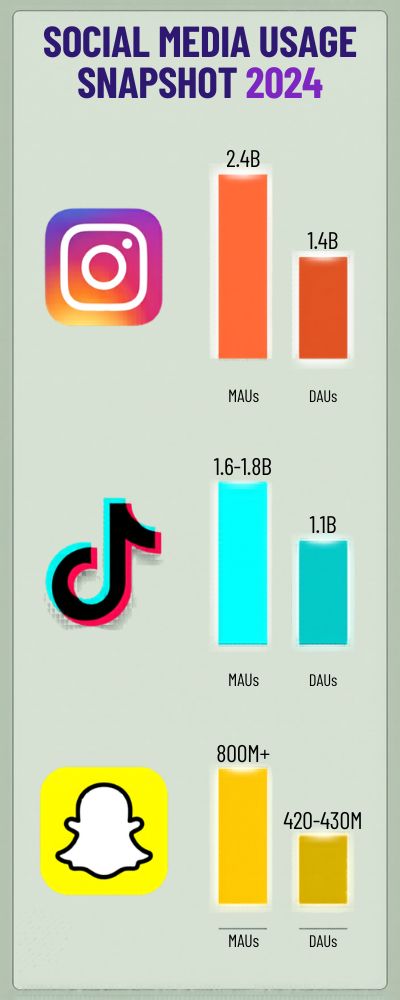
A Snapchat vs Instagram vs TikTok showdown is like comparing apples, oranges… and that one weird thing you binged on at 2am. Here are the big numbers:
| Platform | Monthly Active Users (MAUs) | Daily Active Users (DAUs) |
|---|---|---|
| ~2.4 billion | ~1.4 billion | |
| TikTok | ~1.6–1.8 billion | ~1.1 billion |
| Snapchat | ~800+ million | ~420–430 million |
At first glance, the answer seems simple. It’s Instagram. The platform is huge. Impossible to ignore. It still reaches the most people on the planet via Meta Investor Relations. Now, let’s get complicated. Because more isn’t always better when it comes to the way people use these apps.
Time Spent: Where Users Are Getting Addicted
Let’s get real. Time spent is the big metric. TikTok wins big here. Users average 90 to 95 minutes per day watching the app. That’s not dabbling. That’s a “let me watch one more video” gone wild.
| Platform | Avg. Time Spent Per Day |
|---|---|
| TikTok | ~90–95 minutes |
| ~30–35 minutes | |
| Snapchat | ~25–30 minutes |
Behavioral reports suggest that the TikTok algorithm does a better job at retaining users according to DataReportal Digital 2025 Report.
Conversely, Snapchat doesn’t aim to keep you scrolling for hours on end. Instead, it’s more of a daily check-ins type of deal. Entirely different.
Engagement Style: Passive vs Active
Here is where the script gets flipped.
TikTok and Instagram are both very passive. You scroll. You watch. You like. You’re entertained.
But Snapchat is different.
The user sends messages, snaps, and replies. It’s not “look at this” as much as it is “say something to me.” According to Snapchat’s own data, the average user opens the app over 30 times per day (according to Snap Newsroom).
That matters.
That shows that users have adopted the platform as a habit, not just a curiosity.
And I’ll say it, Snapchat feels more intimate. Less “showy.” You’re not speaking to the world. You’re speaking to individuals.
Demographics: Who’s Using What?
Alright, now that we’ve covered who’s who in the social media world, let’s take a look at who’s using these sites because, well, this is where it gets interesting.
| Platform | Core Age Group | Key Insight |
|---|---|---|
| Snapchat | 13–34 (Gen Z heavy) | Strongest among teens |
| 18–44 | Broad, aging slightly | |
| TikTok | 16–34 | Gen Z + younger millennials |
Snapchat is still the preferred choice among teens in many areas. In fact, the demographics show that it connects with over 75% of 13-24-year-olds in various countries as per Statista, Snapchat demographics.
Instagram, in comparison, seems a little more… refined, perhaps a little more mature as well. TikTok is the middle ground, young, but increasingly gaining an older audience too.
And if you are concerned about the future, Gen Z is more important than the current numbers. Because Gen Z dictates the future.
Content Creation vs Communication
What isn’t being asked enough here is: What exactly are people doing on these platforms?
- TikTok = Making and viewing viral clips
- Instagram = Building your identity, posting your best moments
- Snapchat = Chatting, sharing moments, privately
That last one is under appreciated.
Snapchat doesn’t try to be your portfolio, your showcase, your display case. It is your group chat, your meme sharing, your ‘I’m bored on a Tuesday’ story.
Billions of snaps are made daily, most of which are not viewed by a large audience (as per Snap Company Stats).
And you know what? That’s kind of nice. Not everything has to go viral.
So… Who wins?
Well, that depends on how you define a win.
By size, it’s Instagram. No question.
By engagement, by addiction, it’s TikTok. By a landslide.
By engagement, by daily usage, by personal communication though? Snapchat still has it going.
And to be honest, I don’t think there’s a clear winner anymore. Each of these platforms have taken over a part of human interaction:
- TikTok owns your boredom
- Instagram owns your image
- Snapchat owns your conversations
And in my opinion, which you did ask for, I think Snapchat’s share is the toughest to replace.
Because trends will come and go. But the need to communicate with other human beings? That’s a constant.
The Snapchat demographics by age, gender and location
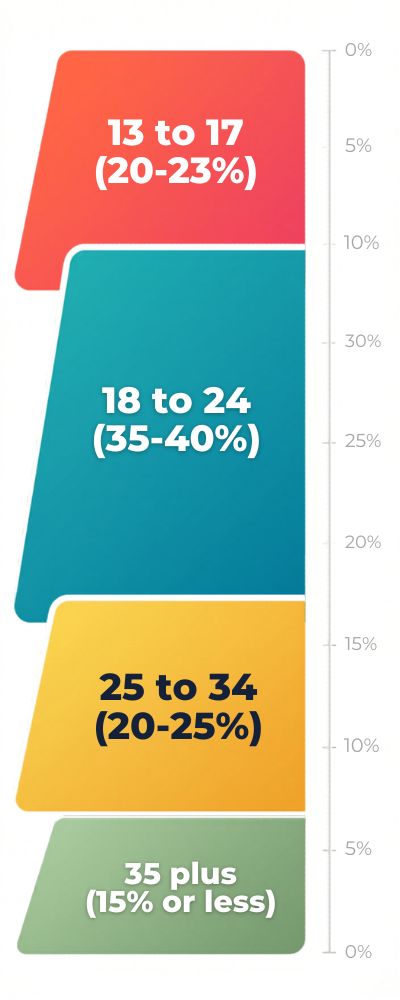
Now that we know how many people use Snapchat, let’s dig into the demographics and find out who those people actually are. Because, let’s be honest, 800 million people sounds great… but who are they? When it comes to age, Snapchat isn’t as evenly distributed as other social media platforms. It’s skewed much younger.
In fact, in many developed countries, Snapchat reaches a huge portion of Gen Z internet users (based on Statista, Snapchat demographics). Frankly, this makes a lot of sense. The app FEELS different, because the users are different.
Now, let’s look at the age demographics. Gen Z are the kings and queens of Snapchat. If Snapchat was a nightclub, Gen Z would be the DJ, the bouncer and the owner.
So, here’s a rough breakdown of the Snapchat age demographics:
| Age Group | Share of Users |
|---|---|
| 13–17 | ~20–23% |
| 18–24 | ~35–40% |
| 25–34 | ~20–25% |
| 35+ | ~15% or less |
Yeah, most users are under 34. And that’s not a coincidence, it’s how Snapchat was designed. Fast communication, ephemeral content, no heavy expectations. It lines up really nicely with young user behavior.
The majority of 13-24-year-olds in many major markets use Snapchat, over 75%, according to audience data via Snap Inc. Insights.
My own theory is that users don’t “grow into” Snapchat as much as they grow into Facebook or Instagram. You either grew up with it… or you didn’t really join later.
Gender Distribution: Pretty Even (Slightly Skewed)
Snapchat has a pretty balanced user base between genders, which is relatively unique in social media.
| Gender | Share of Users |
|---|---|
| Female | ~52–54% |
| Male | ~46–48% |
Slightly more women than men use Snapchat. But just slightly. Here’s a graph of the distribution from platform data, and fairly consistent over the last few years according to Statista, Snapchat gender distribution:
Now, this is the interesting part (at least for me):
I’ve noticed that Snapchat feels more conversational among female users, while male users tend to engage more casually or sporadically. B
ut there are plenty of men on it, and it’s definitely not a sausage-fest or, I dunno, the female equivalent. How do I know this? I dunno, just go with it. Or don’t. Your call. Grain of salt. Etc. etc. etc. On to the next question.
Regional Distribution: It’s No Longer a Western App
This one always surprises people. Snapchat used to be very US-centric. Not anymore.
| Region | Share of Users |
|---|---|
| North America | ~20–22% |
| Europe | ~25–28% |
| Asia-Pacific | ~30–35% |
| Rest of World | ~15–20% |
The APAC region is Snapchat’s largest growth area these days. India alone, for instance, is experiencing explosive growth, particularly among younger, mobile-first users.
Interestingly, a report by Statista shows that the number of Snapchat users has grown significantly in regions beyond the US and Europe in recent years Statista, Snapchat users by region.
That’s hardly surprising, however, given that Snapchat’s visual-centric, text-light nature lends itself to universal appeal, regardless of language or cultural background.
Urban vs Rural
Here’s a factor that’s not often discussed, but should be. Generally speaking, Snapchat usage is higher in urban and suburban regions, where smartphone penetration rates are higher, and people tend to maintain larger social networks.
According to a report by Pew Research, urban youth are significantly more likely to use Snapchat daily compared to rural populations (Pew Research Social Media Report). However, the divide is closing.
As more people in developing nations gain access to mobile devices, we can expect to see more Snapchat users emerge from smaller cities and towns. And once they join the network, it’s relatively easy to get accustomed to the platform, given its simplicity.
Why Demographics Matter
Now we get to the more personal aspect of it all. Demographics influence everything about a platform, from the way it feels to the type of content that’s shared. Snapchat feels raw, edgy, and spontaneous because its users skew young, hyper-social, and mobile.
There’s less of a need to present a perfect image, and more of an emphasis on simply being present. Perhaps that’s why the app still matters. For brands, creators, and anyone else trying to make sense of where people are spending their time, this information isn’t nice to know, it’s need to know.
Ultimately, people shape platforms, not the other way around. And Snapchat remains a Gen Z-dominated platform. Whether or not that will remain the case in the future remains to be seen.
20+ Snapchat Usage Statistics That Prove Gen Z Still Loves the App
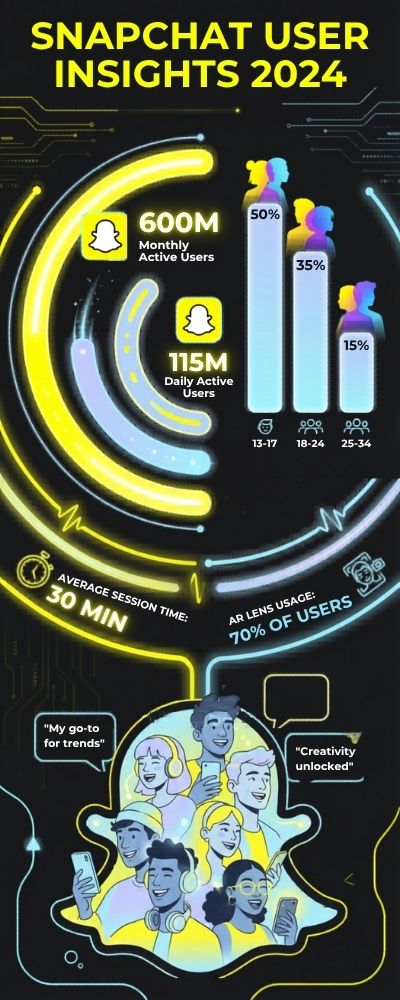
Gen Z Didn’t Leave, They Just Stopped Explaining Themselves
There’s this ongoing assumption that Gen Z jumps from app to app like it’s musical chairs. And yeah, sometimes that’s true. But with Snapchat, it’s different. They didn’t leave, they just made it their own quiet corner of the internet.
Snapchat reaches over 75% of 13 to 24-year-olds in key markets, which is honestly a ridiculous level of penetration when you think about it. That’s not casual usage, that’s cultural integration according to Snapchat.
And if you’ve ever seen a group of teenagers sitting together, all snapping each other instead of talking… yeah, the data checks out.
Your Almost Unconscious Habits
You open Snapchat over 30 times a day 5 Billion snaps are made every day You spend around 25 to 30 minutes a day on Snapchat
These are habits. Second nature. Something that you do on autopilot. Apparently, this frequency is due to direct messaging rather than passive scrolling As you might expect, Gen Z craves communication, not just content. Quick and dirty. Raw.
Here are 20+ Snapchat Usage Statistics (The Juicy Part)
Here are the key stats to get a clear idea of the above:
| # | Statistic |
|---|---|
| 1 | 420+ million daily active users globally |
| 2 | 800+ million monthly active users |
| 3 | 75%+ reach among ages 13–24 in some markets |
| 4 | Users open Snapchat 30+ times daily |
| 5 | 5+ billion snaps created per day |
| 6 | Average session time: ~25–30 minutes daily |
| 7 | Over 60% of users create content daily |
| 8 | 90% of Gen Z users use Snapchat to message friends |
| 9 | Snapchat ranks among top messaging apps for teens |
| 10 | Over 250 million users engage with AR daily |
| 11 | Spotlight reaches hundreds of millions monthly |
| 12 | Over 300 million users engage with Stories daily |
| 13 | Majority of users are under 34 |
| 14 | Snapchat is installed on most Gen Z smartphones |
| 15 | High retention rates among teen users |
| 16 | Private messaging dominates usage behavior |
| 17 | Group chats and streaks drive daily engagement |
| 18 | Gen Z prefers Snapchat for close friend communication |
| 19 | Less than 10% of content is public-facing |
| 20 | Snapchat leads in “real friend” interactions vs competitors |
Most of these findings are based on a combination of Snap reports and third-party research, according to
Yeah, sure, no shit, Sherlock, when you put it all together like that, it all seems pretty clear.
But here’s the thing people keep forgetting, Gen Z don’t actually like broadcasting
They’re bloody sick of it.
The key function of Snapchat is messaging. Not posting. Not performing. Just… talking.
90% of Snapchat users use it mainly for messaging, not content consumption, according to
This is important. Because it means Snapchat isn’t competing in the way that Instagram and TikTok are. They’re in a completely different competition.
Maybe that’s why it’s still holding its own.
AR, Filters, and the “Fun Factor”
Okay, let’s not forget the elephant in the room, Snapchat is fun. Like, actually fun. Not algorithmically-fun. Just, well… fun.
- 250M+ daily users engage with AR
- Billions of lenses are used daily
- Gen Z is heavy on the AR try-ons and filters
- claims Snapchat has the most consumer AR use
And if you’ve wasted five minutes scrolling through filters for no reason, you know exactly what I’m talking about.
Does Gen Z Still Love Snapchat?
The short answer? Yes. But not the way you expect. It’s not the platform where they go to get likes. It’s the platform where they go to be themselves. And I think that’s the big difference. Snapchat isn’t about clout. It’s about connection. It’s the app you don’t even think about; you just open it. And in a world where everything feels a little curated and a little exhausting, that space matters more than we probably give it credit for.
Average Snapchat Usage Time: Snapchat’s Addictive?
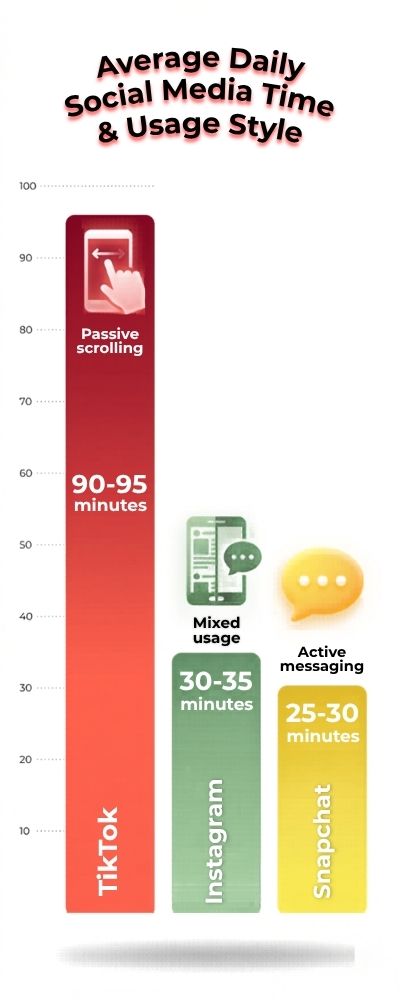
The amount of time spent in an app is the best indication of an app’s usage, not downloads. Anyone can download an app, but how long they stay is the question.
On average, users spend 25-30 minutes a day on Snapchat. While that doesn’t seem like a lot of time, you have to remember that isn’t consecutive time, that’s over the course of a day.
For example, a report by stated, “Instead of time spent, Snapchat’s usage is better characterized by the number of times users open the app”
With that in mind, it makes sense. You don’t really spend time on Snapchat, you just check it every now and again. And then again. And again. And before you know it, you’ve spent 25-30 minutes on the app.
Time Spent Isn’t The Important Metric, Opens Are
As previously mentioned, users open Snapchat over 30 times per day. That’s 30 times you open an app in one day.
That isn’t even the crazy part. The crazy part is that that’s borderline instinct. People open Snapchat that often every day.
It’s not hard to understand why either. When you’re waiting in line, you check Snapchat. When you’re walking, you check Snapchat. When you’re watching TV, you check Snapchat.
In fact, an article by wrote, “The main drivers of Snapchat’s high open rate are its messaging features and “streaks””
It makes sense. The idea of a streak is childish, but it works. People don’t want to break a streak.
Time Spent On Snapchat Compared To Other Apps
| Platform | Avg. Time Spent Per Day | Usage Style |
|---|---|---|
| TikTok | ~90–95 minutes | Passive scrolling |
| ~30–35 minutes | Mixed usage | |
| Snapchat | ~25–30 minutes | Active messaging |
Alright, TikTok wins when it comes to time. That’s a no brainer. It’s built to keep you on the app. But, that’s not Snapchat’s aim. As , engagement on Snapchat may be shorter, but it’s more frequent than on most other apps.
This leads to a very strange conclusion…which is more addictive? 90 minutes of use in a single session, or 30 daily sessions with little to no forethought?
Micro-Addiction: The Snapchat Effect
Now, I’m going to make a statement here that could be controversial. Snapchat isn’t “addictive”. It doesn’t try to keep you on the app. At least, not in the classical sense. It builds micro-addictions. Small, daily habits that are really no big deal. You see a message.
You respond to a snap. You want to keep a streak going. You want to share an update. Individually? No big deal. Collectively? A ritual. As , messaging platforms tend to form more habitual use patterns than content-based ones Once you realize this, you can’t ignore it.
Why Gen Z Keeps Coming Back
This bit feels less like stats and more like observation.
Gen Z doesn’t just use Snapchat, they need it. It’s their communication layer. Not text. Not phone calls. Snaps.
And because it disappears, you don’t feel pressured. You don’t overanalyze the snap you’re sending. You just send it.
As previously mentioned, users have said they feel more comfortable sharing in-the-moment, raw snaps
And that comfort becomes a habit. And that habit becomes a daily activity.
So, Is Snapchat Still Addictive?
Depends what you mean by “addictive.”
If you mean sheer time spent, no, TikTok is the clear winner here.
But if you mean frequency of instinct to open the app? Snapchat is right up there.
And in my opinion? I’d say the latter is more dangerous.
Because it’s not about spending hours in it. It’s about integrating into your routine without even realizing it.
Like checking your phone, or drinking coffee, or saying “one more snap” and meaning it.
How Often Do People Open Snapchat? Frequency, Streaks, and Habit Data
You ever unlock your phone for something important… and somehow end up on Snapchat instead? Yeah, same. That’s not random, that’s habit.
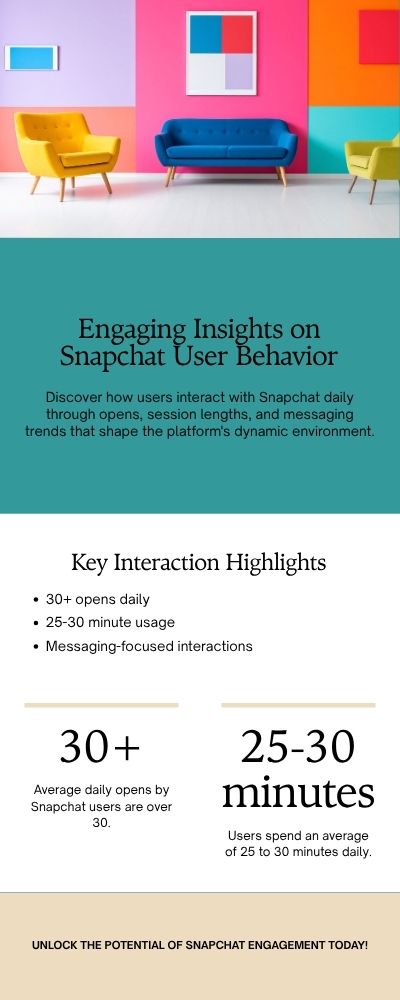
On average, users open Snapchat 30+ times per day, which is honestly a bit wild when you stop and think about it. According to Snap’s official data, this high open rate is driven mainly by messaging behavior rather than passive scrolling.
It’s not about long sessions. It’s about constant check-ins. Quick glances. Tiny interactions that stack up before you even notice.
Frequency vs Duration: Death by a Thousand Opens
Here’s where Snapchat plays a completely different game compared to other platforms. Sessions are short. Really short sometimes. But they happen all the time.
| Metric | Snapchat Behavior |
|---|---|
| Opens per day | 30+ |
| Avg. session length | Seconds–minutes |
| Total daily time | ~25–30 minutes |
| Interaction type | Messaging-heavy |
Global digital behavior data: Snapchat’s success hinges on frequent and time-efficient interactions, as opposed to apps that keep users scrolling for extended periods of time.
Instead of losing an hour in one go, you lose a few minutes here and there, all throughout the day. Sneaky? Perhaps. Effective? Absolutely.
The Streak Effect: Small Feature, Big Emotional Hook
Okay, now let’s talk about streaks. Because if you haven’t used Snapchat, you can’t really appreciate how potent they are. So here’s the gist of it, a streak is a counter that increments every time you send snaps every day. If you fail to send a snap for a day, the streak is lost.
That’s it. It really is that simple. But that’s just it, it doesn’t feel simple. Millions of users take the time to maintain their streaks every single day Some streaks have extended for hundreds if not thousands of days. When you lose a streak, it feels almost… intimate.
Based on Snapchat’s rundown of their features, streaks are one of the primary reasons for daily engagement and app revisitation.
Yeah, I’m just gonna say it, there’s something inherently emotional about that little flame symbol. It takes what could be a function of communication and turns it into one of commitment.
Habit Formation: How It Becomes a Habit
This is the sneaky part.
You don’t consciously decide to open Snapchat. You just… open it. Sitting in line? Open it. A little bored? Open it again.
Behavioral studies suggest that social, instant, and variable rewards lead to the strongest habits.
Snapchat has all three:
- Your messages come at variable times
- You can respond easily and quickly
- You’re having a conversation instead of composing a formal message
It’s like the app is always pinging you a little, but never so much that it gets obnoxious.
Who’s Opening it the Most?
Not everyone is opening Snapchat at the same rates. There is an age dynamic at play here.
| Age Group | Avg. Opens Per Day |
|---|---|
| 13–24 | 30–40+ |
| 25–34 | 20–30 |
| 35+ | 10–20 |
Their most active users are quite a bit younger, Gen Z to be more specific. According to this statista page, teens and young adults use Snapchat at a much higher rate than any other age group. This is because for this age group, Snapchat is a means of communication with friends.
Why Does This Matter?
30 times a day isn’t just “engagement.” It’s something more. It’s knowing that the product has seamlessly integrated itself into someone’s life. There’s no hook. No infinite scrolling loop. Just 30 times a day. And in my opinion, that’s a healthier form of engagement. Because you don’t even realize you’re doing it.
Snapchat Engagement Rate vs Other Platforms: A Data-Backed Comparison
Engagement Isn’t Just Likes, It’s What People Actually Do
When someone says engagement, most of you probably think of likes, comments, and shares. At least, that’s what I used to think. I believe many of us use the term engagement to describe all social media platforms in a vacuum without realizing how different the types of engagement are.
Let’s dive in. Instagram engagement is likes, comments, shares, etc. TikTok engagement is watch time, replays, interactions, etc. But Snapchat engagement? That’s messaging. Direct, back-and-forth communication.
Because of this, when someone says Snapchat has lower engagement, I’m always confused on what they’re comparing to. Snapchat’s engagement, by its very nature, is mostly interaction-based rather than content-based. In other words, people are chatting more than they are consuming content.
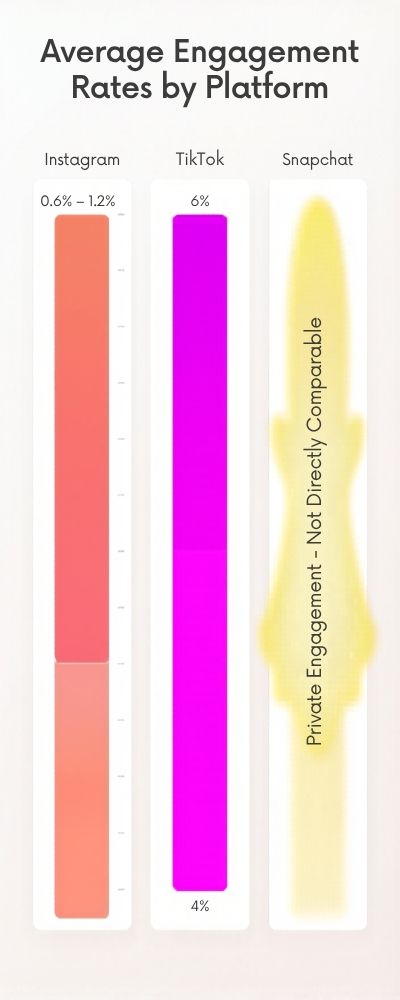
Average Engagement Rates Across Platforms
Now these are just general stats, but let’s put some actual numbers out there because otherwise this is a lot of theory:
| Platform | Avg. Engagement Rate (Content-Based) |
|---|---|
| ~0.6% – 1.2% | |
| TikTok | ~4% – 6% |
| Snapchat | Hard to compare (private engagement) |
TikTok does better in those classic engagement metrics because of its algorithm-based content curation. Instagram falls somewhere in between depending on the number of followers and quality of the content
Snapchat, however, doesn’t really fit into this chart. Most of the activity is private: snaps, messages, replies, etc. Not really reflected in the engagement rate
TBH, that’s where the fun starts
Public vs Private Engagement: The Real Divide
Does engagement need to be public to be valid?
Billions of snaps are sent on Snapchat every day. None of them are public. None of them are performative. But they’re still engagement
Over 5 billion Snaps are created every day.
How many taps does Instagram get? How many time does somebody watch a TikTok video?
Different mechanics. Different psychology
Engagement Frequency: Who Wins Here?
Now, if we talk frequency, not rate, it’s a different story.
| Platform | Avg. Daily Opens / Sessions |
|---|---|
| Snapchat | 30+ opens per day |
| ~10–15 sessions | |
| TikTok | ~8–12 sessions |
Snapchat users check the app far more often than users of other platforms. According to behavioral data, this high-frequency usage is tied to messaging habits rather than content browsing.
So even if each interaction is small, they add up. A lot.
Depth vs Breadth: Two Different Kinds of Engagement
TikTok gives you depth-long sessions, immersive content.
Instagram gives you breadth-a mix of content, messaging, and discovery.
Snapchat? It gives you closeness.
According to user behavior studies, Snapchat is primarily used for communication with close friends, which leads to more meaningful but less visible interactions, according to https://www.pewresearch.org/internet/2023/11/15/teens-social-media-and-technology-2023/
And yeah, I’ll say it-that kind of engagement feels different. Less about numbers, more about relationships.
So… Which Platform Actually Wins?
Well, that depends.
If you want to go viral and have a lot of public engagement, TikTok is the obvious winner.
If you want relatively consistent results and exposure for your brand, Instagram is still your best bet.
But if you’re interested in real engagement, the kind of conversations that are had daily, Snapchat is killing it.
And I think that’s what gets lost.
Engagement doesn’t always have to be public. Sometimes it’s in DMs, sometimes it’s in streaks, sometimes it’s in Ephemeral content.
And oddly enough, it might be the most authentic of them all.
Why Do Snapchat Streaks Work? The Psychology in Numbers of Maintaining a Snapchat Streak
When you think about it, Snapchat streaks are pretty ridiculous. You send a snap, they send a snap, you send a snap, and a number increments. You fail to send a snap, the number goes away.
That’s it. That’s the whole thing. There aren’t any prizes or monetary incentives. It’s not like you get a college scholarship for a 1000-day Snapchat streak or anything. So why do people care so much?
On Snapchat, millions of users keep their streaks going every day. Some streaks have lasted for hundreds or thousands of days. Why do people care about something so seemingly pointless?
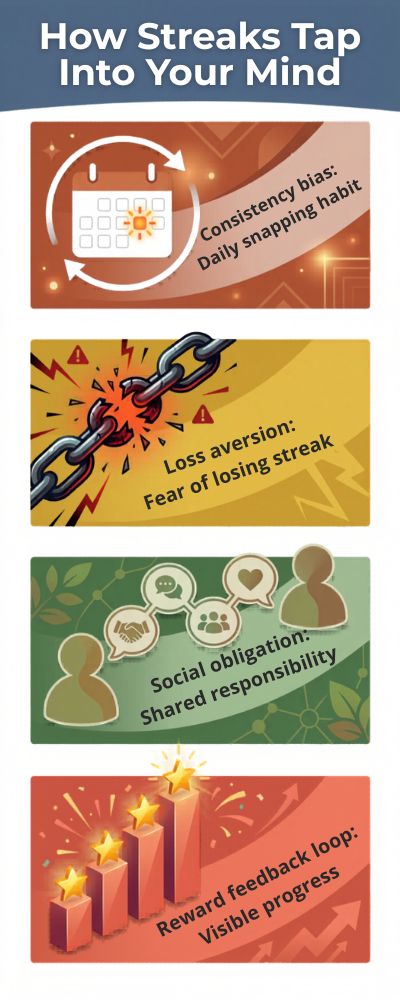
The answer lies in psychology. In behavioral psychology, there’s something called a “consistency principle.” When we begin something, we have a strong desire to continue it. Snapchat streaks play off of that principle perfectly.
| Psychological Trigger | How Streaks Use It |
|---|---|
| Consistency bias | Daily snapping habit |
| Loss aversion | Fear of losing streak |
| Social obligation | Shared responsibility |
| Reward feedback loop | Visible progress (🔥 number) |
Behavioral studies have found that humans are far more motivated by fear of loss than reward. And that’s exactly what streaks are: they offer you nothing but threaten to take something away from you.
Loss Aversion: The Real Hook
We all know that nobody starts a streak and says to themselves “This will be important to me someday.” But after 50 days? 100 days? Now it’s important. That’s loss aversion research has shown that losses are felt 2x as intensely as gains of an equivalent magnitude feel good.
That means that losing a 200 day streak feels worse than the good feeling you got from earning it. And that weight is what gets people to return daily, even when they don’t want to.
The Quiet Pressure of Someone Else
Not everyone is alone in their streaks. Most have a partner in crime and when you end the streak, you’re not just breaking your own, you’re breaking someone else’s too. That applies a different kind of pressure.
Photo by Jan Kahánek on Unsplash Research by pewresearch.org found that when habits involved others, participants were more likely to follow through.
It isn’t an explicit pressure where someone is going to be mad at you, but there’s a silent agreement there that says, “Let’s keep going.” Strangely, that’s enough.
Minimum Effort, Maximum Reward
The final reason for the success of streaks? They require next to no effort. You have to take a photo of your toes, a dirty floor, a toilet. Literally anything, and boom.
That minuscule amount of effort cancels out almost all of the friction and as mentioned before, low friction habits are sticky. Research by jamesclear.com found that habits which require minimal effort but offer consistent reward are more likely to become automatic. Snapchat got this right. You don’t have to think, you just snap something.
Why Generation Z Takes It to the Extreme
If you’ve ever seen someone have a meltdown about losing a streak, you’ll know that this isn’t just a feature, it’s emotional. Generation Z specifically have taken streaks to a whole new level and turned it into a sort of low effort bonding mechanism.
It’s not a meaningful conversation or a long text, it’s just a sign of still being alive and breathing. Photo by Allan Filipe Santos Dias on Unsplash According to Snapchat’s own insights, streaks are a top reason for daily engagement among younger users.
You know what, that kind of makes sense. In a world where everything seems fast and temporary, streaks are a small sign of permanence. A ribbon of continuity that says, “We’re still here.”
So… Why Do Streaks Really Work?
It’s not one thing. It’s a mix.
- Fear of losing progress
- Social accountability
- Easy, low-effort interaction
- Visible feedback (that little number climbing up)
Put all that together, and you get something surprisingly powerful.
And here’s my take-it’s not really about the streak itself.
It’s about what it represents. Consistency. Connection. A small daily signal that someone is still part of your routine.
And maybe that’s why people hold onto them.
Not because they have to. But because, in a weird, quiet way… they want to.
Snapchat Advertising Statistics: ROI, CPM, and Conversion Benchmarks
We’ll begin with the question that every marketer is too afraid to ask: Is Snapchat advertising effective, or is it just a fad targeting Gen Z? The short answer is yes. But not in the way you’re thinking. Snapchat generated more than $4.6 billion in ad revenue last year.
That wouldn’t happen if brands weren’t getting a positive response. As you can see in the graphic below, advertising is the main revenue source for Snap.
With that said, just because the company is generating revenue, doesn’t mean its ads are necessarily efficient. So let’s take a closer look.
Snapchat CPM: How Much Does It Cost to Reach Users?
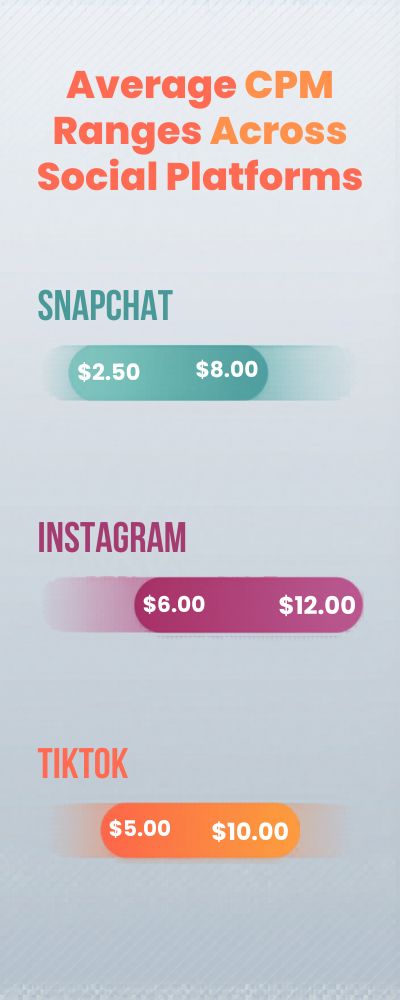
The first stat to consider is CPM, or the cost per 1,000 impressions. Here’s how Snapchat stacks up:
| Platform | Average CPM |
|---|---|
| Snapchat | $2.50 – $8.00 |
| $6.00 – $12.00 | |
| TikTok | $5.00 – $10.00 |
CPMs on Snapchat are often lower than on Instagram and TikTok, so Snapchat can be a good option for advertisers with smaller budgets.
Some ad benchmark reports show that less competition in some verticals means lower CPM on Snapchat.
Yes, lower costs are great, but impressions are worthless if no one converts.
Conversions: Where Truth Meets Reality
So here’s where it gets interesting.
Average conversion rates for Snapchat ads range widely by campaign type, but decent targeting can deliver conversions in the 1% to 3% range.
| Platform | Avg. Conversion Rate |
|---|---|
| Snapchat | ~1% – 3% |
| ~1% – 2.5% | |
| TikTok | ~1.5% – 3.5% |
As we can see from the chart, Snapchat is strong for mobile-first and impulse purchasing, particularly for younger demographics.
And that’s intuitive. Snapchatters are already primed for fast actions: tap, swipe, reply. Conversions don’t require much of a leap from that behavior.
ROI: The Secret Strength of Snapchat
Where Snapchat gets interesting is with return on investment (ROI).
According to Snap’s internal research, advertisers have seen 2x to 3x return on ad spend (ROAS) on certain types of campaigns, especially those that leverage AR lenses and interactive formats.
Now, I’ll admit it, any ROI data reported by a platform should be viewed with some skepticism. But third-party studies have also found Snapchat to be effective for awareness and mid-funnel engagement.
It may not always be the best for high-ticket, direct conversions. But for reaching and engaging younger demographics? Not bad.
What Makes Snapchat Ads Different?
Alright, this is where things get a bit less “spreadsheet-y” and more… human.
Snapchat ads don’t feel like ads. They’re full-screen, immersive, and often interactive.
- AR lenses that people actually play with
- Vertical video ads that feel native
- Quick swipe-up actions
According to Snap’s advertising research, interactive ad formats result in higher engagement rates than static formats.
And yes, I’ve noticed the same thing, people don’t just watch Snapchat ads. Sometimes they mess around with them.
That’s a different kind of attention.
Who Should Actually Advertise on Snapchat?
Here’s where I’m going to get a little biased. Snapchat isn’t for everyone. If you’re targeting Gen Z or young millennials, great. If you’re in fast-moving consumer goods, fashion, apps, or other impulse-driven verticals, awesome.
But if you’re targeting older professionals or B2B buyers with high-consideration purchases? Not so much. Based on the age distribution of Snapchat users, it makes sense that your mileage may vary depending on the target market: So yes, targeting matters. A lot.
Is Snapchat Advertising Worth It?
Honestly? It depends on your goal. Are you looking for reach at a low price? Yes, absolutely. Are you looking to drive engagement and interactions? Yes. Are you looking to drive high-intent conversions on big-ticket items? Probably not.
However, if you understand how users are actually interacting with the platform and create ads that fit natively into the experience rather than disrupting it, Snapchat may surprise you.
Perhaps that’s the story with Snapchat as a whole. On the surface, it may not seem like a winner, but once you start to understand how users actually behave… it starts to make a lot more sense.
How Brands Use Snapchat in 2026: Marketing Stats You Can’t Ignore
Brands used to post the same ad on Snapchat that they posted on Instagram and call it a day.
Brands used to try to control the Snapchat experience.
Brands used to fail.
Today, brands have learned to roll with the punches. They’ve learned to create ads that don’t feel like ads. They’ve learned to create ads that feel like Snapchat.
Today, Snapchat reaches over 75% of Gen Z in major markets, making it one of the best ways for brands to reach younger consumers.
And if your target audience is hanging out somewhere, not having a presence isn’t a strategy so much as it is a fantasy.
Where Brands Are Actually Spending Their Time
Not all Snapchat features are created equal. Some are a total waste of time. Others can quietly deliver results.
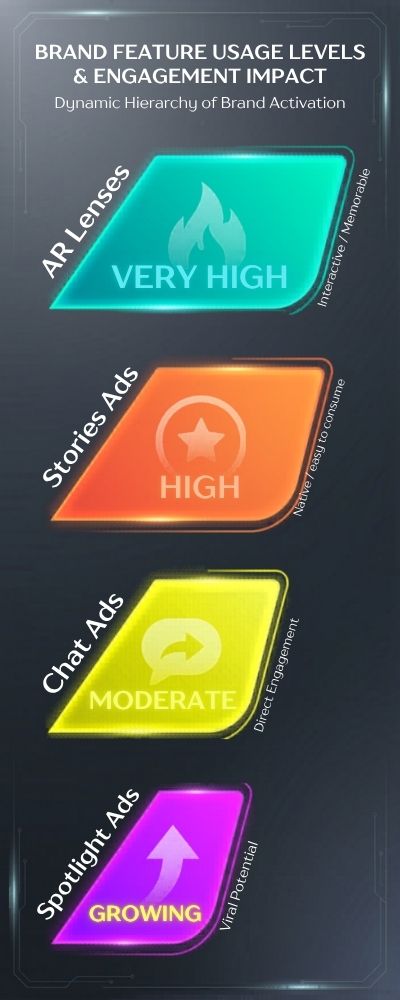
Here’s where brands are focusing their time in 2026:
| Feature | Brand Usage Level | Why It Works |
|---|---|---|
| Stories Ads | High | Native, easy to consume |
| AR Lenses | Very High | Interactive, memorable |
| Spotlight Ads | Growing | Viral potential |
| Chat Ads | Moderate | Direct engagement |
“An AR experience is one of the most engaging ad formats we have, because users are doing something instead of just looking at something.”
Okay, fine, there is a difference between ad viewing and ad playing.
AR Marketing: The Gimmick No More
This might be the coolest part.
Over 250 million Snapchat users are playing with AR every day, which provides marketers with an unusual sandbox. And not just impressions, interaction.
“AR campaigns can drive significantly higher engagement and brand recall compared to traditional formats.”
Because when you try out a pair of sunglasses virtually, or apply makeup virtually, or look at a product in your own room virtually, you are engaged. That’s experiential.
And to be frank, when you’ve done that once, banner ads seem a little… Neanderthal.
Influencers and Creators: A Different Kind of Partnership
Marketing on Snapchat lacks the refinement of Instagram. But that’s the beauty of it.
Snapchat creators post more raw, less curated content. Less feed goals, more what’s actually going on.
Industry reports say that less produced, more genuine content resonates more with Snapchat users, particularly Gen Z.
Brands have had to adapt. Less planning. More faith. More relinquishing control, which, to be fair, can be a challenge for marketing teams.
Conversion and Action: Does It Actually Drive Results?
Now the moment you’ve all been waiting for, does it convert?
Snapchat excels at:
- App installs
- E-commerce (low to mid-ticket items)
- Event promotions
- Brand awareness campaigns
Performance benchmarks show that Snapchat provides a good ROI for mobile-first campaigns, particularly for younger demographics.
It’s not ideal for complicated sales funnels. But for impulse purchases? Yes.
What Brands Get Wrong (And How Some Get It Right)
My not-so-subtle answer?
Brands are trying to be “cool.” I can smell it a mile away. Overproduced, over-efforting, trying to be Gen Z rather than understanding Gen Z.
It often doesn’t work out.
Snapchat users respond better to authentic, spontaneous content rather than highly polished ads.
Brands that succeed feel like they’re supposed to be there.
So… What’s the Real Opportunity in 2026?
Snapchat isn’t the largest platform. It’s not the noisiest platform.
But it has something a lot of platforms are losing: intimate attention.
Brands that get it aren’t trying to interrupt. They’re participating in how people communicate.
Yeah, it’s a little esoteric. But it’s tangible in the metrics: engagement, interaction, recall.
So if you’re considering Snapchat marketing, the question isn’t “Should we be here?”
It’s more like… Can you show up in a way that makes sense?
Snapchat and AR: Statistics that Highlight the Future of Augmented Reality Social Media
AR Isn’t the Future, It’s Already Here (Quietly)
We talk about augmented reality like it’s a thing of the future. Like headsets and Minority Report and all that.
The truth? Millions of people are already using AR everyday on Snapchat. No headset. No learning curve. Just open the camera and go.
250,000,000 Snapchat users engage with AR every day, a stat that actually doesn’t get enough attention, according to . That’s not a niche feature. That’s mainstream behavior.
What Does “Using AR” Actually Mean?
It’s easy to hear “AR” and think it’s complicated. It’s not.
On Snapchat, AR comes in the form of:
- Face filters (yes, the classic ones)
- Virtual try-ons (glasses, makeup, clothes)
- Interactive lenses and games
- Location-based overlays
And people don’t just see these, they interact with them.
AR Feature Type User Behavior
- Face filters: Daily casual use
- Product try-ons: Shopping exploration
- Interactive lenses: Entertainment & sharing
- Branded AR: Engagement + discovery
Billions of AR lens plays occur every day, according to . That’s consistent engagement, not passive scrolling.
It’s not passive. It’s hands-on.
AR Engagement vs Traditional Content
Here’s where things get interesting.
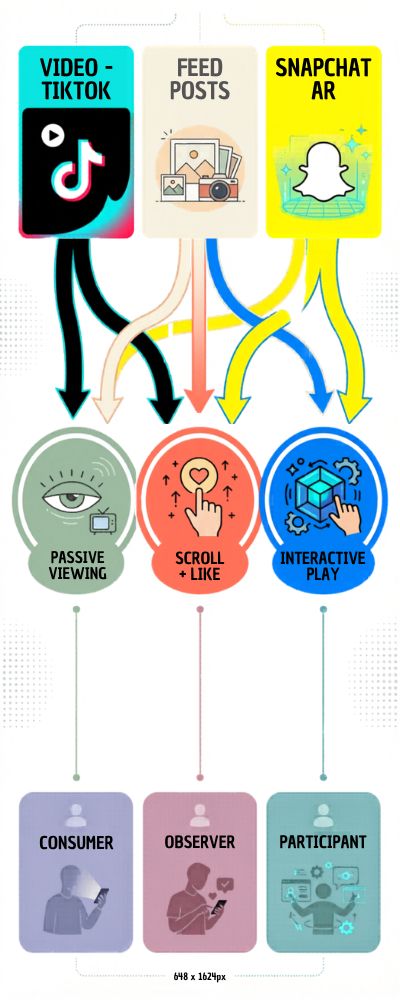
AR doesn’t behave like normal content. You don’t just watch it, you do something with it.
| Content Type | Engagement Style | User Role |
|---|---|---|
| Video (TikTok) | Passive viewing | Consumer |
| Feed posts | Scroll + like | Observer |
| Snapchat AR | Interactive play | Participant |
Research on digital activity suggests that immersive media like AR result in greater engagement and retention than non-interactive content, according to datareportal.com
And, well, that makes sense. You remember what you interact with more than what you scroll through.
AR and Shopping: The Silent Revolution
This is where things get a little underrated.
Snapchat has been pushing AR in shopping, and it’s working.
- Users can try on products virtually
- Brands can show products in their intended environment
- Purchasing happens faster
Snap says that AR try-on has resulted in increased conversions and decreased returns for some partners, according to snap.com
And if you’ve ever bought something online that looked nothing like the pictures… you’ll know why that’s important.
Who’s Adopting AR?
Not surprising, it’s younger users.
Gen Z and younger millennials are the most frequent users of AR, using it as a medium for communication rather than a gimmick.
Younger demographics are far more likely to use AR features than older demographics, according to statista.com
And, honestly, that tells you everything you need to know about this.
Because anything Gen Z picks up usually becomes the norm later.
Why Snapchat Is Winning in AR (For Now)
Okay, here’s my theory, and, yes, I’m biased.
Snapchat didn’t implement AR as a feature. They integrated it as the main event. The camera is the first thing that opens. It’s where everything begins.
And that makes a huge difference.
As it is, AR is integrated into daily user behavior rather than being an optional add-on.
Most social media platforms offer some form of AR capabilities, but they feel tacked on. On Snapchat, they feel like the norm.
So… Is This the Future of Social Media?
I’d argue we’re already in the midst of it; we’re just not labeling it as such.
AR is not going to replace social media; it’s going to evolve the way we consume it. There’s less text, less captioning, less content “posting.” Instead, there’s more visualization, more “in the moment” experiences.
And Snapchat is quietly positioned in the dead center of that transition.
Not in a loud way. Not in a terribly obvious way. Just subtly, in a way that builds daily habits.
And once those habits are formed, which they generally are, we’ll stop thinking of AR as “a feature.”
We’ll just think of it as… well, the way things are done.
How is Snapchat performing? Is it growing or losing users? (2026-2030) is the million-dollar question
Are Snapchat gaining or losing users? That’s a question I seem to get asked every year. Followed by a comment, like “Snapchat is dying” or “Gen Z has moved to another app”. And every time I look at the stats, it’s more of the same.
As of late 2025, Snapchat had roughly 946 million monthly users and it’s growing. Daily active users (DAUs) kept on increasing every quarter in 2025. So yeah, not dying. But not growing that much either. It’s just… growing. Slowly, steadily, quietly… and under the radar.
User growth
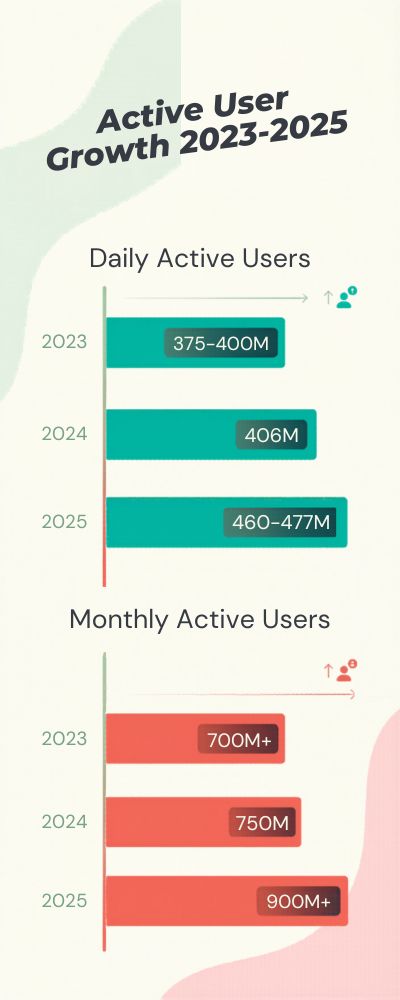
Slow, steady, and under the radar. The thing is that Snapchat’s user growth has not been explosive for years. It’s been steady.
| Year / Period | Daily Active Users | Monthly Active Users |
|---|---|---|
| 2023 | ~375–400 million | ~700+ million |
| 2024 | ~406 million | ~750 million |
| 2025 | ~460–477 million | ~900+ million |
This type of growth is boring, so people don’t focus on it. But according to Snap’s earnings reports, it’s all about international growth and better retention features.
And slow growth is a great sign. It means people are committing to the app, not just testing it.
Where the Growth Is Actually Coming From
Here’s the fun part.
The future of Snapchat isn’t really in the U.S. It’s everywhere else.
India is driving a ton of the growth. According to global digital reports, Snapchat’s ad reach in India alone tops 200 million users, which is ideal for growth.
That is important.
Because emerging market growth is:
- Faster
- More scalable
- Less saturated
Even if you believe Western markets are “mature” Snapchat still has plenty of runway globally.
AR and Innovation: The Unseen Flywheel
Here’s where Snapchat is underappreciated.
Not only is it a messaging service, it also has a strong AR focus.
- 350M+ users interact with AR every day
- Billions of lens interactions a day
“As seen on our own platform, the ecosystem for AR continues to grow as a fundamental aspect of our users’ behavior, not just a fun, one-off experience.”
And my interpretation is that if AR becomes a larger part of social activity (which I believe it will), Snapchat is well positioned.
Not by accident. By design.
2026 to 2030 Projections: What’s Probable?
We don’t have crystal balls. Anybody tells you they do, they’re just too confident for their own good.
However, with the current pace, this is what I think is likely:
| Scenario | What Happens by 2030 |
|---|---|
| Growth Case | 1B+ MAUs, strong global expansion |
| Stable Case | Continued steady growth, niche dominance |
| Decline Case | Growth slows, competition eats attention |
Taking all of this into account, I think it’s more likely that Snapchat will continue to grow or remain steady rather than decline.
Mostly because, as you can see in this chart from, global social media use is on an upward trend, with billions of new users expected to join in the coming years.
And generally, if the market as a whole is growing, apps like Snapchat will reap the rewards, especially when they have ingrained habits like this.
What Could Hold Snapchat Back?
It’s not all rainbows and unicorns, though.
There are still threats to Snapchat’s growth:
- TikTok and Instagram competition
- Revenue pressure
- Shifting user behaviors over time
As you can see in this analysis from, social media platforms are in a constant war for our attention, and if an app isn’t keeping up? Users are quick to jump ship.
And let’s be real. Gen Z is fickle. Yesterday’s news is, well, yesterday’s news.
So… Is Snapchat Growing or Declining?
Sorry to disappoint.
But there isn’t a super exciting answer here.
Snapchat isn’t exploding. But they aren’t imploding either.
They’re growing. Just slowly.
And in my opinion, that’s incredibly underrated.
Why? Because while everyone else is scrambling to get our attention with flashier features and more content, Snapchat has something that’s much harder to replicate: daily habit.
Users don’t just open the app. They come back daily.
And as long as that behavior holds true, Snapchat isn’t going anywhere anytime soon.
Monetization Models: Beyond Advertising
Alternative revenue streams are being explored. These include merchandise sales, memberships, and ticketed live events. Additionally, crowdfunding platforms are used to fund content creators. This diversification decreases the dependence on any one revenue stream.
The Minimum You’ll Need to Get Started
Creating a podcast can be done at a relatively low cost. All you need is a microphone and some editing software to get started. Of course, if you want a more professional product you may need to spend a bit more. This relatively low barrier to entry has been one of the contributing factors to the growth of the industry.
Independent Creators vs. Traditional Media: Which One Has More Influence?
Independent creators are the dominant players in the podcasting space. Many have managed to attract a dedicated audience without the backing of a major media network. With the availability of publishing tools and platforms, it is easier than ever for creators to publish their content. This has resulted in a lot of competition as well as a diverse range of different content that is available.
A Breakdown of the Industry by Region
The popularity of podcasts varies from region to region. North America and Europe are established markets whereas places like Asia and Africa are catching up fast . The popularity of podcasts can depend on cultural factors as well as the languages that are spoken in each region. These emerging markets will be the key to the future growth of the industry.
The Most Spoken Languages in the Podcasting Space
While the majority of podcasts are recorded in English, there are a number of other popular languages. These include Spanish, Hindi, and Portuguese. As the industry continues to grow, more and more podcasts will be published in a diverse range of different languages. This is similar to what we have seen with the internet in general.
A Breakdown of Daily Consumption
While the most popular times to listen to podcasts are typically during the morning and evening commutes, this is starting to change as more and more people work from home. Now, people are listening to podcasts at all hours of the day. This is a trend that we expect to see continue as remote working becomes more popular.
Why Audio Content is so Appealing
One of the reasons why podcasts have become so popular is that they can be listened to while people are doing other things. Some examples include listening while you cook, exercise, or work. Unlike video content, you don’t need to actively watch what is going on which makes it easier to multitask. This is one of the reasons why podcasts are becoming so popular.
The Role of Podcast Ratings and Reviews
While people may not always leave ratings and reviews for the podcasts that they listen to, they do play a role in helping new listeners discover a show. Podcasts that have a high rating are more likely to be featured. Ratings and reviews can also help creators improve the quality of the content that they are producing.
The Frequency of New Content
There is no hard and fast rule about how often a podcast should be published. However, for the most popular shows, it seems like once a week is the most common frequency. Some podcasts are published daily or every other week depending on the type of content they are producing. Consistency is key to keeping an audience engaged. If you are too inconsistent with new content, you are likely to lose listeners.
How Are Podcast Creators Using Cross-Promotion?
This is one of the most popular techniques that podcasters use to gain new listeners. By appearing as a guest on another popular show, creators can gain exposure to a brand-new audience. This cross-promotion also helps build a sense of community within the industry as podcasters support each other.
Music vs. Podcast Consumption: Is Music Declining in Popularity?
It seems like people are allocating more and more of their time listening to spoken word podcasts. It is no longer a battle between music and podcasts as people will now dedicate some of their time to listening to music and the rest to podcasts. In part, this trend is being driven by platforms like YouTube. Music remains incredibly popular and its consumption is not declining.
Are Video Podcasts More Engaging Than Audio-Only?
The platforms like YouTube are reporting higher engagement rates for video content than for audio-only. Visuals add an extra layer to the personality of a show and make it easier to share. However, people still prefer to listen to audio-only when they are doing other things at the same time. With these findings, we are seeing more and more creators develop a video-audio hybrid approach.
Why This is So Important For Engagement
Yes, most people listen to the same podcasts for months and even years. As long as the content remains high quality and they have a good connection with the host, people will continue to listen to the same show. This long-term engagement helps build a community around a podcast as well as establish trust with the audience. It also provides more opportunities for monetization.
Is the Space Becoming Too Crowded?
Yes, there are millions of active podcasts out there, but the reality is that only a very small percentage of them are getting any significant traction. Like many other industries, the space follows a long-tail distribution model. One of the biggest challenges facing podcasters today is discoverability. If you have a niche idea, this may actually be a blessing in disguise.
Conclusion
So after all this, what do we know? Snapchat didn’t outlast everyone because it’s the biggest or the flashiest. It survived because it’s… practical. Intimate. So mundane it’s basically invisible. While TikTok soaks up eyeballs and Instagram crafts personae, Snapchat gives you something much more valuable, an ability to communicate.
In private. Without much thought. Without much effort. Without needing to keep up appearances. Without needing to build a personal brand. Without having to think about what it’ll mean for the curation of your online persona. Without any of that.
And perhaps that’s why Snapchat isn’t going anywhere. Not because it’s cool, not because it’s hip. Not because it’s trendy. But because it solves a problem we still have, talking to each other without feeling the need to curate every moment.
If anything, these numbers seem to indicate that Snapchat is not in decline, but rather is coming into its own. Into its true form. As something not as a social media giant, but as something even harder to displace. And in the wild west world of apps, that’s no accident. That’s by design.


