

Main Features You Get with Walter AI Content Detector
Understanding Walter AI Content Detector and Its Purpose
Perhaps a better example would be a university professor, who has been handed a stack of essays from his students. The essays are well-written, fairly-formatted, and generally well-standardized, but something doesn’t seem quite right. They seem too standardized, and a few of the essays seem to use the same phrases in the same ways. The professor doesn’t want to jump to conclusions, but he’d like some way to determine whether any of these essays have the potential of being AI-generated, so he can know how to proceed.
That’s where Walter AI comes in.
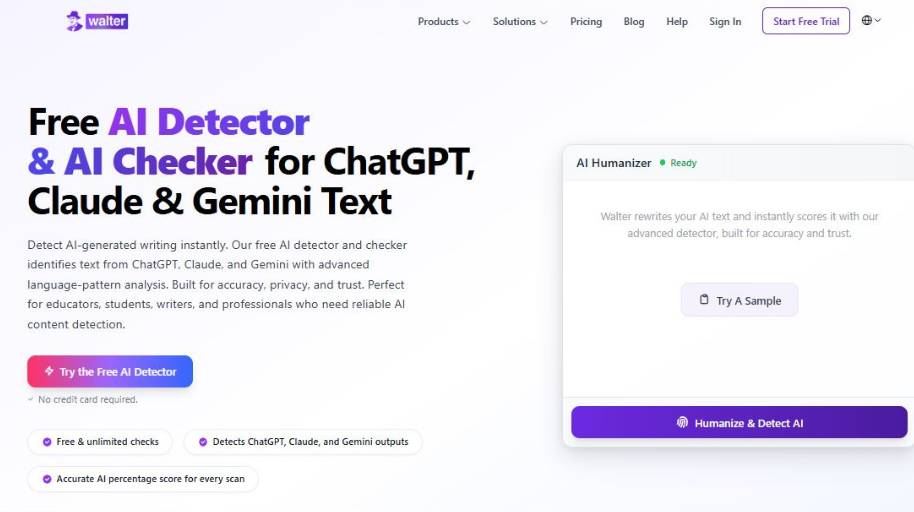
Walter AI is an AI detector that attempts to determine the probability of whether a piece of text has been generated by an AI tool. It doesn’t just give you a yes or no answer, it looks at the language patterns, the standardization of formatting, and various other tells that are commonly found in AI-generated text to give you an idea of just how likely it is that a given piece of text was generated by a machine. Usually, the tool expresses this likelihood as a simple probability.
A university professor can copy the text of an essay into Walter AI, and then get a probability (and potentially, highlighted sections) to let him know how likely it is that the essay was AI-generated, so he knows which essays to scrutinize more closely.
Similar use cases would apply in other scenarios. A blog manager can copy the text of articles from a new freelancer into Walter AI, a publisher can copy the text of guest posts into Walter AI, a company’s regulatory team can copy sections of an internal report into Walter AI, etc. The key value proposition of the tool is that it gives you some degree of probability, some level of analysis, so you can make a more informed decision.
Walter AI isn’t a tool meant to prove whether or not text has been generated by a human; it’s a tool meant to provide some level of analysis, in order to support your decision.
Advantages and Disadvantages of Walter AI Content Detector
Explore Alternatives to Walter AI Content Detector
Walter AI Alternative: Choosing the Best AI Plagiarism Detection Tool While considering all other Walter AI alternative tools, the typical comparison is between the simple and the complex ones. Everything else is just in between. Some people prefer simple, others prefer feature-rich tools.
Here is another perspective to help you decide:
Simple Tools
These tools are for those who want to save time.
- Fast Results
Just copy and paste, and click the button. That’s it! If you need a yes or no answer without much of a technical headache, these are the tools for you.
- Visual Results
Some of these tools show results in the percentage or true/false format. If you have a lot of content to check, these tools can help.
- Less Technical Requirement
There’s no need to think about API, integration, or advanced setup. Most of these tools don’t require any of that. If you’re not a tech-savvy person, these are perfect for you.
Feature-Rich Tools
These tools are for those who need customization.
- Customizable
Some of these tools let you adjust the sensitivity level, or set a threshold. If you have a certain risk appetite, it matters.
- Detailed Results
Some of these tools return results sentence-wise or give you the option to export a detailed report. This is essential for auditing or legal reasons.
- Integration Option
Some of these tools come with an API or provide integration facility. If you work in a big organization, this is a must.
What about Walter AI?
Walter AI is somewhat simple. It gives results in probability and sentence-wise. Doesn’t need much of a technical setup. It’s easy to use but doesn’t offer customization like the complex ones.
Which One to Choose?
Well, there isn’t any particular tool that is the best. Only the tool that best suits your requirements is the best.
If you prefer convenience, go for the simple tools.
If you need detailed reports, adjustable sensitivity, or integration for your organization, go for the complex ones.
The important thing is to choose a tool that suits your working style, not just your requirements.
Who Walter AI Content Detector Is Best Suited For

How to use Walter AI? Although Walter AI is suitable for different kinds of users, the tool’s applicability and value will differ based on user’s prior experience with AI detectors and the intended use. Below is a user classification (beginner, intermediate and advanced) to demonstrate the applicability of Walter AI.
For starters
For those of you that are not familiar with AI detection tools, Walter AI is very accessible. The interface is straightforward, and all you have to do is copy your text and get a probability score. Beginners appreciate the fact that no technical knowledge is required to work with Walter AI.
That being said, it can be difficult for inexperienced users to gauge whether the given probability is “high” or not and what to do with a borderline result. Walter AI is best used as a suggestion for new users rather than a concrete indicator.
Overall fit: Easy to use but may involve a bit of discretion to apply results in a responsible manner.
For Those With Some Experience
While anyone can use Walter AI, I think that teachers, editors, content moderators, and other experienced users of AI detectors are the best candidates. They understand that AI detection is not a binary process, and the results need to be interpreted.
Advanced users can utilize other functionalities like sentence-level highlighting and summary documents. Intermediate users can use Walter AI as a triage tool, to determine whether a particular contract is worth their time and attention.
Total fit: Great, especially for screening situations and lower volume of documents.
Power Users
Power users (compliance officers, developers, digital forensics analysts, etc.) will have other needs and requirements from Walter AI. They might need more flexibility, more reporting, more APIs.
While Walter AI can be used as a blunt instrument, power users may discover that Walter AI isn’t nearly as configurable as a dedicated enterprise AI detection tool, and they may use Walter AI in concert with tools that allow for tuning, API integration, and greater report granularity.
OVERALL SUITABILITY: It’s quite useful as an additional filtering device but I don’t think it’s necessarily suitable for something mission critical or technical.
In conclusion
Overall, I would say Walter AI is ideal for those who need functional AI detection and not very bespoke testing. It’s easy for beginners to use, easy for intermediates to integrate, and easy for experts to use as a part of their fact-checking. Whether it’s right for you will depend on your needs for control, reporting granularity and integration.
Closing Thoughts on Walter AI Content Detector
Walter AI’s role in a changing market Walter AI sits in a market for content authentication that is both very new and rapidly changing. As the usage of AI writing tools becomes more and more widespread across educational, journalistic and professional writing, the need for formal tools to identify AI writing grows with it. Customers in this market are no longer wondering if AI writing is real; they are looking for tools to evaluate it.
Industry trends in AI writing detection Right now, the trend across the AI writing detection industry is toward tools that are easy and fast to use and that report probabilities rather than certainties. This is in keeping with the truth that AI writing detection, like all classification problems, is probabilistic rather than deterministic. Most tools on the market today describe themselves as tools to inform decisions, rather than tools to make decisions.
Walter AI participates in that trend by reporting only probabilities and providing sentence-level information, rather than making a definitive determination about whether a piece of writing is human or AI generated. Customer expectations for AI writing detectors In this market, customers expect tools to be easy to use, easy to understand and easy to integrate into their workflow.
Walter AI delivers on those expectations with an intuitive interface and output that can easily be folded into academic, journalistic or professional workflows with little to no technical expertise. Simultaneously, the market as a whole is grappling with the trade-offs between ease of use and customer demand for a high degree of customization and advanced integration.
As a part of that market, Walter AI carves out the niche of screening tools that prioritize ease of use and everyday functionality. Walter AI in context Walter AI is part of a cohort of tools prioritizing the creation of practical and scalable systems to support, but not replace, human evaluation of AI writing.


