

- Quickly determine whether a text sample is AI generated
- Helpful tool in a blog, newsletter, or publishing workflow
- Has a simple interface that doesn’t require any coding knowledge to use
- Not for an enterprise
- Output is a probability score
- Limited accuracy when it comes to short text samples
Introducing Originality.ai Content Detector: What You Need to Know
Originality.ai is a website and tool that analyzes text to determine the likelihood that it was written by AI, stolen (plagiarized), or is totally original. This tool does not just look for specific keywords, it analyzes and runs the text through different machine learning models and similarity algorithms to provide a likelihood (probability) that the text is AI generated along with sentence-by-sentence analysis.
First, a user inputs content to the system. This is done by copying and pasting into the interface, importing a document, or by entering a live URL. The input content serves as the source text for analysis. Next, the user chooses a scan type — for example, AI detection, plagiarism detection, or both. This decides which analytical models and comparison algorithms will be used to analyze the input.
Once you begin the scan, we preprocess the text. Preprocessing may include sanitizing and formatting the text to make it easy for our system to process. We also divide the text into sentences and sometimes paragraphs to evaluate the text on a sentence or paragraph level rather than rating a whole document as one item. This makes the scoring and report much more accurate.
To test AI-generated material, the tool analyzes the writing using various machine learning classifiers that assess linguistic style, syntactical coherence, repetition, and other statistical properties that commonly accompany AI-generated prose. Rather than delivering a verdict on whether a piece is likely to be human- or AI-generated, it generates a series of probability measures that compare the work against the statistical signatures of the model.
If plagiarism checking is chosen, it will compare the given text to items it has already indexed. That comparison will determine if they’re identical or nearly identical, and it will compile those results into a similarity index. So, if you chose AI detection, it uses machine learning, and if you chose plagiarism, it uses indexed comparisons. The tool can do both and give you an initial assessment of the content’s originality.
Once the algorithm finishes running, a report is produced. Typically, there is an overall score, but parts of the text are highlighted to indicate where the score was affected. The user can then look at the marked areas to determine the scoring variation. The report is constructed in a way that the user is then going through a review process rather than a yes/no determination.
Following analysis, a user may edit the text and perform another check if desired. A record of the scans is stored so that the user can compare between versions and easily share a report if proof of a scan is necessary. In this input-analysis-report cycle, Originality.ai serves as a workflow application for the assessment of content that packages detection, review, and reporting into one.
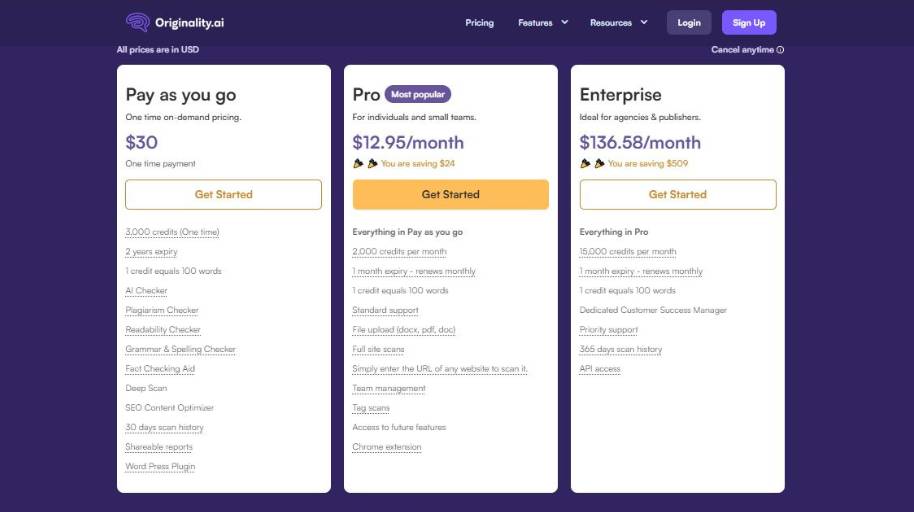
Originality.ai Content Detector Pricing
Who Originality.ai Content Detector Is Best Suited For
The tool is perfect for anyone who wants to confirm the originality of a piece of content before it’s published, submitted or shared. If you are in need of a tool that checks for human authorship as part of the content creation process, this is your go-to tool.
If you need to mitigate risk in a content supply chain, for example, if you want to ensure that any content going out the door does not contain AI-generated content without your knowledge, then this is the tool for you. As such, it’s well-suited to editorial review, legal and compliance, and QA checks.
If you want a paper trail, if you need to show that you have done your due diligence and checked for AI-generated content, then Originality.ai can also support you in that endeavor. In addition to detection, the platform can also provide a level of traceability and explainability to decision making.
If you’re working with multiple writers, contractors, or external contributors and need to enforce consistent standards, then this platform can support you too. You can ensure that all of your writers, regardless of where they are based, meet the standards that you require of them. Instead of having to trust individual writers to deliver what they say they will, you can create a standardized, repeatable process for validating content.
Finally, if you need to keep tabs on how AI writing tools are being used within your organization, Originality.ai is a good bet. If you want to permit the use of AI in some circumstances but not others, this platform can help you to manage that process in a data-driven way rather than having to make educated guesses.
However, if you’re primarily looking for tools to edit, rewrite or otherwise improve the style of content, then this tool isn’t for you. This platform isn’t about improving or optimizing content for style, it’s about evaluating content for authenticity. If you want help making your content sound more human, you’re going to need another tool.
Is Originality.ai Content Detector Worth Using?
Originality.ai is a content analysis tool meant to determine if a piece of content was likely created by AI and if that content was previously published elsewhere. Unlike a writing tool, it serves as a check that exists as part of a content workflow to validate content before publication, submission or sharing.
In this article, we have discussed what happens when it analyzes content, how it reports on content, and when it is used best in practice. Its greatest use is in standardizing a “probability” based approach to AI detection and similarity in one tool. It is ideal for risk management, reliability and liability.
No tool can be used to conclude certainty and Originality.ai is a resource to help you make a more informed decision before publishing or submitting content. If you want to know if the content is original, and you want to use this tool to ensure that with more confidence, the tool is designed to do that.


