

Undetectable AI Content Detector Features Explained
If an AI detector flags an entire text, it’s daunting to rewrite it. But if you know which sentences or paragraphs raised red flags, you can revise those, instead of the whole piece. Likewise, in an educational setting, teachers can discuss problematic passages directly with students.
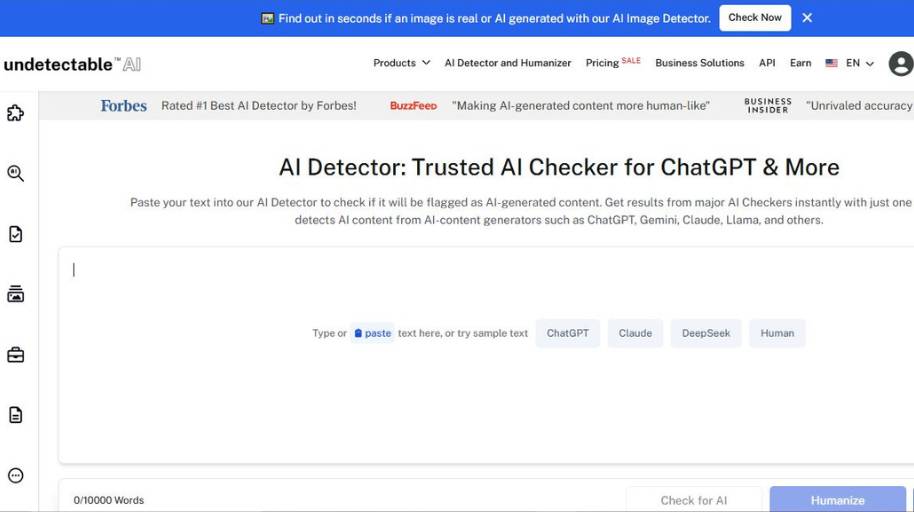
What Is Undetectable AI Content Detector and How Does It Work?
The best way to describe this tool is to say that it’s a SaaS (Software as a Service) application that is used to detect and deconstruct AI generated content. Undetectable is a tool used in the industry of AI content detection and editing, and is specifically used for detecting AI generated text and images as well as editing and deconstructing AI generated text to make it sound more human-like and less likely to be identified as AI generated.
Broken down into two main components, I would describe this tool as being a:
AI content detector – Users can input text into the tool to gauge the likelihood of the text being written by an AI model.
Content editing and deconstruction tool – Users can edit and deconstruct AI generated text to make it sound more human-like.
What sets this tool apart from a traditional grammar and spell check editing tool is that not only can users check to see the likelihood of text sounding like it was written by an AI model, but they can also use the tool to edit the text and reduce the likelihood of it sounding AI generated.
In essence, this tool serves as an intermediary between detecting AI generated text and editing the text to sound less AI-like.
Undetectable AI Content Detector Strengths and Weaknesses
Best Undetectable AI Content Detector Alternatives
1. Specialized AI Detectors for Academic Papers
Perfect for: Teachers, academic integrity committees, scholars
You might find it more convenient to use specialized AI detectors if you’re grading papers and need to enforce an honor code. Many of these tools are integrated with learning management systems and offer more detailed reports on the AI likelihood of an essay. If you have a hundred papers to grade or a hearing to conduct, you might appreciate those features.
2. Plagiarism Checkers
Perfect for: Scientists, editors, writers
If you’re concerned about AI-generated content because you want to check for similarities with previously published work, you should use a plagiarism checker. These tools are designed to find identical or near-identical copies of text from academic journals, books, and web pages.
3. Writing Tools That Help with Grammar and Style
Perfect for: Writers, copywriters, editors
Perhaps you don’t care if your students use AI tools at all. Instead, you just want them to write better. In that case, you should use a tool that emphasizes grammar and style. AI detectors aren’t perfect, so if you don’t mind AI use in the first place, you should focus on other aspects of writing.
4. AI Writing Tools with a “Human” Setting
Perfect for: Content marketers, copywriters, bloggers
If you don’t mind students using AI tools but want them to sound more human, consider using a writing tool that allows you to adjust the output for more or less humanity. Instead of detecting AI-generated text after it’s written, you can set the parameters for how human-like you want it to sound beforehand.
5. Collaborative Writing Tools
Perfect for: Content teams, copy teams, marketers
Finally, if you work with a team, you might consider a writing tool that has AI detection built-in but also allows real-time collaboration and editing. These tools are helpful if you need to work with others and keep all your comments and changes in one place.
Common Use Cases for Undetectable AI Content Detector

The use case for Undetectable AI is usually in situations where AI generated content will be edited, modified, or fact-checked prior to submitting or publishing. I find it’s easiest to think of this one in terms of jobs to be done, rather than features.
Testing Content Against AI Detection Tools
This paragraph is likely to be classified as AI-generated by detection tools.
With Undetectable AI, you can immediately determine if your content seems unnatural to the naked eye. Use this tool before turning in a paper, publishing a blog post, or handing in a client project.
Result: Users have an opportunity to see the risk of detection and opt to edit their work prior to releasing it in public or for a grade.
Revising Text to Eliminate AI-Like Patterns
Task: Rewrite text so that AI detection tools won’t be able to identify it as AI-generated.
If the content has a high AI likelihood, the tool assists in rephrasing and restructuring the content to make it sound less automated. This means users don’t have to start over and rewrite entire sections; they can edit within the same workflow.
Result: The rewritten text has a more diverse tone and style, which can assist in minimizing detection signals without altering the meaning.
Content preparation for academic submission
Job: Provide an update on whether assignments comply with the university’s AI policies.
Before submitting their work, students and researchers can leverage Undetectable AI to look through their drafts. If a piece reads as too deterministic or automated, they can revisit that paragraph and rewrite it in their own voice.
Result: More assured that work submitted meets academic integrity standards and policies.
Editing AI-Generated Content Before Publication
Task: Develop or improve upon AI-generated content used for blog posts, marketing copy, or client documents.
If authors use AI to assist them in writing, they can pass their writing through Undetectable AI to make sure that their text is sufficiently human-like and doesn’t lean too much on techniques that a detector can pick up.
Result: The content is more human-like and suitable for situations where the AI-generated content might be closely monitored.
Iteratively Testing and Refining Content
Task: Enhance accuracy in the detection algorithm after several iterations.
Since detecting and rewriting are two sides of the same coin, you can perform edits interactively – making modifications, then checking the output, and tweaking some more, all without ever having to leave the tool.
Result: Improved revisions that strike a better balance between tone and detection.
Internal Content Review
For Teams or Organizational content screening before publication.
Internal editorial or fact-checking departments can run Undetectable AI on articles written by third parties, or generated by AI, to make sure they don’t contain anything problematic. This does not need a whole software ecosystem to function.
Result: Improved coordination and regularity in the management of AI generated content, across projects.
This means in real-world use that Undetectable AI works best for situations where it’s not only about detecting AI generated text, but actually optimizing the performance of content in detection-sensitive contexts. It’s best used as a tool to take the user from unsure, to a known, more controlled result.
Final Thoughts on Undetectable AI Content Detector
So, who is Undetectable AI for? As mentioned above, I think this tool is mainly useful for people that work in spaces where AI detection results are relevant. If you’re often working with AI-generated first drafts and want more agency in how this content is read – for example if you have to turn them in for school, send them to clients, or review them with colleagues – this tool might be a useful gatekeeper.
It’s most valuable when knowing whether content can be detected as AI-generated is an important consideration in your work process – rather than something you only need to worry about every now and again.
I think it’s a tool that might be particularly valuable for students working with their schools’ AI policies, for content writers working with anxious clients or partners, or for agencies looking to implement best practices to mitigate risk. On the other hand, if your main concern is simply to write better, to do originality research, or to edit collaboratively, you might be better off using a dedicated tool for that purpose.


