

CopyLeaks AI Grammar Checker Features Overview
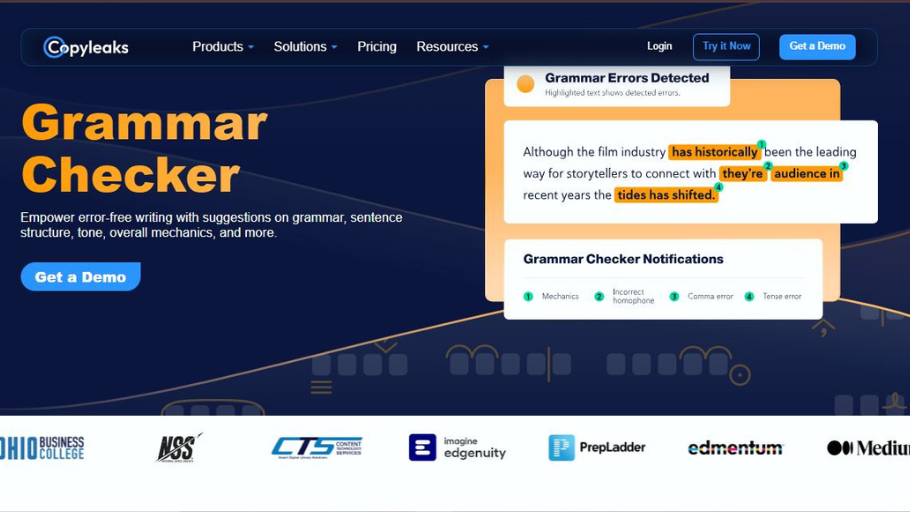
Introducing CopyLeaks AI Grammar Checker: What You Need to Know
Imagine you have to submit a report today. It’s based on some research, some data you’ve collected, and a couple of sections that you got help with from an AI tool and then edited. But before you turn it in, you want to make sure of a few things. First, that it’s well-written. Second, that it’s original. And third, that it doesn’t contain sections that could be identified as written by AI or sections that are too similar to other texts that have already been written.
That’s where CopyLeaks comes in.
CopyLeaks is an AI-enabled grammar and text analyzer that’s intended for cases where you need to do more than just check for grammar and spelling mistakes. Not only will it check for grammar and spelling mistakes like most grammar and spell checkers do. But it will also enable you to check for originality and for sections that could be identified as written by AI.
In practice, here’s how you can use CopyLeaks. You copy the text that you want to check. Or you can integrate CopyLeaks with your Learning Management System (LMS), Content Management System (CMS), or any other system that you use to manage your texts. Then you run it through CopyLeaks. What it will do is that not only will it check the text for grammar and spelling mistakes. But at the same time, it will also run a plagiarism check on it, a cross-language plagiarism check, and a check for sections that could be identified as written by AI. This means that you don’t need to run each of these checks separately. Rather, you can run them together at the same time.
For teachers, this tool enables you to check student assignment submissions for both grammar and spelling mistakes as well as originality and AI-written sections. For content creators, you can use this tool to check your content for both grammar and spelling mistakes as well as originality and AI-written sections before you publish it. And for businesses, you can use this tool to check texts that you produce for both grammar and spelling mistakes as well as originality and AI-written sections if you need to submit those texts as part of a business process.
The Pros and Cons of Using CopyLeaks AI Grammar Checker
- Grammar Checking based on Honesty
- AI-Generated Content Detection
- Cross-Language Plagiarism Detection
- Source Code Plagiarism Detection
- Enterprise Reporting and Integration
- Slightly Lesser Focus on Creative Tone Optimization
- Focus on the Analytical Rather than
- Top Choice for Structured Settings
CopyLeaks AI Grammar Checker Alternatives Worth Considering
Alternative to CopyLeaks
CopyLeaks is an odd mix of grammar and AI detection and plagiarism checking, so you might find one of these tools is a better match for your needs, which tend to split along technology/functionality lines.
1. Writing Assistants that are Style-Focused
These are tools that are mainly focused on enhancing clarity, tone, readability and flow. They do a lot of sentence rephrasing, tone matching and on the fly styling.
You may not want to use CopyLeaks if you’re primarily concerned with style, readability, or tone, or if you need to adjust the tone for various audiences. (That is, unless you are concerned about detecting AI or want to ensure your writing is original.) Those other tools are a bit more conversational and are geared toward marketers, bloggers, and business communicators.
Downside: Generally does not have AI detection, and possibly only basic plagiarism detection.
2. Generative AI Writing Tools
Others are the reverse — AI content generation is the core offering, and grammar tools are embedded as part of the writing process. These tools assist with idea generation, idea elaboration, rephrasing, or full content generation.
Those who value haste, ideas, and content creation may find this more suitable than the CopyLeaks’ system that places verification front and center. Grammar-checking in these applications is often an integral part of the wider generative process.
Downside: However, they don’t have strong tools for AI detection or non-native language plagiarism detection.
3. Plagiarism detectors for students and academics
The next group is academic honesty. These tools primarily provide similarity reports, citation analysis and LMS integration.
Other options for higher education users might be a tool that is more institutionally grounded or one that has more widespread adoption in the university. Both of these tools tend to focus on submission management and some sort of originality reporting.
Downside: The grammar support in these tools is not the primary focus, so it’s not as robust as other grammar-specific tools.
4. Basic Grammar and Spell Checkers
Some options provide simple grammar and spell checks, without any analytics at all. They are intended for casual editing, not regulatory tracking.
For those who are looking for a smooth and speedy editing experience but do not need AI detection, plagiarism check across languages, and audit reports, this is the perfect option for them.
Downside: You sacrifice more advanced content validation and creativity insights.
5. Enterprise Content Governance Platforms
On the opposite end of the spectrum, there are tools designed for content management and policy control within an organization. It may involve compliance tracking, process automation and auditing.
In the event that a company is looking at CopyLeaks for a substantial roll-out and is perhaps looking for something more inclusive in terms of policy, they should also consider this section of the content analysis software.
Downside: These systems can be more complex and less writing-focused, and may require a lot of set up and training.
How to Decide
Since CopyLeaks focuses on grammar and also offers AI detection and plagiarism detection it might be less ideal for some situations and more ideal for others, especially those that require very careful control over the originality of content. If a user is more focused on writing and editing suggestions or only uses a tool to aide in creative writing, minor editing, or very technical academic writing they might want to use another tool.
Which one is “better” will depend on whether you need to generate content, edit content, or fact-check content and how you integrate these tasks into your workflow.
Who Should Use CopyLeaks AI Grammar Checker?

I would recommend CopyLeaks for anyone who needs to address issues of authenticity, AI-generated content, and writing responsibility — not just correctness. The primary functionalities of this tool are most relevant in contexts where content integrity is a priority alongside content correctness.
When Students Submit AI-Generated Work
The growth of AI also means that teachers will encounter essays and homework that were partially or even wholly written by a machine, raising questions about how to judge not only grammar and syntax, but ideas and ownership.
This is where CopyLeaks comes in handy. It offers grammar checking alongside AI detector and multi-language plagiarism checking tool. When teachers want to generate reports and see similarity index to turn in, it’s convenient to have everything under the same umbrella.
Problem it solves: Inconsistent expectations regarding the use of AI and concerns about translated plagiarism in student assignments.
Academic Institutions Upholding Standards
Academic institutions and certification organizations have formal guidelines for reviewing originality statements. They require solutions that generate audit trails and can be linked to LMS.
Furthermore, CopyLeaks meets this requirement by providing similarity reports, AI probability scores, and flexible implementation choices. It is suitable for use cases where company policies and record-keeping are integral to the process — not afterthoughts.
Pain point addressed: Consistency in academic integrity review of a high volume of submissions.
Editors and publishers that approve articles from contributors
This is the reason that content editors who work with freelance writers and other remote content contributors will want to check whether the pieces they are being sent are original and follow rules around using AI appropriately before publishing them: Grammar isn’t the only thing you need to fact-check.
It helps with this process that CopyLeaks lets editors inspect clarity as well as check for originality and AI detection, all in one go, so the requirement to chain up too many tools is minimized.
Concern solved: Chances of publishing duplicate or unrevealed AI-generated content.
The first category is compliance-driven organizations. These companies operate under a specific set of rules and regulations, such as financial institutions and banks. For instance, when banks issue loans, they have to follow certain regulations and guidelines. This type of business is well-suited for processes like loan sanctioning, as it involves a fixed set of steps that need to be adhered to.
Especially in fields requiring text to be original and accredited to its authors, like documentation for certification or legal documents or company policies, it is important to have oversight.
CopyLeaks’ reporting and detection features help businesses that require professional, audit-compliant analysis instead of general writing recommendations.
Solves: Requirement for auditable verification in compliance-driven or policy-governed contexts.
Technical Educators and Coding Instructors
Since CopyLeaks offers source code plagiarism detection, it is most useful for computer science classes or other tech-oriented classes. Standard grammar checkers don’t operate in this realm.
Use case: Detecting duplicated code within submissions, despite differences in formatting or variable names.
Who it may not be suited for
If you are searching for a writing assistant that can aid in collaborative writing, tone or speedy content creation then you might find that CopyLeaks is geared more towards checking and validating content instead of creating it.
Closing Thoughts on CopyLeaks AI Grammar Checker
One of the things that makes CopyLeaks unique is that it’s a grammar tool that also focuses on the legitimacy of the content itself. While it’s a strong option for any user, it’s ideal for those situations when it’s important that grammar is correct, but also when it’s important that original content, AI-created content, and reporting are traceable. It’s a good choice for educators, publishers, and compliance-driven teams, or anywhere else that grammar, plagiarism, and AI recognition need to be included in a report.
In those cases, its ability to check all of these things, including cross-language plagiarism detection, in one tool is a major advantage. If you don’t need those reporting features, it might not be the best tool for you. Another time when it might not be the best tool is when you need creative suggestions.
The best use for CopyLeaks is when you need grammar checking and reports, or if you need tools that will identify AI-created work. It’s also a good choice when you don’t need suggestions for the tone or the language to sound more conversational. In cases when you need a report or verification of the grammar, then it might be worth it to use the CopyLeaks tool.
However, if you need help with the tone and language or if you want a more conversational tone, then you should consider a different tool. If you need grammar and reports, then CopyLeaks is an excellent choice. If you need help with the tone and language or need a conversational tone, then consider a different tool.


