

- Agent orchestration SuperAGI excels at orchestrating multiple AI agents
- Granular control
- Scalability SuperAGI is intended for scalability
- For developers, by developers SuperAGI doesn’t abstract away too much
- Steep learning curve
- Resource-intensive
- Not no-code
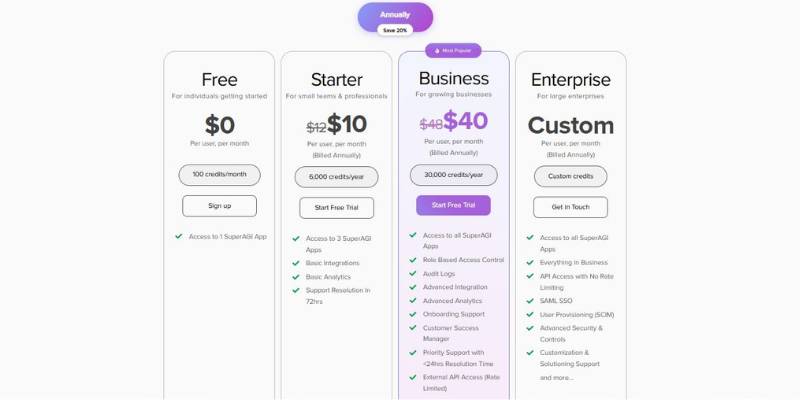
SuperAGI AI Development Tool Pricing
SuperAGI AI Development Tool Explained: A Quick Overview
SuperAGI’s SuperCoder is a systematic, iterative coding process, integrated with a version-control system, that utilizes an agent to take in a high-level goal and produce a piece of code that achieves that goal. In other words, SuperCoder is not a one-time source code generator, but a systematic coding agent. It assumes that the path from a well-specified goal to reviewed, tested code should be automated and auditable.
The workflow starts when the user instantiates a SuperCoder agent and gives it a goal. The goal can be a few words describing a feature, a fully specified user story, or a detailed specification of what to build, complete with acceptance tests. Rather than directly generating code, the system must first understand the goal and structure it into a more formal internal representation. This gives the agent a clear understanding of what it is being asked to do, including any implicit and explicit constraints.
Once the goal is defined, the agent will then attempt to plan how it will fulfill the goal, converting the specification into technical specifications and if necessary writing tests to validate its success. This level of specification serves as the intermediary between intentionality and implementation and is a key aspect of SuperCoder. It allows the program to know what to build and how it will be verified before the generation occurs.
After planning the action, the agent executes the plan in a codebase. It fetches the main branch, assesses the state of the repository, and then makes alterations to it. It generates or edits code according to the requirements and commits it to the project. The agent performs a series of assertions to ensure that the solution fulfills the requirements and that the application works as intended.
Once SuperCoder has made all the modifications, it opens a pull request. The pull request represents a controlled review step that allows the user to review the generated changes in a comfortable and known version control environment. The review process is interactive. The user can view diffs, run the modified application, and give specific feedback. If there are problems, the user enters feedback as part of the workflow, and the agent reconstructs or modifies the implementation. This review cycle repeats until the desired outcome is achieved.
After the user has accepted the result, the pull request is merged and the modifications are integrated into the main code. The next tasks are based on that new version of the code, so that the process continues.
What does that look like in real life? Well, here is what the interaction with SuperCoder looks like: The user defines the objective, the agent plans and acts inside the repo, the user reviews the work and provides feedback. We have designed the tool to be controllable. The tool does development work from start to finish, but the user is still in control at various points. It gives you the ability to input some sort of description of what you want, and then this tool generates, tests, reviews and prepares to merge the code for you.
Common Use Cases for SuperAGI AI Development Tool
Who uses SuperAGI? Teams that need to create and orchestrate AI agents that perform tasks independently. Here are some common scenarios:
1. Developers & Engineering Teams
How:
- Integrate AI agents into applications and software
- Automate complex technical workflows
- Test and perfect agent behaviors before deployment
For engineering teams, SuperAGI is a set of tools to build more intelligent systems that require less human input to make decisions and act.
2. AI & Data Teams
How:
- Experiment with AI agents and workflows
- Integrate multiple models into a single workflow
- Perfect agent decision-making and response logic
AI and Data teams use SuperAGI to test the ability of autonomous agents to accomplish tasks, and to perfect their decision-making and response logic over time.
3. DevOps & IT Teams
How:
- Automate system monitoring and diagnostics
- Automate repetitive infrastructure management tasks
- Integrate tools and services across cloud environments
Rather than write one-off scripts to accomplish repetitive tasks, DevOps and IT teams use SuperAGI to build autonomous agents that follow rules and adjust to context.
4. Operations Teams
How:
- Automate business processes
- Automate document processing
- Automate interdepartmental workflows
Operations teams use SuperAGI primarily to automate business processes and eliminate busywork.
5. Startups Building AI-enabled Products
How:
- Rapidly prototype AI-enabled applications
- Accelerate the development of agent-enabled products and services
- Scale AI-enabled products and services as startups grow
Startups building AI-enabled products use SuperAGI to get a jump-start on building out the orchestration layer, which can be complex.
SuperAGI is used by teams that need to create and orchestrate AI agents that can perform multi-step processes independently. While it does support simple automation tasks, the primary use cases are more focused on building systems that can reason through and act on their own within prescribed limits.
SuperAGI AI Development Tool Review Summary
SuperAGI is an open-source framework for creating and managing autonomous AI agents. Instead of a simple prompt interface, it offers a framework for developing multi-step agents that can reason, use tools, iterate on results, and be integrated with other systems. In this article we’ve discussed its trade-offs, particularly between flexibility and complexity, and the kinds of teams and industries that tend to find it a good fit.
The advantages are in control and customizability. SuperAGI gives technically skilled users control over agent design, tooling, and structured autonomy. For companies that want customization, control over deployment, and orchestration at the level of individual agents, SuperAGI can be a valuable tool.
On the other hand, it requires users to want to handle configuration, infrastructure, and iteration. It’s not for people who want automation with zero setup.
The key insight here is simple: SuperAGI is the right choice for teams that want to treat AI agents as software to be designed, rather than tools to be employed. Whether or not it’s a fit depends less on a comparison of features, and more on whether your team has the technical expertise, interest in customization, and stomach for operations.

