

- It provides both AI-generated content detection and a plagiarism check in a single platform
- The scan history is saved in your account, which is useful for tracking and record purposes
- It’s a tool that is specifically designed for content managers, which includes an agency, publisher, or any academic professional who needs to manage multiple authors
- As mentioned earlier, no AI detection tool can provide a 100 percent accurate result
- Plagiarism results may not be 100 percent accurate as the tool does not have access to everything present on the internet
- The credit system may not be feasible for everyone, especially for those who need to perform an occasional scan
- Last but not least, in some cases, if the length of the content is small, the tool may not provide the desired results
Originality.ai Plagiarism Checker Explained: A Quick Overview
Quoting straight from their website, “Originality.ai is an artificial intelligence technology company focused on detecting and preventing AI-generated content, including text, audio, video, images, or animations from being presented as original.” They offer an online tool that you can use to check for any AI-generated content. You simply copy and paste your article into the tool and it will show you the likelihood of the content being AI-generated. Note that while the tool is pretty accurate, there is still a chance of false positives.
Originality.ai is a web-based content checking tool that uses automated scanning to check for originality. This is not a scoring program but a step-by-step program through which the content goes until a report is generated.
The user starts by logging into the web application and submitting their text for analysis. They can do this by copying it into the editor, uploading a file, or submitting a web page URL. At this point, the text is normalized and formatted for processing.
After inputting the content, the user chooses which analysis to run. The tool can run different detection algorithms on the same piece of text, depending on the user’s goals. Some people may want to determine whether the text seems to have been produced by AI tools, for example, while others might be looking to spot plagiarism. The chosen setting will influence the tool’s analysis of the text.
Once the user presses the button to scan, it will scan the text. Unbeknownst to the user, the text will be broken up and run through machine learning and comparison algorithms to see if it passes probability and linguistic markers for AI and matching text for Plagiarism. This will all happen behind the scenes while the user waits for the results.
Once the check finishes, you’ll receive a formatted report. The report generally includes an overall score and additional details that provide some insights into how the score was calculated. Sometimes, sentences or paragraphs where a signal was detected will be marked so you can focus on a section rather than having to read a percentage of your text that might be problematic. The goal is to provide you with enough information to evaluate the results and determine if a text should be updated.
The result of the scan is saved to the user’s history for later retrieval. The user can come back to scan results later, or scan an older version of a document to see what changes were made, or share results with colleagues, editors, or clients. This history feature means the tool is not only something you use once, but can be integrated into the editing process.
Put simply, Originality.ai is a decision making tool. It allows a user to input data, select some options, click a button, and get a report that includes an overview and some more detailed context on what was found. It was built to walk someone through a logical process of entry, processing, and decision making.
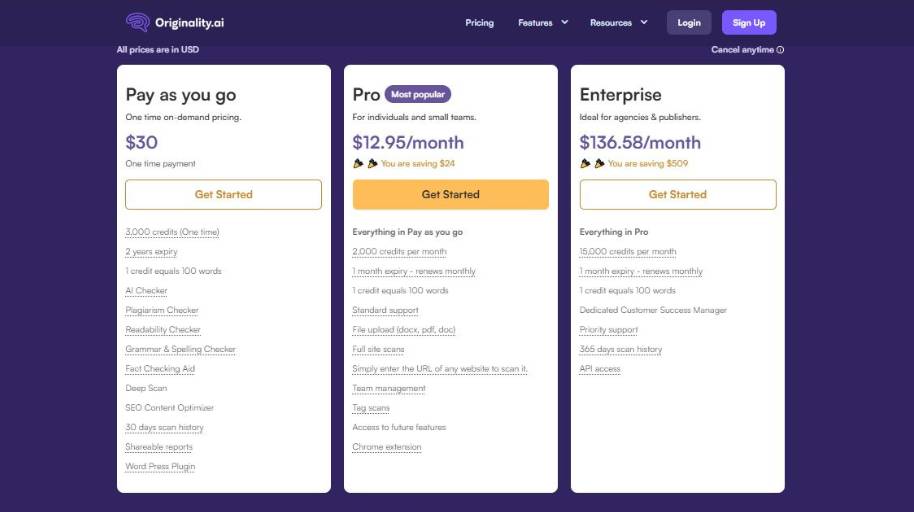
Originality.ai Plagiarism Checker Pricing
Practical Applications of Originality.ai Plagiarism Checker
Another example would be the screening of articles, blogs, and website content prior to publication. Here the user (e.g. website owner or publisher) wants to check the originality of a piece of content, and see if it matches anything else on the internet. A prescreen via Originality.ai helps to identify duplication and authorship flags if they are there prior to publication, helping prevent potential issues down the line with respect to reputation, search engine de-listing and editorial issues. The result is assurance that the published content is indeed original.
Freelance or outsourced work
Companies or agencies that accept freelance writers’ work may require a universal way to check every submission they receive. In this case, Originality.ai can offer a standardised way of checking. Simply scan your submitted article, see the results, and determine if you need to edit or accept it for payment and publication. This way, you can control quality and maintain a standard level of originality without entirely relying on human review.
Content Audit of Existing Libraries
For companies that have been creating content for a while, they may want to check some of their existing content to see if it’s still unique and compliant. Running older blog posts and website content through the tool can help identify duplicates or matches that were not checked when they were published. Running this analysis helps maintain the integrity of your content, especially if you’re relying on that content for search and if you care about your IP.
Assisting with Plagiarism Detection
Originality.ai can be used by teachers and peer reviewers as one component of a multi step integrity check on written work. The AI tool will determine if the essay or manuscript appears to have been written by a student or it may indicate that a passage is of concern. Teachers and peer reviewers will still have to decide what to do with the information provided by the AI tool.
Editing AI-Generated Content Prior to Client Distribution
Prior to delivering a final draft to a client in a document where an AI tool was employed for the writing (totally or partially), I check the final document to make sure that it passes the Originality Test and is okay to submit or if it needs more editing. This allows you to be up-front and truthful in terms of what was delivered to the client and is very important in cases where originality is required by the terms of a client engagement.
Define an Editorial Process
This is particularly important for teams that are responsible for reviewing work from a variety of different authors. Running Originality.ai as part of your editing routine provides an added level of quality control that can be hard to enforce otherwise. From now on, rather than getting into an argument with an author or another team member about whether the text was “good enough” or not, you can just show them their Originality Report.
Originality.ai plays a role in these situations as a quality control tool for content managers. The goal is to identify issues so they can be addressed prior to publication, distribution, or storage.
Originality.ai Plagiarism Checker Review Summary
The need for bloggers, marketers and academic institutions to verify that text has not only not been plagiarized but also that it was not written by an AI has emerged. Originality.ai can do both and now provides both functions in one combined tool.
In essence, this is the direction of the industry. Where in the past one would need to utilize one tool to verify originality and another to verify if text was AI generated, this is no longer the case. The roll out of this tool is keeping up with the fact that publishers, advertising agencies and educational institutions have adapted to the new pace of content creation and the increasing percentage of text that is written by humans and AI.
That being said, tools like Originality.ai are meant to be aids, not the ultimate arbiters. The output of these tools is a data point but not the final data point. In virtually every setting the ultimate arbiters are still human editors, publication guidelines, or Institutional policies.
In summary, Originality.ai exists in a market that is adapting to a changing environment. It meets current demands of efficiency and integration of tools and it will play an important role in the quality and integrity of content.


