

Facia AI Face Detector Features Overview
How to use Facia AI Face Detector?

Introducing Facia AI Face Detector: What You Need to Know
You manage onboarding for thousands of new customers for a new financial services platform, and despite strong authentication and identity checks, you still find accounts being opened with stolen identities, deepfakes, or replay attacks. Your identity service catches many of the obvious forgeries, but can’t effectively determine when someone is using AI-faked but increasingly convincing photos or video. How do you limit the risk of forged identities without introducing more friction to the onboarding process?
This is where Facia comes in. Facia is an AI-powered, facial biometric identity service that can confirm a user is a real, live person with minimal disruption and maximum security. Unlike solutions that simply verify if an image is a face, Facia’s technology can verify if a user facing the camera is a real, live person (not a picture, video, mask, deepfake, etc.) and that the live image matches a claimed identity for access, authentication, or identity proofing.
Where does Facia fit in?
When a user takes a selfie or initiates a live camera session, you send the image or video to Facia, whose AI analyzes the input to check for liveness (via 3D motion and biometric signals), verify if the face is real and not a forgery (deepfake detection), and match the live face to a claimed identity or photo ID, all within milliseconds. This way, the user barely notices the verification process.
More than just “detecting faces,” Facia’s automated spoof and deepfake detection can be easily integrated into your security workflow to prevent even the most sophisticated attacks that would normally go undetected by biometric solutions. The result is fewer false positives, fewer manual reviews, and greater confidence in every verified identity, whether it’s used for secure app login, access control, or identity proofing.
Put simply, Facia adds a new layer of assurance to your identity workflow, enhancing your identity processes with AI that can not only tell you whose face you’re looking at, but verify that it’s a real face.
The Pros and Cons of Using Facia AI Face Detector
- Robustness to Liveness and Deepfakes
- Real-World Accuracy
- Privacy-Conscious Architecture
- Scalable for High-Volume Operations
- Overkill for Low-Risk Applications
- Integration requires technical capacity
- Reliant on Quality of Input from Cameras
Best Facia AI Face Detector Alternatives
Now, here are some other face detection and recognition tools in comparison to Facia’s contextual face detection and liveness detection, along with what they are particularly good at.
Amazon Rekognition – Highly scalable cloud-based face detection & analysis
Pro: Batch processing of faces at massive scale, and robust attribute analysis While Amazon Rekognition can identify, process and compare faces in images and videos, it can also return face details, like facial expressions, or even occlusions and it does so in support of video processing at scale. Furthermore, it can maintain searchable face indexes in massive databases.
Versus Facia: Rekognition is stronger on large-scale, cloud-based work and on analytics of commercial cloud-based data. If you have a very large amount of media to process, or if you need metadata for media attributes other than mere detection, it is easier to deploy Rekognition.
Microsoft Azure Face API – Recognition & Organization
Pro: Built-in face matching and grouping functionalities The Face API from Microsoft provides cloud-based services for face detection, verification, recognition, and grouping functionalities. The service can also group similar faces and store persistent face lists for recognition scenarios.
Versus Facia: When you need to control structured identities, manage and group people and match them against existing databases, Azure API is the way to go. If you’re already on the Azure platform, it also provides a great level of integration and tooling.
Google Cloud Vision API – Comprehensive Vision Capabilities
Pro: Part of a multi feature computer vision offering. Google’s Cloud Vision API offers facial detection alongside other computer vision features like object detection, landmark detection, and content moderation.
Versus Facia: If you need to understand images of various things other than faces like documents, layout, objects, text, Vision API suite provides single APIs instead of different services.
Megvii (Face++) – Fast Recognition & Attribute Extraction
Pro: Enhanced feature extraction and similarity search Face++ offers face detection, similarity scoring and metadata extraction (age, head pose etc.) as well as efficient face search. It’s one of the most popular APIs used for global production services for both detection and recognition.
Versus Facia: Face++ is a better option if you require a fast attribute analysis and set-based matching but don’t care as much about the additional real-time liveness and anti-spoofing security.
Kairos – Face Recognition API
Pro: Cross platform and demographics Kairos has simple face detection and recognition APIs, with demographics and anti-spoofing capabilities. They also provide SDKs for multiple platforms and languages.
Versus Facia: Kairos may offer more appeal to teams who prefer a cross-platform solution with more intuitive APIs, but it likely trails Facia in terms of both detection accuracy and anti-spoofing strength.
Third Party Open-Source Libraries (e.g., OpenCV, DLib, FaceNet)
Pros: Customization and no vendor lock-in OpenCV and other deep learning based libraries give users the flexibility to create customized solutions for face detection and recognition with the full ownership of model and data.
Versus Facia: If you prefer open-source, require customizability and high degrees of configurability, or can’t or don’t want to depend on cloud services, they may be a good choice. Typically, they require more investment in engineering to match the stability and real-time detection capabilities that come built-in with Facia.
Edge-Optimized SDKs include: Sighthound
Pro: Fast face detection on device Mobile or edge based solutions require fast face detection on the device itself (with low server requests).
Versus Facia: Great for embedded or offline use where server round trips are not feasible, but the cost is next-level spoofing and contextual cloud-powered intelligence.
If you’re considering other options, it’s worth noting that it might come down to your need for scalability and general analytics support, identity and grouping functionality, multimodal image analysis, open-source customizability, or edge real-time detection. Facia’s contextual liveness and anti-spoofing is an option in this list, but often solutions are used together in order to achieve the optimal outcome for a given use case.
Facia AI Face Detector Target Audience
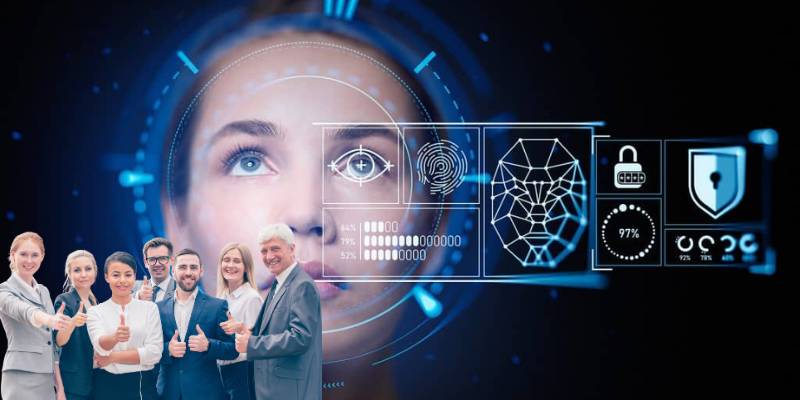
Facia is ideal for businesses where determining whether a face is genuine, live, and legitimate is a key risk factor. Here are some of the typical user profiles that will most value its service.
1. Financial Institutions and Fintech Platforms
Profile: Banks, digital wallets, crypto exchanges, lending platforms etc.
They are being targeted all the time by identity fraud, synthetic identities, and deepfake-based onboarding attempts. They need to do more than just detect a face; they need to assure liveness and anti-spoofing at scale.
Facia is a good match for remote onboarding, KYC flows, and step-up authentication scenarios where fighting fraud directly influences regulation adherence and minimizing financial losses.
2. Government and Public Sector Bodies
Profile: e-Government portals, digital ID schemes, border and access control organizations
This is especially pertinent in the government space, where secure identity authentication is crucial, but privacy regulations may be stringent. Facia’s decoupling from the rest of the biometric data process could help it find applications in such circles.
Especially valuable for digital ID verification and secure citizen services access where trust and auditability are paramount.
3. Mega-Digital Platforms
Profile: Social media, online marketplaces, ride-hailing, and gig economy platforms
For platforms with millions of users, impersonation, bot accounts, or AI-generated profile abuse may be a concern. Facia may be used as an identity verification layer at the sign-up process or when taking a risk-sensitive action.
Due to its scalability, it’s recommended for scenarios where checks are constantly performed and need to stay automated without affecting the user experience.
4. Telecommunications and SIM card registration Services.
Profile: Telecom operators who want to verify the identity of the person trying to activate a SIM card.
SIM registration laws mandate the verification of identity documents in many countries. Where applicable, Facia can be incorporated into out-of-branch SIM registration processes to reduce the need for human verification, without diminishing anti-fraud measures.
5. Medical and Insurance Services
Profile: Telehealth software and insurance enrollment platforms
Another interesting application of the technology would be in the health care industry where patient identity verification is required to maintain privacy and to combat health insurance scams. Facia could be used for patient login verification or remote verification for medical services that are provided online.
6. High-Security Access Enterprises
Profile: Companies that run secure facilities or handle confidential information
The second example involves companies that are using physical badges for access. However, there are cases where they might need an additional authentication step with facial verification. Here is where Facia comes in, particularly in the cases where the spoofing or presentation attack must be prevented.
People Who Do Not Require Facia
Facia may not be indicated for:
- Small businesses with a low risk of fraud
- Tools for which internal basic authentication is enough.
- Cases where all you need is a basic face detection (no recognition needed)
- Perhaps in less-vulnerable and less-critical situations, a lighter-weight alternative will suffice.
Closing Thoughts on Facia AI Face Detector
Facia is an AI-driven face detection technology optimized for use cases in which proving the actual presence of a human being is as crucial as the detection of the face itself. In other words, it’s more focused on proving liveness and anti-spoofing detection rather than just face detection.
We’ve gone through this article and discussed what sets Facia apart, including its contextual understanding, its dynamic detection sensitivity, its privacy-first engineering, and its enterprise-grade audibility. We’ve also discussed its value proposition for regulated industries such as fintech, public services, telecommunications, and digital marketplaces, as well as cases in which its functionalities may offer too much for small and medium-sized businesses or non-regulated services.
Facia’s greatest value is its ability to tackle contemporary threats such as deepfakes and presentation attacks while also scaling to meet heavy traffic demands. However, it requires careful implementation and is mostly indicated for businesses and services for which identity verification is not just a nice-to-have but a must-have.
If you’re reading this article to decide if Facia is the right technology for your business, the most important question to ask yourself is: how much risk am I willing to take on? If the answer is “none” and you need to prevent identity fraud, adhere to regulations, and provide assurance for remote identity verification services, Facia can be the way to go. If you need to merely detect faces without the need for advanced protection, you might not need Facia.
