

Agriculture is undergoing a revolution of sorts. Not the kind that makes the front page news, but the kind that is changing the very fabric of how we live. For millennia, farming has been based on experience, observation, and a bit of well-informed guesswork.
Table of Contents
Farmers have looked up at the sky, dug their hands in the dirt, and acted based on seasons that have sometimes been unpredictable. But now there’s something new in the mix: data. AI, satellites, drones, sensors, and autonomous equipment are slowly but surely becoming integral parts of farming life. Not everywhere, naturally, but enough to make a difference.
1. The Rise of Smart Farming: Market Growth, Investments, and the Companies Leading the Way
Not so very long ago, farming was more art than science. A farmer would glance up at the clouds, dig a finger into the dirt, perhaps chat with a few colleagues over coffee and decide. Today? Next week? It was a little bit of everything.
Agriculture isn’t like that anymore. AI is finding its way into the fields, into the barns, into the greenhouses. Sometimes you don’t even notice, sometimes you hear a drone buzzing in the sky.
The statistics are telling. A recent report by MarketsandMarkets put the global smart agriculture market at some $15.8 billion in 2023, and projects that it will top $33 billion by 2027, with much of that growth driven by AI-enabled analytics, sensors and automation.
Fair enough, really. You aren’t going to feed nearly 10 billion people by 2050, as the Food and Agriculture Organization (FAO) projects, without something beyond the traditional techniques.
Farmers understand that. Investors understand that. Governments understand that.
Data Is Becoming the New Fertilizer
The point here that gets lost is that AI in farming isn’t about replacing farmers with robots. It’s about giving farmers something akin to superpowers.
Sensors to tell how moist the soil is. Satellites to monitor crop stress. Algorithms to predict a pest infestation weeks before it develops.
A recent study by McKinsey & Company found that the precision agriculture enabled by these technologies can improve crop yields by as much as 20% while cutting fertilizer use by about 15%.
That seems like a decent bargain to me.
And it isn’t really theoretical at this point. Scores of farms across North America, Europe and in parts of Asia are now depending on AI-enabled tools every day.
| AI Technology | Primary Use | Estimated Impact |
|---|---|---|
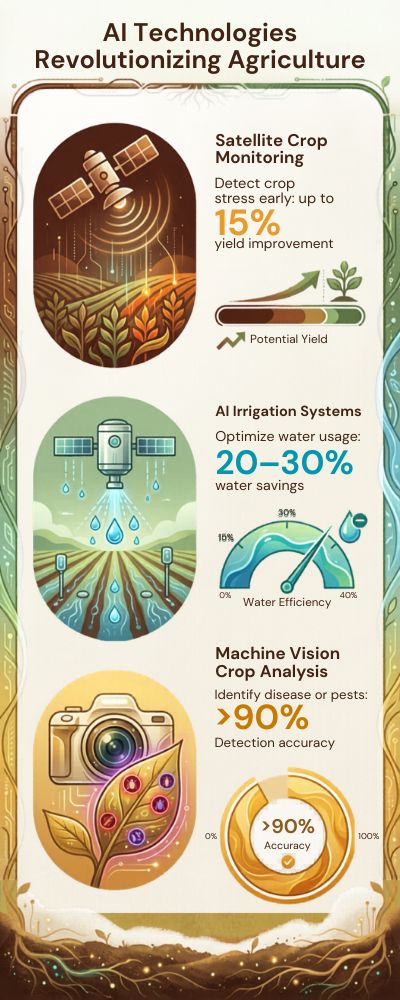
| Satellite crop monitoring | Detect crop stress early | Up to 15% yield improvement |
| AI irrigation systems | Optimize water usage | 20–30% water savings |
| Machine vision crop analysis | Identify disease or pests | Detection accuracy above 90% |
The Unspoken Truth: Farmers Are Embracing
Imagine an old farmer’s reaction to high-tech wizardry. That’s not what’s really happening. Farmers are often practical men and women. They have a problem to solve (dirt needs tilling, crops need monitoring, cows need milking, etc.). If technology can help them solve that problem, they’ll try it out. Over 60% of larger farms in the United States and other developed nations already use some kind of precision farming tool, according to a survey from Deloitte’s agriculture technology study. Technology adoption is increasing.
| Region | Estimated Smart Farming Adoption |
|---|---|
| North America | 65–70% of large farms |
| Europe | ~55% |
| Asia-Pacific | ~35% but rapidly growing |
Technology More Than You’d Suspect
What we’re seeing isn’t a lightswitch moment, where suddenly farmers are all plugged into the Matrix. Rather, it’s a series of increments: a farmer buys one sensor, then another; one drone, then a second; a farmer uses an AI-powered app to make one decision, then another.
But if you step back and consider it, what we’re witnessing is this: One of humanity’s oldest industries is increasingly becoming one of its most tech-enabled. And if the pace of change continues, a decade from now farms will look less like the fields we’re used to and more like living data labs. A bit strange, perhaps. But kinda cool, too.
2. Precision Agriculture: How Data Helps Farmers Grow More While Using Less
If you ask any farmer about their biggest fears, you’ll probably get the same answers: the weather, blights, prices and the eternal uncertainty of input costs. Precision agriculture hasn’t made all of those problems go away, but it has made them more manageable.
Soil sensors monitor moisture levels. Satellites monitor crops. Computers analyze yield maps like bean counters on April 14th.
The Food and Agriculture Organization (FAO) says that the world will need 60% more food by 2050. However, very little new farmland is available. This means we’ll have to grow more on the same amount of land.
That’s where precision ag really comes in handy.
Increased Yields, Reduced Inputs
The tools of precision ag enable farmers to use the exact amount of water, fertilizer or pesticides they need in the exact place they need it.
This can make a big difference.
A report by McKinsey & Company analyzed precision ag technologies around the world. It found they can:
- Increase crop yields 10% to 20%
- Decrease fertilizer application by up to 15%
- Decrease water use by 20% to 30%
Not bad for something that amounts to measuring twice and cutting once.
| Precision Technology | Main Function | Estimated Impact |
|---|---|---|
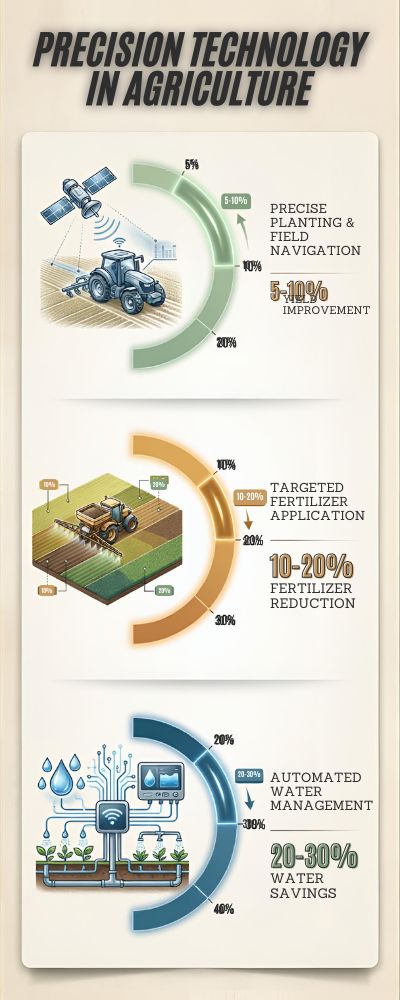
| GPS-guided tractors | Precise planting & field navigation | 5–10% yield improvement |
| Variable rate technology | Targeted fertilizer application | 10–20% fertilizer reduction |
| Smart irrigation systems | Automated water management | 20–30% water savings |
Sensors in the Soil, Satellites in the Sky
It’s worth noting the sheer number of data sources in play for precision agriculture. Some fields now contain dozens of sensors that track soil nutrients, temperature, moisture, and root growth conditions. Satellite imagery also plays a significant role in precision agriculture. Remote-sensing platforms can detect early signs of crop stress long before a farmer can see them walking through the field.
A recent report from NASA Earth Observatory states that satellite-based crop monitoring can identify yield problems two to three weeks earlier than traditional field scouting. That extra time is crucial. Two weeks can be the difference between saving a crop and watching it decline.
Adoption Is Spreading, But Not Everywhere Yet
Precision agriculture hasn’t yet made it to every farm. Cost, connectivity, and technical knowledge are still significant barriers to widespread adoption. However, adoption is growing steadily. According to Statista’s precision agriculture market analysis, the global precision farming market was worth about $9 billion in 2023 and is likely to top $20 billion by 2030.
Here’s roughly how adoption breaks down today:
| Region | Precision Agriculture Adoption |
|---|---|
| United States & Canada | ~70% of large farms |
| Europe | ~50–60% |
| Latin America | ~40% |
| Asia-Pacific | ~30% but rapidly growing |
What’s fascinating isn’t just the growth; it’s the way of thinking that’s causing it. Farmers have always been great observers. Precision agriculture just gives them better eyes, better metrics, and quite honestly, less sleepless nights worrying about having made the wrong decision.
3. How Drones and AI Are Transforming Crop Monitoring and Spraying
Not long ago, the most common perception of drones was a guy flying one in the park or a film crew getting a sweet sunset shot. Agriculture has changed this. Drones are becoming more like agricultural machinery, just like a tractor or water pump, only louder and more high-tech.
They are used to survey fields, monitor conditions, and for targeted crop spraying. The pace of implementation is not slow either. A global drone industry report by PwC estimates that the potential value of the drone-powered solutions in agriculture is $32 billion. This is a significant value for a flying spider with blades.
Eyes in the sky
Agricultural monitoring is one of the most effective uses of drones. Rather than trudging out to fields in the middle of July, a farmer can fly a drone over them in a matter of minutes. The images obtained are then analyzed with AI. This allows the software to pick up changes in plant color, temperature, and other signals to assess issues.
The NASA Earth Observatory reports that drones can detect stress or disease in crops up to 10 days sooner than a human surveyor. With some crops, that can mean the difference between a healthy harvest and a failed one.
| Drone Application | What It Detects | Impact on Farming |
|---|---|---|
| Multispectral imaging | Crop stress & nutrient deficiencies | Earlier intervention |
| Thermal imaging | Irrigation problems | Water efficiency improvements |
| AI crop analysis | Pest & disease detection | Reduced crop loss |
Drone Spraying Is Quietly Revolutionizing Crop Protection
Crop monitoring is only half of the equation. Today, many ag drones are designed for precision spraying, dispersing pesticides or fertilizers in targeted areas. This significantly reduces the amount of chemicals while optimizing the spraying process. Field trial results presented in this study published in Frontiers in Plant Science show that drones can:
- Save 15 to 30% of pesticides.
- Improve the spraying efficiency by 20 to 40%.
- Spray up to 40 to 60 acres per hour, depending on conditions.
Some farmers have switched between tractors and drones and frequently point out the basic benefit: drones can spray areas tractors can’t, like mud or hills.
| Spraying Method | Average Coverage Speed | Chemical Usage |
|---|---|---|
| Traditional tractor spraying | 15–20 acres/hour | Standard |
| Drone spraying | 40–60 acres/hour | 15–30% lower |
Drone Market Takes Flight
The financial side of the drone agriculture industry is expanding as rapidly as the technology.
Market research by Statista’s agricultural drone market forecast estimates that the worldwide agricultural drone market size was approximately $4.5 billion in 2023 and is expected to surpass $18 billion by 2030.
While penetration rates differ from region to region, the industry is expanding all around the globe. Drones are not meant to replace farmers. That wasn’t ever the plan. They do, however, offer farmers a different perspective, in more ways than one. Field issues become more easily identified when seen from the top down.
| Region | Drone Use in Agriculture |
|---|---|
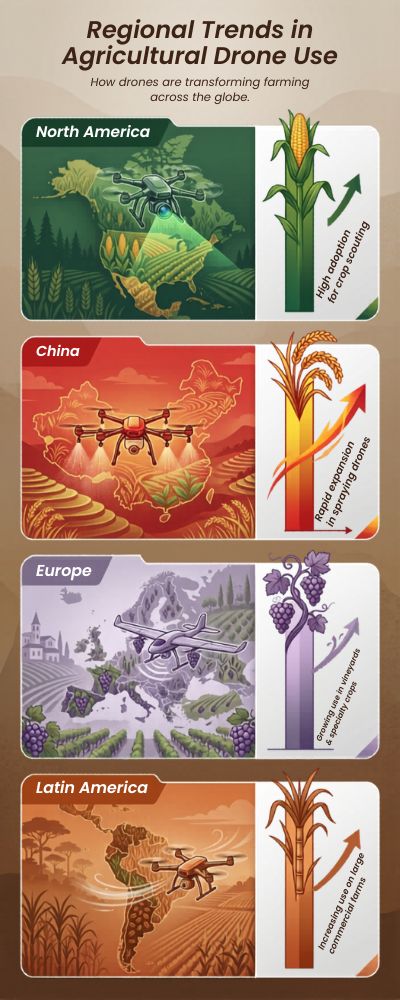
| North America | High adoption for crop scouting |
| China | Rapid expansion in spraying drones |
| Europe | Growing use in vineyards & specialty crops |
| Latin America | Increasing use on large commercial farms |
And if you’ve ever spent your days walking rows of crops in the hot sun, you’d likely agree that sometimes the best view is at around 100 feet in the air.
4. The Smart Farming Boom: Market Growth, Investments, and Key Industry Players
While it may seem like the latest buzz-worthy trend, this industry has actually been gaining steam for the past ten years. Despite the reputation of this industry as being old-fashioned, with many imagining rural tractors and rain boots, agtech has been capturing the attention (and funding) of venture capitalists, venture funds, and governments.
The reason is simple, as the world’s food security is on the line, as global demand increases, arable land supply decreases, and weather patterns become increasingly unpredictable.
The market for smart agtech was valued at roughly $15 to 16 billion in 2023 and is expected to be worth $33 billion by 2027, growing by more than 12% year-over-year, according to a recent report from MarketsandMarkets. That is the kind of growth that we are used to seeing in industries like fintech and AI software, not agriculture.
VC Funds Are Getting Down And Dirty
In the past, venture capitalists tended to avoid investing in agtech startups. They were considered too slow, too old-school, and not scalable enough. At the tail end of the decade, that narrative began to shift.
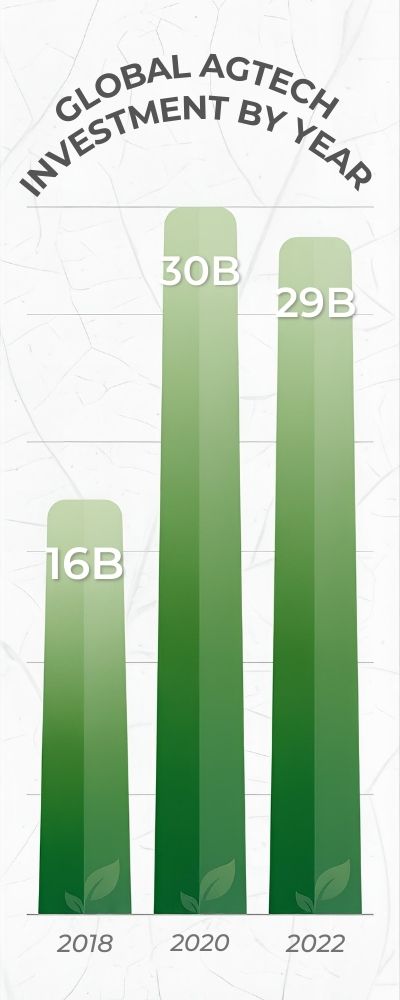
In 2022, agrifood technology startups raised over $29 billion in funding globally, much of that for technologies such as AI data analytics, robots, and precision agriculture platforms, according to AgFunder’s AgriFoodTech Investment Report. Yes, some years are better than others, but overall, the trend is up.
| Year | Global AgTech Investment |
|---|---|
| 2018 | ~$16 billion |
| 2020 | ~$30 billion |
| 2022 | ~$29 billion |
Why the rise? Well, there’s no beating around the bush here. Smart farming tools that enable farmers to make the most out of every input are not just a good business opportunity, they’re also a must.
The smart farming companies
The market doesn’t have a dominant behemoth yet. Instead, it is populated by agricultural machinery companies, software companies and fast-growing startups.
Some have a long history of farming, while others have Silicon Valley printed all over them, in the best way possible.
Here are some of the big boys to watch in the industry:
| Company | Focus Area | Notable Technology |
|---|---|---|
| John Deere | Autonomous tractors & farm analytics | AI-powered precision farming systems |
| Trimble Agriculture | GPS guidance & farm management | Precision mapping technology |
| Climate Corporation (Bayer) | Crop analytics & weather data | FieldView digital farming platform |
| DJI Agriculture | Agricultural drones | Crop monitoring & spraying drones |
Not every region is moving at the same clip. North America and Europe are currently the biggest adopters of smart farming techniques, but nations with large agricultural economies like Brazil, India, and China are also heavily investing in precision farming tech.
By 2030, the global precision agriculture and smart farming market could top $40 billion, according to market size predictions from Statista’s smart agriculture analysis.
This isn’t just a tech trend. It’s a structural shift. Farmers aren’t being replaced by software developers, but their fields are beginning to resemble data ecosystems. And, frankly, when you consider that they’re going to have to feed a couple billion more humans, that shift is probably long overdue.
5. How AI Can Spot Crop Diseases Before Farmers Even See Them
You know how it is. The diseases don’t announce their arrival with a loud knock on the door. They just arrive, without any fanfare, often without anyone’s knowledge. A few specks here, a slight change in color there and voilà, half the farm is infected.
I have had the opportunity to chat with a few farmers and almost all of them tell me the same thing, it’s not the disease that’s the problem, it’s the time of detection.
If they could manage to catch it early on, the damage would be limited. But most of the time, by the time it’s detected, it’s too late. In fact, the Food and Agriculture Organization (FAO) estimates that “Up to 40% of global crop production is lost to plant pests and diseases each year”. That’s huge. AI comes to the rescue here.
How AI Detects Problems Earlier Than the Human Eye
Most AI-powered systems in agriculture employ computer vision, a subset of machine learning that can recognize patterns from images. They are fitted with cameras on drones, tractors, and even smartphones which keep scanning the crops. And the best part is that these AI algorithms can detect disease signals even before the symptoms are visible to the naked eye.
Scientists have been working with image datasets of crops to train AI models to detect disease symptoms at an early stage. Studies have shown that AI models can detect diseases with an accuracy of more than 90% as published in this paper in Scientific Reports (Nature).
What do these systems scan for?
- color changes in the leaves
- growth changes in plants
- thermal imaging to detect temperature differences
Think of it like a health scanner for farms!
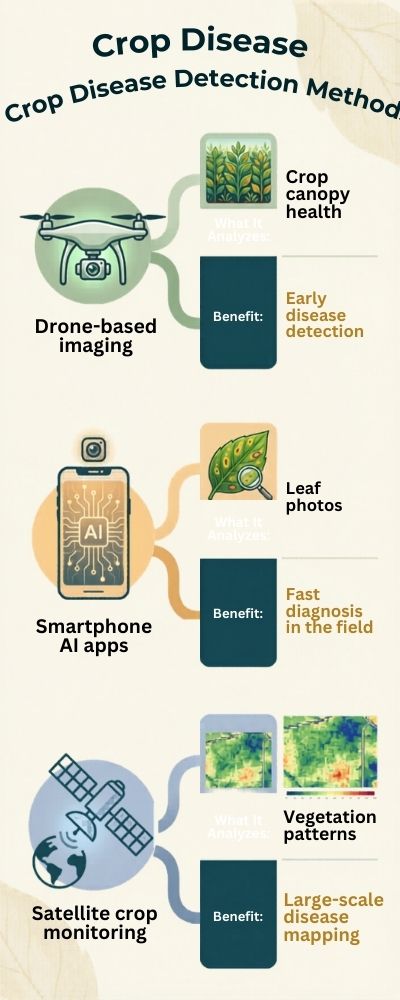
| Detection Method | What It Analyzes | Benefit |
|---|---|---|
| Drone-based imaging | Crop canopy health | Early disease detection |
| Smartphone AI apps | Leaf photos | Fast diagnosis in the field |
| Satellite crop monitoring | Vegetation patterns | Large-scale disease mapping |
Early Detection Changes the Economics of Farming
The timing of disease detection makes a huge difference.
If farmers can catch diseases early, they can use a much smaller, targeted application of treatment. If they wait too long, sometimes the only cure is to uproot entire rows of infected plants before the disease spreads.
The data says that AI-enabled monitoring systems can reduce disease-related losses between 10 to 25% depending on crop type and farming conditions, according to a research study by McKinsey’s digital agriculture team.
10-25% doesn’t sound like a huge difference, but for big farms (or whole regions), that’s millions of tons of production.
| Impact of AI Disease Monitoring | Estimated Improvement |
|---|---|
| Reduction in crop loss | 10–25% |
| Faster disease identification | Up to 7–10 days earlier |
| Reduced pesticide use | 15–20% |
Farmers Still Make the Final Call
Despite all the talk about AI, farmers aren’t about to hand the reins over to an algorithm, and they shouldn’t.
AI is best used as a decision-support tool, not a replacement for human judgment. AI might recognize anomalies in plant images, but farmers know how to contextualize them with weather patterns, soil issues, and local knowledge that AI systems can’t easily account for.
So far, that seems to be the trend in the farming sector, technology coupled with farmer experience and expertise.
If AI can help farmers catch diseases earlier, use fewer chemicals, and save harvests in the process, I think most farmers would say that’s not replacing traditional farming. It’s just giving it better vision.
6. Autonomous Tractors and Farm Robots: How Automation Is Quietly Transforming Agriculture
It’s not uncommon for a tractor to be driving around a field these days with an empty seat. No one is behind the wheel adjusting course every so often; the vehicle just rolls along in precise rows.
That sounds like the future, but it’s already here. Autonomous tractors are being used in many places, navigating fields using GPS. That means instead of a farmer sitting in the cab for a 12-hour day, which many farmers might not complain about if it went away, tractors are being controlled by AI.
That’s according to a report from digital agriculture at McKinsey: “Up to 40 percent of labor demand in some farms could be met through the use of automation, autonomous tractors, robotic harvesting, etc.”
That’s of particular interest to farms experiencing labor shortages.
Robots Are Doing the Dirty Work
Don’t worry, robots are not replacing farmers. They’re doing a lot of the dirty work, or at least the work nobody enjoys.
From weeding to harvesting to checking on livestock in the dead of night, there are plenty of opportunities for robots to shine in agriculture.
One example of an agricultural robot is a weeder. Robotic weeders use cameras and AI to spot and pull individual weeds, meaning farmers don’t have to blanket a field in herbicides. A study in Nature Food looked at several agricultural robot projects and found, in some cases, herbicide application can be reduced up to 90 percent using robotic weed control.
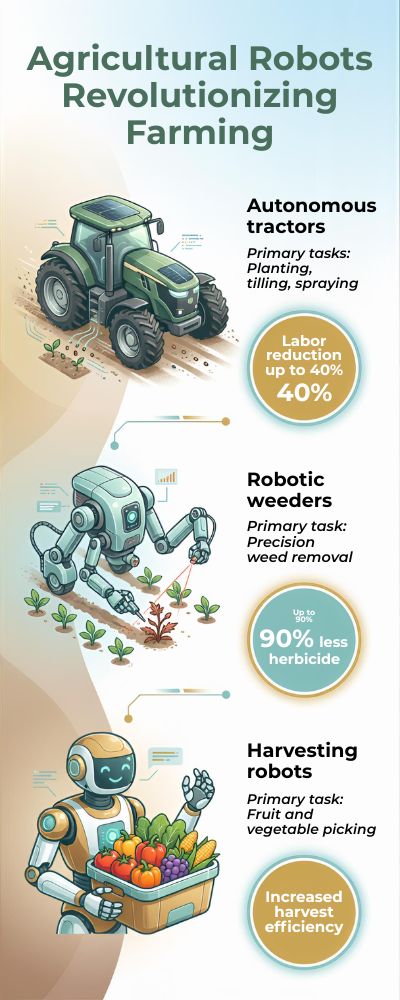
| Agricultural Robot | Primary Task | Estimated Impact |
|---|---|---|
| Autonomous tractors | Planting, tilling, spraying | Labor reduction up to 40% |
| Robotic weeders | Precision weed removal | Up to 90% less herbicide |
| Harvesting robots | Fruit and vegetable picking | Increased harvest efficiency |
Robots are nearly as popular among investors as they are among farmers.
According to market research firm Statista, the worldwide market for agricultural robots was $7-8 billion in 2023 and could reach over $20 billion by 2030.
Part of this growth is due to labor shortages. It can be hard to find enough seasonal labor to plant and harvest crops in rural areas.
That’s where automation comes in.
| Region | Robotics Adoption Trend |
|---|---|
| North America | Strong adoption on large farms |
| Europe | Growth in specialty crop robotics |
| Japan | High robotics use due to aging farmers |
| Australia | Increasing use in large-scale farming |
Farmers aren’t losing control, they’re gaining flexibility
There is an important distinction that often gets lost in discussions of automated farming: Farmers aren’t walking away from their fields. They are just finding new ways to control them.
Rather than planting and harvesting themselves, farmers are increasingly monitoring their fields from a distance, checking data, and fixing problems if necessary.
In other words, the work is changing.
Farming is an inherently innovative field, from seed development to tools to farming techniques. Autonomous farming is just another innovation. And if it allows farmers to be more productive while protecting their yields and resources, most would say that’s a good thing.
7. Smart Irrigation and Soil Sensors: The Technology Behind Precision Farming
Soil has never been something farmers ignore. It’s really the entire ball game. But traditionally, the way to figure out what’s going on with it was to dig a hole, scoop up some dirt, squeeze it between your fingers if you’re feeling extra scientific, and make an educated guess. Long-time farmers get pretty good at this, but there’s still no substitute for, you know, actually measuring it.
That’s where smart irrigation and soil monitoring systems come in. Rather than taking a guess about whether crops need watering, sensors are measuring the moisture in the soil constantly, sometimes every few minutes.
And here’s the dirty little secret that agriculture has been dealing with for years: we’re wasting a lot of water.
The Food and Agriculture Organization (FAO) estimates that some 70% of global freshwater withdrawals go to agriculture. That’s a huge proportion, so any gains we can make here really add up.
How Smart Irrigation Actually Works
Smart irrigation systems work by deploying a series of sensors across a field to measure soil moisture, sometimes temperature, and occasionally other factors like nutrient availability.
Those sensors then beam that data back to a farm management platform or irrigation controller, which can then automatically trigger a watering session if the soil has gotten too dry.
It’s a pretty basic idea, but it really, really works.
Studies compiled by the World Bank’s smart farming project show that precision irrigation techniques can cut water use by 20 to 30% while sustaining or even improving yields.
That’s not too shabby for just telling farmers: “Hey, wait a minute. That soil is still pretty damp. No need to douse the entire field.”
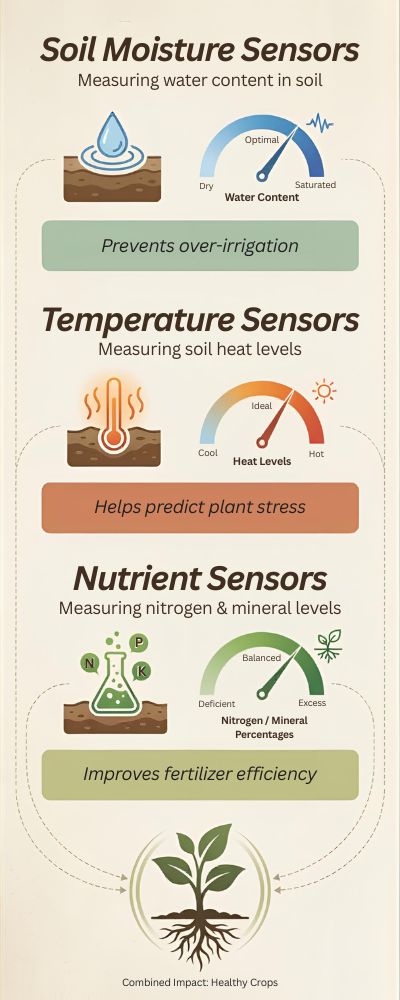
| Technology | What It Measures | Benefit |
|---|---|---|
| Soil moisture sensors | Water content in soil | Prevents over-irrigation |
| Temperature sensors | Soil heat levels | Helps predict plant stress |
| Nutrient sensors | Nitrogen & mineral levels | Improves fertilizer efficiency |
Water Savings Can Be Dramatic
Smart irrigation can save a lot of water. In places like California, Australia, and southern Europe, water is a precious commodity. Many farmers in these areas have already switched to sensor-enabled irrigation systems. Farms that use data-driven irrigation can save 25% or more in water compared to using traditional scheduled watering systems, according to research cited by the NASA Earth Observatory.
| Irrigation Method | Water Efficiency |
|---|---|
| Traditional scheduled irrigation | Baseline usage |
| Sensor-driven irrigation | 20–30% water savings |
| AI-assisted irrigation forecasting | Up to 35% savings in some regions |
Smart irrigation is booming. Not a Silicon Valley boom, but a boom that occurs when farmers realize they have found the solution to a big problem. Case in point.
According to Statista, the global smart irrigation market was around $1.8 Billion in 2023 and will exceed $4 Billion by 2030. That is a growth curve for a technology that few outside the agricultural sector ever discuss.
The reason many of us misinterpret the boom in smart irrigation is that we misunderstand why farmers adopt it in the first place.
Most farmers didn’t adopt soil sensors because the market is booming, nor because a consultant told them it was the future of farming. In most cases, farmers adopt technology for one of two reasons. Either it simplifies their life or saves them money.
Water management is increasingly a tightrope. Weather patterns are becoming less predictable, water use restrictions are tightening in many places, and irrigation mistakes are expensive. Overwatering is a waste of resources, but underwatering affects yield.
Neither is an ideal outcome. Smart irrigation technology helps farmers walk that tightrope. Soil sensors and automated irrigation controllers provide farmers with a more accurate picture of what is happening below the ground, a task that used to involve a lot of guessing and crossing fingers.
But this technology isn’t meant to replace the farmer’s expertise. Far from it. The farmer still makes the decision. The technology just further refines their judgement.
And to be blunt, when water is a precious commodity and every drop counts, that extra refinement can make a bigger difference than most of us appreciate. Sometimes the technologies that have the biggest impact are those that help farmers make better decisions.
8. How AI Is Helping Farmers Deal With Climate Change and Extreme Weather
Now, however, the weather roulette wheel has a few more bullets in it. Climate change is making weather patterns more unpredictable and in some areas more intense.
Climate-related disasters have led to more than $108 billion in crop and livestock losses in developing countries alone over the past two decades, according to a report by the Food and Agriculture Organization (FAO). So it’s no surprise farmers are asking, “If the weather is becoming more unpredictable, how can technology help us stay ahead of it?”
AI Forecasting Is Changing Farm Planning
While standard weather forecasts can be useful, they are usually based on larger metropolitan areas or regions. Farms, however, require far more specific data. Sometimes, down to the individual field level.
This is where AI comes into play. AI-powered weather forecasting platforms incorporate weather data, satellite images, historical climate data, and soil data to predict how weather events will impact a specific crop.
Scientists in Nature Food climate and agriculture studies say AI-assisted climate forecasting models can improve short-term agricultural weather forecasts by up to 30 percent over non-AI-enabled models.
While 30 percent may not seem like much, for farmers making irrigation, planting, or harvesting decisions, any boost to the accuracy of weather forecasting can be significant.
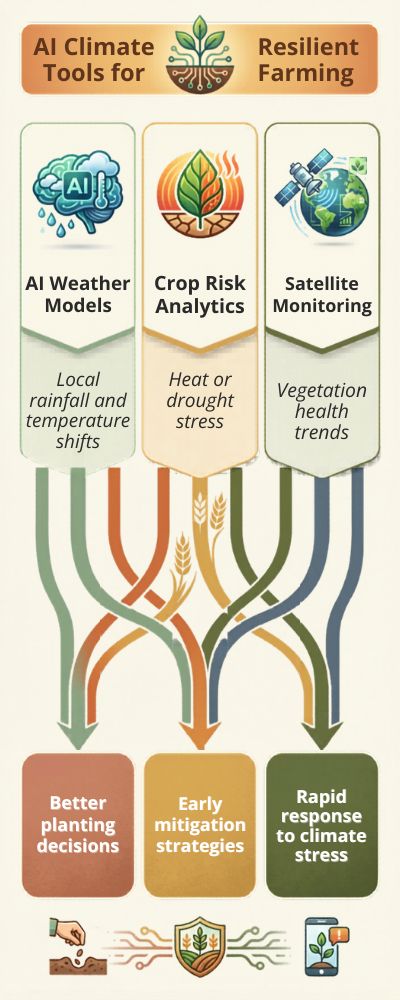
| AI Climate Tool | What It Predicts | Benefit for Farmers |
|---|---|---|
| AI weather models | Local rainfall and temperature shifts | Better planting decisions |
| Crop risk analytics | Heat or drought stress | Early mitigation strategies |
| Satellite monitoring | Vegetation health trends | Rapid response to climate stress |
Early Warnings Can Save Entire Harvests
One more thing that AI can do well is to warn about severe weather.
Floods, droughts, and heatwaves are usually predictable well in advance. An AI system trained on enough climate data can recognize those early warning signs and alert farmers well before traditional monitoring systems can.
By World Bank’s smart farming initiative analysis, smart agricultural monitoring systems that utilize AI can provide early warnings to droughts weeks in advance, giving farmers the opportunity to prepare for it by adjusting irrigation and crop management.
| Climate Threat | AI Warning Capability | Potential Impact |
|---|---|---|
| Drought | Soil moisture monitoring | Reduced crop losses |
| Heat waves | Crop stress detection | Early irrigation adjustments |
| Flood risk | Rainfall pattern modeling | Improved drainage planning |
Farmers Are Blending Old Wisdom With New Tools
Given all the discussion around algorithms and predictive models, you might assume farmers are ditching the traditional ways entirely. Not quite. There’s still no replacing the expertise that comes from decades on the land, knowing when to plant by watching the clouds, how to read the soil conditions, how to recognize the early signs of disease or pests.
Instead, AI is being used to augment that expertise.
These systems can recognize subtle patterns that might be hard to pick up on a human scale, particularly on a large farm. But the ultimate planting and harvesting decisions still depend on the instincts of the farmer.
Maybe that’s just what modern farming needs. Climate change is throwing in some wild cards, and farmers have always been great at adjusting. AI just gives them one more card up their sleeve, one that could help make those unpredictable seasons feel a little less daunting.
9. Is AI Farming Worth the Investment? Costs, Returns, and Productivity Gains Explained
That’s a fair ask. The margins in ag are not always the highest, and no farmer wants to spend money on some fancy gadgets that will only end up collecting dust in the barn.
The massive levels of investment globally point to a lot of farms concluding that it does. Market research from Statista shows that the precision agriculture market was valued at around $9 billion in 2023 and is expected to top $20 billion by 2030. That level of growth usually indicates a return on investment.
But it’s probably safe to say that farmers aren’t committing all at once. Most start by implementing technology in one field, or one season, or on one type of equipment.
Significant investment is often required at the outset
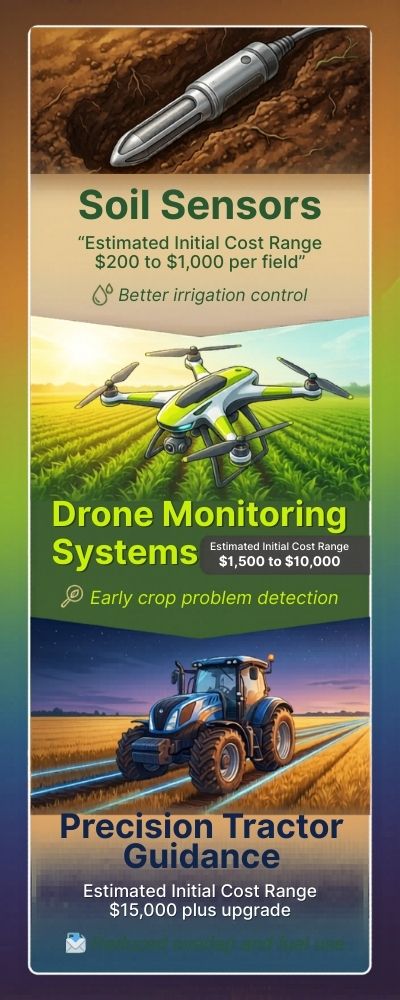
AI farming tools come in many forms, from crop monitoring software and soil sensors to drone imagery and autonomous equipment. Each of these tools has its own cost. A basic precision ag package may include guidance, yield mapping, and variable-rate application. Costs vary widely depending on the size of the operation.
One report cited in McKinsey’s digital agriculture report suggests that in the short-term, the cost of implementing precision farming tools may add 5 to 10% to operating costs as farmers invest in equipment and software. But again, there are also costs for not investing.
| Technology | Estimated Initial Cost Range | Primary Benefit |
|---|---|---|
| Soil sensors | $200–$1,000 per field | Better irrigation control |
| Drone monitoring systems | $1,500–$10,000 | Early crop problem detection |
| Precision tractor guidance | $15,000+ upgrade | Reduced overlap and fuel use |
Where AI really pays off is with gains in productivity
If AI can save on waste or enhance yields, the returns can add up fast. PwC agriculture technology insights found that farms using digital and AI-enabled precision agriculture can experience productivity increases of 10% to 25% depending on the crop and geography. Those gains come from a combination of factors such as:
- Using less fertilizer and pesticides
- Improved planting accuracy
- Optimizing irrigation
- Detecting crop stress and disease sooner Rather than later
| Performance Metric | Typical Improvement |
|---|---|
| Crop yield | +10–20% |
| Fertilizer efficiency | +10–15% |
| Water savings | 20–30% |
Returns vary depending on the size of the farm
While many people look at the technology of AI farming as the key factor in returns on investment, the size and strategy of the farm itself also play a huge role. The bigger the farm, the faster the technology will pay for itself as it’s being used on more acres. Smaller farms may be more targeted in the technologies they adopt, perhaps relying more on soil sensors and drones for scouting.
Ultimately though, the idea is the same. Data helps farmers make better decisions. AI farming isn’t necessarily about removing the farmer from the equation or starting from scratch. It’s about cutting costs, eliminating waste, and giving farmers the tools they need to navigate the increasingly complicated job of growing crops.
Given the many variables from weather to market fluctuations to input costs that farmers have to navigate, it seems that anything that helps farmers make better decisions can’t help but pay for itself in the end.
10. The Future of Farming: How AI, Satellites, and Digital Twins Could Shape Agriculture by 2035
In 2035, if you were to drive by a field, you’d likely see crops swaying in the breeze, a tractor crawling along the field, and a farmer standing by a fence, eyeing the clouds for signs of rain. That much will remain the same. There is always an artisanal aspect to farming.
But if you were to peer behind the curtain, you’d find a field quite different from the one you see today. Orbiting satellites would beam down images and data about the field. Sensors buried in the soil would report on moisture and nutrient levels. AI would be crunching all the data to produce insights that no human could possibly calculate on their own.
That future is already here. The global precision agriculture market is expected to top $20 billion by 2030, according to estimates from Statista, as farms increasingly adopt AI-enabled data analysis, satellite imagery, and precision farm management software.
And this isn’t because farmers have necessarily become more “techy” than they used to be. It’s because all this data makes farming a heck of a lot less chancy.
Satellites: The Eyes in the Sky
Farmers have long relied on their own eyes to gauge the health of their crops. They walk through the fields to check on them, look for diseased plants, monitor the weather, and make educated guesses.
Satellites are just doing what farmers have always done, only better.
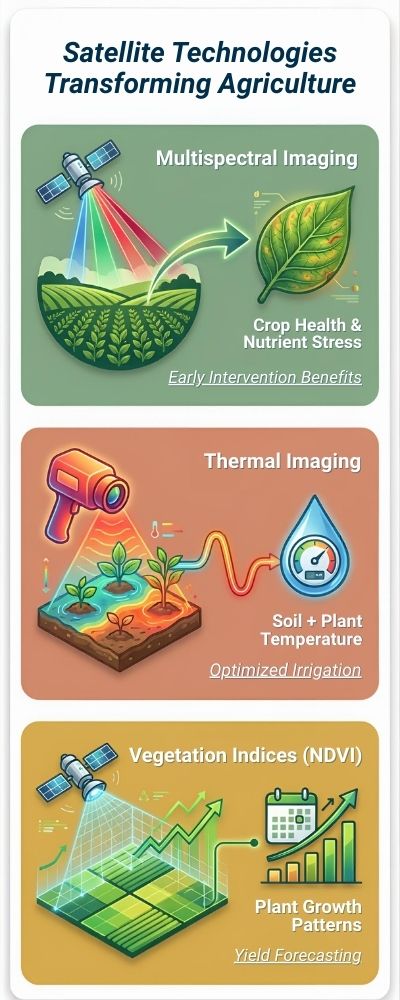
Most satellite imaging used in farming today can analyze the health of plants across a field, often down to a specific section. That lets farmers see problems, like water or nutrient deficiencies, or signs of disease, well before they become visible to the naked eye.
One study cited by NASA’s Earth Observatory found that satellite-based monitoring of crop health can detect stress in vegetation weeks before farmers can see it. That gives farmers weeks to respond.
| Satellite Tool | What It Tracks | Why It Matters |
|---|---|---|
| Multispectral imaging | Plant health & nutrients | Early crop problem detection |
| Thermal imaging | Soil and plant temperature | Smarter irrigation timing |
| NDVI vegetation index | Growth patterns | Better yield forecasting |
Digital Twins: A Farm You Can Test Before You Risk It
Alright, so this one does sound a bit sci-fi to begin with. But, digital twins are really straightforward. Essentially, you create a virtual simulation of your farm. Everything’s updated in real-time to reflect what’s going on on the actual farm. Soil moisture, weather predictions, growth stages of crops, etc. all get incorporated into the model.
Then, whenever a farmer wants to try something new (different irrigation timing, new crop type, fertilizer application rates, etc.), they can try it out in the digital twin first. According to the authors of the recent digital agriculture studies published in Nature Food, these models will eventually help farmers predict yields, minimize wasted resources, and better mitigate risks.
| Digital Twin Capability | Potential Benefit |
|---|---|
| Crop growth simulations | Predict harvest outcomes |
| Water-use modeling | Reduce irrigation waste |
| Soil monitoring | Improve nutrient planning |
AI Will Help Farmers Make Sense of It All
Let’s be clear: farming is messy. The weather affects the soil which affects the pests which affects the market. Some days it doesn’t feel like farming so much as solving a giant puzzle made of living things.
This is where AI comes in.
Rather than sifting through all that data themselves, AI can identify trends and make recommendations. There’s nothing particularly clever or insidious about it. It’s just faster.
McKinsey’s digital agriculture research suggests that AI-enabled farm management could increase productivity by 10-25% in some farming systems.
That’s a big deal for big farms.
The Farmer Remains in Charge
Despite all this technology, the AI models, the satellites, the digital twin of the farm, the farmer is likely to remain firmly in charge.
The farmer makes the decisions.
The technology can provide guidance, flag risks, even offer solutions. But ultimately it’s up to someone with an intimate knowledge of their land, the climate and their farm’s eccentricities to decide what to do.
And that’s probably a good thing.
In farming, at least, the future of work may not be about removing the farmer but empowering them with better technology to navigate an increasingly uncertain world. Sometimes progress is just a bit less uncertainty, a bit more certainty and a bit less lying awake at night when the rain starts.
11. Over 70% of Farmers Using AI Report Increased Productivity
Surveys show that most farmers adopting AI tools see measurable productivity gains. These include higher yields, reduced input costs, and better decision-making. AI helps optimize nearly every stage of farming. Adoption satisfaction rates remain high.
12. Satellite Data Combined with AI Covers Over 90% of Global Farmland
AI systems increasingly rely on satellite imagery for large-scale monitoring. Modern satellites can observe the majority of the world’s farmland. AI processes this data to track crop health, moisture, and growth patterns. This enables global-scale agricultural insights.
13. AI-Based Livestock Monitoring Can Reduce Mortality Rates by 30%
Sensors and AI systems monitor animal health, behavior, and movement. Early detection of illness allows faster intervention. This can reduce livestock mortality by up to 30%. It also improves overall farm profitability.
14. Farm Robotics Market Is Growing at Over 20% CAGR
Automation in agriculture is expanding rapidly. The farm robotics sector is experiencing annual growth rates exceeding 20%. This includes harvesting robots, planting systems, and autonomous vehicles. Labor shortages are a major driver of this growth.
15. AI Can Optimize Planting Density to Increase Yields by 10–15%
AI analyzes soil conditions and crop types to recommend optimal planting patterns. Adjusting density improves sunlight exposure and nutrient usage. This can increase yields by up to 15%. It also enhances overall farm efficiency.
16. Smart Sensors Can Provide Soil Data Every 15 Minutes
Modern IoT sensors continuously monitor soil conditions such as moisture, temperature, and nutrients. Many systems update data in real time or every few minutes. This enables highly responsive farming decisions. Farmers can act immediately when conditions change.
17. AI-Driven Weather Forecasting Improves Accuracy for Farmers by 20%
Localized AI weather models provide more precise forecasts than traditional systems. This helps farmers plan planting, irrigation, and harvesting. Accuracy improvements of around 15–20% are common. Better forecasts reduce weather-related risks.
18. Digital Twin Farms Can Simulate Crop Growth Scenarios in Real Time
Digital twin technology creates virtual replicas of farms. Farmers can test different strategies before applying them in the real world. AI simulations help optimize yields and reduce risks. This approach is gaining traction in advanced farming systems.
19. AI Can Reduce Farm Labor Costs by Up to 40%
Automation reduces reliance on manual labor. Tasks like planting, spraying, and harvesting can be partially or fully automated. This can cut labor costs significantly—up to 40% in some operations. It also addresses workforce shortages.
20. Over 50% of New Agricultural Startups Focus on AI Solutions
Agri-tech innovation is heavily centered on AI. More than half of new startups in agriculture are developing AI-driven tools. These range from crop analytics to robotics. Venture capital investment continues to grow in this space.
21. AI-Powered Supply Chain Optimization Can Reduce Food Waste by 30%
AI helps match supply with demand more accurately. It improves storage, transportation, and distribution planning. This reduces spoilage and waste across the supply chain. Food waste reductions of up to 30% are possible.
22. Smart Greenhouses Can Increase Crop Yields by Up to 50%
AI-controlled environments optimize temperature, humidity, and lighting. This creates ideal growing conditions year-round. Yields can increase dramatically compared to traditional methods. It also reduces dependency on external weather conditions.
23. AI-Based Soil Analysis Can Cut Testing Costs by 50%
Traditional soil testing can be expensive and time-consuming. AI models can analyze soil using sensors and image data. This reduces the need for lab testing. Costs can drop by up to half.
24. AI Can Detect Nutrient Deficiencies Before Visible Symptoms Appear
Machine learning models analyze subtle changes in plant color and growth. These changes are often invisible to the human eye. Early detection allows timely nutrient adjustments. This prevents yield loss.
25. Autonomous Harvesting Robots Can Reduce Harvest Time by 30%
Robotic harvesters work faster and more consistently than human labor. They can operate around the clock in some cases. This reduces harvest time significantly. It also minimizes crop damage.
26. AI Adoption in Agriculture Is Growing Faster in Asia-Pacific Regions
Countries in Asia-Pacific are rapidly investing in smart farming. Population growth and food demand are major drivers. Governments are supporting digital agriculture initiatives. Adoption rates in the region are among the highest globally.
27. Carbon Emissions from Farming Can Be Reduced by 20% with AI Optimization
AI helps optimize fuel use, fertilizer application, and resource management. These improvements reduce greenhouse gas emissions. Farms using AI can cut emissions by around 15–20%. This supports sustainable agriculture goals.
28. AI Can Improve Crop Quality Consistency by 25%
Standardizing growing conditions and monitoring crops continuously improves quality. AI ensures crops meet consistent standards. This is especially important for export markets. Quality improvements can reach up to 25%.
29. Over 80% of Agricultural Data Remains Untapped Without AI
Farms generate massive amounts of data from sensors, machines, and satellites. Without AI, much of this data goes unused. AI unlocks actionable insights from this information. This is a key driver of digital transformation in agriculture.
30. AI-Powered Market Forecasting Helps Farmers Increase Profits by 10–20%
AI analyzes market trends, pricing, and demand patterns. Farmers can decide when and what to sell more strategically. This can increase profits by up to 20%. It also reduces financial risks.
Conclusion
The big picture is that agriculture is moving into a new era. The tools may be different, satellites instead of notebooks, AI instead of a farmer’s well-trained eye, but the objective remains the same. Farmers want to grow healthy crops, maintain their land, and ensure that when harvest time comes around, it has all been worth it.
Technology is simply allowing them to do all of those things more accurately, with fewer unknowns, and greater ease. Drones mean you can see entire fields in a matter of minutes. Sensors mean you can know what is going on beneath your feet. AI means you can be alerted to problems before they become a crisis.
None of them replace the skills of the farmer, but they certainly augment them.
Moving forward, the farms of the next ten years will likely be a mix of the traditional and technological, in a way that will seem startlingly natural. There will still be early starts and long days, muddy boots and hot sun.
But there will also be dashboards and data visualizations, predictive algorithms and background programs designed to help farmers make better decisions. And if the trends and the statistics are any indication, it’s that farming isn’t just readying itself for the future, it’s busy building it.
Sources
https://www.fao.org/ – Food and Agriculture Organization (FAO)
https://earthobservatory.nasa.gov/features/PrecisionAgriculture – NASA Earth Observatory: Precision Agriculture
https://www.statista.com/statistics/1262310/global-precision-agriculture-market-size/ – Statista: Precision Agriculture Market Size
https://www.statista.com/statistics/1211884/smart-irrigation-market-size-worldwide/ – Statista: Smart Irrigation Market Size
https://www.statista.com/statistics/1263359/agriculture-drone-market-size-worldwide/ – Statista: Agricultural Drone Market
https://www.statista.com/statistics/1099593/agricultural-robotics-market-size/ – Statista: Agricultural Robotics Market
https://www.nature.com/articles/s43016-021-00392-9 – Nature Food: Digital Agriculture Research
https://www.mdpi.com/2077-0472 – Agriculture Journal (MDPI): Research on Precision Farming Technologies
https://www.frontiersin.org/journals/plant-science – Frontiers in Plant Science: Agricultural Technology Research


